Every unsanctioned AI agent operating without governance represents a potential data breach, compliance violation, or operational failure waiting to happen. With shadow AI affecting organizations across industries and with a recent IBM report finding that among organizations who suffered an AI-related breach, 97% lacked access controls, the solution isn't restricting AI adoption—it's deploying a centralized MCP Gateway that enforces consistent security policies across every agent, model, and tool in your enterprise.
Key takeaways
- Organizations report up to a 73% reduction in AI-related security incidents after implementing comprehensive agent governance
- Centralized control planes deliver $4.2 million average savings per prevented data breach
- Implementation timelines vary by scope, but focused rollouts can move from proof of concept to full deployment in as little as ~4 weeks—then expand in phases across the agent fleet
- Organizations report risky AI agent behaviors at high rates without governance oversight
- Runtime policy enforcement adds less than 50ms latency per policy evaluation
The challenge of decentralized AI: Why agent sprawl creates critical blind spots
Your teams are already using AI tools—with or without IT approval. Developers deploy coding assistants like Cursor and Claude Code. Marketing runs content through ChatGPT. Finance experiments with data analysis agents. Each tool operates independently, accessing different data sources with inconsistent security controls.
This fragmented approach creates three immediate problems:
- Zero visibility into what agents access and when
- Inconsistent policies across tools, teams, and departments
- Compliance gaps that auditors will eventually find
Research from Obsidian Security reveals that healthcare AI agents leaked patient records for months because traditional security couldn't detect legitimate-looking access patterns. The agents had proper credentials—they simply exceeded their intended scope without triggering alerts.
The root cause isn't malicious behavior. It's architectural: traditional perimeter defenses assume threats come from outside. AI agents operate from within, using valid credentials to access systems across your entire infrastructure.
Why traditional security frameworks fail for AI agents
The perimeter defense problem
Firewalls, intrusion detection systems, and endpoint protection focus on blocking external threats. AI agents bypass these controls entirely—they authenticate legitimately, operate within approved network segments, and access data through sanctioned APIs.
According to MIT Sloan Review research, autonomous agents processing healthcare exam requests introduced prompt injection and data poisoning risks that legacy security systems couldn't identify. The agents had OCR access, LLM integration, and billing system connectivity—all approved individually but creating aggregate risk no single system monitored.
The Multi-Model complexity challenge
Modern enterprises deploy agents across multiple frameworks and providers:
- Microsoft Copilot for productivity tasks
- Claude or ChatGPT for content generation
- Custom LangChain agents for specialized workflows
- Vendor-specific AI tools embedded in SaaS platforms
Each operates with different authentication mechanisms, logging formats, and permission models.
The Application-Layer limitation
Content-based guardrails—filters that scan agent outputs for problematic text—address only surface-level risks. They can't prevent an agent from executing a terraform destroy command or transferring funds to unauthorized accounts. Infrastructure-layer policy enforcement intercepts agent-to-tool interactions before execution, blocking destructive actions rather than just filtering responses.
Building your enterprise AI governance framework
Effective centralization requires three foundational components: discovery, policy design, and enforcement infrastructure.
Component 1: Agent discovery and inventory
Before enforcing policies, you need visibility into what exists. This means:
- Automated scanning of network traffic for API calls to AI services
- DLP integration detecting unauthorized tool usage
- Registry creation documenting every agent's identity, owner, data access, and business purpose
- Risk classification using frameworks like the EU AI Act (prohibited, high-risk, limited-risk, minimal-risk)
Component 2: Policy architecture design
Policies must address multiple enforcement layers:
Data Access Policies
- Block agents from accessing PII/PHI unless explicitly authorized
- Require encryption for sensitive data in transit and at rest
- Implement least-privilege access—agents get minimum permissions needed
Action Policies
- Require human-in-the-loop approval for high-risk operations
- Block destructive commands (database deletions, production deployments)
- Set transaction limits for financial operations
Tool Policies
- Whitelist approved MCP servers and integrations
- Block access to unsanctioned third-party tools
- Configure granular permissions by role and department
Component 3: Centralized enforcement platform
Policy enforcement requires infrastructure-layer control planes that:
- Intercept agent-to-tool interactions at runtime
- Evaluate requests against defined policies before execution
- Log every action with full audit trail
- Alert security teams to violations and anomalies
- Block unauthorized actions automatically
Understanding MCP gateway architecture provides the foundation for implementing these enforcement mechanisms effectively.
Leveraging centralized tools for policy enforcement and monitoring
Real-Time monitoring for complete visibility
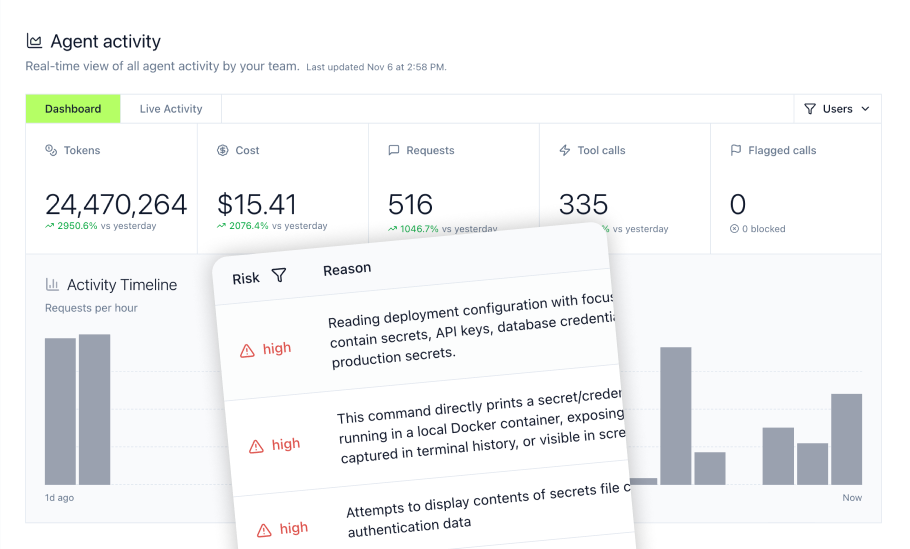
Centralized control planes provide dashboards showing:
- Active agents and their current operations
- Data access patterns and anomalies
- Policy violations with severity ratings
- Inter-agent communication flows
- Tool invocation history with timing data
Automated policy enforcement mechanisms
Runtime enforcement engines evaluate every agent action against defined rules. The Airia Agent Constraints technical deep-dive outlines enforcement patterns:
- IF-THEN rules blocking specific command patterns
- Context-aware policies evaluating time, user permissions, and data sensitivity
- Rate limiting preventing excessive API calls or data access
- Circuit breakers isolating agents exhibiting anomalous behavior
Performance overhead remains minimal—less than 10ms for simple policies, under 50ms for complex multi-condition evaluations.
Comprehensive audit trails for compliance
Every agent interaction generates immutable log entries capturing:
- Agent identity and authentication method
- Requested action and target system
- Policy evaluation results
- Execution outcome (approved/blocked)
- Data accessed or modified
- Timestamp and session context
These logs support tool governance requirements for SOC2, HIPAA, and GDPR compliance audits.
Securing access: Authentication and identity for AI agents
Implementing Enterprise-Grade authentication
AI agents require the same identity management rigor as human users—often more. Composio's infrastructure guide recommends:
- OAuth 2.1 with PKCE for all agent-to-service authentication
- Short-lived tokens rotating every 1-2 hours
- Workload identity assigning unique cryptographic credentials to each agent
- Brokered credentials ensuring LLMs never directly access API tokens
Traditional username/password authentication fails for autonomous agents operating 24/7 without human intervention. Workload identity—where agents receive cryptographically verifiable credentials—provides the authentication foundation modern governance requires.
Centralized credential management
Scattered API keys across configuration files, environment variables, and code repositories create security nightmares. Centralized credential vaults:
- Store all agent credentials in encrypted repositories
- Rotate tokens automatically on defined schedules
- Revoke access instantly when agents are decommissioned
- Track credential usage for audit purposes
Granular access control by role
Not every agent needs access to every tool. Salesforce's Agentforce implementation demonstrates five foundational security attributes:
- Role defining what the agent is designed to accomplish
- Data specifying which information sources the agent can access
- Actions listing permitted operations
- Guardrails establishing behavioral boundaries
- Channel determining where the agent operates
This attribute-based approach ensures agents receive exactly the permissions required—nothing more.
Ensuring compliance: SOC2 HIPAA and GDPR with centralized governance
Meeting Industry-Specific compliance standards
Regulatory frameworks increasingly address AI-specific requirements:
- GDPR Article 22 mandates human oversight for automated decision-making affecting individuals
- HIPAA requires audit trails for all PHI access, including AI agent interactions
- EU AI Act classifies AI systems by risk level with corresponding governance obligations
- ISO 42001 establishes AI management system requirements
The role of audit logs in regulatory adherence
Complete audit trails serve multiple compliance functions:
- Incident investigation reconstructing what happened during security events
- Compliance reporting demonstrating policy adherence to auditors
- Explainability documenting AI decision-making for regulatory review
- Accountability tracking responsibility delegation across multi-agent systems
Data residency and global operations
Multinational enterprises face data sovereignty requirements dictating where information can be processed and stored. Centralized governance platforms support:
- Region-specific data processing restrictions
- Cross-border transfer controls
- Local compliance requirement enforcement
- Multi-region deployment with geographic policy variations
Review the security overview documentation for detailed implementation guidance on data residency controls.
Implementation roadmap: From discovery to production
Phase 1: Discovery and inventory (weeks 1-2)
Week 1 Activities:
- Deploy network scanning tools identifying AI service API calls
- Survey teams about current AI tool usage
- Document known agents with ownership and purpose information
- Map data access patterns and integration points
Week 2 Activities:
- Classify agents by risk level using standardized frameworks
- Identify compliance gaps and priority remediation targets
- Establish baseline metrics for current security posture
- Create agent registry with complete metadata
Common Stumbling Point: Shadow AI detection proves difficult when employees use personal accounts. Integrate DLP tools with browser extensions for comprehensive visibility.
Phase 2: Platform selection and integration (weeks 3-4)
Evaluate control plane platforms based on:
- Multi-model support for heterogeneous agent environments
- Integration ecosystem connecting to your existing SaaS stack
- Policy engine capabilities including context-aware, real-time enforcement
- Compliance features with automated audit trails and reporting
- Scalability supporting current agent volume plus projected growth
Connect selected platforms to enterprise IAM systems, SIEM infrastructure, and critical SaaS applications during this phase.
Phase 3: Policy design and pilot (weeks 5-8)
Policy Development:
- Create 10-15 core rules aligned with risk tolerance
- Start with "monitor mode" logging violations without blocking
- Refine policies based on baseline behavioral data
- Document policy rationale for compliance purposes
Pilot Deployment:
- Deploy policies to 5-10 low-risk agents initially
- Validate enforcement mechanisms work correctly
- Train teams on dashboard usage and alert response
- Iterate policy configurations based on pilot results
Phase 4: Production rollout and continuous governance (weeks 9-12)
Scaled Deployment:
- Expand enforcement to all agents in phased rollout
- Monitor for policy conflicts and false positives
- Establish escalation procedures for security events
- Document operational procedures for ongoing maintenance
Continuous Improvement:
- Schedule quarterly policy reviews
- Conduct red team exercises testing policy effectiveness
- Update policies for emerging threats and new use cases
- Track governance metrics demonstrating program value
Following enterprise MCP deployment best practices accelerates implementation while reducing operational friction.
Integrating AI agents with enterprise systems securely
Connecting AI to data warehouses and databases
Enterprise AI agents derive value from accessing organizational data. The Snowflake MCP integration demonstrates secure patterns for:
- Natural language to SQL conversion with governance controls
- Semantic view queries with dimension and metric filtering
- Read-only access enforcement preventing unauthorized modifications
- Audit logging capturing every query executed
Similarly, Elasticsearch integrations enable AI-powered knowledge base search while maintaining access controls and query logging.
Ai-powered customer support and communication
Agents handling customer interactions require special governance consideration. The Gmail MCP integration supports:
- Controlled email search within approved workflows
- Draft creation with human review before sending
- Thread integrity preservation for professional communication
- Complete audit trails of all email operations
These integrations demonstrate how centralized governance enables powerful AI capabilities while maintaining security boundaries.
Development workflow automation
- Multiple review requirements for destructive operations
- Protected branch enforcement for critical repositories
- Cost approval workflows for expensive infrastructure changes
- Rollback capabilities for all AI-generated modifications
Why MintMCP delivers Enterprise-Grade agent security
While various platforms address pieces of the AI governance puzzle, MintMCP provides the unified infrastructure that transforms fragmented agent security into production-grade governance—fast.
MCP gateway: Centralized policy enforcement
The MCP Gateway addresses the core challenges covered throughout this article:
- One-click deployment transforms local MCP servers into production services with built-in security
- OAuth + SSO enforcement automatically wraps every MCP endpoint with enterprise authentication
- Real-time monitoring provides live dashboards for server health, usage patterns, and security alerts
- Complete audit logs support SOC2, HIPAA, and GDPR compliance requirements
- Granular tool access control configures permissions by role—enable read-only operations while blocking write tools
Organizations achieve centralized governance without rebuilding existing agent infrastructure. MintMCP works with current AI tool deployments, requiring no changes to developer workflows.
LLM proxy: Visibility and control for coding agents
The LLM Proxy solves the specific challenge of monitoring coding agents like Cursor and Claude Code:
- Track every tool call and bash command across all coding agents
- See which MCPs are installed and monitor usage patterns across teams
- Block dangerous commands in real-time before they execute
- Protect sensitive files preventing access to .env files, SSH keys, and credentials
- Complete command history for security review and incident investigation
Coding agents operate with extensive system access—reading files, executing commands, accessing production systems through MCP tools. Without monitoring, organizations cannot see what agents access or control their actions.
Enterprise-Ready infrastructure
MintMCP is SOC 2 compliant. The platform provides:
- High availability with automatic failover and enterprise SLAs
- Multi-region support with data residency controls
- Virtual MCP servers exposing only minimum required tools
- Centralized credential management eliminating secrets sprawl
Deploy in minutes, not months. Book a demo at enterprise@mintmcp.com to see how MintMCP transforms shadow AI into sanctioned AI.
Frequently asked questions
What is 'shadow AI and how can centralized governance help mitigate its risks?
Shadow AI refers to AI tools and agents deployed without IT approval or security oversight—employees using personal ChatGPT accounts, teams spinning up custom LangChain agents, or departments embedding vendor AI into workflows. McKinsey research indicates shadow AI grows significantly year-over-year as employees seek productivity gains. Centralized governance addresses this through discovery tools identifying unauthorized usage, policy enforcement bringing shadow tools under management, and self-service access enabling teams to get approved AI tools quickly—eliminating the incentive to go around IT.
What compliance standards can centralized AI governance support?
Properly configured control planes support SOC2 Type II, HIPAA, GDPR, ISO 42001 (AI management systems), and NIST AI RMF alignment. Specific capabilities include immutable audit logs capturing all agent actions, automated compliance reporting for auditor review, data residency controls enforcing geographic processing restrictions, and explainability documentation reconstructing AI decision paths. Galileo's compliance framework provides technical guidance for implementing federated identity management and compliance verification checkpoints required by emerging AI regulations.
Can centralized governance integrate AI agents with existing databases and enterprise applications?
Yes—integration represents a core value proposition. Centralized platforms provide pre-built connectors for databases (PostgreSQL, MySQL, Snowflake), productivity tools (Gmail, Outlook, Notion), development systems (GitHub, Jira), and custom APIs. These integrations enforce governance policies at connection time: agents only access data matching their permissions, all queries generate audit logs, and destructive operations require approval workflows. The Composio infrastructure guide documents how brokered credential patterns ensure LLMs never directly access database passwords or API tokens.
How long does IT take to implement centralized AI agent governance?
Implementation typically takes 4-12 weeks depending on complexity. Phase 1 (Discovery and Inventory) requires 2 weeks for scanning, classification, and registry creation. Phase 2 (Platform Integration) takes 1-2 weeks for IAM and SIEM connections. Phase 3 (Policy Design and Pilot) spans 3-4 weeks for rule creation and validation. Phase 4 (Production Rollout) requires 2-4 weeks for enterprise-wide deployment. Organizations typically see break-even on investment within 4-6 months through prevented breaches, reduced security team workload, and compliance automation—security teams report 40% efficiency gains after deployment.