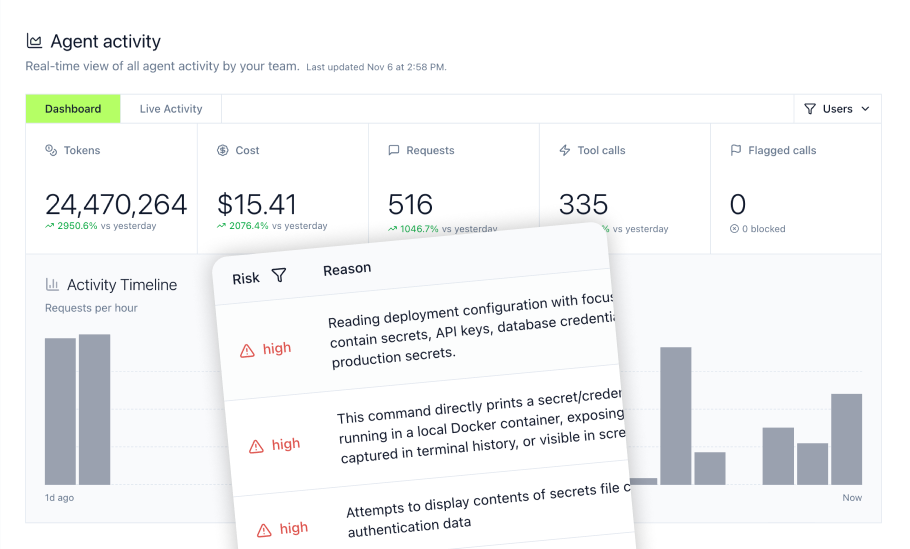
Customer-facing AI agents are moving from pilot programs to production deployments across enterprises, and security teams are asking hard questions about data governance. When AI agents interact directly with customers, accessing CRM systems, support tickets, and sensitive account information, the stakes multiply. A single credential leak or unauthorized data access incident can erode customer trust overnight.
The MCP Gateway category has emerged as the infrastructure layer that solves this problem. These platforms sit between AI agents and the tools they access, providing centralized authentication, audit trails, and policy enforcement. For customer-facing deployments, the gateway becomes the control point where security teams gain visibility into every tool call, every data access, and every agent action.
This guide covers agent gateways built for customer-facing AI in 2026, ranked by compliance depth, customer data protection, and production readiness.
Key Takeaways
- MintMCP combines MCP Gateway for governed data connections with Agent Gateway for agent identities, permissions, memory, and monitoring, plus Virtual MCP Bundles, Agent Bundles, hosted connectors, and JS sandbox middleware
- Open-source performance optimization can achieve approximately 11 microseconds of gateway overhead at 5,000 RPS in vendor benchmarks
- Unified AI platforms combine LLM routing, MCP governance, and agent deployment in one stack
- OAuth 2.1 support enables flexible SaaS, VPC, and self-hosted deployment options for enterprise authentication
- Virtual MCP server architecture provides security isolation through curated tool endpoints
- Security research platforms map controls to OWASP Top 10 LLM threat categories
- Mature API management infrastructure can extend to handle MCP protocol support
- Pre-built integration libraries offer 1,000+ managed app connections with just-in-time tool selection
1. MintMCP: Agent Gateway for customer-facing deployments
MintMCP combines its MCP Gateway for governed data and tool connections with an Agent Gateway for agent identities, permissions, memory, and monitoring. Built specifically for organizations deploying AI agents that touch customer data, the platform takes a data-permissions-first approach: governance is the foundation, and agents are enabled on top.
Why MintMCP fits customer-facing deployments
Customer-facing AI agents require stricter controls than internal tools. When an agent accesses customer records in Salesforce, queries support tickets in Zendesk, or reads communication history in Gmail, every action needs attribution, audit logging, and policy enforcement.
MintMCP addresses this through its Agent Gateway layer, which provides identities and permissions for agents that work alongside users. The Virtual MCP Bundles create per-use-case endpoints with SCIM-driven group membership. A customer support team gets an endpoint exposing only the CRM read tools they need, while the customer success team gets a different bundle with account management capabilities. This minimum-exposure architecture reduces the blast radius if any single agent or user is compromised.
Core capabilities for customer data protection
Authentication and access control:
- SSO enforcement through Okta, Azure AD, and Google Workspace
- SCIM-driven RBAC that syncs automatically with IdP group changes
- Per-agent identity through Agent Bundles with M2M auth and independent credential rotation
- Tool-level access control enabling database reads while blocking writes
Audit and compliance:
- Full conversation-level logging capturing prompts, tool calls, responses, and context
- Per-user attribution for every agent action
- SIEM export to Sentinel, Splunk, and S3
- SOC 2 Type II audited, compliant with HIPAA standards
Policy enforcement:
- Custom Gateway Middleware in JS sandbox with external DLP integrations
- Built-in templates for AWS Bedrock Guardrails, jailbreak detection, and PII masking
- Tool-update policy requiring admin approval before new upstream tools activate
Customer-facing integration ecosystem
MintMCP provides hosted connectors for the systems customer-facing agents typically access:
- Salesforce for CRM data with read/write controls
- Zendesk for support ticket management
- Gmail and Outlook for customer communication
- Snowflake for customer analytics and reporting
- HubSpot for marketing automation data
The platform runs connector instances on your behalf with auto-scaling and sandboxed execution per connector. Your team does not manage Kubernetes pods or connector runtimes.
Two-layer governance architecture
MintMCP provides both MCP Gateway coverage for tool connections and Agent Monitor coverage for local agent activity in Cursor and Claude Code. This addresses the visibility gap where agents might access customer data through non-MCP channels like bash commands or file operations.
Deployment: Managed SaaS-first with US and EU availability. VPC and self-hosted deployment available on request.
Getting started: Visit mintmcp.com/mcp-gateway to start a free trial with no sales call required.
2. Bifrost (Maxim AI)
Bifrost is an open-source AI gateway built in Go, optimized for low-latency performance in high-volume deployments. The project focuses on speed and efficiency for teams processing large numbers of AI requests.
Where Bifrost fits
Bifrost reports approximately 11 microseconds of internal gateway overhead at 5,000 requests per second on an AWS t3.xlarge benchmark, positioning it for performance-sensitive customer-facing applications where gateway processing time directly impacts user experience. The Go-based architecture provides consistent performance characteristics compared to Python alternatives.
Technical capabilities
- Open-source under Apache 2.0 license
- MCP Code Mode for reduced token usage
- Semantic caching for cost reduction on repeated queries
- Zero-config deployment via npx command
- Support for 1,000+ models across multiple providers
Considerations for customer-facing use
Teams evaluating Bifrost for customer-facing deployments should assess whether the open-source model includes the compliance attestations, hosted connector operations, and managed governance layer their security team requires.
Deployment: Self-hosted via binary, Docker, Kubernetes, VPC, on-premises, or air-gapped environments. No managed SaaS offering currently available.
3. TrueFoundry Agent Gateway
TrueFoundry provides a unified AI platform that combines LLM routing, MCP tool governance, and agent deployment capabilities. The platform targets enterprise AI infrastructure teams building comprehensive agent stacks.
TrueFoundry's primary focus
The platform emphasizes full-stack AI infrastructure, offering deployment services alongside gateway functionality. TrueFoundry holds SOC 2 Type II attestation and HIPAA compliance for organizations with regulatory requirements.
Technical capabilities
- Approximately 3-4ms of gateway overhead while handling 350+ requests per second on 1 vCPU in TrueFoundry's benchmark
- Unified LLM, MCP, and agent gateway in one platform
- VPC, on-premises, and air-gapped deployment options
- Unified access to 1,000+ LLMs across 15+ provider platforms
Considerations for customer-facing use
Teams already committed to a full AI platform stack may find value in TrueFoundry's unified approach. Organizations seeking a focused MCP gateway without the broader platform components should evaluate whether the full stack aligns with their architecture.
Deployment: Hybrid with managed SaaS and self-hosted options.
4. Portkey MCP Gateway
Portkey provides LLMOps capabilities with MCP gateway functionality, offering flexible authentication and deployment options for enterprise teams.
Portkey's primary focus
The platform emphasizes authentication flexibility with OAuth 2.1 support and fine-grained authorization at org, team, workspace, and user levels. Portkey reports a SOC 2 Type II attestation and ISO 27001 certification, along with HIPAA and GDPR compliance.
Technical capabilities
- OAuth 2.1 flow initiation capability
- Fine-grained authorization hierarchy
- Distributed tracing for debugging
- 1,600+ LLM support through unified API
- SaaS, VPC, and self-hosted deployment options
Considerations for customer-facing use
Portkey's authentication depth suits customer-facing deployments requiring granular permission models. Teams should evaluate whether the LLMOps focus aligns with their MCP-specific governance needs.
Deployment: SaaS with VPC and self-hosted options for enterprise.
5. Zuplo MCP Gateway
Zuplo's MCP Gateway is currently in public beta and brings its API gateway model to the MCP protocol, focusing on developer experience and security isolation through virtual server architecture.
Zuplo's primary focus
The platform introduces "virtual MCP servers" as a security primitive, creating curated views of upstream MCP servers that expose only selected tools at their own gateway URLs. This approach provides endpoint-level isolation for different teams or use cases.
Technical capabilities
- Virtual MCP server architecture for tool isolation
- Built-in OAuth 2.1 authorization server
- Two-layer authentication (client-to-gateway and gateway-to-upstream)
- OpenAPI-to-MCP generation
- Curated library of popular MCP servers
Considerations for customer-facing use
Zuplo's virtual server model provides security isolation suitable for customer-facing deployments. Teams should evaluate whether the managed cloud platform meets their data residency and compliance requirements.
Deployment: Managed cloud SaaS; the MCP Gateway is currently in public beta.
6. Operant AI MCP Gateway
Operant AI focuses on security research and threat protection for MCP deployments, providing detection capabilities for emerging attack vectors.
Operant AI's primary focus
The platform emphasizes security research, publishing analysis of agent attack surfaces including prompt injection and tool poisoning threats. Operant maps security controls to the OWASP Top 10 LLM threat categories.
Technical capabilities
- Real-time threat detection for agent workloads
- OWASP Top 10 LLM threat mapping
- Security research informing product development
- Cloud-native deployment model
Considerations for customer-facing use
Organizations prioritizing security research and threat intelligence may value Operant's specialized focus. Teams needing broader governance primitives like SCIM-driven RBAC and hosted connector operations should evaluate the full feature set.
Deployment: Cloud-native service.
7. Kong AI Gateway
Kong extends its established API management platform to handle AI and MCP traffic, offering organizations with existing Kong deployments a unified management approach.
Kong's primary focus
The platform leverages Kong's Nginx-based architecture and existing ecosystem of plugins, authentication integrations, and monitoring tools. Kong provides an MCP Registry in technical preview for server discovery alongside its MCP traffic gateway capabilities.
Technical capabilities
- Integration with existing Kong and Konnect deployments
- Semantic caching for LLM responses
- MCP Registry in technical preview for server discovery
- Kong ecosystem plugin compatibility
- Hybrid deployment with SaaS control plane
Considerations for customer-facing use
Organizations already standardized on Kong infrastructure can add MCP support without deploying separate systems. Teams without existing Kong deployments should evaluate whether the API gateway heritage provides the MCP-specific governance primitives they need.
Deployment: Hybrid with Konnect SaaS control plane and self-hosted data plane.
8. Composio MCP Gateway
Composio provides managed MCP gateway services with an emphasis on pre-built integrations and developer productivity features.
Composio's primary focus
The platform offers 1,000+ managed app integrations and just-in-time tool selection that reduces context window usage. Composio supports IdP delegation to Okta, Microsoft Entra, and Google Workspace.
Technical capabilities
- 1,000+ managed app integrations available through the MCP gateway
- Just-in-time tool selection for efficiency
- IdP delegation for enterprise identity providers
- Sandboxed execution environments
- Managed cloud deployment
Considerations for customer-facing use
Composio's integration breadth suits teams needing rapid connectivity to many systems. Organizations requiring deeper governance primitives should evaluate the full RBAC and policy capabilities.
Deployment: Managed cloud with VPC and on-premises options on enterprise tier.
9. Lunar.dev MCPX
Lunar.dev provides MCPX as an MCP gateway for teams centralizing access control, policy enforcement, and observability across their agent deployments.
Lunar.dev's primary focus
MCPX functions as an MCP server aggregator, collecting multiple upstream MCP servers behind centralized governance. The platform provides MCPX Enterprise evaluation sandbox capabilities for testing new servers before production deployment.
Technical capabilities
- MCP server aggregation
- GUI control plane for agent workspaces
- MCPX Enterprise evaluation sandbox for testing
- Per-agent workspaces with approval workflows
- Open-source core with enterprise add-ons
Considerations for customer-facing use
Lunar.dev's evaluation sandbox supports careful vetting of MCP servers before they access customer data. Teams requiring managed SaaS deployment should evaluate whether the self-hosted model fits their operational capacity.
Deployment: Self-hosted and managed gateway options, with centralized control-plane and dashboard features available for enterprise deployments.
10. AgentGateway.dev (Linux Foundation)
AgentGateway.dev is an open-source project under the Linux Foundation's Agentic AI Foundation, providing neutral governance and community-driven development for agent gateway infrastructure.
AgentGateway.dev's primary focus
The project delivers a Rust-based data plane built specifically for AI agent workloads, supporting LLM, MCP, and A2A protocols in a single plane. The Linux Foundation governance provides vendor-neutral stewardship with contributors from major technology organizations.
Technical capabilities
- Rust-based data plane for performance
- LLM, MCP, and A2A support in unified plane
- Open Policy Agent integration for authorization
- 300+ contributors across 60 organizations
- Apache 2.0 licensing
Considerations for customer-facing use
Organizations prioritizing open-source transparency and neutral governance may value the Linux Foundation model. Teams needing production-ready managed services should evaluate whether the community-driven development timeline aligns with their deployment schedule.
Deployment: Self-hosted open-source.
11. SnapLogic AI Gateway
SnapLogic brings enterprise integration platform expertise to agent gateway functionality, emphasizing user identity propagation through backend systems.
SnapLogic's primary focus
The platform introduces Trusted Agent Identity, flowing user identity from agents through the integration layer into backend systems rather than using shared service accounts. SnapLogic's AgentCreator provides visual no-code agent building.
Technical capabilities
- User identity propagation (not shared service accounts)
- 1,000+ native connectors to ERP, CRM, databases, and SaaS
- Visual no-code agent builder
- Integration with existing SnapLogic platform investments
Considerations for customer-facing use
SnapLogic's identity propagation model provides audit clarity for customer data access. Organizations without existing SnapLogic deployments should evaluate whether the enterprise integration platform heritage aligns with their MCP-specific requirements.
Deployment: Managed enterprise platform.
Selecting an agent gateway for customer-facing AI
Compliance requirements for customer data
Customer-facing AI agents access sensitive data: customer records, support histories, account information, and communication logs. Security teams typically require SOC 2 Type II attestation, audit trails with per-user attribution, and HIPAA compliance for healthcare data.
Evaluate whether your gateway provides these controls natively or requires custom implementation. The EU AI Act creates obligations that may apply to customer-facing AI systems depending on their role and risk classification. Its highest penalty tier, for prohibited AI practices, can reach €35 million or 7% of total worldwide annual turnover, while other violations carry lower maximums.
Authentication architecture for customer-facing agents
Customer-facing deployments often require per-agent identity rather than shared service accounts. When investigating an issue with a specific customer interaction, security teams need to trace exactly which agent accessed which data and when.
Agent Bundles with M2M authentication and independent credential rotation address this requirement. Shared credentials complicate incident response and make rotation disruptive.
Audit and observability for customer interactions
Without comprehensive logging, organizations face a visibility gap where they cannot trace agent behavior during customer interactions. Essential capabilities include:
- Per-user and per-agent attribution for every tool call
- Conversation-level logging with full context
- Real-time alerting for sensitive data access
- SIEM integration for security operations workflows
The MCP Gateway architecture transforms scattered point-to-point connections into a centralized control plane where every interaction is logged and auditable.
Policy enforcement for customer data protection
Customer-facing agents need guardrails preventing unauthorized data access, PII exposure, and credential leakage. Evaluate whether your gateway supports:
- Inline DLP integration for PII detection and masking
- Tool-level access controls (read vs. write permissions)
- Rate limiting per user and team
- Custom policy code execution on every tool call
Custom Gateway Middleware enables security teams to integrate existing DLP investments like AWS Bedrock Guardrails, Microsoft Purview, and Nightfall directly into the MCP request flow.
Why MintMCP's Agent Gateway matters for customer-facing AI
Customer-facing AI agents represent both opportunity and risk. They can transform customer support, accelerate response times, and personalize interactions at scale. They also access your most sensitive data and interact directly with the people your business depends on.
MintMCP's Agent Gateway provides the control layer that makes customer-facing AI deployment possible. While its MCP Gateway handles governed data and tool connections for AI systems users already run, the Agent Gateway extends governance to agent identities, permissions, memory, and monitoring. This two-layer approach means agents that work alongside users, hold context across conversations, and take action on behalf of teams can do so within a governed framework.
The platform's data-permissions-first architecture means governance is not an afterthought. Virtual MCP Bundles scope every team and agent to minimum required access. Agent Monitor extends visibility beyond MCP to local agent activity in Cursor and Claude Code. SOC 2 Type II audited controls, compliance with HIPAA standards, per-agent identity, and comprehensive audit trails give security teams the controls they need to approve production deployment.
According to NIST's AI Risk Management Framework, organizations deploying AI systems that interact with customers must implement governance controls that map to their risk profile, provide transparency into system behavior, and maintain accountability for outcomes. The OMB's guidance on AI governance reinforces that federal agencies and their contractors must implement minimum practices for AI safety and rights impact assessments before customer-facing deployment.
MintMCP's Agent Gateway addresses these requirements by providing the governance layer where security teams can enforce policy, maintain audit trails, and monitor behavior in real time. The platform makes customer-facing AI deployment possible without compromising the controls that protect both your organization and the customers who depend on you.
Start a free trial at mintmcp.com to evaluate MintMCP for governed customer-facing AI agent deployments.
Frequently asked questions
What is an AI agent gateway and why do customer-facing AI agents need one?
An AI agent gateway sits between AI agents and the tools and data they access, providing centralized authentication, policy enforcement, and audit logging. Customer-facing agents need gateways because they access sensitive customer data including CRM records, support tickets, and communication history. Without a gateway, organizations face fragmented security policies, zero visibility into agent behavior, and scattered credentials that complicate incident response. The gateway creates a single control point where security teams can enforce policy and monitor every interaction.
How do AI agent gateways protect sensitive customer data?
Agent gateways implement defense-in-depth security through multiple layers. Authentication ensures only authorized agents and users can access tools. Role-based access control limits each agent to the minimum required capabilities. Inline DLP integration detects and masks PII before it leaves your infrastructure. Comprehensive logging creates audit trails that support compliance and incident investigation. Real-time alerting notifies security teams when agents attempt to access sensitive data or exhibit unusual behavior patterns.
What compliance standards should I look for in an AI agent gateway for customer-facing operations?
For customer-facing deployments, evaluate SOC 2 Type II attestation, which validates that security controls are operating effectively over time. Organizations handling protected health information need HIPAA compliance with Business Associate Agreements available. The EU AI Act introduces requirements for AI systems interacting with customers, making compliance documentation increasingly important. Beyond certifications, look for comprehensive audit trails, per-user attribution, SIEM integration, and data residency options that align with your regulatory requirements.
Can AI agent gateways help detect shadow AI usage in customer service departments?
Yes. Agent gateways transform shadow AI into governed AI by requiring all agent connections to route through centralized infrastructure. The gateway catalogs approved MCP servers, enforces role-based access, and maintains audit trails of every tool invocation. Connections to unauthorized servers are blocked. Platforms with Agent Monitor capabilities extend visibility to local agent activity in tools like Cursor and Claude Code, detecting off-gateway MCP usage that would otherwise go unnoticed.
How do Virtual MCP Bundles simplify the deployment of customer-facing AI agents?
Virtual MCP Bundles create per-use-case endpoints with curated tool lists and SCIM-driven group membership. Instead of configuring access for each tool individually, administrators create a bundle exposing only the capabilities a team needs. A customer support bundle might include CRM read access and ticket management, while a customer success bundle includes account management tools. This minimum-exposure architecture reduces configuration complexity while enforcing least-privilege access by default.