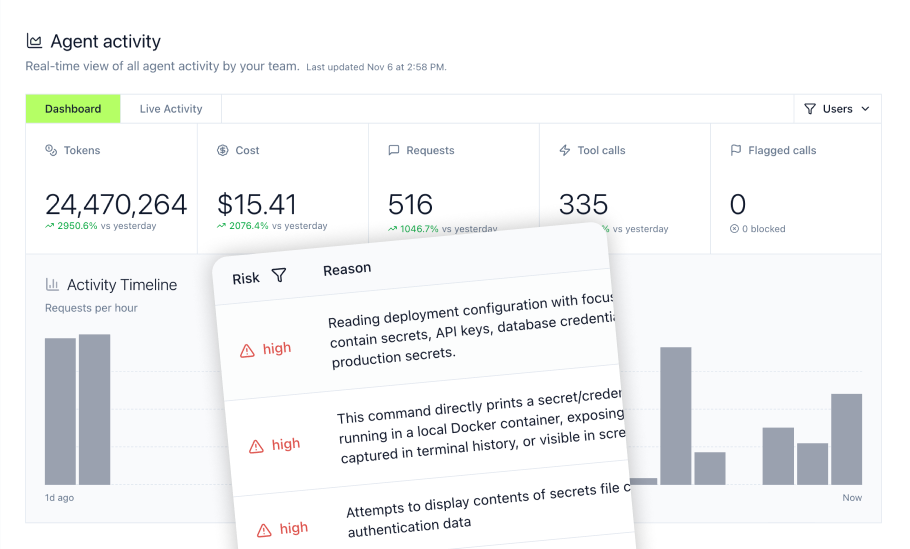
Connecting AI agents to internal tools without proper governance creates a security and operational mess that grows exponentially with each new integration. When 100 agents access 20 tools, you face 2,000 individual connections requiring separate authentication, monitoring, and policy enforcement. Agent gateways collapse this complexity into a single managed control plane.
The right agent gateway transforms how your organization deploys AI agents by providing centralized authentication, real-time monitoring, and enterprise-grade compliance for every agent-to-tool interaction. Unlike traditional API gateways, agent gateways understand agentic protocols like Model Context Protocol (MCP) and handle stateful, multi-step workflows where agents make sequential tool calls across databases, APIs, and business systems.
Key Takeaways
- MintMCP's Agent Gateway provides agent identities, permissions, memory, and monitoring built on its MCP Gateway foundation with Virtual MCP Bundles, Agent Bundles with M2M auth, hosted MCP connectors, and audit logs
- Purpose-built agent gateways offer unified management of MCP traffic with protocol translation, session management, and centralized observability
- Open-source options provide infrastructure control for teams requiring self-hosted deployment with full code visibility
- Agent gateways solve the N-to-N connection problem by providing centralized authentication, authorization, and observability across all agent-to-tool interactions
- Organizations face exponentially growing complexity when managing point-to-point agent connections without gateway infrastructure
1. MintMCP: Agent Gateway built on MCP Gateway
MintMCP's MCP Gateway governs data and tool connections through authentication, tool-level access control, credential management, logging, and rule-based policy. MintMCP's Agent Gateway builds on that foundation with agent identities, permissions, memory, and monitoring. Its data-permissions-first architecture starts with SSO, SCIM-driven RBAC, IdP groups, Virtual MCP Bundles, tool-level policy, and audit logs, then enables agents on top.
Unlike traditional approaches that require weeks of infrastructure setup, MintMCP helps teams turn MCP servers and hosted connectors into governed production services with centralized observability and enterprise authentication.
What makes MintMCP different
MintMCP solves the fundamental integration challenge enterprises face when AI agents need access to multiple data sources. The platform's architecture wraps stdio, hosted, HTTP-streamable MCP servers behind SSO-fronted remote MCP endpoints with OAuth brokering, SCIM-driven membership, and rule-based policy. This eliminates the fragmented security policies and visibility gaps that create operational chaos when managing point-to-point connections between AI agents and internal tools.
Core capabilities
- Hosted MCP Connectors: MintMCP runs connector instances on the customer's behalf with auto-scaling and sandboxed execution per connector, reducing the infrastructure overhead that typically delays production deployment
- OAuth Brokering: Add enterprise authentication to local and hosted MCP servers, including OAuth 2.x, bearer tokens, headers, and SSO-fronted access without rebuilding each server
- Real-Time Monitoring: Live dashboards showing server health, usage patterns, tool call tracking, and security alerts across all MCP connections
- Granular Access Control: Configure tool access by role with read-only operations for analysts while restricting write tools to authorized administrators
- Virtual MCP Bundles: Create team-specific, per-use-case endpoints that expose only the minimum required tools with SCIM-driven membership, curated tool lists, and fine-grained role-based access
- Agent Bundles: Give internal agents first-class identities with M2M auth, scoped tools, independent rotation and revocation, and an "act as agent" flow for connectors that require per-agent OAuth
- Custom Gateway Middleware: Runs customer-authored middleware in a JS sandbox with external DLP and guardrails integrations for masking, blocking, and policy enforcement
Security architecture
MintMCP implements defense-in-depth security through centralized governance, SSO enforcement, SCIM-driven RBAC, tool-level policy, credential management, and observability controls. Organizations making extensive use of security AI and automation lowered breach costs by an average of $1.88 million compared with organizations that did not use these capabilities. The platform provides visibility into which teams and agents use which tools, when they access data, and how frequently, solving the visibility black hole that exists with direct agent-to-tool connections.
Enterprise integrations
- Snowflake data warehouse access with natural language queries
- Elasticsearch knowledge base search for documentation and log analysis
- Gmail integration for AI-driven automation
- Custom MCP server deployment for internal tools
- Claude, Cursor, ChatGPT, Gemini, and Copilot governance through centralized gateway and Agent Monitor coverage
Deployment and compliance
Deploy quickly with managed SaaS-first delivery, US and EU availability, hosted MCP connectors, pre-configured policies, and self-service access for developers. VPC and self-hosted deployment are available on request.
MintMCP is SOC 2 Type II audited with continuous compliance monitoring. Enterprise SSO, complete audit trails, PII detection, and role-based access control are built into every layer of the platform. Customers handling protected health information can request HIPAA documentation. MintMCP signs BAAs.
Getting started
Visit mintmcp.com/mcp-gateway for the deployment guide
2. TrueFoundry Agent Gateway
TrueFoundry provides an agent gateway as part of a broader AI platform that includes model serving, LLMOps, and unified observability. The gateway focuses on centralizing MCP traffic alongside other AI infrastructure needs.
Primary focus
TrueFoundry targets platform engineering and ML platform teams who want to consolidate agent gateway functionality with model deployment and monitoring capabilities. The platform handles MCP protocol translation, converting JSON-RPC calls to REST APIs or other backend formats while providing session management for multi-step agent workflows.
Gateway features
- Protocol translation for MCP to REST API conversion
- Stateful session management for long-lived agent workflows
- Integration with TrueFoundry's AI platform for model serving
- Observability across agent and model traffic
Deployment options
TrueFoundry offers hybrid deployment with managed SaaS plus self-hosted control plane options in customer Kubernetes or cloud environments. Air-gapped deployment is available via forward proxy for organizations with strict network requirements.
Tradeoffs to consider
TrueFoundry bundles agent gateway functionality with a broader AI platform, which may be valuable for teams consolidating AI infrastructure but adds complexity for organizations focused specifically on MCP governance. Teams should evaluate whether they need the full platform or capabilities like Virtual MCP Bundles, Agent Bundles with M2M auth, and hosted connector operations.
3. Kong AI Gateway
Kong extends its established API gateway platform with MCP protocol support, providing unified governance across API, AI, and agent traffic. Organizations already standardized on Kong can add MCP capabilities without deploying separate infrastructure.
Primary focus
Kong targets platform engineering and API platform teams who want to manage MCP traffic alongside existing REST API governance. The gateway leverages Kong's authentication, rate limiting, and monitoring capabilities for MCP workloads.
Gateway features
- Unified management of APIs and MCP servers
- Integration with existing Kong authentication and rate limiting policies
- Zero-trust networking capabilities
- Plugin ecosystem for extending functionality
Deployment options
Kong offers hybrid deployment with Konnect SaaS control plane plus self-hosted data plane, or fully self-hosted options for organizations requiring complete infrastructure control.
Tradeoffs to consider
Kong can proxy remote MCP servers and use its AI MCP Proxy plugin to convert HTTP APIs into MCP tools or aggregate multiple tool sets behind an MCP endpoint. Teams should evaluate whether they also need vendor-operated STDIO hosting, Virtual MCP Bundles, Agent Bundles, hosted connector runtime, tool-update policy, OAuth brokering for stdio servers, and audit logs designed around tool invocation.
4. Bifrost from Maxim AI
Bifrost provides an open-source agent gateway with Apache 2.0 licensing, focusing on ultra-low latency overhead and full infrastructure control for teams comfortable managing self-hosted deployments.
Primary focus
Bifrost targets developers, platform engineering teams, and AI-ML teams who prioritize open-source transparency and require minimal gateway overhead. The gateway emphasizes performance with approximately 11µs overhead per request.
Gateway features
- Open-source codebase with Apache 2.0 licensing
- Low-latency design for performance-sensitive deployments
- Self-hosted deployment via Go binary or Docker
- Extensible architecture for custom integrations
Deployment options
Bifrost is primarily self-hosted, available as a Go binary or Docker container. Enterprise tier options include in-VPC deployment for organizations requiring managed support.
Tradeoffs to consider
An open-source, self-hosted model provides infrastructure control but requires the customer to operate the runtime, scaling, and governance stack. Teams comparing Bifrost with managed options should evaluate how much authentication, SCIM-driven RBAC, tool-level policy, audit logging, OAuth brokering, and agent identity governance they need beyond raw gateway performance.
5. Obot Platform
Obot Platform provides open-source MCP gateway capabilities as part of a broader AI agent orchestration framework. Built for Kubernetes-fluent infrastructure teams, Obot emphasizes transparency and extensibility through its open-source architecture.
Primary focus
Obot targets platform engineering and IT-Sec-AIOps teams that want MCP hosting, registry, gateway, and agent capabilities through either a hosted platform or self-hosted infrastructure.
Platform features
- Open-source gateway implementation with community support
- Agent workflow orchestration via the companion Nanobot framework
- Extensible architecture for custom integrations
- Self-hosted deployment with full infrastructure control
Deployment options
Obot offers an open-source self-hosted platform, with Docker recommended for development and Kubernetes for production, plus a hosted MCP platform for teams that do not want to operate the infrastructure themselves.
Tradeoffs to consider
Obot's self-hosted model provides full infrastructure control but requires the customer to operate the runtime, Kubernetes deployment, scaling, connector lifecycle, and governance stack. Its hosted option reduces that operational burden. Teams comparing Obot with managed options should evaluate whether they want self-hosted orchestration or capabilities like hosted MCP connectors, SCIM-driven RBAC, Virtual MCP Bundles, Agent Bundles, and centralized audit.
6. Lunar.dev MCPX
Lunar.dev MCPX provides an MCP gateway that centralizes policy enforcement, access control, and observability to take MCP from local experimentation to governed production deployments.
Primary focus
MCPX targets platform and infrastructure teams deploying MCP to production, as well as application teams building AI agents that need centralized access control and observability.
Gateway features
- Centralized RBAC and policy enforcement
- Full observability including tool-call usage, latency, errors, and audit logs
- Support for STDIO and remote HTTP MCP servers
- Docker and Kubernetes deployment options
Deployment options
MCPX supports Docker for open-source deployments and self-hosted Kubernetes for Enterprise. Lunar.dev also offers a managed gateway option for teams that do not want to operate the gateway themselves.
Tradeoffs to consider
MCPX provides a strong fit for teams that want to self-host or operate gateway infrastructure. Teams should compare whether they also need managed SaaS-first deployment, hosted MCP connectors, SCIM-driven Virtual MCP Bundles, Agent Bundles with M2M auth, tool-update policy, and Gateway plus Agent Monitor coverage for both MCP and local non-MCP agent activity.
7. Docker MCP Gateway
Docker's MCP Gateway brings container management to MCP server operations, providing a Docker-native gateway for running and managing MCP servers through Docker Desktop, MCP Toolkit, and the Docker MCP CLI.
Primary focus
Docker MCP Gateway targets developers running MCP servers locally and organizations with existing Docker environments seeking to run and manage MCP servers through familiar container tooling.
Gateway features
- Container isolation for MCP server deployments
- Docker Desktop MCP Toolkit and Docker MCP CLI support for managing servers, catalogs, profiles, and OAuth credentials
- Profiles and custom catalogs for organizing approved MCP servers across projects and teams
- Standard container security practices and image management
Deployment options
Run through Docker Desktop or the Docker MCP CLI in local or headless Docker environments. Docker AI Governance's managed enterprise gateway is currently invite-only.
Tradeoffs to consider
A container-native gateway provides infrastructure control but requires teams to operate the relevant Docker runtime and container lifecycle themselves unless they have access to Docker AI Governance. Teams should evaluate how much authentication, SCIM-driven RBAC, tool-level policy, audit logging, OAuth brokering, and agent identity governance they need beyond container lifecycle management.
Selecting the right agent gateway for internal tool integration
Deployment speed vs. control tradeoffs
Purpose-built gateways like MintMCP provide fast managed SaaS-first deployment with hosted MCP connectors and pre-configured governance controls. Self-hosted open-source options require infrastructure setup but offer full control. Consider whether you need production deployment quickly or can invest weeks building and operating custom infrastructure.
Security and compliance requirements
Organizations in regulated industries face security concerns as a top challenge. SOC 2 Type II audited status, audit logs, SSO, SCIM-driven RBAC, credential management, and tool-level access controls are important for healthcare, finance, and enterprises handling sensitive data. Evaluate whether your gateway provides these controls or requires you to implement them yourself.
STDIO vs. remote server support
The critical question is whether your gateway handles STDIO-based MCP servers, which represent a large share of community-built servers but are difficult to deploy without proper infrastructure. Solutions that only support remote HTTP servers limit ecosystem access and require rebuilding existing STDIO tools. MintMCP supports stdio and Streamable HTTP, plus legacy SSE upstream servers for backward compatibility.
Authentication architecture
The March 2025 MCP specification added an OAuth 2.1-based authorization framework and replaced HTTP+SSE with Streamable HTTP, but gateway implementations still vary. Some gateways broker OAuth and wrap stdio or hosted servers with enterprise SSO, while others require manual OAuth configuration per server. Consider whether you need shared service accounts, per-user authentication, per-agent identity, M2M auth, or an "act as agent" flow depending on your use cases.
Observability and monitoring
Without comprehensive logging and monitoring, organizations face a visibility black hole where they cannot see which tools agents use or track data access. Essential metrics include tool call tracking, performance analytics, error rates, and cost allocation per team. Evaluate whether your gateway provides real-time dashboards, audit logs, and centralized observability or requires separate monitoring infrastructure.
Integration ecosystem
Assess which data sources your AI agents need to access. If your requirements include Snowflake data warehouses, Elasticsearch knowledge bases, Gmail, hosted MCP connectors, or custom internal tools, verify your gateway supports these integrations without extensive custom development.
Understanding agent gateway architecture
Agent gateways solve fundamental problems that cannot be addressed through direct agent-to-tool connections at enterprise scale. The architecture transforms an exponentially complex N-to-N mesh into a manageable 1-to-N hub-and-spoke model where the gateway provides a single control plane for authentication, authorization, security policies, and observability.
The point-to-point problem
Without gateways, organizations face fragmented security policies across dozens of individual MCP servers, zero visibility into which agents access which tools, duplicated authentication logic, and inconsistent logging. This creates the operational chaos that makes production deployment impossible.
Gateway value proposition
Centralized gateways provide unified authentication eliminating scattered credentials, complete audit trails for compliance, real-time monitoring across all interactions, simplified troubleshooting through a single logging endpoint, and shared caching and rate limiting. For organizations deploying 10 or more MCP servers, the operational benefits justify gateway infrastructure investment when they reduce manual authentication, governance, and monitoring work.
Security architecture
A defense-in-depth pattern implements security through multiple layers. The first layer protects AI client-to-LLM communication including prompt injection and PII filtering. The second layer protects LLM-to-MCP server communication including tool authorization and parameter validation. The third layer protects MCP server-to-external API communication including rate limiting and authentication.
Implementation roadmap: deploying your agent gateway
Phase 1: pilot deployment (2-4 weeks)
Begin with a limited scope deployment for 10-50 users accessing 3-5 carefully selected MCP servers. Choose low-risk use cases like internal knowledge base search or development tool integration. This phase validates architecture, identifies integration challenges, and establishes baseline metrics without organization-wide risk.
Phase 2: governance framework (4-8 weeks)
Establish policies for server vetting and approval, define role-based access controls aligned with organizational structure, implement monitoring and alerting for security events, and document operational procedures for ongoing management. Create a governance council including security, legal, and business stakeholders to approve new MCP server deployments.
Phase 3: enterprise rollout (8-12 weeks)
Expand to additional teams and use cases based on pilot success metrics. Integrate with enterprise identity providers for SSO enforcement. Connect production data sources like data warehouses and enterprise search. Enable self-service access for developers while maintaining centralized governance. Monitor usage patterns to optimize resource allocation and identify additional integration opportunities.
Success metrics
Track deployment velocity from server request to production, security events detected and prevented, developer satisfaction with tooling access, compliance audit preparation time, and cost per AI interaction. Organizations see meaningful reductions in time spent on authentication setup when centralized gateway infrastructure replaces one-off server-by-server configuration.
Deploy governed agent infrastructure with MintMCP
The shift from connecting AI agents to tools toward governing agent identities, permissions, and operations represents the evolution from MCP Gateway to Agent Gateway. MintMCP's Agent Gateway builds directly on its MCP Gateway foundation, extending governed data and tool connections with agent-specific capabilities that production deployments require.
Where MCP Gateway provides SSO-fronted endpoints, OAuth brokering, and tool-level access control for data sources, Agent Gateway adds Agent Bundles that give internal agents first-class identities with M2M auth, scoped tools, and independent credential rotation. Virtual MCP Bundles create team-specific endpoints with SCIM-driven membership, ensuring agents inherit governed access from day one. Custom gateway middleware runs in a JS sandbox, enabling organizations to integrate external DLP and guardrails for masking, blocking, and policy enforcement across both human and agent activity.
This architecture solves the operational chaos that emerges when organizations manage point-to-point agent connections without centralized governance. Agent Monitor extends coverage beyond MCP traffic to local agent activity including bash commands, file operations, and prompt submissions from coding agents like Cursor and Claude Code, creating comprehensive visibility across the entire agent landscape.
Start your free trial at mintmcp.com to deploy governed agent infrastructure.
Frequently asked questions
What is the difference between an agent gateway and a traditional API gateway?
Agent gateways specifically handle protocols like Model Context Protocol (MCP) for connecting AI assistants to tools and data, supporting the current stdio and Streamable HTTP transports, with some gateways retaining legacy SSE support for backward compatibility. Traditional API gateways route HTTP/REST requests between services. While some API gateway vendors are adding MCP features, purpose-built agent gateways understand protocol-specific requirements like context state management across multi-step agent workflows, tool authorization semantics, and stdio server hosting that traditional gateways do not address.
How quickly can I deploy an agent gateway in my organization?
Deployment speed varies by approach. Managed services like MintMCP Gateway can accelerate deployment with managed SaaS-first delivery, hosted MCP connectors, SSO-fronted access, and pre-configured governance controls. Self-hosted open-source solutions often require additional time for infrastructure setup, authentication integration, and security configuration. Traditional API gateway extensions can also require time to implement MCP protocol support and configure enterprise controls.
How do agent gateways prevent shadow AI tool usage?
Gateways transform shadow AI into sanctioned AI by providing centralized authentication that requires AI agent connections to route through governed infrastructure. The gateway catalogs approved MCP servers, enforces role-based access controls determining which users and agents access which tools, maintains audit trails of tool invocations, and blocks unauthorized server connections. Organizations gain visibility into which tools teams use, when they access data, and how frequently, reducing the visibility gap that enables shadow AI proliferation.
What authentication methods do agent gateways support?
Enterprise gateways can support OAuth 2.x, SAML for enterprise SSO integration, OpenID Connect (OIDC) for modern identity providers, bearer tokens, headers, and API token management for service accounts. Leading implementations provide shared service accounts, per-user OAuth flows, and per-agent identity models including M2M auth and "act as agent" flows. This flexibility addresses the authorization challenges enterprises face when internal practices conflict with standard OAuth flows.
Can agent gateways work with coding agents like Cursor and Claude Code?
Yes. Specialized governance layers like MintMCP's Agent Monitor can monitor MCP tool invocations, bash commands, file operations, and prompt submissions from Cursor, Claude Code, and other coding agents. This creates two-layer governance: the gateway covers MCP traffic while Agent Monitor covers local non-MCP agent activity such as Bash usage, file reads and writes, and prompt submissions. This addresses the unique security challenges of coding agents that operate with extensive system access, reading files, executing commands, and accessing production systems through MCP tools.