Every unmonitored AI agent is a potential security incident waiting to happen. With 79% of organizations actively evaluating or deploying agentic AI, the gap between deployment speed and security readiness has become the defining challenge for enterprise IT and security teams. The solution is not slowing down AI adoption but implementing a layered AI-agent governance strategy that combines governed MCP access, first-class agent identity, monitoring, runtime guardrails, and enterprise controls to make AI agents deployable, governed, measurable, and swappable without creating bottlenecks for engineering teams.
Key Takeaways
- 63% of organizations cannot enforce purpose limitations on their AI agents
- The governance-containment gap shows 58% report continuous monitoring and 59% report human-in-the-loop oversight, while only 37% have purpose binding and 40% have kill-switch capabilities
- Organizations with proper audit trails show 20-32 point advantages on AI maturity metrics versus those without
- 33% of organizations lack evidence-quality audit trails, creating governance gaps
- Security scans found 36.82% of 3,984 agent skills contained security flaws
The Urgent Need for Enterprise AI Security
AI agents are being deployed faster than governance can keep pace. Employees use Claude, Cursor, ChatGPT, Gemini, and Copilot across developer endpoints, SaaS applications, and cloud environments. Each agent makes autonomous decisions about which tools to call, which data to access, and which actions to execute.
Traditional security tools were built for human users. They assume predictable access patterns, static permissions, and manual credential rotation. AI agents break all three assumptions:
- Unpredictable access patterns: Agents decide at runtime which tools to invoke based on natural language prompts
- Dynamic tool surfaces: MCP clients rediscover available tools through
list_tools, and malicious tool descriptions can become injection surfaces - Credential sprawl: API keys end up on developer laptops, and one leak becomes keys to the entire kingdom
The real-world consequences are documented. Production database wipes, credential theft campaigns, and zero-click data exfiltration attacks have all been traced back to improperly secured AI agents. The OWASP Top 10 for Agentic Applications now covers ten distinct risk categories specific to autonomous AI systems.
Why Visibility Alone Falls Short
Most organizations have invested in monitoring. The problem is that monitoring provides awareness without protection. Security teams know an agent is doing something wrong but cannot stop it in real time.
This creates the governance-containment gap:
- Continuous monitoring: 58% of organizations
- Human-in-the-loop oversight: 59% of organizations
- Purpose binding: 37% of organizations
- Kill-switch capability: 40% of organizations
Closing this gap requires runtime controls that can block unsafe actions before they execute.
Establishing AI Governance Frameworks
Effective AI governance starts with data and tool access, not with agents. The core principle is that an autonomous agent should never receive broader permissions than the specific task requires.
The Data-Permissions-First Architecture
The most effective approach centralizes governance at the connection layer. Instead of trying to restrict agents after they have broad access, organizations define permitted data and tool connections upfront.
This architecture uses a key abstraction: the Virtual MCP (VMCP). A Virtual MCP bundles approved connectors and a curated tool surface behind one governed endpoint for a particular team, role, use case, or agent.
With Virtual MCPs, organizations can:
- Create read-only and read-write tool sets over the same underlying connector
- Drive membership through directory groups via SCIM
- Apply consistent access policies without requiring every employee to configure each MCP server separately
- Maintain a single audit trail for all tool invocations
The result is that security teams gain a governance control plane across supported AI clients and governed tool connections, rather than managing each tool or vendor separately.
Implementing Agent Identity and Authentication
The single biggest governance gap in most AI deployments is identity. Autonomous agents operate through whichever human credential or shared API key happens to be available. This approach collapses audit logs, over-privileges agents, breaks credential rotation, and creates single points of failure.
Treating Agents as First-Class Non-Human Principals
The solution is giving each autonomous agent its own agent identity. This means:
- Named, org-scoped identity: Each agent becomes a principal in the same authorization model as humans
- Independent credentials: Bearer keys, M2M tokens, or workload identity federation
- Scoped MCP access: Each agent gets a Virtual MCP scoped to just that agent
- Independent rotation: Rotate or revoke one agent's credentials without touching users or other agents
- Attributable audit trail: Every action attributed to the specific agent that performed it
Authentication Mechanisms by Security Level
| Mechanism | Security Level | How It Works | Best For |
|---|---|---|---|
| Bearer Keys | Basic | Static key on every request with name, expiry, individual revocation | Simple integrations, development |
| M2M Tokens | Standard | OAuth client-credentials exchange for short-lived tokens | Production agents requiring refresh |
| Workload Identity Federation | Advanced | Agent infrastructure mints short-lived OIDC tokens, no secret stored | High-security, Kubernetes, cloud-native |
M2M authentication uses an OAuth client-credentials exchange for short-lived tokens, keeping the client secret out of normal request traffic. For secretless authentication, workload identity federation lets the agent's infrastructure mint short-lived OIDC tokens so Mintive (formerly MintMCP) does not hold an agent secret.
Centralizing Access: AI Gateways and Virtual MCPs
With agents deployed across Claude Code, Cursor, ChatGPT, Gemini, and Copilot, organizations face configuration sprawl. Every developer configures every MCP server locally, creating N installs, N auth flows, and N points of failure.
The MCP Gateway Solution
An MCP Gateway provides a single governed entrypoint between AI clients and enterprise tools. Instead of each developer managing their own MCP configurations, they connect once to a Virtual MCP and get access to all approved tools.
Core capabilities include:
- Hosted connectors: Run in a managed data plane, never exposed to the public internet
- Remote connectors: Connect to on-premises or private network systems
- Credential injection: Connectors never hold long-lived secrets
- RBAC and tool curation: Access granted at the VMCP level, driven by directory groups
- Private network tunnel: Reach on-prem connectors without public exposure
- Audit logging: Every tool call logged with full context
How Virtual MCPs Enable Least Privilege
The Virtual MCP abstraction makes least privilege practical. Consider a data analytics team:
- Read-only VMCP: Access to query tools only, no write permissions
- Read-write VMCP: Full access for data engineers who need to modify schemas
- Both serve the same connector: Tool curation determines what each role sees
This approach trims context-window bloat by showing agents only the tools they need. It also ensures role-based access control falls naturally out of role design.
Implementing Runtime Guardrails for AI Agents
Visibility tells you what happened. Guardrails determine what can happen. Effective AI agent security requires both.
The Three-Layer Guardrail Architecture
A comprehensive guardrail strategy operates at three complementary layers:
Layer 1: Managed Detection Policies
Mint Guard provides out-of-the-box, centrally maintained detection for:
- Prompt injection attacks
- Credential and secret exposure
- PII in tool calls and responses
- Harmful content patterns
These policies run in monitoring or enforcing mode, screening every tool call with one toggle and nothing to author.
Layer 2: Declarative Rules
Custom rules match tool names, argument patterns, or content via regex. Supported actions include:
- Flag: Log the event for review
- Block: Prevent execution entirely
- Ask: Require user confirmation before proceeding
- Mask: Redact sensitive information
- Notify: Send alerts to Slack or other channels
Layer 3: Gateway Middleware
For complex logic beyond pattern matching, gateway middleware runs sandboxed JavaScript on every matching call. Use cases include:
- Calling external DLP classifiers before allowing data access
- Enforcing resource allowlists based on business rules
- Transforming or redacting results before returning to agents
- Integrating with existing security tools
Blocking Dangerous Actions in Real Time
The practical implementation combines multiple control layers:
- Endpoint command controls: Agent Monitor guardrails can block dangerous bash commands and other risky operations
- Sensitive file controls: Agent Monitor can restrict access to files such as
.envfiles, SSH keys, and credentials - Gateway enforcement: Mint Guard, Rules, and Gateway Middleware can detect, restrict, transform, or block gateway tool activity
- Operational shutdown controls: Organization-wide and VMCP-level controls provide an emergency way to stop governed gateway access
Monitoring and Observability: Gaining Visibility into Agent Activity
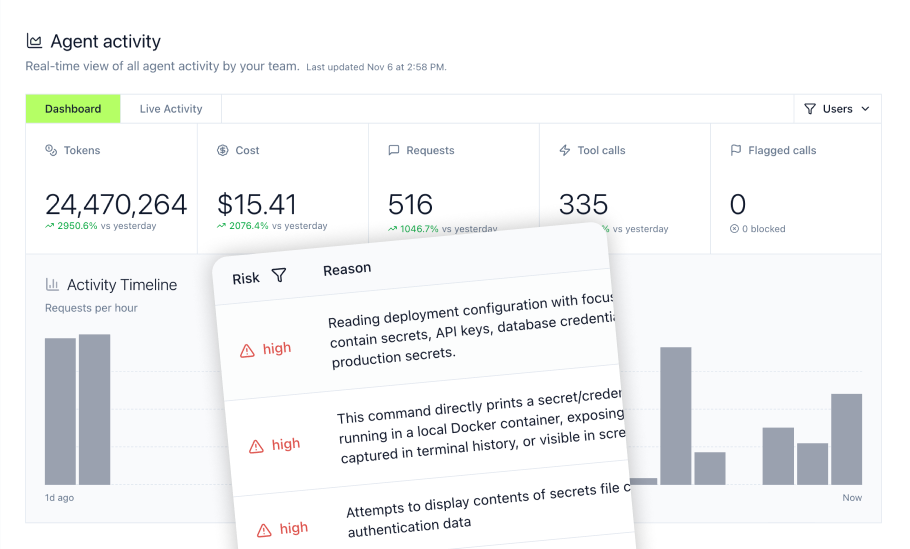
Agent Monitor provides organizational visibility into supported AI agent activity across the organization. Unlike gateway-only logging, it captures activity at the endpoint level.
What Agent Monitor Captures
- Supported prompt submissions: Prompts submitted through monitored agent environments
- File access: Including
.envfiles, SSH keys, and sensitive configuration - Commands: Bash, installs, git operations, and shell activity
- MCP tool calls: Which tools are invoked and with what arguments
- Usage metrics: Token spend by model, user, agent, and session
Live Activity and Filtering
Security teams can filter the live activity feed by user, team, agent type (Claude Code, Cursor, Codex, Copilot), tool, connector, time range, and risk level.
This provides cross-platform visibility into supported agent activity beyond gateway traffic, with coverage varying by client, agent, and hook phase.
SIEM Integration for Compliance
For compliance requirements, SIEM export sends structured logs via OTLP or Splunk HEC. Exportable events include:
- Tool-call events
- Prompt submissions
- Gateway requests
- Access policy changes
- Credential lifecycle events
This gives security and compliance teams centralized records that can support audit evidence alongside their existing controls and processes.
Company-Owned Memory and Persistent Workflows
As organizations move beyond coding assistance to autonomous workflows, memory becomes a governance concern. Coworker Agents provide persistent agents that operate alongside employees while maintaining company ownership of all state.
What Makes Coworker Agents Different
Coworker Agents are long-running agents that:
- Operate through Slack: Respond to mentions, run scheduled tasks, and continue work across days
- Maintain company-owned memory: Git-backed memory with org, team, and individual scopes
- Use governed tool access: VMCP-scoped tool allowlists
- Run in sandboxed environments: Restricted egress with secret brokering
The Repo-as-Memory Architecture
The agent's configuration, instructions, memory, and audit log are all reviewable files:
CLAUDE.md: Agent instructions and capabilitiesprogress.md: Persistent memory across sessionsinbound/: Task drop for scheduled work
This makes agents inspectable rather than black boxes. Teams can review what an agent knows, how it is configured, and what actions it has taken.
Portable Intelligence
Mintive's LLM gateway connects OpenAI, Anthropic, or Fireworks, so teams can switch providers without rewiring each agent. Allowed-model lists use the groups already managed in Mintive, keeping model choices under shared governance.
Enterprise-Grade Security Features
Production AI deployments require the same security infrastructure as any enterprise system.
Identity and Access Management
Enterprise SSO integration supports:
- SSO providers: Okta, Entra ID, Google Workspace
- SCIM provisioning: Directory groups drive both admin roles and tool access
- Automatic propagation: IdP user lifecycle and directory-group changes propagate to governed user and tool access
Audit and Compliance
Every tool call, credential lifecycle event, and access policy change is logged with:
- Tamper-evident history: Access-grant history signed at write time, verifiable offline
- Complete attribution: Who initiated, which tools called, what data flowed, and when
- Exportable format: OTLP or Splunk HEC for integration with existing compliance infrastructure
Operational Controls
When incidents occur, teams need immediate response capabilities:
- Organization-wide gateway kill switch: Immediate, audited shutdown of governed gateway access across the organization
- Per-VMCP disable: Selective shutdown of specific tool sets
- Connector restart: Force credential refresh and connection reset
- Credential rotation: Rotate specific credentials without affecting other agents
Configuration as Code
For organizations managing multiple environments, configuration as code enables version-controlled gateway configuration, declarative policy definitions, reproducible deployments, and audit trails of configuration changes.
The 2026 Approach to AI Agent Security
Enterprise AI security is a defense-in-depth problem spanning identity, governed tool and data access, monitoring, runtime enforcement, and adversarial testing. One practical way to evaluate an enterprise AI security stack is to separate several complementary control categories:
| Category | What It Addresses |
|---|---|
| Identity Security | Task-scoped credentials, zero standing privileges |
| Runtime Security | Real-time inspection and blocking of unsafe actions |
| AI Gateways | Proxy layer for LLM requests, multi-provider routing |
| MCP Gateways | Governed tool access, Virtual MCPs, credential injection |
| Red Teaming | Adversarial testing specific to agentic attack vectors |
Implementation Timeline
One example phased deployment plan for enterprise AI agent security:
Week 1-2: Discovery and Assessment
- Scan all environments for existing AI agents
- Inventory MCP servers, tool access patterns, and data connections
- Identify high-risk agents accessing sensitive data or production systems
Week 2-3: SSO and Identity Integration
- Configure SSO/SCIM with identity provider
- Establish service accounts for AI agents with least-privilege access
Week 3-4: Gateway Deployment
- Deploy MCP Gateway as the single approved endpoint
- Configure allow lists for approved MCP servers
- Configure VMCP access policies and tool-level controls
Week 4-6: Runtime Protection and Monitoring
- Enable runtime guardrails in monitor-only mode
- Configure SIEM integration for audit logs
- Set up alerting for anomalous behavior
Week 6-12: Phased Enforcement Rollout
- Start with least-critical teams
- Enable enforcement for low-risk policies first
- Gradually expand to high-risk controls
- Validate policies do not block legitimate work
Common Implementation Challenges
| Challenge | Mitigation |
|---|---|
| Developers bypass governance with personal API keys | Use applicable network, identity, and endpoint controls to restrict unsanctioned access |
| Policies too restrictive, blocking legitimate work | Begin in monitor-only mode and tune policies against real usage before broader enforcement |
| Shadow MCP servers running locally | Use supported MDM deployment and Agent Monitor controls to discover and govern local MCP activity |
| Alert fatigue from false positives | Establish behavioral baselines and tune detection policies before applying stricter thresholds |
Why Mintive Addresses Enterprise AI Security Challenges
Mintive addresses the core challenge facing security teams: enterprises are rolling out AI agents faster than they can govern them. The platform makes agents deployable, governed, measurable, and swappable without creating bottlenecks.
What Sets Mintive Apart
- Virtual MCPs as the Governance Unit: Instead of managing permissions per tool or per user, Mintive bundles connectors into Virtual MCPs that serve as the unit of deployment, access control, tool curation, and audit. Create a read-only VMCP and a read-write VMCP over the same connector, and role-based access falls out naturally.
- Agent Identities for Non-Human Principals: Each autonomous agent gets its own identity, credentials, scoped MCP access, and audit trail. Rotate or revoke one agent without touching users or other agents. No shared keys to leak.
- Tool and model visibility: The MCP gateway logs governed tool traffic, and Agent Monitor uses hooks to capture file reads, commands, and MCP tool calls, including activity outside the gateway path. The LLM gateway records usage, cost, model, and latency for each model call next to tool calls.
- Runtime Controls That Block Unsafe Actions: Three complementary guardrail layers work together. Mint Guard provides managed detection policies. Rules enable declarative pattern matching. Gateway middleware runs customer-authored JavaScript for complex DLP integration and policy enforcement.
- Enterprise Infrastructure Built In: SSO and SCIM integration, RBAC, tamper-evident audit trails, SIEM export, kill switches, and configuration as code ship today as baseline capabilities.
For teams evaluating AI agent security infrastructure, Mintive's data risk guide provides a practical framework for assessing exposure and prioritizing controls.
Frequently Asked Questions
What are the primary security risks of deploying AI agents in production?
AI agents introduce risks that traditional security tools were not designed to address. The OWASP Top 10 for Agentic Applications identifies ten categories including agent goal hijacking, tool misuse, identity abuse, supply chain compromise, code execution vulnerabilities, memory poisoning, inter-agent communication risks, cascading failures, trust exploitation, and rogue agents. The most immediate risks in production environments include prompt injection attacks that hijack agent behavior, credential exposure through tool calls, and data exfiltration via unauthorized data access patterns.
Why is monitoring alone insufficient for AI agent security?
Monitoring provides visibility without protection. 58% of organizations report continuous monitoring and 59% report human-in-the-loop oversight, while only 37% have purpose binding and 40% have kill-switch capabilities. This governance-containment gap means security teams watch problems unfold in real time but cannot intervene. Effective security requires runtime controls like command blocklists, file system restrictions, and kill switches that prevent dangerous actions before they execute, not just log them after the fact.
How do Virtual MCPs enable least-privilege access for AI agents?
Virtual MCPs bundle approved connectors and curated tool surfaces behind one governed endpoint. Instead of granting agents access to entire systems, teams create VMCPs scoped to specific use cases. A read-only VMCP might expose query tools for a data analytics team while a separate read-write VMCP provides full access for data engineers. Both serve the same underlying connector, but tool curation determines what each role sees. Directory groups via SCIM drive membership, so access policies stay synchronized with organizational structure.
What compliance considerations matter when securing AI agents handling sensitive data?
Organizations handling regulated data must address audit trail completeness, access attribution, and credential lifecycle management. 33% of organizations lack evidence-quality audit trails for AI activity, creating significant auditability and evidence gaps for organizations subject to frameworks such as SOC 2, HIPAA, and GDPR. Effective compliance requires tamper-evident logging of every tool call, credential event, and access policy change. Logs must attribute actions to specific agents (not just the humans who created them) and export to SIEM platforms for integration with existing compliance infrastructure.
How long does it take to implement enterprise AI agent security?
Implementation time varies substantially by organization size, existing identity and security infrastructure, deployment scope, and enforcement requirements. The phased sequence above should be treated as an example rollout plan rather than a universal implementation benchmark. Most organizations benefit from a 4-6 week pilot period in monitor-only mode to baseline normal usage patterns and tune policies before enabling enforcement.