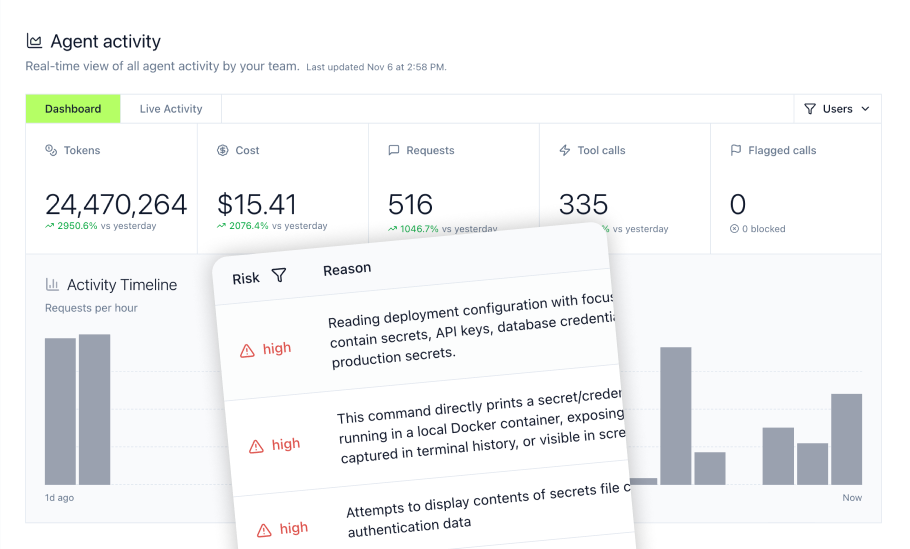
MongoDB's flexible document model and powerful query capabilities make it ideal for AI-powered applications. The Model Context Protocol (MCP) enables AI agents to interact with MongoDB databases through natural language, but implementing these connections at enterprise scale requires robust security infrastructure. This guide shows developers and DevOps engineers how to deploy MongoDB MCP SDK integrations that meet enterprise security requirements while enabling AI agents to perform sophisticated database operations across your MongoDB clusters.
Key Takeaways
- MongoDB MCP SDK provides AI agents with natural language access to collections, indexes, aggregation pipelines, and real-time change streams through standardized tools
- Enterprise deployments require authentication, encryption, audit trails, and access controls that standalone MongoDB connectors cannot provide
- MintMCP's gateway architecture enables centralized MongoDB MCP deployment with OAuth protection and comprehensive monitoring
- The SDK supports both MongoDB Atlas cloud deployments and self-hosted clusters with connection string configuration
- Role-based access control at the tool level ensures AI agents only access collections and operations appropriate for their function
- Real-time security rules block dangerous operations like collection drops or unauthorized data modifications before execution
- Production deployments benefit from connection pooling, query optimization, and caching strategies built into the managed infrastructure
What is MongoDB MCP SDK
The MongoDB MCP SDK bridges AI applications with MongoDB databases through the Model Context Protocol. Instead of writing custom database integration code for each AI tool, the SDK exposes MongoDB operations as standardized MCP tools that AI agents can invoke through natural language.
Traditional MongoDB integrations require developers to handle connection management, query construction, error handling, and result formatting for each AI application. When connecting Claude, ChatGPT, Cursor, and internal automation tools to MongoDB, teams maintain separate integration layers with different authentication patterns and no unified observability.
The MCP SDK standardizes these interactions. AI agents send natural language requests that the SDK translates into MongoDB operations. The SDK handles connection pooling, query optimization, cursor management, and result formatting automatically.
Core MongoDB Operations Through MCP
The MongoDB MCP SDK exposes these essential capabilities to AI agents:
Collection Management
- List databases and collections with metadata
- Create and configure new collections
- Manage indexes for query performance
- Set validation rules and schema enforcement
Document Operations
- Insert single or bulk documents
- Find documents with query filters
- Update documents with atomic operations
- Delete documents matching criteria
Aggregation Framework
- Build aggregation pipelines through natural language
- Perform grouping, filtering, and transformations
- Execute lookup joins across collections
- Generate analytics and reporting queries
Change Streams
- Monitor real-time database changes
- React to insert, update, and delete events
- Process streaming data for AI workflows
- Maintain synchronized data views
Administrative Functions
- Monitor database statistics and performance
- Manage user permissions and roles
- Configure replication and sharding
- Execute maintenance operations
Why Enterprise Teams Need Managed MongoDB MCP
Running MongoDB MCP SDK locally introduces significant operational and security challenges:
- Connection String Exposure: Database credentials stored in configuration files across developer machines create security vulnerabilities
- No Audit Trail: Zero visibility into which collections AI agents access or what operations they perform against production data
- Access Control Gaps: Cannot enforce role-based permissions or revoke access centrally when team members change roles
- Compliance Violations: Unable to demonstrate database access patterns for SOC2, HIPAA, or GDPR audits
MintMCP solves these challenges by running MongoDB MCP servers in managed infrastructure with enterprise security controls. Administrators configure MongoDB connectors once and provide governed access through Virtual MCP servers.
Setting Up MongoDB MCP SDK with MintMCP
This section walks through deploying MongoDB MCP integration for your team using MintMCP's hosted connector approach, which balances deployment simplicity with configuration flexibility.
Prerequisites and Environment Setup
Before starting the MongoDB MCP deployment, ensure you have:
- MintMCP account with administrator privileges
- MongoDB cluster (Atlas or self-hosted) with network access configured
- MongoDB connection string with appropriate authentication
- Clear understanding of which teams need access to which databases and collections
For MongoDB Atlas deployments, configure network access to allow connections from MintMCP's infrastructure IP ranges. For self-hosted clusters, ensure your firewall rules permit inbound connections from MintMCP gateways.
Creating MongoDB Connection Credentials
Your MongoDB MCP connector requires authentication credentials to access databases. MongoDB supports multiple authentication mechanisms, with MongoDB Atlas preferring database users with scoped permissions.
For MongoDB Atlas:
- Navigate to Database Access in your Atlas project
- Click "Add New Database User"
- Choose "Password" authentication method
- Set username and strong password
- Configure database user privileges:
- Read-only access for analytics teams
- Read/Write for development teams
- Atlas Admin for infrastructure teams
- Add IP address restrictions if required
- Save the user and construct your connection string
Connection String Format:
| mongodb+srv://username:password@cluster.mongodb.net/database?retryWrites=true&w=majority |
|---|
For production deployments, use MongoDB's built-in roles or create custom roles that grant minimum required permissions for each team's use case.
Configuring the Hosted MongoDB Connector
Navigate to the MintMCP console and configure your MongoDB connector:
- Add Connector
- Go to MCP Connectors section
- Click "Add Connector"
- Select "Hosted Server" option
2. Configure Server Settings
Provide the MCP standard configuration for MongoDB:
{
  "mcpServers": {
    "mongodb": {
      "command": "npx",
      "args": [
        "-y",
        "@mongodb-mcp-server"
      ],
      "env": {
        "MDB_MCP_CONNECTION_STRING": "<your-connection-string>"
      }
    }
  }
}
3. Set Environment Variable Scopes
MONGODB_CONNECTION_STRING: Set to "Global" for organization-wide access with a service account, or "Per-User" to prompt each user for their own credentials- Add additional environment variables for connection pooling, timeout settings, or feature flags as needed
4. Deploy and Verify
- Click "Save" to trigger deployment
- MintMCP launches the server in a managed container
- Monitor the connector detail page for startup logs
- Verify available tools match your MongoDB configuration
The deployment typically completes within 30-60 seconds. Check logs for connection issues if the server fails to start.
Creating Virtual MCP Servers for Team Access
With the MongoDB connector deployed, create Virtual MCP servers that bundle tools for specific teams. This pattern implements role-based access control at the tool level.
Development Team Virtual Server
Create a Virtual MCP server for developers who need read/write access:
- Navigate to Virtual MCP Servers
- Click "Create Virtual Server"
- Name it "MongoDB - Development Access"
- Add your MongoDB connector
- Configure tool customization to expose:
- All read operations (find, aggregate)
- Document modifications (insert, update)
- Index management capabilities
- Restrict administrative operations
- Assign to development team members
Analytics Team Virtual Server
Create a read-only Virtual MCP server for analytics:
- Create new Virtual Server named "MongoDB - Analytics Read-Only"
- Add the same MongoDB connector
- Use tool customization to expose only:
- Find and aggregate operations
- Database and collection listing
- Statistics and monitoring tools
- Remove all write operations
- Assign to analytics team members
Infrastructure Team Virtual Server
Create a full-access Virtual MCP server for DevOps:
- Create Virtual Server named "MongoDB - Infrastructure Admin"
- Add MongoDB connector
- Enable all available tools including administrative functions
- Configure approval workflows for destructive operations
- Assign to infrastructure team members only
This approach ensures teams only access MongoDB capabilities appropriate for their responsibilities while maintaining centralized control.
Implementing AI Queries with MongoDB MCP
MongoDB's query language and aggregation framework provide powerful data retrieval capabilities. Through MCP, AI agents construct these queries using natural language, making database interactions accessible to non-technical users while maintaining query efficiency.
Natural Language to MongoDB Query Translation
The MongoDB MCP SDK translates natural language requests into optimized MongoDB queries. AI agents describe their data needs conversationally, and the SDK generates appropriate query syntax.
Simple Query Examples:
Natural language: "Find all users who signed up last month" MongoDB query generated:
db.users.find({
  createdAt: {
    $gte: ISODate("2024-10-01"),
    $lt: ISODate("2024-11-01")
  }
})

Natural language: "Show me products under $50 with high ratings" MongoDB query generated:
db.products.find({
  price: { $lt: 50 },
  rating: { $gte: 4.0 }
})
The SDK handles query optimization automatically, adding appropriate indexes hints and limiting result sets to prevent performance issues.
Aggregation Pipeline Construction
MongoDB's aggregation framework enables sophisticated data transformations. AI agents build these pipelines through conversational requests:
Revenue Analytics Pipeline:
Natural language: "Calculate monthly revenue by product category for the last quarter"
The SDK constructs:
db.orders.aggregate([
  {
    $match: {
      orderDate: {
        $gte: ISODate("2024-07-01"),
        $lt: ISODate("2024-10-01")
      }
    }
  },
  {
    $lookup: {
      from: "products",
      localField: "productId",
      foreignField: "_id",
      as: "product"
    }
  },
  {
    $unwind: "$product"
  },
  {
    $group: {
      _id: {
        month: { $month: "$orderDate" },
        category: "$product.category"
      },
      revenue: { $sum: "$totalAmount" }
    }
  },
  {
    $sort: { "_id.month": 1, "_id.category": 1 }
  }
])
The SDK optimizes pipeline stages, manages memory limits, and handles result pagination for large datasets.
Enterprise Security Implementation
MongoDB deployments contain sensitive business data requiring comprehensive security controls. MintMCP's security architecture provides multiple layers of protection for MongoDB MCP integrations.
Authentication and Authorization Strategies
Enterprise MongoDB deployments require granular access control beyond basic authentication. MintMCP implements a staged approach to authentication that scales with organizational needs.
Connection-Level Security:
Configure MongoDB connection strings with appropriate authentication mechanisms:
- SCRAM-SHA-256: Default for MongoDB Atlas and most deployments
- X.509 Certificates: For environments requiring certificate-based authentication
- LDAP/Kerberos: Integration with enterprise directory services
- AWS IAM: For MongoDB Atlas deployments in AWS
Store connection strings in MintMCP's encrypted environment variables, never in code or configuration files.
User-Level Attribution:
MintMCP's authentication models ensure every database operation traces back to an individual user:
- Users authenticate with MintMCP through SSO integration
- MintMCP obtains MongoDB credentials through secure workflows
- Each operation includes user context in audit logs
- Access revocation happens instantly across all tools
Role-Based Access Control:
Map organizational roles to MongoDB permissions through Virtual MCP servers:
- Developers: Read/write to development databases only
- Analysts: Read-only access to analytics collections
- DevOps: Full administrative access with approval workflows
- Support: Limited read access to customer data
Configure these mappings through tool governance policies in the MintMCP console.
Encryption and Data Protection
Protect MongoDB data at multiple levels:
Transit Encryption:
- TLS 1.2+ for all MongoDB connections
- Certificate validation to prevent MITM attacks
- Encrypted tunnels between MintMCP and MongoDB clusters
Connection Security:
- Connection strings encrypted at rest in MintMCP
- Temporary credentials with automatic rotation
- IP allowlisting for database access
Query Result Protection:
- Results encrypted in transit to AI agents
- Sensitive field masking based on user roles
- PII detection and redaction capabilities
Audit Logging and Compliance
MintMCP's audit and observability features provide comprehensive logging for MongoDB operations:
Operation Logging: Every MongoDB operation through MCP captures:
- User identity and authentication method
- Timestamp and operation duration
- Database, collection, and operation type
- Query parameters and filters used
- Result count and data volume
- Success or failure status
Compliance Reporting: Generate reports for regulatory requirements:
- SOC2: Access control and change management logs
- HIPAA: PHI access audit trails with user attribution
- GDPR: Data access patterns and retention compliance
- PCI DSS: Cardholder data environment access logs
Anomaly Detection: Monitor for suspicious database activity:
- Unusual query patterns or data volumes
- Access attempts outside normal hours
- Bulk data exports or deletions
- Failed authentication attempts
Access these features through the MintMCP activity log with real-time alerting for critical events.
Implementing Security Rules
MintMCP's LLM proxy rules enable real-time security enforcement for MongoDB operations:
Preventing Destructive Operations:
Create rules that block dangerous commands:
rule: Block Collection Drops
condition: tool_name == "mongodb_drop_collection"
action: block
message: "Collection deletion requires approval workflow"
Data Access Restrictions:
Limit access to sensitive collections:
rule: Restrict Financial Data
condition:
  tool_name == "mongodb_find" AND
  collection IN ["payments", "transactions", "accounts"]
action: require_approval
approvers: ["security-team", "finance-team"]
Rate Limiting:
Prevent data exfiltration through rate limits:
rule: Limit Bulk Exports
condition:
  tool_name == "mongodb_find" AND
  result_count > 1000
action: throttle
limit: 10 requests per hour
Configure these rules through the MintMCP console with immediate effect across all Virtual MCP servers using your MongoDB connector.
Connecting AI Agents to MongoDB MCP
Once your MongoDB MCP infrastructure is configured, connect AI agents to start querying databases through natural language. Each AI platform has specific configuration requirements.
Claude Desktop Integration
Configure Claude Desktop to use your MongoDB Virtual MCP server:
- In Claude Desktop, go to Settings → Connectors → Add custom connector
- Paste your Virtual MCP URL from MintMCP
- Complete OAuth authentication if required
- Start querying MongoDB through natural language
Claude can now execute queries like:
- "Show me all orders from last week with totals over $500"
- "Find customers who haven't made a purchase in 90 days"
- "Calculate average order value by product category"
ChatGPT Custom Actions
Create a Custom GPT with MongoDB access:
- Generate OpenAPI specification from your Virtual MCP endpoint
- Create new Custom GPT with the generated spec
- Configure OAuth 2.0 authentication pointing to MintMCP
- Add instructions for MongoDB operations
Your Custom GPT can perform database operations through conversation, maintaining context across multiple queries.
VS Code and Cursor Integration
Configure MongoDB MCP in your development environment:
VS Code Setup:
- Install MCP extension from marketplace
- Open settings and navigate to MCP Servers
- Add remote server with Virtual MCP endpoint URL
- Authenticate through MintMCP OAuth flow
- Access Cursor settings
- Add MongoDB Virtual MCP server endpoint
- Complete authentication
- Use AI assistance for database queries while coding
Developers can now query MongoDB directly from their IDE, generating code snippets and analyzing query results inline.
API Integration for Custom Applications
Integrate MongoDB MCP into custom applications using the MintMCP API:
import requests

# Query MongoDB through MCP
response = requests.post(
    "https://api.mintmcp.com/v1/tools/invoke",
    headers={
        "Authorization": "Bearer YOUR_TOKEN",
        "Content-Type": "application/json"
    },
    json={
        "tool": "mongodb_find",
        "params": {
            "collection": "users",
            "filter": {"status": "active"},
            "limit": 100
        }
    }
)

results = response.json()
This approach enables custom AI applications to leverage MongoDB MCP capabilities while maintaining security and audit trails.
Best Practices for Production Deployment
Successfully deploying MongoDB MCP at scale requires attention to performance, security, and operational considerations.
Connection Pool Management
Optimize database connections for high-throughput AI operations:
Pool Configuration:
- Set minimum connections to handle baseline load
- Configure maximum connections based on MongoDB cluster capacity
- Implement connection timeout to prevent resource exhaustion
- Enable connection pooling in your MCP connector configuration
Monitoring Metrics:
- Track active vs. idle connections
- Monitor connection wait times
- Alert on connection pool exhaustion
- Review connection lifecycle patterns
Query Optimization Strategies
Ensure AI-generated queries perform efficiently:
Index Strategy:
- Create indexes for frequently queried fields
- Use compound indexes for multi-field queries
- Monitor index usage through MongoDB profiler
- Remove unused indexes to reduce storage overhead
Query Patterns:
- Implement query result limits to prevent memory issues
- Use projections to return only required fields
- Leverage aggregation pipeline for data transformations
- Cache frequently accessed reference data
Performance Monitoring:
- Track query execution times
- Identify slow queries through profiler
- Analyze query plans for optimization opportunities
- Set up alerts for long-running operations
Scaling Considerations
Plan for growth as AI agent usage increases:
Horizontal Scaling:
- Deploy multiple MongoDB MCP connectors for load distribution
- Use MongoDB sharding for large datasets
- Implement read preference for replica set deployments
- Configure geographic distribution for global teams
Caching Strategy:
- Cache metadata and schema information
- Implement query result caching for repeated queries
- Use TTL indexes for automatic data expiration
- Configure cache invalidation policies
Resource Planning:
- Monitor MongoDB cluster resource utilization
- Plan capacity based on AI agent growth projections
- Implement auto-scaling for cloud deployments
- Review and optimize resource allocation regularly
Monitoring and Troubleshooting
Comprehensive monitoring ensures reliable MongoDB MCP operations and quick issue resolution.
Key Metrics to Track
Monitor these essential metrics for healthy operations:
Database Performance:
- Query response times and throughput
- Index hit ratios and scan statistics
- Lock percentages and queue depths
- Replication lag for replica sets
MCP Connector Health:
- Tool invocation success rates
- Authentication success/failure ratios
- Connection pool utilization
- Memory and CPU usage
AI Agent Activity:
- Query patterns by user and team
- Data volume accessed per session
- Most frequently accessed collections
- Error rates by operation type
Common Issues and Solutions
Issue: Slow Query Performance
Symptoms: Timeouts, high latency, user complaints
Solutions:
- Review query patterns in MongoDB profiler
- Add appropriate indexes for common queries
- Optimize aggregation pipelines
- Increase connection pool size if needed
Issue: Authentication Failures
Symptoms: Access denied errors, connection refused
Solutions:
- Verify connection string credentials
- Check network access and IP allowlisting
- Review user permissions in MongoDB
- Confirm authentication mechanism compatibility
Issue: Memory Exhaustion
Symptoms: Out of memory errors, connector crashes
Solutions:
- Implement query result limits
- Use cursor-based pagination for large results
- Optimize aggregation pipeline memory usage
- Scale connector resources in MintMCP
Issue: Connection Pool Exhaustion
Symptoms: Connection timeouts, queued requests
Solutions:
- Increase maximum pool size
- Review connection lifecycle and timeouts
- Identify and fix connection leaks
- Distribute load across multiple connectors
Performance Optimization Tips
Query Optimization:
- Use explain() to analyze query plans
- Create covering indexes for read-heavy workloads
- Avoid large in-memory sorts
- Batch operations where possible
Infrastructure Optimization:
- Place MintMCP infrastructure close to MongoDB clusters
- Use dedicated network paths for database traffic
- Enable compression for large data transfers
- Implement connection pooling at all layers
Monitoring Best Practices:
- Set up proactive alerts for key metrics
- Maintain historical baselines for comparison
- Conduct regular performance reviews
- Document optimization decisions and results
Frequently Asked Questions
How does MongoDB MCP SDK handle schema changes in my database?
MongoDB MCP SDK dynamically adapts to schema changes thanks to MongoDB's flexible document model. When collections add new fields or modify existing structures, the SDK automatically recognizes these changes without requiring connector restarts. AI agents query the updated schema immediately. For significant structural changes, update your Virtual MCP server tool descriptions to help AI agents understand new fields and their purposes. The SDK's schema inference capabilities examine documents at runtime, ensuring queries work correctly even as your data model evolves.
Can AI agents perform transactions across multiple MongoDB collections?
Yes, MongoDB MCP SDK supports multi-document transactions for MongoDB 4.0+ deployments. AI agents can request transactional operations through natural language, and the SDK manages transaction sessions automatically. For example, an agent can request "Transfer inventory from warehouse A to warehouse B atomically," and the SDK wraps the necessary updates in a transaction. Configure transaction timeout settings in your connector environment variables. Note that transactions require replica set or sharded cluster deployments and may impact performance for long-running operations.
What's the recommended approach for handling large dataset queries through AI agents?
For large datasets, implement pagination and streaming strategies to prevent memory issues and timeouts. Configure your MongoDB MCP connector with reasonable default limits (typically 100-1000 documents). AI agents can request specific page sizes or use cursor-based pagination for sequential processing. The SDK automatically implements MongoDB's cursor management for result sets exceeding 101 documents. For analytical queries on large datasets, encourage AI agents to use aggregation pipelines with $sample stages or pre-aggregated views. Monitor query performance through MintMCP's activity logs and adjust limits based on your infrastructure capacity.
How do we prevent AI agents from accessing sensitive fields like SSNs or credit card data?
Implement field-level security through multiple layers. First, use MongoDB's field-level encryption for sensitive data at the database level. Second, configure Virtual MCP servers with tool customization that excludes sensitive operations. Third, implement LLM proxy rules that detect and block queries accessing sensitive fields. For example, create rules that block any query containing field names like "ssn", "creditCard", or "bankAccount". Additionally, use MongoDB views to create sanitized versions of collections that exclude sensitive fields entirely, then grant AI agents access only to these filtered views.
Can MongoDB MCP integrate with existing MongoDB monitoring and alerting tools?
MongoDB MCP SDK works alongside existing MongoDB monitoring infrastructure without interference. The SDK's operations appear as standard client connections in MongoDB logs, Atlas monitoring, and third-party APM tools. You can correlate MCP operations with database metrics by including correlation IDs in your queries. MintMCP's audit logs complement MongoDB's native monitoring by adding user attribution and AI agent context. Export MintMCP metrics to your existing observability platforms through webhook integrations. This dual-layer monitoring provides complete visibility from AI agent request through database operation to result delivery.