Model Context Protocol (MCP) is an open standard that enables AI assistants to connect to external data sources, tools, and enterprise systems through a consistent interface. Introduced in November 2024, MCP functions as a universal protocol, often compared to USB-C for electronics, standardizing how AI applications interact with databases, APIs, and internal resources. For organizations deploying AI agents at scale, an MCP Gateway provides the governance layer necessary to manage authentication, access control, and audit logging across all MCP connections.
This article explains what MCP is, how it works technically, why enterprises need it, and how to implement secure MCP deployments that meet compliance requirements while enabling AI-powered productivity gains.
Key Takeaways
- MCP standardizes AI-to-system connectivity through three core primitives: Resources (data exposure), Prompts (reusable templates), and Tools (executable functions), solving the N×M integration problem where every AI application previously required custom integrations
- MCP has gained broad support across Claude, Cursor, Microsoft Copilot, Gemini, VS Code, and ChatGPT, with server discovery available through the official MCP Registry
- MCP deployments require explicit authentication, least-privilege access controls, centralized logging, and policy enforcement because the protocol alone does not provide a complete enterprise governance layer
- The EU AI Act entered application in phases beginning in 2025, with transparency rules applying from August 2, 2026. Organizations should determine which documentation and governance obligations apply to their role and system type
- MCP can reduce duplicated integration work by standardizing how compatible AI clients connect to tools and data sources, although realized savings depend on the implementation
Understanding Model Context Protocol
The Technical Foundations
MCP addresses a fundamental challenge in enterprise AI: AI systems are isolated from the data they need to be useful. Before MCP, connecting an AI assistant to company systems required building custom integrations for every combination of AI application and data source. A company using three AI tools and five data systems would need fifteen separate integrations.
MCP solves this through a standardized specification built on JSON-RPC 2.0 over UTF-8, supporting two standard transports: stdio for local subprocess-based servers and Streamable HTTP for remote connections. Streamable HTTP may use Server-Sent Events for streaming, while the older HTTP+SSE transport is deprecated. The protocol defines three core primitives:
- Resources: Expose data from databases, file systems, or APIs to AI models
- Prompts: Provide reusable templates for common tasks and workflows
- Tools: Enable executable functions that AI agents can call to take actions
With MCP, companies build N+M integrations instead of N×M. Each AI application implements the MCP client specification once, each data source implements the MCP server specification once, and any client can connect to any server.
Industry Standardization
The protocol has rapidly moved from an internal project to an industry standard. In December 2025, MCP transitioned to the Linux Foundation's Agentic AI Foundation for governance, signaling its evolution beyond a single vendor's control. OpenAI, Anthropic, Google, and Microsoft offer MCP support in specific AI applications, APIs, or developer platforms.
This standardization wave mirrors the emergence of API gateways in the previous decade. Just as REST APIs created a common language for service-to-service communication, MCP creates a common language for AI-to-system communication.
How AI Agents Use MCP
Connecting to Internal Systems
AI agents from Claude, ChatGPT, Gemini, Cursor, and GitHub Copilot use MCP to access enterprise resources that would otherwise require manual copy-pasting or custom development. Official MCP SDKs are available in 10 programming languages, including TypeScript, Python, Go, Java, Kotlin, C#, PHP, Ruby, Rust, and Swift.
Early adopters Block and Apollo integrated MCP, while Zed, Replit, Codeium, and Sourcegraph were working with the protocol at launch. The protocol supports several agent categories:
- Development workflow agents: Connect to GitHub, Jira, and CI/CD pipelines
- Data analysis agents: Query Snowflake, BigQuery, and PostgreSQL
- Customer support agents: Access CRM systems and ticket platforms
- Knowledge workers: Interface with Notion, Confluence, and Slack
Real-World Applications
The MCP servers catalog includes hundreds of prebuilt connectors for common enterprise tools. Rather than building custom integrations, teams activate connectors for Salesforce, GitHub, Slack, HubSpot, Notion, Linear, Gmail, and Stripe.
For organizations with unique systems, MCP's specification allows custom server development. A company with proprietary internal tools can build MCP servers that expose those tools to any MCP-compatible AI client, whether Claude Desktop, Cursor, or a custom-built agent.
Enterprise AI Integration with MCP
Solving Integration Challenges
Enterprise AI adoption faces what practitioners call the "last mile problem": AI models are powerful in isolation but struggle to access the internal systems and data sources where real work happens. MCP provides the bridge, but raw MCP adoption without governance creates significant risks.
Organizations deploying AI agents need centralized security, authentication, and observability. An agent gateway provides this control layer, managing how AI agents connect to enterprise resources while maintaining audit trails and enforcing access policies.
Streamlining Deployment
MCP reduces the engineering overhead traditionally required for AI integrations. Instead of dedicating developer time to building and maintaining custom connectors, teams configure MCP servers once and connect any AI client.
The practical impact depends on the implementation. Teams may reduce duplicated connector work by reusing MCP-compatible clients and servers, while production timelines still vary based on authentication, security review, custom-system complexity, and deployment requirements.
MintMCP addresses this by providing hosted MCP connectors with auto-scaling and sandboxed execution, eliminating the need for organizations to manage Kubernetes pods, runtimes, or scaling for the connector layer.
Development and Infrastructure
MCP for Developers
Platform engineering teams and CTOs evaluating AI infrastructure find MCP attractive because it separates concerns cleanly. AI application developers focus on building agent logic; integration developers focus on building MCP servers; and infrastructure teams focus on governance, security, and operations.
The protocol supports stdio for local subprocess-based MCP servers and Streamable HTTP for remote servers. REST APIs and SDKs enable programmatic management for CI/CD integration and infrastructure-as-code workflows.
For teams with existing MCP servers running locally, STDIO server support automatically converts those servers to hosted, production-ready services with OAuth wrapping, requiring no code changes.
Infrastructure Automation
Developers interact with MCP through several patterns:
- Local development: Run MCP servers as local processes, connected via stdio to Claude Desktop or Cursor
- Hosted deployment: Deploy MCP servers to cloud infrastructure
- Gateway-mediated access: Route all MCP traffic through a central gateway
The third pattern, gateway-mediated access, is increasingly common in enterprise settings. It allows IT teams to maintain visibility and control while developers work with their preferred AI tools.
Configuration as code capabilities enable version-controlled MCP deployments, making it possible to audit changes, roll back configurations, and maintain consistency across environments.
Security and Governance
Establishing Trust
MCP deployments can introduce serious authentication risks when servers use weak token handling, expose credentials to clients, or apply overly broad scopes. Common attack vectors in MCP architectures include:
- Prompt injection: Malicious content in data sources manipulates agent behavior
- Tool poisoning: Compromised MCP servers execute unauthorized actions
- Privilege escalation: Agents gain access beyond their intended scope
- Lateral movement: Compromised agents access additional systems
- PII leakage: Sensitive data exposed through tool calls
- Supply chain compromise: Malicious code in third-party MCP servers
A zero-trust architecture for MCP requires mandatory authentication and authorization per request, with no default access assumptions. Security governance frameworks enforce these principles at the gateway level.
Advanced Security Features
MintMCP's gateway implements several security controls:
- OAuth token brokering: Tokens never reach end-user devices; the gateway manages credential lifecycle
- Tool-level access control: Enable database reads but block writes; allow Slack posting but restrict channel access
- Custom policy code execution: Sandboxed JavaScript middleware can call API-accessible DLP services, with starter templates for AWS Bedrock Guardrails, Google Cloud Model Armor, OpenAI moderation, and Teleskope
- Per-agent credential scoping: Each agent receives its own credentials that can be rotated independently
The middleware capabilities run in a JS sandbox with pre- and post-phase hooks that can transform, mask, or block requests based on content analysis.
Observability and Compliance
Monitoring Agent Behavior
Visibility into agent actions is essential for both security and compliance. Detailed audit logging captures authentication events, tool invocations, parameters, results, and session context with user attribution. Configurable retention policies and export to SIEM platforms like Microsoft Sentinel and Splunk enable integration with existing security operations workflows.
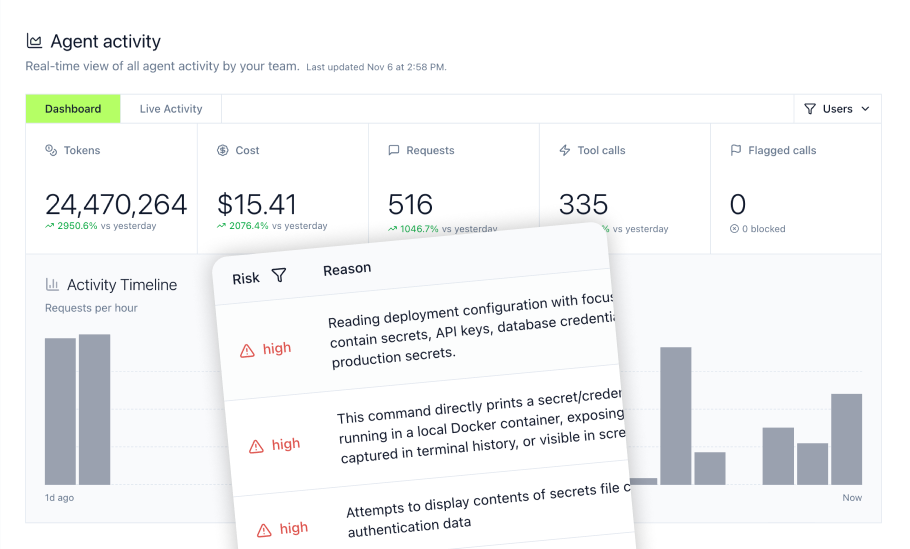
Agent Monitor provides real-time visibility into agent actions across the organization, including activity in tools like Cursor and Claude Code that occurs outside the gateway.
Shadow AI Detection
Shadow AI, the deployment of AI tools without IT oversight, represents a significant governance challenge. This can include unmanaged MCP servers, AI browser extensions, and agents connected directly to production systems without centralized governance.
Detection capabilities identify:
- MCP calls made outside the gateway
- PII exposure in agent interactions
- Credential leakage including API keys and tokens
- Risky bash commands executed by coding agents
- Prompt injection attempts
MDM integration enables push of detect-only or enforce-mode configurations to developer machines, ensuring consistent policy application. The Agent Monitor client documentation covers deployment for various AI development tools.
Regulated Industries
Meeting Compliance Requirements
The EU AI Act entered application in phases beginning in 2025, with transparency rules applying from August 2, 2026 and certain high-risk-system rules scheduled later. Penalties under the EU AI Act are tiered by the type of violation, with the highest ceiling reserved for prohibited AI practices.
Healthcare organizations handling protected health information must determine whether a Business Associate Agreement is required and implement applicable HIPAA safeguards, including access controls, audit controls, and transmission security. Financial services organizations navigate SOX, PCI-DSS, and various state-level regulations.
MintMCP's compliance posture addresses these requirements:
- SOC 2 Type II audited with continuous Drata monitoring
- Compliant with HIPAA standards, with BAA available for healthcare customers
- Penetration tested infrastructure
- Data encrypted in transit and at rest
- Data residency options
- Uptime SLA for mission-critical deployments
Visit the Trust Center or contact security@mintmcp.com for compliance documentation.
Secure Data Handling
Regulated industries require specific capabilities:
- Tamper-evident audit records: Signed, append-only logging that supports later verification
- Provenance tracking: Document the chain of data access across multi-step agent workflows
- Deployment and residency: Confirm available hosting regions and deployment models against your organization's requirements
- Role-based access control: Limit tool access based on user role and data classification
The MCP gateways for healthcare guide covers implementation patterns for AI agent deployments designed to support HIPAA requirements.
MCP and LLMs
The Bridge Layer
MCP is not a competitor to large language models; it is the layer that connects them to enterprise systems. Claude, ChatGPT, Gemini, and other LLMs provide the intelligence; MCP provides the connectivity.
AI applications and developer platforms from OpenAI, Anthropic, Google, and Microsoft include MCP client support; the foundation models themselves are not MCP clients. The protocol is model-agnostic, so an MCP server can often be reused across compatible hosts, provided each host supports the server's transport, authentication method, and required MCP capabilities.
Enabling Workflow Integration
Before MCP, integrating an LLM into business workflows required custom API development for each data source, authentication handling per integration, error handling and retry logic, rate limiting and quota management, and logging and audit trail implementation.
With MCP, the interface for discovering and invoking tools, resources, and prompts is standardized. Authentication, credential management, rate limiting, retries, and enterprise audit logging still depend on the client, server, infrastructure, or gateway implementation.
This separation can make integrations more portable across compatible clients. Organizations may be able to reuse the same MCP servers when adding another AI platform, although client capabilities, authentication flows, and deployment requirements can still require changes.
MintMCP Platform for Enterprise Governance
MintMCP provides comprehensive MCP governance through a differentiated architecture designed for both immediate deployment needs and long-term agent operations. The platform addresses the full lifecycle of AI integration, from secure connectivity to ongoing monitoring and compliance.
Bundle Architecture
MintMCP differentiates through its Bundle architecture, which packages tool access, policy enforcement, and audit logging into single governance units per team or role. Unlike approaches requiring manual configuration of separate plugin, access rule, and credential objects, Bundles provide a unified primitive for both human teams and agent identities.
Virtual MCP Bundles create per-use-case endpoints with SCIM-driven membership and curated tool lists. A sales team Bundle might include Salesforce, HubSpot, and Slack access, while an engineering team Bundle includes GitHub, Jira, and database access. Each Bundle maintains its own access policies and audit trail.
Agent Bundles extend this model to non-human principals. Each deployed agent receives its own persistent identity with scoped credentials that can be rotated independently. This addresses the agent identity challenge where traditional approaches share service account credentials across multiple agents, making attribution and revocation difficult.
Two-Layer Architecture
The platform operates across two connected layers:
- MCP Gateway: Governed data and tool connections for AI systems users already run, including Claude, Cursor, ChatGPT, Gemini, and Copilot
- Agent Gateway: Identities, permissions, memory, and monitoring for agents that work alongside users
This architecture supports both immediate MCP governance needs and emerging agent deployment patterns, providing a complete solution for enterprises scaling AI operations while maintaining security and compliance requirements.
Frequently Asked Questions
What is the difference between MCP and traditional API integrations?
Traditional API integrations require building custom connections between each AI application and each data source, creating N×M integration complexity. MCP standardizes this through a common protocol: each AI application implements the MCP client specification once, each data source implements the MCP server specification once, and any client can connect to any server. This reduces duplicated integration work to an N+M pattern while providing a consistent message and capability-discovery interface. Authentication, audit logging, retries, and operational controls remain implementation responsibilities.
Can I use MCP with AI models other than Claude?
Yes. MCP is model-agnostic and works with all major AI platforms including ChatGPT, Gemini, GitHub Copilot, Cursor, and open-source models. An MCP server may be reusable across Claude, ChatGPT, or a custom agent when each host supports the server's transport, authentication method, and required capabilities. This portability can reduce the amount of integration work required when adding or switching AI providers, although client-specific changes may still be necessary.
How do I discover and remediate Shadow AI in my organization?
Shadow AI discovery requires visibility into AI tool usage across endpoints, network traffic, and cloud services. Detection approaches include endpoint scanning for installed AI applications and MCP clients, network monitoring for MCP traffic patterns, and identity provider analysis for OAuth grants to AI services. Once discovered, bring existing deployments under governance through a centralized gateway that enforces authentication, logging, and access policies. The shadow AI detection capabilities in Agent Monitor automate much of this discovery process.
How does MCP handle authentication for AI agents that need their own identity?
Traditional approaches share service account credentials across multiple agents, making it difficult to attribute actions to specific agents or revoke access without disrupting others. Agent Bundles solve this by giving each agent its own persistent identity with bearer API keys and OAuth 2.0 client credentials. Credentials can be rotated or revoked per agent without affecting other agents. The "act as agent" admin flow handles connectors that require per-agent OAuth, enabling fine-grained access control at the agent level rather than the user level.