Mistral AI has emerged as a prominent European large language model provider, offering enterprises a combination of API access, open-weight models, deployment flexibility, and regional data-processing options. For organizations deploying AI agents across tools like Claude, Cursor, ChatGPT, Gemini, and Copilot, the question is not just which model to choose but how to govern agent access to enterprise data regardless of the underlying LLM. This is where platforms like MintMCP's MCP Gateway become essential, providing the authentication, access control, and audit infrastructure that enterprise Mistral deployments require.
This article covers Mistral AI's model lineup, pricing structures, enterprise readiness, and governance requirements to help technical and business leaders evaluate whether Mistral fits their AI strategy.
Key Takeaways
- Mistral AI's current catalog ranges from compact 3B Ministral models to Mistral Large 3, a mixture-of-experts model with 675B total parameters and 41B active parameters, with API pricing starting at $0.10 per 1M input tokens for selected models
- Mistral supports self-deployment for multiple open-weight models, but licensing varies by model, including Apache 2.0 and Modified MIT terms
- Enterprise pricing is custom and may include regional inference endpoints, system-level SLAs, increased rate limits, premium support, and deployment-specific infrastructure
- Mistral's European base, regional inference options, and self-deployable models can support data-sovereignty strategies, although GDPR compliance depends on the specific deployment, contracts, and customer controls
- Basic API access can be configured quickly, while enterprise and self-hosted deployments require deployment-specific planning for infrastructure, security, integrations, and testing
- Mistral's Agents API SDK can leverage Model Context Protocol tools, enabling agents to connect with external systems through standardized interfaces
- MintMCP's Agent Gateway provides identities, permissions, memory, and monitoring for agents operating across multiple LLM providers, ensuring centralized governance regardless of which model powers the underlying system
Understanding Mistral AI Models
Mistral AI, founded in Paris in 2023, differentiates itself through a dual strategy: releasing powerful open-weight models while offering commercial API services. This approach gives enterprises flexibility in how they deploy and manage language models.
Model Portfolio Overview
Mistral's lineup spans models designed for different use cases and computational requirements:
Current Open-Weight Models:
- Mistral Small 4: A 119B-parameter mixture-of-experts model with 6.5B active parameters, combining instruction following, reasoning, coding, and multimodal capabilities
- Mistral Medium 3.5: A multimodal model optimized for agentic and coding workloads, released under a Modified MIT license
- Mistral Large 3: Mistral's open-weight flagship with 675B total parameters and 41B active parameters
- Ministral 3: A family of 3B, 8B, and 14B models designed for edge and resource-constrained deployments
Commercial Models:
- Mistral Small 4: Optimized for efficient general-purpose workloads at $0.15 input and $0.60 output per 1M tokens
- Mistral Medium 3.5: Balanced performance at $1.50 input and $7.50 output per 1M tokens
- Mistral Large 3: Open-weight flagship model at $0.50 input and $1.50 output per 1M tokens for complex workloads
Specialized Models:
- Devstral/Codestral: Code generation specialists for development workflows
- Mistral OCR 4: Document processing and data extraction from PDFs and scanned forms
- Voxtral: Speech, transcription, and audio models with multilingual capabilities
Key Differentiators
A key Mistral differentiator is the availability of both hosted APIs and downloadable open-weight models. Deployment rights and infrastructure options vary by model and license, so enterprises should evaluate the specific model rather than applying one deployment description to the entire portfolio.
Mistral Large 3 is Mistral's current open-weight flagship, with 675B total parameters, 41B active parameters, and API pricing of $0.50 per 1M input tokens and $1.50 per 1M output tokens. Benchmark comparisons should use current models evaluated on the same tests and settings.
Mistral AI for Business
Enterprise deployment requires more than raw model capability. Organizations need authentication, access controls, audit trails, and compliance infrastructure that production AI systems demand.
Deployment Options
Cloud API (La Plateforme):
- Setup time: Minutes for basic access
- Authentication: API key-based
- Best for: Initial testing, teams under 50, variable workloads
Azure AI Foundry:
- One-click serverless deployment with enterprise SLAs
- Regional availability and data-processing controls depend on the selected Azure model deployment and region
- HIPAA-regulated workloads require confirming that the selected service is in scope, using the applicable BAA, and configuring the workload to meet the organization's compliance obligations
- Best for: Enterprises already on Azure, regulated industries
Self-Hosted:
- Hardware requirements vary significantly by model, precision, context length, concurrency, and inference engine. Mistral Large 3 has 675B total parameters and 41B active parameters, so production self-hosting requires deployment-specific capacity planning across multiple accelerators or nodes
- Full control over data flow and network architecture
- Timeline: Varies based on model size, infrastructure readiness, security requirements, and production testing
- Best for: Organizations with hard data-sovereignty requirements or high-volume inference needs
Integration Ecosystem
Mistral integrates with major cloud platforms including Microsoft Azure AI Foundry, Amazon Bedrock, Google Vertex AI, and IBM watsonx.
For organizations running AI agents that need governed access to enterprise tools and data, Mistral's Agents API SDK can leverage MCP tools through MCP Gateway infrastructure. MintMCP's Agent Gateway builds on that foundation with identities, permissions, memory, and monitoring for agents operating across Claude, Cursor, ChatGPT, Gemini, Copilot, and Mistral-powered workflows.
Mistral AI Pricing
Understanding Mistral's pricing requires distinguishing between pay-as-you-go API access, enterprise contracts, and self-hosted total cost of ownership.
API Pricing Tiers
| Tier | Price | What You Get |
|---|---|---|
| Open-Weight | $0 | Downloadable models (requires your GPU infrastructure) |
| Le Chat Free | $0 | Web chatbot interface with rate limits |
| Pay-As-You-Go | Model-specific pricing | Text models are generally billed by input and output tokens, while OCR, audio, and agent tools use separate page, minute, character, image, or call-based pricing |
| Enterprise | Custom pricing | Regional processing, SLAs, dedicated infrastructure |
Current Mistral API Pricing:
- Mistral Small 4: $0.15 input and $0.60 output per 1M tokens
- Mistral Large 3: $0.50 input and $1.50 output per 1M tokens
- Mistral Medium 3.5: $1.50 input and $7.50 output per 1M tokens
Cross-provider comparisons should use current models, comparable capabilities, and separate input and output rates.
For a chatbot processing 2M requests monthly at 500 total tokens per request, monthly cost depends on the selected model and the split between input and output tokens. Teams should apply the published input and output rates to measured production usage rather than relying on a single blended estimate.
Enterprise Contract Reality
Enterprise tier pricing is not publicly listed but typically involves:
- Pricing: Negotiated with Mistral based on usage, deployment, support, and regional requirements
- Available features: Regional inference endpoints, system-level SLAs, increased rate limits, premium support, and deployment assistance
- Contract details: Minimum commitments, discounts, SLA targets, and professional-services fees depend on the individual agreement
Self-Hosted TCO
Self-hosting eliminates per-token API costs but introduces infrastructure expenses:
- Infrastructure: Hardware and cloud-compute requirements depend on model size, quantization, context length, concurrency, and availability targets
- Operations: Self-hosting requires model serving, monitoring, scaling, security patching, and incident response
- Staffing: Teams must account for platform engineering and ML operations in addition to raw compute
Break-even should be calculated from measured API usage and the organization's complete infrastructure and staffing costs. Mistral does not publish a universal token threshold at which self-hosting becomes cheaper.
Large Language Models & Mistral AI
Mistral's combination of performance, cost efficiency, and deployment flexibility enables specific enterprise applications.
Document Processing in Regulated Industries
Healthcare providers processing patient records must ensure that PHI is handled through appropriately secured environments, with required safeguards and agreements such as a BAA when an external service provider processes the data. Mistral's document-processing models can be deployed through supported cloud or self-hosted environments. Healthcare organizations must verify service scope, data flows, contractual terms, and configuration before using the system with protected health information.
Potential outcomes include faster document extraction, more consistent structured output, and reduced manual review, subject to testing against the organization's documents and accuracy requirements. Mistral currently lists OCR 4 at $4 per 1,000 pages and Document AI at $5 per 1,000 pages, before any additional application, storage, validation, or review costs.
Multilingual Customer Support
Mistral's multilingual models can support customer-service workflows across multiple European and international markets, enabling 24/7 service without hiring multilingual agents for each region.
Multilingual support agents can help classify requests, draft responses, and automate selected Tier 1 workflows. Resolution rates, latency, and cost reductions depend on the knowledge base, integrations, escalation rules, and evaluation process.
Code Generation for Development Teams
Devstral automates infrastructure-as-code and boilerplate generation, providing assistance with Terraform, Kubernetes configurations, code review, and other software-engineering workflows at $0.40 input and $2.00 output per 1M tokens for Devstral 2.
For teams deploying AI coding assistants alongside tools like Claude Code or Cursor, MintMCP's Agent Monitor provides visibility into agent actions including file operations and bash commands that occur outside API boundaries.
Security & Compliance
Deploying any LLM in production requires addressing authentication, access control, audit logging, and data protection. Mistral provides foundational security, but enterprises need additional governance layers.
Mistral's Security Posture
Mistral publishes security and compliance materials through its Trust Center. Before publication, verify the current scope, audit period, covered services, certifications, encryption controls, regional processing terms, and any documentation required for regulated workloads. Azure availability or a Microsoft BAA does not automatically make a customer deployment compliant with HIPAA standards.
Mistral operates under European data-protection requirements, but each organization must assess whether its specific deployment and data-processing practices meet GDPR obligations.
What Enterprises Need
Mistral handles model security. Enterprises must layer on:
Access Control:
- SSO integration for user authentication
- Role-based permissions determining who can invoke which tools
- Per-agent identity when deploying autonomous systems
Audit Requirements:
- Complete logs of prompts, tool calls, and responses
- User attribution for every request
- SIEM export for security monitoring
Data Protection:
- PII detection and masking before data reaches models
- DLP integration preventing sensitive data leakage
- Prompt injection defense
For organizations running multiple AI agents across Mistral and other providers, MintMCP's security governance infrastructure provides the authentication, policy enforcement, and audit logging that production deployments require. The platform integrates with DLP systems including AWS Bedrock Guardrails, Google Cloud DLP, Microsoft Purview, Nightfall, and Skyflow.
Building with Mistral AI
Technical implementation requires understanding API patterns, SDK options, and common integration challenges.
API Integration Path
Step 1: Account Setup
- Create account at console.mistral.ai
- Generate API key (shown once, store securely)
- Set environment variable:
MISTRAL_API_KEY=your_key
Step 2: SDK Installation
- Python:
pip install mistralai - JavaScript:
npm install @mistralai/mistralai
Step 3: Model Selection
Start with Mistral Small 4 for cost-sensitive general workloads, then evaluate Medium 3.5 or Large 3 when testing shows that additional capability is required.
Step 4: Production Configuration
- Use a low temperature and a fixed seed when supported to improve reproducibility, while recognizing that exact determinism is not guaranteed across model or infrastructure changes
- Implement streaming for better user experience
- Add retry logic with exponential backoff for rate limits
Common Implementation Challenges
Memory Requirements:
- Hardware requirements vary significantly by model, precision, context length, concurrency, and inference engine
- Use quantized (4-bit or 8-bit) versions to reduce memory footprint by 50-75%
- Smaller models (Ministral 8B) fit in standard 24GB cards
Rate Limits:
- Pay-as-you-go rate limits vary by model and account; confirm current limits in the console or contract before capacity planning
Cost Management:
- Set billing alerts from day one
- Cache common responses at application layer
- Monitor token usage per endpoint
For teams building agentic systems with Mistral, MintMCP handles OAuth authentication complexities including brokering for hosted connectors and managing per-agent credentials that can be rotated independently of human user access.
Mistral AI Use Cases
Practical deployment patterns demonstrate where Mistral delivers measurable business value.
Financial Services: Compliance Document Analysis
Banks analyzing regulatory filings must assess whether external APIs meet their security, confidentiality, regulatory, and third-party risk-management requirements. Self-hosted Mistral enables automated extraction of key metrics from 10-K filings, cross-reference checking against internal databases, and audit trails proving no data left corporate network.
Healthcare: Clinical Documentation
Mistral OCR 4 on Azure processes medical records with structured extraction of diagnoses, medications, procedures, and integration with EHR systems. Potential reductions in manual chart-abstraction work are subject to clinical validation and human review.
Software Development: DevOps Automation
Devstral integrated into CI/CD pipelines generates Terraform modules matching team conventions, reviews pull requests for security issues, and documents APIs from code automatically.
For all these use cases, enterprises running AI agents need governed data connections. MintMCP's catalog of MCP servers provides pre-built connectors to databases, SaaS tools, and internal systems with authentication and access control built in.
Governing Mistral with MintMCP
The Model Context Protocol standardizes how AI agents connect to data sources and tools. Mistral's Agents API SDK can leverage MCP tools, enabling enterprises to build agentic systems with centralized governance.
Why MCP Matters for Mistral Deployments
Without MCP, each agent integration requires custom authentication, logging, and access control. With MCP, one governance layer covers all AI tools, audit trails consolidate across Claude, Cursor, ChatGPT, Gemini, Copilot, and Mistral-powered agents, and policy changes apply instantly across the organization.
MintMCP as the Governance Layer
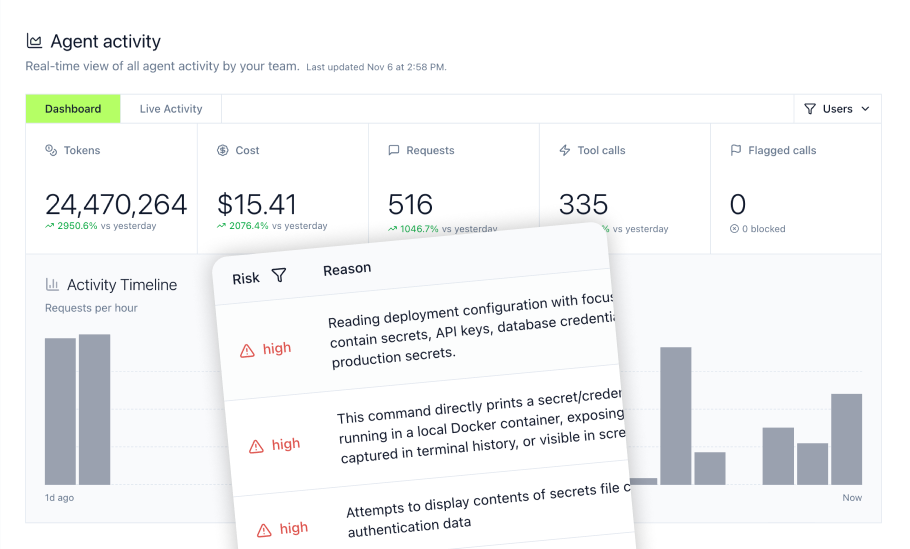
MintMCP's MCP Gateway provides the control plane for Mistral and other LLM deployments, managing tool and data connections with authentication and access control. MintMCP's Agent Gateway builds on that foundation by adding the control layer for agent identities, permissions, memory, and monitoring.
This architecture means enterprises can evaluate and swap LLM providers, including Mistral, without rebuilding governance infrastructure for each change. Agent identities carry per-agent OAuth credentials, tool-level access control enables database reads while blocking writes, real-time visibility through Agent Monitor tracks agent actions, and integration with existing DLP and SIEM investments supports compliance monitoring and policy enforcement.
Organizations deploying Mistral alongside other LLMs gain a unified governance framework that eliminates credential sprawl, provides comprehensive audit trails, enforces consistent security policies, and scales as agent deployments grow. MintMCP handles the complexity of multi-provider agent environments while maintaining the security and compliance posture enterprise deployments require.
Frequently Asked Questions
Can Mistral AI run entirely within my corporate network?
Yes. Mistral supports self-deployment for multiple open-weight models, but licensing varies by model, including Apache 2.0 and Modified MIT terms. When configured without external data flows, self-deployment can keep model processing within the organization's environment. Organizations handling classified information must also satisfy the applicable infrastructure, authorization, and security requirements. The trade-off is GPU infrastructure investment for hardware capable of running production workloads. Azure AI Foundry provides a middle ground with regional deployment keeping data within specified geographic boundaries while Mistral handles infrastructure.
How does Mistral's multilingual capability compare to competitors for global enterprises?
Mistral's multilingual models provide particularly strong performance in European languages including French, German, Spanish, Italian, and Dutch. This reflects Mistral's European heritage and training data composition. For organizations serving global markets from a European base, Mistral's multilingual capability can handle 12+ language markets without separate model deployments or translation layers.
What migration path exists from OpenAI or Claude to Mistral?
Migration from API-based competitors requires minimal data transfer since both systems are API-based. Migration effort depends on the number of prompts, integrations, evaluation datasets, safety controls, and fine-tuned models involved. Teams should test representative workloads, re-evaluate prompts, and price any customization using Mistral's current model-specific training and storage rates.
What happens when Mistral releases new models?
Mistral publishes model-specific deprecation and retirement dates, and the timelines vary by model. Enterprises should monitor lifecycle notices and allocate compatibility testing based on the number of prompts, integrations, evaluations, and production workflows affected. Self-hosted deployments give you control over upgrade timing, while API users eventually must migrate when endpoints are retired.
How do I ensure AI agents using Mistral cannot access unauthorized data?
Model-level safety alone is insufficient. Enterprises need a governance layer between agents and data sources that enforces access policies regardless of what prompts are submitted. This requires SSO-authenticated connections to data sources, role-based tool access where agents can only invoke approved functions, per-agent credentials preventing lateral movement, and audit logging capturing every tool call with user attribution. MintMCP's MCP Gateway provides this infrastructure for Mistral and other LLM deployments, ensuring agent permissions are always a governed subset of organizational access policies.