An MCP server is a program that exposes tools, resources, and prompts to AI applications through the standardized Model Context Protocol. Introduced by Anthropic in November 2024, MCP servers act as the "USB-C for AI," providing a consistent way for AI applications to access external capabilities without building custom integrations for each data source. For enterprises deploying AI coding assistants and automation agents, an MCP gateway provides the centralized security, authentication, and observability layer required to operate MCP servers at scale.
This guide explains how MCP servers work, the security considerations enterprises must address, deployment options across different environments, and practical implementation strategies for 2026.
Key Takeaways
- MCP servers expose AI capabilities through three standardized primitives: tools (executable functions), resources (read-only data), and prompts (instruction templates), each requiring different security controls
- The first large-scale security study found 7.2% of MCP servers contain vulnerabilities and 5.5% exhibit MCP-specific tool poisoning, requiring specialized detection beyond traditional SAST/DAST tools
- MCP adoption accelerated in 2025 with OpenAI, Google, and Microsoft all implementing the protocol, leading to Linux Foundation governance by year-end
- The March 2025 specification introduced an OAuth 2.1-based authorization framework for HTTP transports, although authorization remained optional for MCP implementations
- Enterprise teams report 76% concern about guardrails when moving GenAI to production, making MCP security governance a critical priority
Understanding the Model Context Protocol and Its Specification
The Model Context Protocol (MCP) standardizes how AI models interact with external systems. Before MCP, each AI model required custom integration code for every external tool or data source, creating an unsustainable "M x N problem" where M AI models multiplied by N tools creates multiplicative integration complexity. MCP reduces this to M + N: each AI application implements MCP client support, while each external system exposes its capabilities through an MCP server.
The Role of MCP in Modern AI Architectures
MCP operates through a three-component architecture: the MCP Host (user-facing AI application like Claude Desktop or Cursor), the MCP Client (protocol translator within the host), and the MCP Server (capability provider exposing tools, resources, and prompts). This separation between Host, Client, and Server provides integration points where organizations can add identity, policy, and logging controls.
The protocol uses JSON-RPC 2.0 message encoding over UTF-8 with two standard transport mechanisms: STDIO for local subprocess communication and Streamable HTTP for remote communication, with authentication supported when required. This pragmatic engineering choice favors simplicity and broad compatibility over technical sophistication.
Tracing the Evolution of the MCP Specification
MCP has matured rapidly since its 2024 introduction. The March 2025 specification update introduced an OAuth 2.1-based authorization framework for HTTP transports. Authorization remained optional, but implementations using it were required to follow the framework's security requirements. By December 2025, the protocol transitioned to Linux Foundation governance under the Agentic AI Foundation, signaling industry consolidation around MCP as the de facto standard.
Adoption by OpenAI, Google, Microsoft, and other platform providers demonstrated broad industry convergence around MCP during 2025.
What Is an MCP Server? Core Functions and Benefits
An MCP server is the capability provider in the MCP architecture, exposing tools, data, and instructions that AI agents can access through the standardized protocol. Rather than building point-to-point integrations between each AI application and each enterprise system, MCP servers provide a standardized interface that organizations can secure and govern through their implementation or an MCP gateway.
How MCP Servers Bridge AI Agents to Internal Systems
MCP servers expose capabilities through three standardized primitives:
- Tools: Executable functions like
searchFlightsorsendSlackMessagethat the LLM actively calls. Tools can modify external systems, requiring approval workflows and strict authorization. - Resources: Read-only data sources like file contents or database schemas that provide context. Resources need data classification controls and governance policies.
- Prompts: Pre-built instruction templates that guide model behavior. Prompts require validation to prevent manipulation and injection attacks.
The communication layer handles message serialization, transport, and protocol compliance. Request handlers process incoming calls and route them to appropriate capability implementations. Session orchestration manages state across multi-step agent workflows.
Key Benefits of Deploying MCP Servers for Enterprise AI
MCP servers address what MintMCP calls the "last mile problem" in enterprise AI: giving agents secure, governed access to internal systems without extensive engineering overhead for each integration.
Primary benefits include:
- Standardized integration: One protocol handles connections to GitHub, Jira, Salesforce, Snowflake, and hundreds of other systems
- Centralized governance: Security teams can apply consistent authentication, authorization, and audit policies across all AI tool access
- Reduced complexity: Teams avoid maintaining custom integration code for each AI model and data source combination
- Audit capability: Gateway logging records user or agent identity, tool calls, and related request activity for review and audit purposes
MintMCP's Agent Monitor extends this visibility beyond MCP traffic to track local non-MCP agent activity in tools like Cursor and Claude Code, addressing gaps in the standard MCP spec.
Types of MCP Servers: Examples and Deployment Scenarios
MCP servers deploy across three primary scenarios, each with different security and operational considerations.
Local vs. Hosted MCP Servers: STDIO and Beyond
STDIO servers run as local subprocesses on developer machines. The AI host spawns the MCP server process, communicating through standard input/output streams. This is common for local development, but enterprise deployment requires additional infrastructure to centralize authentication, credential management, policy enforcement, and audit logging.
Hosted MCP servers typically run remotely using Streamable HTTP, which may optionally use SSE for server-to-client streaming and can support authentication. Enterprise teams can centralize credential management, apply consistent policies, and maintain audit logs. MintMCP's gateway hosts and operates MCP servers on behalf of customers, providing auto-scaling and isolated execution per connector without requiring teams to manage Kubernetes pods.
Virtual MCPs: Simplifying Complex Agent Deployments
Virtual MCPs bundle multiple MCP servers into single, role-based endpoints. Instead of configuring access to 15 different servers for a data analyst role, administrators create one VMCP with curated tool access, SCIM-driven group membership, and unified policy enforcement.
This abstraction can reduce onboarding complexity by presenting users with one role-based endpoint instead of multiple individual server configurations.
MCP Server vs. API: Clarifying the Interoperability Landscape
MCP servers do not replace APIs. They standardize how AI applications discover tools, invoke actions, and access contextual resources through a consistent protocol.
Beyond Basic API Calls: What MCP Adds
MCP provides tool discovery, capability negotiation, structured tool calls, and session support. Authentication, data masking, approval workflows, granular authorization, and audit attribution must be implemented by the MCP server, host application, or an MCP gateway.
MCP gateways extend these controls for AI-specific concerns such as tool discovery, agent attribution, and context-aware authorization.
Securing Your MCP Servers: Critical Controls and Governance
Security vulnerabilities in MCP servers present real risks. The first large-scale empirical study evaluated 1,899 open-source MCP servers and found 7.2% contain vulnerabilities, 5.5% exhibit MCP-specific tool poisoning, and 66% contain code smells. CVE-2025-6514 affected the mcp-remote npm package through version 0.1.15 and could enable OS command injection when connecting to an untrusted MCP server. The issue was patched in version 0.1.16.
Implementing Zero-Trust Security for AI Agents
The FINOS AI Governance Framework defines three security tiers for MCP deployment:
- Tier 1: Centralized proxy with human-in-the-loop approval for development and coding assistants
- Tier 2: Pre-approved servers with automated monitoring for moderate-risk production workloads
- Tier 3: Distributed deployment with comprehensive security controls for autonomous high-risk agents
Each tier builds on the previous with increasing controls: supply chain verification, mutual TLS authentication, real-time behavioral monitoring, network segmentation, and incident response capabilities.
MintMCP's security governance capabilities support this tiered approach with enterprise SSO, SCIM-driven access control, credential management, granular tool-level policies, and audit logging.
Protecting Against Shadow AI and Data Leakage
Shadow AI occurs when developers independently install unvetted MCP servers without security review. This mirrors traditional shadow IT problems but with AI-specific risks: unvetted servers may contain vulnerabilities, lack maintenance, or expose sensitive data to AI models.
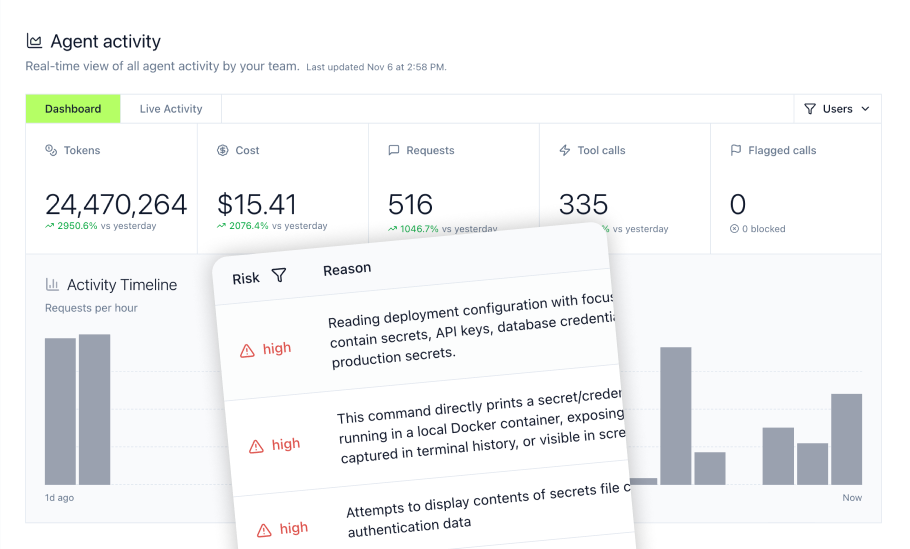
MintMCP's Agent Monitor detects off-gateway MCP usage and local non-MCP agent activity through hooks in Cursor and Claude Code. The system identifies PII exposure, credential leakage, risky bash commands, and prompt injection attempts using built-in rules, with MDM integration enabling policy enforcement across developer machines. For long-running agents, MintMCP's Agent Gateway builds on the MCP Gateway foundation to manage agent identities, permissions, memory, and monitoring.
Managing Multiple MCP Servers: Simplifying Enterprise Deployment
Organizations scaling AI agent deployments across multiple teams face significant coordination challenges. Each team may need different tool combinations, security policies, and audit requirements.
The Power of Bundle Architecture for Unified Governance
MintMCP's Bundle model packages tool access, policy enforcement, and audit logging into single governance units per team or role. Each Bundle ties SCIM group membership to a curated MCP server list, custom policy rules, and an isolated audit trail.
Key Bundle capabilities include:
- Role-based access: Bundles map to organizational roles, automatically granting appropriate tool access when employees join teams
- Per-Bundle policies: Each Bundle can apply curated tool access and role-specific policy rules
- Identity sync: SCIM-driven group membership keeps Bundle access aligned with the organization's identity provider
- Agent Bundles: Each deployed agent receives its own persistent identity with scoped credentials that can be rotated independently
This approach gives each AI agent its own credentials and scope rather than sharing service account keys. Per-agent identities and independently rotatable credentials reduce reliance on shared service-account keys.
MCP Server Adoption: Market Trends and Future Outlook
MCP adoption accelerated dramatically in 2025. By December, the Linux Foundation listed Claude, Cursor, Microsoft Copilot, Gemini, VS Code, and ChatGPT among the platforms that had adopted the protocol.
The Rapid Growth of the MCP Ecosystem
By December 2025, the Linux Foundation reported more than 10,000 published MCP servers as MCP moved under the Agentic AI Foundation's neutral governance. This adoption pace mirrors earlier infrastructure standardization waves like containerization and API gateways.
However, 45% of organizations are moving to production or scale with GenAI in 2026, while 76% remain concerned about guardrails and 62% about data readiness. This gap between adoption momentum and security preparedness creates urgency for governance frameworks.
Real-World Use Cases: How MCP Servers Empower AI Agents
Enterprises deploy MCP servers across multiple functional areas:
- Data analysis agents: Query databases, generate reports, and connect to Snowflake, Elasticsearch, and internal data warehouses
- Development workflow agents: Access GitHub, Jira, and CI/CD pipelines for code review, issue tracking, and deployment automation
- Customer support agents: Connect to CRM systems, ticket platforms, and knowledge bases for case resolution
- Compliance teams: Maintain audit-ready logs of all agent data access with configurable retention and SIEM export
MCP-connected agents can reduce manual steps in routine workflows when tool access, permissions, and approvals are properly governed.
Integrating MCP Servers with Your Existing AI Stack
MCP has been adopted by platforms including Claude, Cursor, ChatGPT, Gemini, Microsoft Copilot, and VS Code, although supported transports and features vary by host application. This vendor-neutral compatibility means organizations can maintain governance consistency regardless of which AI models their teams use.
MintMCP provides REST APIs and SDKs for programmatic management, enabling CI/CD integration and infrastructure-as-code workflows. Custom middleware hooks support integration with existing DLP investments including AWS Bedrock Guardrails, Google Cloud DLP, Microsoft Purview, Nightfall, and Skyflow.
Choosing the Right MCP Server Infrastructure
The decision between managed MCP gateway services and self-hosted deployment depends on team size, compliance requirements, and operational capacity.
Managed gateway services make sense when:
- You want a managed platform to operate authentication, policies, hosted connectors, and audit infrastructure
- You need immediate deployment without multi-month infrastructure setup
- Security requirements include a SOC 2 Type II audited platform and compliance with HIPAA standards, with supporting documentation and BAAs available for qualifying customers
- Teams lack dedicated platform engineering resources for MCP operations
Self-hosted deployment makes sense when:
- Operations span air-gapped environments or strict data residency requirements
- You have dedicated platform engineering capacity for Kubernetes operations
- Specific customization requirements exceed managed service capabilities
MintMCP offers managed SaaS deployment, with VPC and self-hosted options available on request. This flexibility allows organizations to start with managed services and transition to self-hosted as requirements evolve.
MintMCP: The Enterprise-Grade MCP Gateway for Production AI
As organizations move from AI experimentation to production deployment, they face a critical inflection point: how to provide AI agents with secure, governed access to enterprise systems at scale. MintMCP's MCP Gateway addresses this challenge by centralizing authentication, authorization, policy enforcement, and audit logging across all AI agent interactions.
Rather than managing authentication, credentials, and policies separately for each AI tool and each data source, MintMCP provides a single control plane. The platform hosts and operates MCP servers on behalf of customers, eliminating infrastructure overhead while maintaining enterprise security standards. Organizations gain visibility into every tool call, data access, and agent action with per-user and per-agent attribution, creating audit-ready logs that satisfy compliance requirements.
The Bundle architecture simplifies complexity for teams with diverse AI needs. Security and platform teams define role-based access once, mapping organizational groups to curated tool sets and policies that automatically sync with identity providers through SCIM. Each AI agent receives its own persistent identity and independently rotatable credentials, eliminating shared service-account keys and reducing blast radius.
For enterprises concerned about shadow AI, Agent Monitor extends governance beyond the gateway to detect off-policy MCP usage in developer tools, identifying PII exposure, credential leakage, and risky commands before they reach production. As AI agents become more autonomous, MintMCP's Agent Gateway builds on this foundation to govern agent identities, permissions, memory, and behavior across long-running workflows, ensuring that production AI remains both powerful and controlled.
Frequently Asked Questions
What security vulnerabilities are specific to MCP servers that traditional tools miss?
MCP introduces attack vectors beyond traditional API security. Tool poisoning occurs when malicious tool descriptions manipulate AI model behavior. Prompt injection through MCP channels can bypass application-level controls. Confused deputy problems arise when servers execute actions without proper user context verification. Researchers identified eight unique vulnerability types, five distinct from traditional software vulnerabilities, requiring MCP-specific detection techniques that standard SAST/DAST tools do not provide.
How does MCP server governance differ from traditional API gateway governance?
Traditional API gateways manage request routing, rate limiting, and authentication for application-to-application communication. MCP governance addresses AI-specific requirements: context management across multi-step workflows, tool discovery protocols, inline policy enforcement with data masking, and audit attribution tracking which user, which agent, and which specific tool call accessed what data. The three-layer MCP architecture provides integration points where MCP gateways can implement AI-specific controls that traditional API gateways do not address.
Can I use MCP servers with AI models from different vendors simultaneously?
Yes. MCP provides vendor-neutral standardization, allowing organizations to run Claude, ChatGPT, Gemini, Cursor, and Copilot through the same governance infrastructure. MintMCP's MCP Gateway centralizes authentication, authorization, and audit logging regardless of which AI model initiates tool calls. This prevents policy fragmentation across AI vendors and maintains consistent security controls as organizations adopt new models.
What is the difference between STDIO and HTTP transport for MCP servers?
STDIO transport runs MCP servers as local subprocesses, communicating through standard input/output streams. This works for development but lacks centralized authentication and audit capabilities. The March 2025 MCP specification introduced an OAuth 2.1-based authorization framework for HTTP transport, but authorization itself remained optional. Streamable HTTP enables enterprise deployment with credential management, consistent policies, and audit logs when properly implemented.