On March 24, 2026, the widely used open-source LLM proxy LiteLLM suffered a supply chain attack involving two malicious PyPI releases. According to security researchers, LiteLLM was present in approximately 36% of observed cloud environments, highlighting its widespread adoption rather than the number of compromised systems. The malicious versions, 1.82.7 and 1.82.8, contained credential-stealing code designed to harvest AWS keys, SSH credentials, OpenAI API keys, and database connection strings from affected systems. For enterprises deploying AI agents at scale, this incident crystallizes why a governed LLM gateway with centralized credential management, runtime security screening, and complete audit trails is no longer optional.
This article breaks down the attack mechanics, explains why traditional API security fails for AI infrastructure, and provides actionable strategies for building an LLM gateway architecture that can withstand supply chain compromises.
Key Takeaways
- The LiteLLM attack exploited CI/CD pipeline weaknesses involving a compromised Trivy security scanner, enabling attackers to publish malicious versions to PyPI that remained available for approximately 2 hours and 32 minutes before quarantine
- Version 1.82.8 used a malicious .pth file that executed during Python startup in affected environments, even when applications did not explicitly import LiteLLM, potentially affecting unrelated Python workflows
- Per-agent identity with scoped permissions and independent credential rotation reduces the blast radius of compromised agent credentials, although it does not prevent malware from harvesting other secrets accessible on an infected system
- Restrictive egress filtering could have limited data exfiltration by blocking connections to known attacker-controlled destinations, making workload-level network controls an important defense for LLM infrastructure
- Shadow AI visibility extends security beyond gateway traffic to detect local tool calls, bash commands, and off-gateway MCP use on developer machines
- Centralized credential management, short-lived tokens, and documented rotation procedures can simplify remediation and reduce the time required to revoke exposed access
Understanding the LiteLLM Supply Chain Attack: What Happened (and Why it Matters)
The Anatomy of the Attack
The attack chain began days before the malicious packages appeared on PyPI. On March 19, 2026, threat actor group TeamPCP exploited compromised credentials to modify Aqua Security's Trivy releases and GitHub Action tags. On March 23, the campaign expanded to Checkmarx GitHub Actions and related tooling. LiteLLM's CI/CD pipeline subsequently executed compromised Trivy tooling, exposing PyPI publishing credentials that attackers used to publish malicious LiteLLM packages outside the normal release process.
Attack timeline on March 24, 2026:
- 10:39 AM UTC: Version 1.82.7 published with malicious code in proxy_server.py
- 10:52 AM UTC: Version 1.82.8 added a .pth file for auto-execution on any Python process
- 11:48 AM UTC: Security researcher Callum McMahon detected a fork bomb and opened GitHub Issue #24512
- 12:44 PM UTC: Attacker closed the issue and flooded it with bot comments attempting suppression
- Later that day: PyPI quarantined the LiteLLM package and coordinated with maintainers to remove the malicious releases
According to the PyPI incident report, the compromised LiteLLM versions were downloaded more than 119,000 times before quarantine. This figure represents package downloads, not confirmed compromises or unique affected systems.
Impact on LLM Gateways
What made this attack particularly devastating was the .pth file technique used in version 1.82.8. Python's site module executes certain instructions in .pth files during interpreter startup. The malicious litellm_init.pth file could therefore execute whenever Python initialized the affected environment with site processing enabled, even without importing LiteLLM.
Credentials harvested included:
- AWS credentials from ~/.aws/credentials and environment variables
- GCP service account keys from ~/.config/gcloud/
- Azure credentials from ~/.azure/
- SSH keys and configurations from ~/.ssh/
- All LLM provider API keys (OpenAI, Anthropic, Google) from environment variables
- Kubernetes configurations and service account tokens
- Database connection strings containing passwords
- Shell history files often containing credentials passed as command arguments
The malware compressed harvested data, encrypted it with AES-256, and exfiltrated via HTTPS to models.litellm.cloud. Because the attacker-controlled domain resembled legitimate LiteLLM infrastructure, unauthorized outbound requests could be mistaken for normal application traffic without appropriate domain filtering, behavioral detection, and network monitoring.
Lessons Learned for Enterprise AI
This attack exposes fundamental weaknesses in how enterprises manage AI infrastructure credentials:
- Credential sprawl: API keys scattered across developer laptops created thousands of potential compromise points
- No egress filtering: Organizations without restrictive outbound network policies faced greater exposure because the malware could attempt to transmit harvested credentials to attacker-controlled infrastructure
- Unpinned and mutable dependencies: CI/CD pipelines using unpinned packages or mutable GitHub Action tags risked executing compromised code when trusted dependencies were replaced or updated
- Persistence beyond removal: The backdoor installed systemd services that survived package uninstallation, requiring full system rebuilds
For organizations using AI agents, the attack demonstrated that traditional API security models fail when malicious code can reach credentials stored in environment variables or local files. Understanding MCP data risk becomes essential when every tool call potentially exposes enterprise systems.
Why AI Security is Critical: Mitigating Risks in LLM Gateways
The Expanding Attack Surface of AI Agents
AI agents introduce unique security challenges that traditional application security does not address. Unlike conventional APIs with fixed endpoints and predictable behavior, AI agents:
- Decide at runtime which tools to call based on model interpretation
- Can have their behavior modified through prompt injection in tool descriptions
- Access multiple enterprise systems with potentially broad permissions
- May execute commands, read files, or make network requests without explicit user approval
The LiteLLM attack exploited just one layer: the supply chain. But enterprises face multiple attack vectors when deploying LLM gateways:
- Tool poisoning: Malicious tool descriptions inject instructions into agent prompts
- Prompt injection: Adversarial inputs cause agents to bypass security controls
- Credential theft: Compromised dependencies or malicious servers harvest API keys
- Data exfiltration: Agents unknowingly send sensitive data to unauthorized endpoints
- Persistence mechanisms: Attackers establish backdoors that survive remediation
Compliance Mandates for AI Deployment
Regulatory frameworks increasingly require organizations to demonstrate control over AI systems. SOC 2 Type II audits expect documented access controls, audit trails, and incident response procedures. HIPAA requires appropriate safeguards for electronic protected health information, including access controls and mechanisms to record and examine activity in systems that contain or use it. GDPR mandates data minimization and purpose limitation for automated processing.
The LiteLLM attack could have triggered compliance investigations and reporting obligations for affected organizations, depending on the systems, credentials, and regulated data involved:
- Credentials potentially accessed by unauthorized parties
- Potential gaps in logs needed to determine what data was exfiltrated
- Difficulty identifying every affected system and exposed credential
- Challenges documenting the full scope and timeline of containment
Runtime security screening helps address these risks by inspecting gateway tool calls for prompt injection attacks. Mint Guard can block high-confidence prompt injection in enforcing mode, while Rules and Gateway Middleware provide additional policy enforcement and data protection controls.
The Cost of Insecure AI Infrastructure
The financial impact of the LiteLLM attack varied dramatically based on organization size and preparedness.
Small organizations:
- Incident response and forensic investigation
- Rotation of exposed credentials
- Review and recovery of affected developer systems
- Cost impact: Depends on the extent of compromise and resources required
Medium organizations:
- Investigation across developer environments and CI/CD pipelines
- Credential rotation across applications and cloud providers
- Security validation and infrastructure recovery
- Cost impact: Depends on affected systems, operational disruption, and investigation requirements
Large organizations:
- Enterprise-wide assessment of potentially affected dependencies
- Coordinated credential rotation and infrastructure remediation
- Investigation of downstream access and potential data exposure
- Cost impact: Depends on the scale of exposure, operational impact, and applicable regulatory obligations
According to the IBM Cost of a Data Breach Report, the global average data breach cost reached $4.99 million. AI infrastructure compromises can create additional operational and security risks when exposed credentials provide access to multiple downstream systems, although costs vary by incident.
Best Practices for API Security in Your LLM Gateway
Enforcing Strong Authentication and Authorization
LLM gateways require authentication at multiple layers: from users to the gateway, from the gateway to model providers, and from the gateway to enterprise connectors. Weak authentication at any layer creates exploitation opportunities.
Authentication requirements:
- SSO integration: Authenticate users through Okta, Azure AD, or Google Workspace with MFA
- SCIM provisioning: Automatically sync directory groups to control tool access
- Per-request validation: Verify identity on every API call, not just session establishment
- Short-lived tokens: Use OAuth tokens that expire in hours rather than days or weeks
- Credential isolation: Store secrets in dedicated vaults, never in environment variables
The attack succeeded partly because LiteLLM's CI/CD pipeline held publishing credentials that a compromised dependency could access. A governed access routing approach separates credentials by purpose and limits what any single compromised component can reach.
Comprehensive Audit Trails for API Interactions
During the LiteLLM incident, organizations struggled to answer basic questions: Which systems ran the compromised package? What credentials were accessible? Were those credentials used between compromise and rotation?
Effective audit logging captures:
- Governed tool calls with user, agent, server, tool name, timestamp, and outcome, with arguments and results recorded according to supported logging and retention settings
- Credential access events including which secrets were retrieved and by whom
- Access policy changes showing who modified permissions and when
- Model API calls with latency, tokens, cost, and provider
- Security events including guardrail triggers, blocked requests, and policy violations
Audit records should be protected against unauthorized modification through access controls and tamper-evident mechanisms. SIEM export capabilities enable integration with existing security operations through supported export and streaming mechanisms, including OpenTelemetry.
Securing API Endpoints with Best-in-Class Controls
Traditional API gateway patterns apply to LLM infrastructure but require adaptation for AI-specific behaviors:
- Rate limiting: Prevent runaway agent loops and detect anomalous usage patterns
- Input validation: Verify tool arguments match expected schemas before execution
- Output sanitization: Scan responses for secrets, PII, or data that should not leave the system
- Allowlisting: Restrict which tools each agent can access based on role
Advanced API Security Tools: Protecting Against Supply Chain Vulnerabilities
Implementing Automated Vulnerability Management
The LiteLLM attack highlighted several supply chain security risks:
- Unpinned dependencies and mutable references that can expose builds to compromised releases
- Security tooling with access to sensitive CI/CD publishing credentials
- Malicious .pth files capable of executing code during Python startup
- The importance of behavioral monitoring for unexpected network connections and credential access
Vulnerability management requirements:
- Software Bill of Materials (SBOM): Track every component including transitive dependencies
- Dependency scanning: Alert on known vulnerabilities before deployment
- Pin verified versions: Use currently supported, security-reviewed releases with exact version pins, dependency lockfiles, and hash verification; avoid compromised LiteLLM versions 1.82.7 and 1.82.8
- Monitor security advisories: Subscribe to alerts for packages in your dependency tree
- Audit transitive dependencies: Vulnerabilities in dependencies of dependencies affect your security
Leveraging SCA for Open Source Dependencies
Software Composition Analysis tools examine the packages your applications depend on. During a supply chain incident like LiteLLM, dependency analysis combined with package inspection and behavioral detection can help identify:
- Newly published releases requiring additional verification before installation
- Executable initialization code in .pth files that warrants review
- Unexpected network-accessing code in package initialization paths
- Obfuscated payloads requiring static or dynamic malware analysis
Organizations using dependency inventory and security analysis tools could identify repositories containing affected LiteLLM versions and investigate potential exposure. Even developers who removed the malicious package shortly after installation needed to assess whether credentials had already been harvested or persistence mechanisms installed.
Real-time Threat Detection and Response for LLMs
Static analysis catches known patterns; runtime detection catches active attacks. For LLM gateways, runtime security includes:
- Behavioral monitoring: Detect agents making unexpected tool calls or accessing unusual resources
- Egress filtering: Block outbound connections except to approved destinations
- Secrets detection: Identify credentials in request arguments or response data
- Anomaly detection: Flag unusual token consumption, error rates, or latency patterns
Workload-level egress controls could have blocked connections to the attacker-controlled models.litellm.cloud domain, limiting opportunities for data exfiltration even after installation. However, organizations still needed to investigate affected systems, check for persistence, and rotate potentially exposed credentials.
Building a Robust LLM Gateway: Centralized Access Controls and Governance
The Role of a Unified AI Gateway
A unified gateway between AI clients and enterprise systems creates a single enforcement point for authentication, authorization, credential injection, and logging. Without centralization, security policies scatter across developer machines, CI/CD pipelines, and individual applications.
Key capabilities:
- Single entrypoint: All AI-to-tool traffic routes through one governed path
- SSO integration: Users authenticate through existing identity providers
- SCIM-driven access: Directory groups determine which tools each role can reach
- Credential injection: The gateway centrally manages credentials and injects or brokers the appropriate authentication for supported connector calls, reducing the need to distribute long-lived secrets across clients
- Complete audit trail: Every interaction logged with full context
The MCP Gateway approach addresses this by bundling connectors behind governed endpoints. Instead of configuring each MCP server individually across developer machines, teams connect once and receive curated tool access based on their role.
Implementing Granular Access Policies
Least privilege for AI agents means restricting tool access to what each agent genuinely needs. A coding assistant needs read access to code repositories but should not have production database write permissions.
Access policy considerations:
- Role-based tool sets: Engineering sees different tools than customer support
- Read vs write separation: Create separate endpoints with curated tool lists
- Tool-level controls: Enable specific tools while blocking others from the same connector
- Time-based restrictions: Limit certain operations to business hours
- Approval workflows: Require administrator approval before new tools become available
Ensuring Consistent Governance Across All AI Agents
Organizations deploying multiple AI clients face configuration sprawl. Claude Code, Cursor, ChatGPT, and Copilot each require separate MCP setups, creating N configurations to maintain and N potential misconfiguration points.
Centralized governance provides:
- One endpoint that works across all supported AI clients
- Consistent security policies regardless of which client initiates the call
- Centralized audit trails for governed traffic and supported monitored agent activity
- Security teams can administer governed AI access and monitor supported activity through a centralized console
Per-Agent Identity: A Core Principle for Secure LLM Gateways
Avoiding Shared Credentials for AI Agents
The LiteLLM attack harvested credentials from environment variables because that is where most organizations store API keys. When multiple agents and applications share the same credentials:
- One compromise exposes everything those credentials access
- Audit logs cannot distinguish which agent performed an action
- Rotating credentials affects all dependent systems simultaneously
- No way to revoke access for one agent without affecting others
Per-agent identity treats each autonomous agent as a distinct principal with its own credentials, permissions, and audit trail. When an agent is compromised or needs decommissioning, its credentials revoke independently.
The Benefits of Independent Credential Rotation
Organizations affected by LiteLLM faced potentially extensive credential-rotation work because they had to:
- Identify every system that used affected credentials
- Coordinate rotation across multiple applications
- Test that rotated credentials worked correctly
- Update configurations in multiple locations
With per-agent identity:
- Each agent has its own authentication identity and scoped access to approved tools
- Agent-specific credentials can be rotated independently without disrupting other agents
- Revoking an agent's access prevents further authenticated requests through the governed gateway, while exposed downstream credentials may require separate rotation
- Credential lifecycles can be automated using rotation schedules and token expiration policies appropriate to each workload
Programmable Security Policies and Data Loss Prevention (DLP) for LLM Interactions
Implementing Custom Logic for AI Agent Requests
Generic security rules miss AI-specific attack patterns. Custom policies allow organizations to encode their unique security requirements:
- Block commands that read .env files or SSH keys
- Redact internal IP addresses from responses
- Prevent agents from installing packages via curl piped to shell
- Enforce data residency by routing requests to region-appropriate endpoints
- Require approval for operations that modify production systems
Gateway middleware runs custom logic in a sandboxed environment on every matching tool call. Policies can inspect, transform, mask, or block requests based on any criteria the organization defines.
Automating PII and Secrets Redaction
AI agents frequently encounter sensitive data while performing legitimate tasks. A customer service agent might pull account records containing social security numbers. A coding assistant might encounter database connection strings in configuration files.
Automated protection capabilities:
- PII detection: Identify names, emails, phone numbers, tax IDs, and medical record numbers
- Secrets scanning: Detect API keys, OAuth tokens, passwords, and private keys in arguments and results
- Automatic masking: Replace sensitive values with placeholders before they reach the model
- Selective logging: Store redacted versions of requests containing sensitive data
Pre-built Gateway Middleware templates support AWS Bedrock Guardrails. Organizations can also use customer-authored JavaScript to integrate other API-accessible DLP and classification services.
Enforcing Data Residency and Compliance Rules
Regulated industries require data to remain within specific geographic boundaries. Healthcare organizations must ensure PHI flows only through BAA-covered services. Financial institutions need audit trails that prove regulatory compliance.
Programmable gateway policies can support these requirements alongside broader infrastructure and compliance controls:
- Restrict requests to approved regional endpoints where supported
- Block tool calls to destinations that are not approved for handling PHI
- Apply access policies while verifying encryption requirements across connected services
- Record policy decisions and export audit evidence for compliance reviews
Detecting and Preventing Shadow AI: Extending Security Beyond the Gateway
Gaining Visibility into Unsanctioned AI Use
Gateway security only covers traffic that routes through the gateway. Developers running Claude Code or Cursor locally can access MCP servers directly, use bash commands, read files, and make network requests without any central oversight.
Shadow AI creates risks:
- No audit trail for local agent activity
- Credentials stored in environment variables accessible to any process
- Agents installing packages or running scripts without review
- Sensitive data leaving the organization through unsanctioned channels
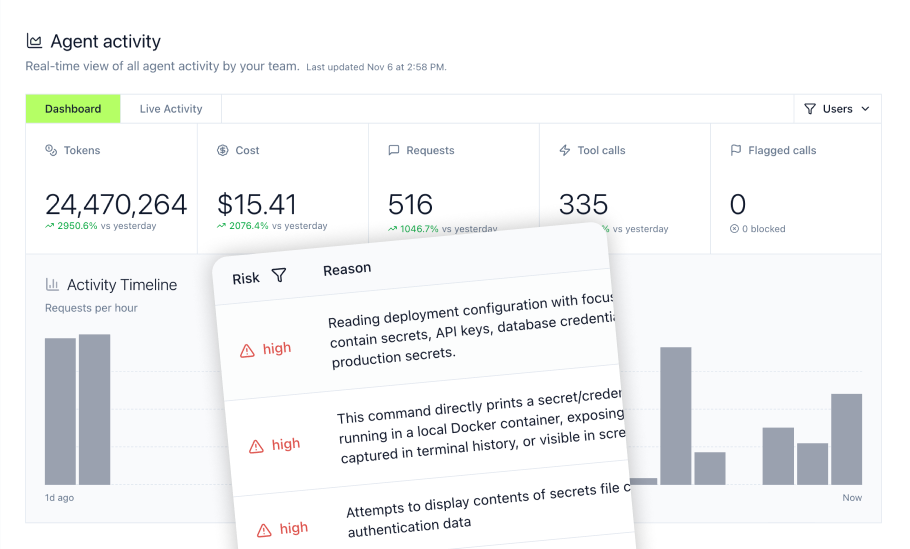
Agent Monitor addresses this by capturing activity from supported AI coding clients, including file reads, commands, MCP tool calls, prompts, and model usage. Coverage varies by client and hook phase, but the goal is visibility into the complete picture rather than just gateway traffic.
Enforcing Policies on Developer Workstations
Detection alone does not prevent risky behavior. Organizations need enforcement capabilities that stop dangerous actions before they execute:
- Block commands: Prevent agents from running curl piped to shell or modifying system files
- Require approval: Some operations need human confirmation before proceeding
- Alert security: Notify the team when suspicious patterns emerge
- Mask sensitive data: Redact credentials before they appear in prompts or logs
MDM-pushed configurations enable detect-and-block mode on developer machines, extending gateway policies to local agent activity.
Proactive Vulnerability Management and Compliance for Your LLM Gateway
Achieving and Maintaining Regulatory Compliance
Compliance is not a one-time certification but an ongoing process. Organizations operating LLM gateways need:
- SOC 2 Type II: Annual audits with continuous monitoring demonstrating security controls
- HIPAA compliance: Business Associate Agreements for handling protected health information
- Penetration testing: Regular third-party assessments identifying vulnerabilities
- Data encryption: Protection in transit and at rest across all components
Mintive is SOC 2 Type II audited, maintains controls aligned with HIPAA standards, and signs Business Associate Agreements for customers handling protected health information.
Leveraging Continuous Monitoring for Security Posture
Point-in-time assessments miss evolving threats. Continuous monitoring capabilities include:
- Real-time dashboards: Active users, success rates, call volumes, and cost tracking
- Anomaly detection: Identify unusual patterns indicating compromise or misconfiguration
- Compliance verification: Automated checks ensuring policies remain enforced
- Incident alerting: Immediate notification when security events occur
Implementing a Zero-Trust Approach for AI Infrastructure
Zero-trust principles can reduce the potential impact of supply chain compromises like the LiteLLM attack by limiting what exposed credentials can access, enforcing least privilege, and monitoring for unauthorized activity. For LLM gateways, this means:
- Verify every request: Authenticate and authorize each API call, not just session start
- Minimize credentials: Grant only the permissions each agent genuinely needs
- Assume compromise: Design systems so one compromised component cannot access everything
- Monitor continuously: Track all activity for signs of unauthorized access
- Respond quickly: Maintain kill switch capabilities for immediate incident response
How Mintive Protects Against Supply Chain Attacks Like LiteLLM
The LiteLLM incident demonstrates why enterprises need purpose-built AI governance infrastructure that extends beyond traditional API security. Mintive addresses the vulnerabilities exposed by this attack through a comprehensive security architecture:
- Centralized credential management reduces the environment variable sprawl that increased exposure during the LiteLLM attack. Instead of distributing connector credentials across developer laptops, Mintive's gateway centrally manages and brokers credentials for governed connections. This limits credential exposure, although compromised machines may still contain other accessible secrets.
- Per-agent identity with scoped permissions ensures that each autonomous agent has independent credentials and narrowly defined tool access. When agent-specific credentials are exposed, organizations can revoke access for affected agents independently. Broader credential rotation may still be necessary if shared downstream credentials or other enterprise secrets were compromised.
- Runtime security screening through Mint Guard inspects gateway MCP tool calls for prompt injection, exposed secrets, and PII. In enforcing mode, Mint Guard blocks high-confidence prompt injection, while secrets and PII detections are logged. Gateway Middleware enables custom policies that can block suspicious actions, redact sensitive data, and support organization-specific data governance requirements.
- Complete audit trails with tamper-evident logging improve visibility during security investigations. Mintive records governed tool activity, supported credential and policy events, and monitored agent activity according to configured logging and retention settings. Supported audit data can be exported to a SIEM for correlation with other security events.
- Shadow AI monitoring extends protection beyond the gateway. Agent Monitor captures local AI coding assistant activity, including file reads, bash commands, and off-gateway MCP tool calls. MDM deployment enables enforcement on developer workstations, blocking dangerous operations before they execute.
Organizations running governed AI infrastructure through Mintive reduce their exposure to supply chain attacks by minimizing credential distribution, enforcing least privilege at the gateway layer, and maintaining comprehensive visibility across both governed and local agent activity.
Frequently Asked Questions
How long does credential rotation take after a supply chain attack?
Rotation timelines depend on how many credentials were exposed, where they were stored, and how easily organizations can identify and revoke them. Teams with centralized credential management and documented procedures may complete remediation faster than organizations with secrets scattered across developer laptops, CI/CD pipelines, and applications. Organizations must also investigate persistence and unauthorized use rather than assuming credential rotation alone completes remediation.
Can egress filtering prevent data exfiltration after malware is installed?
Potentially. Workload-level egress controls can prevent malware from transmitting data to destinations that network policy blocks, including known attacker-controlled domains. However, effectiveness depends on the policy configuration and available network paths, and blocked exfiltration does not eliminate the need for incident investigation.
What is the difference between Mint Guard, Rules, and Gateway Middleware?
These three layers serve different purposes and can operate together. Mint Guard provides managed detection policies for common threats including prompt injection and exposed secrets. Rules offer declarative pattern matching on tool names, arguments, or content using regex. Gateway Middleware runs customer-authored logic for complex scenarios like integrating external classifiers or implementing transformation logic specific to your organization.
How do transitive dependencies affect supply chain attack risk?
Transitive dependencies magnify risk because vulnerabilities can hide several layers deep in your dependency tree. Organizations not directly using a compromised package could still be affected if any library in their stack included it as a dependency. Tools like pip-tools or poetry generate lockfiles that pin every transitive dependency, enabling full dependency tree audits.
What detection methods identify .pth file attacks specifically?
Detection methods include scanning site-packages directories for any .pth files, monitoring for unexpected subprocess creation during Python startup, implementing behavioral analysis that flags network connections from initialization code, checking for systemd user services with suspicious names, and auditing for base64-encoded content in Python package files.