Enterprise teams routing millions of LLM requests face a growing challenge: sending every prompt to frontier models drives costs through the roof while creating security blind spots across fragmented AI deployments. Research on LLM routing shows that learned routers can reduce inference costs on benchmark workloads while balancing response quality, illustrating why organizations are exploring routing across heterogeneous model stacks.
Smart routing can reduce model spend by directing simpler requests to lower-cost models while reserving frontier models for harder tasks, but savings vary substantially by workload, routing method, and quality target. Enterprise teams need more than cost optimization. They need visibility into which agents call which tools, centralized credential management, audit trails for compliance, and runtime controls that stop dangerous actions before they execute.
MCP Gateway addresses the governance gap that pure LLM routers leave open, providing governed tool access and enterprise security controls that can complement existing LLM routing infrastructure. This article covers LLM routers for enterprise teams in 2026, including solutions for governance, performance, and cost optimization.
Key takeaways
- MintMCP provides enterprise AI governance with MCP Gateway, Agent Gateway for non-human identities, Agent Monitor for visibility, Guardrails for runtime security, and Virtual MCPs for team-specific tool bundles
- Bifrost by Maxim AI reports 11 microseconds of gateway overhead in a sustained 5,000 requests-per-second benchmark on a t3.xlarge instance, with automatic fallbacks and semantic caching
- LiteLLM is a widely used open-source gateway with more than 53,000 GitHub stars, support for 100+ LLM providers, and flexible self-hosted deployment options
- Portkey provides enterprise governance with 50+ guardrails and was acquired by Palo Alto Networks in 2026
- OpenRouter provides access to 400+ models across 70+ providers through a unified API
- DigitalOcean Inference Router provides task-aware model routing within DigitalOcean's Inference Engine
- Entelligence Model Router provides per-turn routing for coding agents with prompt-cache awareness
- Hyperscaler solutions from AWS Bedrock and Microsoft Foundry offer deep cloud ecosystem integration
1. MintMCP Gateway: Enterprise AI governance with governed tool access
Overview
MintMCP provides enterprise infrastructure for governing AI clients and autonomous agents across the Model Context Protocol ecosystem. While pure LLM routers focus on model selection and cost optimization, MintMCP addresses the broader enterprise challenge of making AI systems deployable, governed, measurable, and swappable.
The platform's data-permissions-first architecture starts with governed access to company systems rather than granting broad access and restricting afterward. This approach solves the fundamental problem enterprise teams face: AI tools are being adopted faster than security and platform teams can govern what those systems access, whose credentials they use, what actions they take, and how those actions are attributed.
What makes MintMCP different
MintMCP's MCP Gateway serves as the central control point between AI clients and enterprise tools. The key abstraction is the Virtual MCP, which bundles approved connectors and a curated tool surface behind one governed endpoint for a particular team, role, use case, or agent.
This eliminates the configuration sprawl where every developer configures every MCP server locally across multiple machines, creating duplicated setup, inconsistent security, and no centralized visibility into tool usage.
Core capabilities
- Virtual MCPs bundle connectors behind one endpoint with SCIM-driven membership, curated tool lists, and role-based access. Read-only versus read-write access becomes two VMCPs over the same connector with different tool curation
- Agent Gateway treats autonomous agents as first-class non-human principals with their own identities, scoped permissions, independent credentials, and attributable audit trails
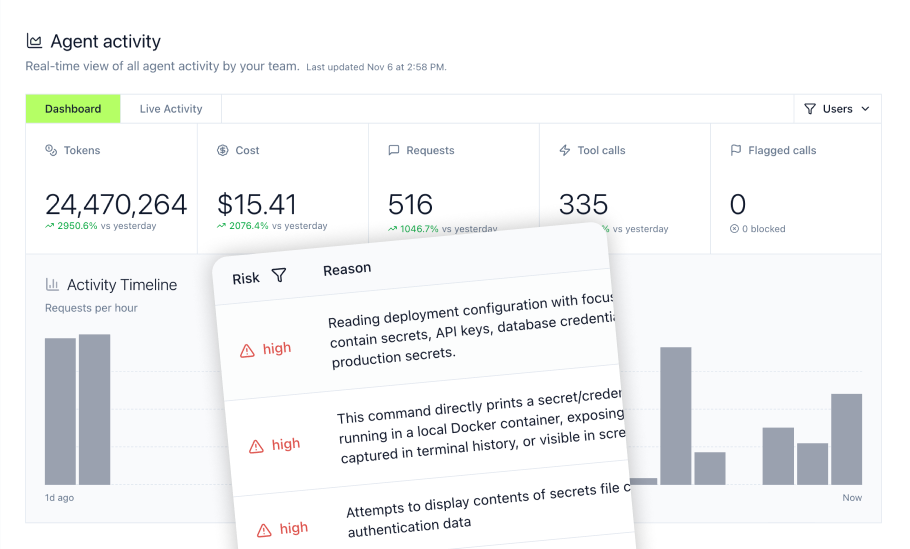
- Agent Monitor provides visibility into supported activity across environments such as Claude Code, Cursor, Codex, and GitHub Copilot, including file access, commands, MCP tool calls, and prompts; coverage and enforcement points vary by client and hook phase
- Guardrails implement runtime controls through Mint Guard for managed detection, Rules for declarative matching, and Gateway Middleware for customer-authored JavaScript logic with DLP integration
- Hosted MCP Connectors run in MintMCP's data plane with auto-scaling and sandboxed execution, reducing infrastructure overhead
- Credential injection ensures connectors never hold long-lived secrets; MintMCP injects per call with encrypted storage and rotated AES keys
Security architecture
MintMCP implements defense-in-depth security through centralized governance, SSO enforcement, SCIM-driven RBAC, tool-level policy, and observability controls. Every tool call, credential lifecycle event, and access-policy change is logged with tamper-evident access-grant history signed at write time.
The platform provides operational controls including:
- Org-wide kill switch
- Per-VMCP and per-tool disable options
- Connector restart capabilities
- Credential rotation
Enterprise compliance
- SOC 2 Type II audited
- Compliant with HIPAA standards (BAA available)
- Penetration tested
- Data encrypted in transit and at rest
Pricing
Contact for enterprise demonstration and pricing
Getting started
Visit mintmcp.com/mcp-gateway for the deployment guide
2. Bifrost by Maxim AI
Overview
Bifrost is an open-source AI gateway built in Go. In Maxim AI's published benchmark on a t3.xlarge instance, it added 11 microseconds of gateway overhead per request at a sustained 5,000 requests per second.
Where Bifrost fits
The Go-based architecture handles sustained high-throughput traffic. Teams running production AI workloads with strict latency requirements may find Bifrost's performance characteristics relevant.
Core capabilities
- Automatic fallbacks with zero downtime when primary models become unavailable
- Semantic caching can serve semantically similar repeated requests from cache to reduce model calls, latency, and cost
- 23+ LLM providers including OpenAI, Anthropic, AWS Bedrock, Google Vertex, Azure, Mistral, Groq, and Ollama
- Enterprise governance features including hierarchical budgets, RBAC, and audit logs
- Drop-in replacement for OpenAI API requiring only a URL change
Deployment
- Open source under Apache 2.0 license
- NPX install under 1 minute or Docker deployment
- SOC 2, GDPR, HIPAA, and ISO 27001 audit log support
Pricing
Free open source with enterprise pricing available on request
3. LiteLLM
Overview
LiteLLM is a widely used open-source LLM gateway with more than 53,000 GitHub stars as of August 2026 and support for 100+ LLM providers. The Python-based solution offers flexible deployment as either a Python package or standalone proxy server, giving teams control over their infrastructure.
Where LiteLLM fits
Organizations that need broad provider coverage and prefer self-hosted deployment with no licensing fees for core gateway functionality will find LiteLLM's ecosystem valuable. The active community provides rapid integration of new providers and models.
Core capabilities
- OpenAI-compatible interface across all providers for simplified integration
- Virtual API keys with budget management and usage tracking
- 100+ LLM providers supported with unified API
- Flexible deployment as Python SDK or standalone proxy
- Open-core licensing with core functionality under the MIT license and separately licensed enterprise features
Performance considerations
LiteLLM's current gateway benchmark reports 8ms P95 proxy overhead at roughly 1,000 requests per second with four instances against a fake OpenAI endpoint. Teams should benchmark their own deployment because results depend on instance count, database configuration, callbacks, and upstream model latency.
Pricing
Free open source for core gateway functionality; SSO is free for up to five users, while larger SSO deployments and organization-level enterprise controls require a paid license
4. Portkey
Overview
Portkey provides enterprise governance and observability with 50+ built-in guardrails covering PII detection, toxicity filtering, and hallucination prevention. The platform was acquired by Palo Alto Networks in 2026 and is becoming the AI gateway within Prisma AIRS.
Where Portkey fits
Regulated industries and enterprises requiring security controls will find Portkey's guardrail architecture and compliance certifications relevant. The Palo Alto Networks acquisition brings additional security validation and enterprise support infrastructure.
Core capabilities
- 50+ guardrails for PII, toxicity, and hallucination detection
- Conditional routing based on request metadata and content classification
- 1,600+ models accessible through unified endpoint
- 40+ data points captured per request for observability
- SOC 2 Type II and HIPAA compliance
Deployment
- Cloud managed with VPC hosting on enterprise tier
- Open-source gateway core available for self-hosting
- SSO and granular budgets on enterprise plans
Pricing
Free tier with 10k logs, $49/mo for production, enterprise pricing custom
5. OpenRouter
Overview
OpenRouter operates as a managed multi-provider marketplace with access to 400+ models across 70+ providers. The platform's Auto Router classifies incoming requests into approximately 30 task types and ranks eligible models using trailing 7-day aggregate spend-share data for each task type.
Where OpenRouter fits
Teams that need access to niche, experimental, or newly released models through a single API will find OpenRouter's catalog valuable. The unified billing across all providers simplifies vendor management for organizations experimenting with multiple models.
Core capabilities
- 400+ models including free models with 50 requests per day
- Auto Router with task-type classification for model selection
- Provider allowlists for compliance requirements
- Zero-data-retention filtering for sensitive workloads
- 5.5% fee on credit purchases with plan-dependent BYOK allowances; BYOK usage above the allowance is charged a 5% fee
Performance
Routing latency varies with the selected model, provider, and routing policy, so teams should measure it against their own workload.
Pricing
Pay-as-you-go with a 5.5% fee when purchasing credits; BYOK includes a plan-dependent monthly fee-free allowance, with a 5% fee above that allowance
6. DigitalOcean Inference Router
Overview
DigitalOcean's Inference Router is built on Plano technology from the Katanemo acquisition, delivering a purpose-built routing model. The solution integrates with DigitalOcean's broader compute, storage, and database ecosystem.
Where DigitalOcean fits
Teams looking to co-locate inference with DigitalOcean compute, storage, and data services can avoid egress fees between supported layers of DigitalOcean's integrated platform while using AI-native routing.
Core capabilities
- 70+ models with preset and custom routing policies
- Semantic task routing using trained classification models
- Live analysis dashboard with evaluation metrics
- BYOM support from Spaces or Hugging Face
- DigitalOcean customer result: DigitalOcean reports that Hippocratic AI achieved 2x higher throughput and 40% lower end-to-end P99 latency while powering 20M+ patient interactions; these figures are not specific to Inference Router
Deployment
Single model-string change to activate routing; public preview currently available.
Pricing
No additional Inference Router fee during public preview; requests are billed at the normal inference rates of the models that serve them
7. Entelligence Model Router
Overview
Entelligence built a router for coding agents including Claude Code, Cursor, Codex, and OpenCode. The platform performs per-turn routing that adapts during agent sessions, automatically escalating to more capable models when agents struggle with complex tasks.
Where Entelligence fits
Engineering teams deploying AI coding agents at scale will find Entelligence's specialization relevant. In Entelligence's July 2026 single-seed Terminal-Bench 2.1 test, its router completed more tasks at lower provider spend than the Opus 5 comparison, but the company notes run-to-run variance and that results may differ with other harnesses or serving paths.
Core capabilities
- Per-turn routing adapts model selection during multi-step sessions
- Automatic escalation when agents encounter difficulties
- Prompt-cache awareness prevents routing decisions that increase costs
- Sub-50ms local classification for responsive routing decisions
- Terminal-Bench results: 71/89 tasks completed, 8 tasks ahead of Opus 5 at 65.5% lower total spend ($0.93 per task versus $3.03)
Deployment
Self-hosted with bring-your-own-key model; two-command setup requiring no workflow changes.
Pricing
Contact for pricing details
8. Respan
Overview
Respan combines an AI gateway with tracing and evaluation in a single platform. Production traces can be scored with online evals, while the gateway provides unified model access, fallbacks, caching, and spend controls.
Where Respan fits
Teams prioritizing output quality alongside cost optimization will find Respan's integrated evaluation approach valuable.
Core capabilities
- 1,000+ models via unified endpoint
- Online evals can score sampled production traffic and attach results to traced spans
- Customer and feature attribution for usage analysis
- Model evaluation using production trace data to compare quality, cost, and latency
- Customer testimonial: Retell AI's CTO says the company scaled from 5 million to 500+ million monthly API calls and used Respan's debugging layer to resolve production issues 10x faster
Deployment
Managed cloud with self-host option on enterprise tier; 99.99% uptime SLA.
Pricing
Free tier with 100k logs and 412 requests per minute; $199/mo team tier; enterprise custom
Why Enterprise Teams Choose MintMCP
LLM routers have evolved from cost optimization tools into infrastructure for enterprise AI deployments. But routing alone addresses only part of the governance challenge. Enterprise teams also need visibility into agent activity, centralized credential management, audit trails for compliance, and runtime controls.
MintMCP addresses these requirements through its integrated platform combining MCP Gateway for governed tool access, Agent Gateway for non-human identities, Agent Monitor for visibility into supported agent activity across environments such as Claude Code, Cursor, Codex, and GitHub Copilot, and Guardrails for runtime security.
The platform's Virtual MCP architecture bundles approved connectors behind governed endpoints with SCIM-driven membership, solving the configuration sprawl that creates security gaps when developers configure MCP servers independently across dozens of machines. Every agent gets its own identity, its own credentials, and its own audit trail rather than operating through whichever human credential or shared API key happens to be available.
For enterprise teams deploying AI agents at scale, the question is not just which models to route to, but how to make those deployments governable, measurable, and compliant. Visit mintmcp.com to learn how governed AI infrastructure centralizes tool access, agent identity, monitoring, credentials, and runtime controls across enterprise AI deployments.
Frequently asked questions
What is an LLM router and why do enterprise teams need one?
An LLM router directs AI requests to different language models based on task complexity, cost, latency requirements, or quality thresholds. Enterprise teams need routers to optimize costs by sending simple queries to lightweight models while reserving expensive frontier models for complex reasoning. Smart routing can reduce model spend compared with routing every request to the same frontier model, but the savings vary by workload, router, model mix, and quality target. Beyond cost, routers provide centralized logging, fallback handling, and simplified vendor management across multiple AI providers.
How do LLM routers differ from MCP gateways?
LLM routers focus on model selection and traffic distribution across language model providers. MCP gateways govern the connection between AI agents and enterprise tools, managing authentication, credentials, access policies, and audit trails for tool usage. Many enterprises need both: LLM routing for model optimization and MCP governance for tool access control. MintMCP's platform addresses the governance layer while integrating with existing routing infrastructure.
What security features should enterprise teams require from AI infrastructure?
Security and compliance requirements depend on the industry, data, and deployment; teams handling regulated data may evaluate controls such as SOC 2 Type II audits, HIPAA-related safeguards, and BAAs where protected health information is involved. Beyond compliance frameworks, teams should evaluate whether solutions provide visibility into agent activity, the ability to revoke access immediately through kill switches, and tamper-evident audit trails for compliance reporting. Runtime guardrails that can intercept dangerous actions before execution provide an additional security layer.
Can LLM routers work with coding agents like Claude Code and Cursor?
Yes, but coding agents present governance challenges beyond model routing. These agents read files, execute commands, and access production systems through MCP tools. Agent Monitor provides visibility into supported activity across Claude Code, Cursor, Codex, and GitHub Copilot, including file access, commands, MCP tool calls, and prompts; coverage and enforcement points vary by client and hook phase. This two-layer approach covers both LLM traffic and local agent activity.
How do agent identities improve enterprise AI governance?
Traditional deployments run agents using human credentials or shared API keys, collapsing audit trails and making it impossible to distinguish agent actions from human actions. Agent Gateway treats autonomous agents as first-class non-human principals with their own identities, scoped permissions, independent credentials, and attributable audit trails. This enables independent rotation and revocation without affecting human users or other agents.