OpenRouter solved the multi-model access problem. With 500+ models across 80+ providers available through a single API, developers can prototype and experiment faster than ever. But as enterprises move from prototyping LLMs to deploying autonomous agents at scale, the control point shifts from which model to call to which tools agents can reach, who they are, and what they can do. That transition exposes a governance gap OpenRouter was never designed to fill.
Enterprise AI governance now extends beyond model routing to encompass tool-level access control, agent identity management, and compliance-ready audit trails. Enterprise AI governance is becoming increasingly important as organizations address regulatory requirements and operational risks associated with autonomous agents. As autonomous agents connect to databases, APIs, and internal systems through protocols like Model Context Protocol, IT leaders need infrastructure that governs not just which model responds, but which enterprise resources each agent can access and with what credentials.
For IT leaders, CISOs, and platform engineering teams evaluating enterprise AI agent infrastructure, this guide examines alternatives that address what OpenRouter cannot: governed tool access, agent identity, compliance-ready audit trails, and shadow AI elimination.
Key takeaways
- Enterprise AI governance requires more than model routing. As organizations deploy autonomous agents across Claude, Cursor, ChatGPT, and Copilot, governed tool access, per-agent identities, and audit trails become critical infrastructure requirements.
- Platform fees compound at scale. Percentage-based credit purchase fees can become a six-figure line item at high volume, making alternative billing models financially attractive.
- Self-hosted and VPC options matter for regulated industries. Healthcare, fintech, and cybersecurity organizations often require deployment architectures where prompts never transit vendor clouds.
- MCP governance is the emerging enterprise requirement. Tool-level access control, credential management, and audit logging for agent-to-data connections now sit alongside model routing as core infrastructure needs.
- Mintive addresses the agent governance gap with Virtual MCPs for role-based tool curation, Agent Bundles for per-agent identity, and SOC 2 Type II audited infrastructure that is compliant with HIPAA standards.
- Open-source alternatives trade licensing fees for operational overhead. Self-hosted options like LiteLLM and Bifrost eliminate gateway costs but require dedicated DevOps capacity for databases, scaling, and security patches.
Where OpenRouter fits
OpenRouter excels at developer velocity and model breadth. The ability to change one URL and access hundreds of models immediately is valuable for prototyping. Consolidated billing replaces 80+ provider invoices with a single credit account.
The challenge emerges when pilot projects become production deployments. Regulated enterprises face requirements OpenRouter's architecture cannot fully address:
- No self-hosted option. Requirements like VPC deployment or keeping prompts inside network boundaries cannot be met at any tier. Cloud-only architecture blocks some security-conscious organizations.
- Model-focused enterprise governance. OpenRouter provides spend controls, managed policy enforcement, SSO/SCIM, and other enterprise features on applicable plans. However, these controls focus primarily on model access and inference traffic rather than centrally governing enterprise MCP tool connections and agent actions.
- No dedicated enterprise MCP governance gateway. OpenRouter offers an MCP Server for model discovery and access, but it does not provide the same centralized governance layer for enterprise MCP connectors, role-based tool curation, and per-agent access controls that dedicated MCP gateways provide.
- Platform fees at scale. OpenRouter charges 5.5% on Standard credit purchases and 8% on Business credit purchases. BYOK usage has a plan-dependent fee-free allowance, with additional charges above that threshold. Enterprises should compare these costs against their existing provider contracts and governance requirements.
- Regional routing requirements. EU and US in-region routing are available on Business and Enterprise plans, but organizations must verify which models and providers are available in each region and assess their broader data residency requirements.
The fundamental issue: OpenRouter governs which model responds to a prompt. It does not govern which tools an agent can reach, which credentials it uses, or what actions it takes on enterprise systems.
1) Mintive: MCP-first agent governance
Mintive provides enterprise AI agent infrastructure and governance platforms for companies deploying AI agents at scale. The platform sits between AI agents (Claude Code, Cursor, ChatGPT, GitHub Copilot, custom agents) and enterprise systems (databases, APIs, internal tools), enforcing authentication, authorization, audit logging, and security policies on every interaction.
Why Mintive stands out
While LLM gateways primarily govern model access, Mintive treats governed tool access as the foundation. Its MCP Gateway centralizes enterprise data and tool connections, while Agent Gateway extends that foundation to first-class agent identities, scoped permissions, credentials, and audit trails.
The MCP Gateway provides centralized management for Model Context Protocol servers, with support for hosted, remote, custom, and STDIO connectors. Mintive also provides a catalog of MCP servers for tools like GitHub, Jira, Salesforce, Snowflake, and internal databases.
Core capabilities
- Virtual MCPs (Bundles). One endpoint per role or use case, with SCIM-driven group membership, curated tools, and access policy. Engineering gets GitHub plus Jira plus Datadog; Finance gets Salesforce plus Snowflake. Users connect once instead of configuring each server.
- Agent Bundles. Each autonomous agent receives its own identity with scoped tool access and independently managed credentials. Supported authentication methods include bearer keys, OAuth 2.0 machine-to-machine tokens, and workload identity federation. When an agent is compromised or decommissioned, its credentials can be revoked independently without affecting users or other agents.
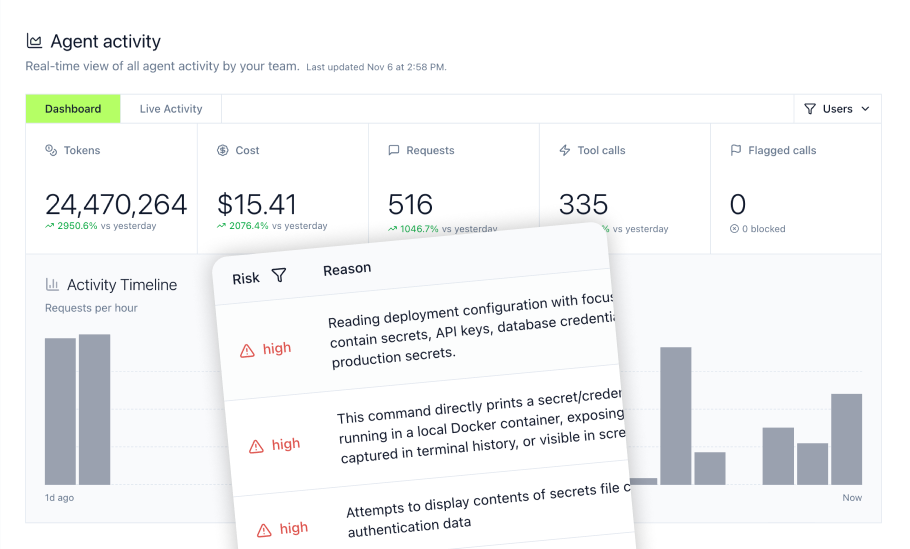
- Agent Monitor. Visibility into agent activity: prompts, commands, file access, MCP tool calls, usage, and cost. Hooks for Cursor and Claude Code report local activity into the same audit log as gateway traffic.
- Runtime guardrails. Mint Guard provides managed detection for prompt injection, PII, secrets, and harmful content. Declarative Rules support additional conditions and enforcement actions, while Gateway Middleware enables customer-authored JavaScript policies and integrations with external DLP and security tools.
Enterprise credentials
Mintive is SOC 2 Type II audited with continuous Drata monitoring. Infrastructure is compliant with HIPAA standards, with BAAs available. Official technology partnerships with Cursor (hooks integration) and Okta (cross-app access governance).
Customer evidence
- Coursera deployed governed AI to 2,000 employees in weeks
- Stability AI's Head of Security noted the platform "solved our most immediate MCP problems" with company-wide deployment in under a month
- Modern Treasury reports agents save Technical Account Managers "30 minutes to 4 hours per case"
Pricing structure
Custom quotes based on team size and requirements. Per-user licensing for active AI agent users, with platform fees that scale according to usage and team size. Enterprise deployment options, SLAs, and support are available based on requirements.
2) TrueFoundry
TrueFoundry provides a unified AI infrastructure platform combining LLM routing, MCP governance, and agent orchestration. TrueFoundry reports processing more than 10B requests monthly across its customer base and identifies large enterprise deployments.
Key capabilities
- Unified platform. LLM Gateway, MCP Gateway, and Agent Gateway in one system, reducing integration complexity
- Model serving included. vLLM, SGLang, and TensorRT-LLM support for organizations running self-hosted models
- Flexible deployment. VPC, on-premises, hybrid, and air-gapped options all supported
- Enterprise deployments. Customer base includes Nvidia and Siemens
MCP gateway features
TrueFoundry supports virtual and composite MCP servers, OAuth 2.0 identity injection, and third-party guardrails integration on Enterprise tier. The platform received Frost & Sullivan's 2026 Global Technology Innovation Award.
Pricing
Developer tier at $0 for up to 3 users with 10K requests per user monthly. Pro starts at $25/user/month with 20K requests per user and additional usage at $20 per 100K requests. Enterprise pricing is custom, while Agent Gateway and Agent Harness pricing is quoted separately.
Tradeoffs to consider
Agent Gateway and Agent Harness currently require custom pricing. MCP Gateway is included in the platform's standard usage model, with MCP tool calls counted alongside LLM requests.
3) Portkey/Prisma AIRS
Portkey was acquired by Palo Alto Networks in May 2026 and rebranded as Prisma AIRS AI Gateway. The platform processes trillions of tokens per month and offers over 50 built-in guardrails for content filtering.
Key capabilities
- Palo Alto Networks integration. Full enterprise security suite backing, including runtime threat detection
- Scale. 99.99% uptime SLA with trillions of tokens processed monthly
- Guardrails. 50+ content filtering options available
- Model support. 3,000+ LLMs supported through the platform
MCP features
Portkey provides an MCP Gateway with server and tool registries, authentication, RBAC, tool-level access controls, runtime policy enforcement, and audit logging. Mintive differs through its Virtual MCP model, which combines curated tools, SCIM-driven membership, and access policies into governed endpoints for specific roles or use cases.
Pricing
Portkey offers a free tier and a Production plan at $49/month, including 100K recorded logs monthly and 30-day log retention. Enterprise pricing requires a custom quote.
Tradeoffs to consider
The acquisition transition creates uncertainty about the standalone Portkey product's future. No public enterprise pricing. Portkey supports MCP server and tool-level governance, although its organization and provisioning model differs from Mintive's Virtual MCP architecture.
4) Kong AI Gateway
Kong AI Gateway extends Kong's mature API management platform to AI and LLM traffic. Data planes run in customer infrastructure, meaning prompts never transit vendor clouds.
Key capabilities
- Data sovereignty. Data planes deploy in customer infrastructure with full prompt privacy
- Mature API platform. 10+ years of enterprise API management expertise
- MCP support. Kong AI Gateway supports LLM, MCP, and agent-to-agent traffic, including MCP Server Bundling, authentication, access policies, and observability
- Performance. Vendor benchmarks indicate strong routing performance
MCP features
Kong AI Gateway supports LLM, MCP, and agent-to-agent traffic, including MCP Server Bundling, authentication, access policies, and observability. It can also expose existing Kong-managed REST APIs as MCP servers. PII sanitization and prompt guards are available as gateway features.
Pricing
Open-source Kong Gateway capabilities are available for self-hosted deployments. Konnect AI Management Plus starts at $25/month plus usage, while Enterprise offers custom annual pricing for larger deployments and advanced controls.
Tradeoffs to consider
Costs depend on deployment architecture, gateway usage, and selected capabilities. Kong's API management foundation remains relevant, but its dedicated AI Gateway now provides native LLM, MCP, and agent-to-agent traffic governance.
5) LiteLLM
LiteLLM provides an open-source LLM proxy with MIT licensing, supporting 100+ providers and 2,500+ models. The platform offers full source control with no vendor lock-in.
Key capabilities
- MIT open-source. No licensing fees for core functionality, full source control
- Provider support. 100+ providers with 2,500+ models accessible
- Spend tracking. Virtual keys, budgets, and tagging built into the open-source tier
- Active community. Extensive documentation and community support
Limitations
LiteLLM is written in Python, and performance depends on hardware, concurrency, configuration, and workload characteristics. Self-hosted deployments require operational investment in databases, infrastructure scaling, monitoring, and security maintenance. LiteLLM supports virtual keys, MCP access policies, and agent-to-agent gateway capabilities. However, its documented identity model differs from Mintive's first-class non-human agent identities with independently managed credentials. Enterprise features including SSO, SCIM, and advanced support require a paid license.
Pricing
Free (MIT license) for core functionality. Enterprise tier available with custom pricing for usage-based or annual agreements.
TCO considerations
While core licensing is free, self-hosted deployment carries infrastructure and operational costs that vary with request volume, availability requirements, staffing, and security controls. Organizations must also assess how the deployment fits into their existing compliance and audit scope.
6) Bifrost
Bifrost by Maxim AI is a performance-focused AI gateway. In a vendor-reported benchmark at 5,000 requests per second, it measured 11 microseconds of gateway overhead on a t3.xlarge instance. Actual performance depends on deployment configuration and workload.
Key capabilities
- Performance-focused architecture. Vendor-reported testing measured 11µs of gateway overhead at 5,000 RPS under specified benchmark conditions
- Apache 2.0 license. Open-source foundation with enterprise options
- Go-based architecture. Compiled binary with minimal dependencies
- Open-source foundation. Routing, caching, virtual keys, and core MCP integration are available in the open-source project, with additional governance and operational features in Enterprise
Limitations
Bifrost provides an open-source gateway with enterprise capabilities for clustering, governance, and access controls. Bifrost Edge also extends supported AI traffic monitoring and enforcement to employee devices. Enterprise capabilities require commercial licensing, while organizations operating the open-source gateway manage their own infrastructure.
Pricing
Free (Apache 2.0) for core functionality. Enterprise tier available with 14-day trial for clustering and support.
7) Cloudflare AI Gateway
Cloudflare AI Gateway provides free core features with edge-based routing through Cloudflare's global network. The platform integrates natively with the Cloudflare Workers stack.
Key capabilities
- Free core features. No gateway licensing cost for basic functionality
- Global edge network. Cloudflare's infrastructure provides low-latency routing worldwide
- Workers integration. Native compatibility with Cloudflare's serverless platform
- Quick deployment. Minimal setup for organizations already using Cloudflare
Limitations
The platform is optimized for edge proxy scenarios rather than enterprise MCP governance. No Virtual MCP equivalent for role-based tool curation. Agent identity features are basic compared to dedicated governance platforms.
Pricing
Core AI Gateway features are free. Additional charges may apply for logging, Workers AI guardrail inference, and other paid services. Unified Billing applies a 5% fee to credit purchases.
Total cost of ownership considerations
Gateway selection involves more than licensing fees. For a 100-user enterprise processing 10 million requests monthly with SOC 2 and HIPAA requirements:
Managed platform approach
- Software licensing and platform fees vary by vendor
- Implementation and onboarding services depend on the provider and contract
- Compliance documentation and contractual commitments vary by provider and plan
- Support coverage and response commitments depend on contractual terms
- Reduced infrastructure management for fully managed deployments, with additional responsibilities for VPC and self-hosted configurations
Self-hosted approach
- No licensing fees for open-source tiers
- Infrastructure costs vary by compute requirements, database architecture, traffic, and monitoring needs
- Engineering costs depend on staffing, deployment complexity, and existing platform operations
- Compliance responsibilities depend on the organization's existing controls, audit scope, and deployment requirements
- Full source control and deployment flexibility
Platform fee considerations
Percentage-based credit purchase fees can become material at scale. For example, $2M in credit purchases would incur $110K at 5.5% or $160K at 8%, before considering Enterprise discounts or alternative billing arrangements. Organizations should also compare BYOK allowances, provider contract terms, and any additional gateway fees.
Why Mintive for enterprise agent governance
Mintive addresses the governance gap exposed when enterprises move from LLM prototyping to autonomous agent deployment at scale. The platform's architecture recognizes that as agents connect to Snowflake, GitHub, Salesforce, and internal databases through Model Context Protocol, governance must extend beyond which model responds to which enterprise resources each agent can access.
Key differentiators include:
- First-class agent identity. Agent Bundles treat autonomous agents as distinct identity primitives with independently managed credentials, scoped permissions, and rotation capabilities separate from user identities
- Virtual MCP architecture. Role-based tool curation through SCIM-driven group membership eliminates per-developer MCP server configuration sprawl
- Runtime security controls. Agent Monitor provides visibility into agent activity, while Mint Guard, Rules, and Gateway Middleware enforce policies at interaction time
- Compliance-ready infrastructure. SOC 2 Type II audited platform compliant with HIPAA standards, with BAAs available for healthcare deployments
- Proven enterprise deployment. Organizations like Coursera, Stability AI, and Modern Treasury have deployed Mintive to thousands of users in weeks, addressing shadow AI visibility and credential management challenges
Mintive's positioning aligns with the enterprise security requirement that as AI agents gain tool access, governance infrastructure must provide the same authentication, authorization, and audit capabilities enterprises already enforce on human users. When Claude Code connects to production databases or ChatGPT accesses customer data through Salesforce, IT leaders need visibility, policy enforcement, and credential lifecycle management that generic LLM routing gateways were not designed to provide.
Frequently asked questions
Can organizations migrate from OpenRouter to enterprise governance platforms?
Migration requirements depend on the alternative and existing architecture. OpenAI-compatible LLM gateways may support API-level migration with configuration changes. Moving to Mintive's MCP Gateway and Agent Gateway involves a broader governance rollout covering tool connections, identities, permissions, SSO/SCIM integration, and audit policies. Teams should evaluate model-routing requirements separately from MCP and agent governance.
Which alternatives work in regulated industries?
Mintive provides enterprise security with SOC 2 Type II audited infrastructure, compliance with HIPAA standards, and BAAs available for customers handling protected health information. Other providers also offer enterprise security and compliance capabilities. Organizations should evaluate each platform's audit documentation, deployment controls, contractual commitments, and fit with their existing compliance programs.
How long does deployment take?
Deployment timelines vary by policy complexity and approved tool count. Mintive reports standard rollouts complete in 1 day to 3 weeks. The fastest deployments can complete in a single afternoon with basic SSO integration. More complex deployments involving custom middleware policies, extensive connector configurations, and SIEM integrations require additional time.
What happens to existing model provider contracts?
Many enterprise gateways support BYOK (bring your own key) configurations that let organizations use existing provider API keys and negotiated contracts. Gateway charges vary by vendor, pricing tier, and usage volume. OpenRouter, for example, provides a plan-dependent fee-free BYOK allowance before additional fees apply. Enterprises should confirm gateway charges separately from underlying inference costs.
Do organizations need an MCP gateway if they already have an LLM gateway?
If AI deployment includes autonomous agents (Claude Code, Cursor, ChatGPT with tools, custom agents) that connect to enterprise systems, MCP governance addresses a different question than LLM routing: not "which model responds" but "which tools can this agent access, with which credentials, logged to which audit trail." Organizations running only simple prompt/response workflows may not need MCP governance immediately, but any tool-using agent deployment benefits from governed access controls.