Investment banks face a critical infrastructure decision: build custom AI agent integrations for substantial costs, or deploy purpose-built MCP gateways that deliver security and governance from day one. Model Context Protocol (MCP) has emerged as the backbone of AI-native enterprises, supported by Anthropic, OpenAI, Google, and Microsoft, but choosing the right gateway determines whether your AI agents operate as compliant, auditable tools or ungoverned security risks.
According to NIST cybersecurity guidelines, financial institutions must implement comprehensive access controls, continuous monitoring, and audit capabilities for all technology systems, areas that MCP gateways can help operationalize for AI agent infrastructure: access control, monitoring, and audit logs. Banks using standardized MCP integrations reduce development time significantly compared to custom API integrations, while maintaining the regulatory compliance that financial services demand.
This guide evaluates eight leading MCP gateway solutions for investment banking, ranked by compliance capabilities, performance benchmarks, security architecture, and financial services integration. Each gateway addresses different priorities, from regulatory compliance to trading-adjacent performance, ensuring you find the right fit for your institution's requirements.
Key Takeaways
- Performance benchmarks vary significantly: TrueFoundry reports low-latency gateway benchmarks, which may matter for real-time analytics and trading-adjacent workflows.
- Standardized MCP integrations can reduce custom integration work: Banks using standardized MCP gateways can reduce development time compared to building custom API integrations.
- Security-first options exist: Lasso Security offers prompt injection detection and tool authorization for banks prioritizing AI-specific threat prevention.
- Integration breadth accelerates deployment: Composio provides a large library of pre-built connections, reducing time-to-production for multi-system implementations.
1. MintMCP - Compliance-First Enterprise Platform
MintMCP is a SOC 2 Type II audited MCP platform, purpose-built for regulated industries where audit trails, enterprise authentication, and tool-level policy are mandatory.
What Sets MintMCP Apart
MintMCP transforms local MCP servers into production-ready services with one-click deployment, OAuth brokering for stdio and hosted MCP servers, and comprehensive audit trails for every interaction. The platform provides complete visibility into AI tool usage, tracking every tool call, file access, and command execution, while enabling SSO and SCIM-driven RBAC, tool-level allowlisting, rule-based policy, credential management, and Virtual MCP Bundles for per-use-case endpoints with SCIM-driven membership.
Core Capabilities
- SOC 2 Type II audited, with compliance documentation available through the MintMCP Trust Center
- Enterprise SSO, SCIM-driven RBAC, OAuth brokering, and role-based access control for enterprise authentication
- Tool-level allowlisting, rule-based policy, and credential management for governed AI access
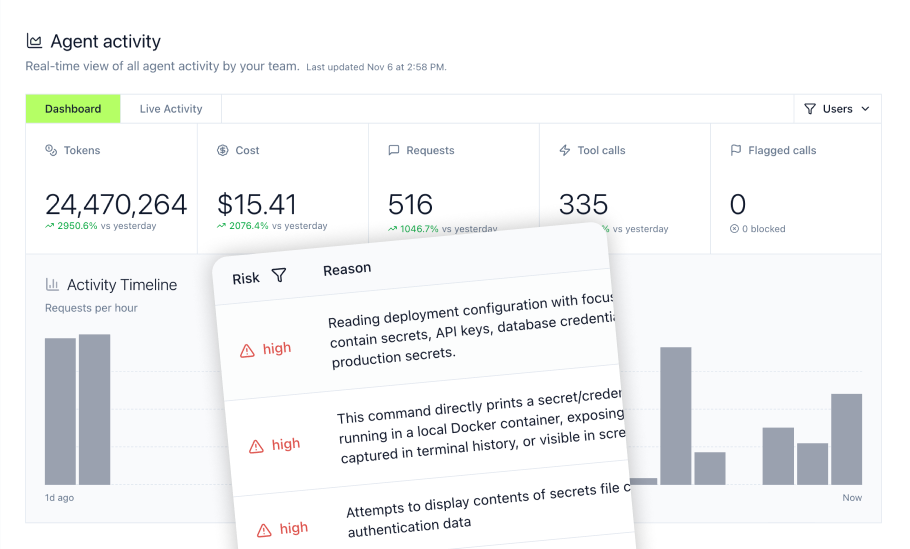
- Real-time monitoring dashboards for usage patterns and security alerts
- Complete audit logs to support SEC/FINRA auditability expectations and GDPR-aligned governance programs
- One-click STDIO server deployment with automatic hosting
- Virtual MCP Bundles for per-use-case endpoints with SCIM-driven membership
- Agent Bundles with M2M auth and “act as agent” flow for per-agent identity governance
- JS Gateway Middleware and external DLP or guardrails integrations for inline policy enforcement
- Snowflake and Elasticsearch connectors for financial data integration
Investment Banking Applications
Financial reporting automation: AI agents access Snowflake data warehouses for real-time variance analysis and forecasting with full audit trails.
Compliance documentation: Complete audit trails demonstrate regulatory adherence during examinations, supporting enterprise MCP deployment requirements.
Customer service enhancement: AI assistants retrieve CRM data and support history with full security oversight and authentication.
Why Investment Banks Choose MintMCP
Banks using standardized MCP integrations through MintMCP reduce development time significantly compared to building custom connections. The platform's data-permissions-first architecture means security and governance start with SSO, SCIM, IdP groups, Virtual MCP Bundles, tool-level policy, and audit before agents are enabled on top.
Best For: Banks requiring a SOC 2 Type II audited platform, centralized observability, tool-level policy, and comprehensive audit capabilities
Deployment: Managed SaaS-first in the US and EU, with VPC/self-hosted deployment on request
2. TrueFoundry
TrueFoundry delivers fast MCP performance, which can matter for investment banks where latency affects real-time analytics and trading-adjacent workflows.
Performance Specifications
TrueFoundry reports production-oriented MCP gateway benchmarks with low added latency and 350+ requests per second on a single vCPU. The platform scales horizontally, supporting high-throughput deployments typical in trading-adjacent environments.
Technical Highlights
- Low-latency MCP gateway performance for real-time financial applications
- 350+ requests per second per vCPU with horizontal scaling
- Unified AI infrastructure combining LLM serving and MCP tool orchestration
- Built-in observability with distributed tracing
- Production-oriented deployment options for enterprise teams
Trading System Integration
For banks running algorithmic trading or real-time risk analysis, TrueFoundry's performance profile can help AI agents operate efficiently. The unified platform consolidates LLM serving and MCP management, reducing infrastructure complexity.
Tradeoffs to consider
TrueFoundry is a broader AI infrastructure and ML platform, so banks should evaluate whether it provides the same MCP-specific governance primitives MintMCP focuses on, including Virtual MCP Bundles, Agent Bundles with M2M auth, tool-update policy, and data-permissions-first access control.
Best For: High-frequency trading systems, real-time analytics, performance-critical AI workflows
Deployment: Hybrid managed SaaS and self-hosted control plane options
3. Lasso Security
Lasso Security addresses MCP's security challenges through a security-focused gateway that protects against AI-specific attack vectors, as described in enterprise AI infrastructure research.
Security Architecture
Lasso's plugin-based architecture provides real-time threat detection, tool authorization with parameter validation, and network filtering for MCP destinations. The platform specifically protects against credential theft, tool poisoning, and unauthorized data access.
Threat Prevention Features
- Real-time prompt injection detection and blocking
- Tool authorization with parameter-level validation
- Network filtering and allowlisting for MCP destinations
- Comprehensive audit trails for all security events
- Open-source architecture for security transparency
Financial Services Application
Investment banks face unique AI security challenges, from protecting proprietary trading algorithms to preventing unauthorized access to client data. Lasso's security-first approach complements broader compliance frameworks.
Tradeoffs to consider
A security-focused MCP gateway may emphasize threat detection, but investment banks should also evaluate governance breadth, including SCIM-driven RBAC, per-use-case tool bundles, credential management, centralized observability, and per-agent identity controls.
Best For: Security-conscious banks with dedicated security engineering teams
Deployment: Self-hosted
4. Lunar.dev MCPX
Lunar.dev MCPX bridges the gap between development velocity and production governance, taking MCP from local development to governed deployments without sacrificing developer experience.
Governance Capabilities
MCPX provides centralized RBAC and policy enforcement across MCP interactions. The platform offers full observability, including latency tracking, token/cost monitoring, and request tracing, integrating with enterprise identity and monitoring systems.
Platform Features
- Centralized role-based access control (RBAC)
- Policy enforcement across MCP connections
- Full observability: latency, token usage, and cost analytics
- Support for both STDIO and remote HTTP/SSE MCP servers
- Docker/Kubernetes deployment with optional SaaS dashboards
DevOps Integration
For banks with mature DevOps cultures, MCPX maintains the agility developers expect while adding the governance layers compliance requires. The platform's flexibility in deployment options accommodates varied infrastructure preferences.
Tradeoffs to consider
MCPX can fit teams that want flexible deployment control, but banks should compare that approach with MintMCP's managed SaaS-first deployment, hosted MCP connectors, Virtual MCP Bundles, Agent Bundles, and centralized governance for Claude, Cursor, ChatGPT, Gemini, and Copilot.
Best For: Banks with strong DevOps culture balancing developer velocity with governance requirements
Deployment: Docker/Kubernetes or managed SaaS
5. Docker MCP Gateway
Docker MCP Gateway leverages existing container expertise and infrastructure, enabling banks with mature Docker deployments to add MCP capabilities without architectural disruption.
Container Integration
Docker's MCP solution provides container isolation for MCP server deployments, Docker Compose integration for orchestration, and standard container security practices. Teams already managing containerized workloads apply familiar patterns to AI agent infrastructure.
Infrastructure Benefits
- Container isolation for security and resource management
- Docker Compose orchestration for scaling
- Standard container security and image management
- Familiar deployment patterns for DevOps teams
- Integration with existing container registries and CI/CD pipelines
Enterprise Considerations
Docker's approach works well for banks already invested in container infrastructure. The platform extends existing DevOps investments rather than introducing new operational paradigms.
Tradeoffs to consider
A container-native gateway can align with existing Docker and Kubernetes operations, but it may require customer teams to operate connector runtimes, scaling, and infrastructure. MintMCP addresses this with managed SaaS-first deployment, hosted MCP connectors, and centralized policy and audit controls.
Best For: Banks with mature container infrastructure seeking infrastructure consistency
Deployment: Container-native: Docker/Kubernetes
6. Traefik Hub
Traefik Hub extends API gateway technology to MCP workflows, implementing a Triple Gate Pattern that provides defense-in-depth across AI, MCP, and API layers.
Security Architecture
Traefik's approach layers security across three gates: AI gateway controls, MCP-specific governance, and traditional API security. The platform supports OAuth 2.0 authentication and Task-Based Access Control (TBAC) for dynamic authorization.
Technical Features
- Triple-gate security architecture: AI, MCP, and API layers
- OAuth 2.0 with On-Behalf-Of authentication
- Task-Based Access Control for dynamic permissions
- Cloud-native design leveraging existing Traefik infrastructure
- Unified gateway for traditional APIs and MCP connections
Integration Advantage
Banks already using Traefik for API management can extend their existing infrastructure rather than deploying separate MCP governance. This reduces operational complexity and leverages existing security configurations.
Tradeoffs to consider
An API gateway extension may fit teams already standardized on Traefik, but banks should assess whether it provides MCP-specific primitives such as Virtual MCP Bundles, Agent Bundles, tool-update policy, hosted connector runtime, and OAuth brokering for stdio and hosted MCP servers.
Best For: Banks with established Traefik API gateway deployments
Deployment: Cloud-native with existing Traefik infrastructure
7. Microsoft Azure MCP Solutions
Microsoft Azure offers dual MCP gateway options: an open-source AKS-based gateway and managed Azure API Management integration for banks standardized on Azure infrastructure.
Azure Ecosystem Integration
Azure MCP solutions provide Azure integration, Azure Monitor and App Insights observability, and native authentication through Azure AD/Entra ID. Banks already invested in Microsoft's enterprise ecosystem can extend their existing infrastructure.
Platform Options
- Open-source Kubernetes gateway for AKS deployments
- Managed Azure API Management for enterprise licensing
- Native Azure AD/Entra ID authentication
- Azure Monitor integration for comprehensive observability
- Microsoft compliance framework integration
Financial Services Alignment
Many investment banks already use Azure for core infrastructure. Azure MCP solutions extend this foundation to AI agent governance without introducing new vendor relationships or security review processes.
Tradeoffs to consider
Azure-native options can reduce friction for Microsoft-standardized teams, but banks should evaluate whether the selected Azure approach includes MCP-specific governance, hosted connector operations, tool-level allowlisting, Virtual MCP Bundles, and Agent Bundles rather than only cloud-native API or Kubernetes controls.
Best For: Banks standardized on Azure infrastructure seeking platform consistency
Deployment: Azure cloud-native
8. Composio
Composio accelerates AI agent development with 500+ pre-built integrations, reducing the integration work that typically consumes months of development time.
Integration Library
Composio operates as an aggregator, providing a single, unified endpoint to a vast library of managed integrations. The platform includes unified OAuth and RBAC out of the box, eliminating the need to build authentication and security for each connection.
Platform Capabilities
- 500+ pre-built, managed tool integrations
- Single unified endpoint for all connections
- Built-in OAuth, RBAC, and PII redaction
- Combined MCP gateway and integration platform
- Accelerated development without DIY integration work
Financial Services Use Cases
Investment banks requiring connections to diverse financial systems, including market data feeds, CRM platforms, trading systems, and compliance databases, can leverage Composio's pre-built library. Teams deploy AI agents accessing multiple data sources efficiently.
Tradeoffs to consider
Composio is oriented toward developer and AI engineering teams building agentic applications. Investment banks should evaluate whether it provides the same IT, security, and AI operations controls MintMCP emphasizes, including SCIM-driven RBAC, audit logs, Virtual MCP Bundles, Agent Bundles, and policy governance for internal employee and internal-agent use cases.
Best For: Banks prioritizing rapid deployment across multiple data sources
Deployment: Managed SaaS-first, with VPC/on-prem available on Enterprise tier
Choosing the Right MCP Gateway
Compliance Requirements
Banks subject to SEC, FINRA, or international regulations should prioritize gateways with documented compliance posture, audit logs, and identity controls. MintMCP is SOC 2 Type II audited and provides enterprise SSO, audit trails, PII detection, role-based access control, and compliance documentation through its Trust Center. Understanding MCP gateway security helps inform regulatory discussions.
Performance vs. Governance
High-frequency trading systems may prioritize low latency, while compliance-critical workloads benefit from comprehensive audit trails, tool-level policy, and agent identity governance. Many banks deploy multiple gateways, using performance-optimized infrastructure for latency-sensitive workflows and governance-focused platforms for regulated client, employee, or internal-agent operations.
Infrastructure Alignment
Evaluate existing investments before selecting a gateway. Banks with mature Docker deployments, established Traefik configurations, or Azure standardization can extend current infrastructure. Greenfield implementations have flexibility to choose purpose-built platforms.
Integration Complexity
The financial AI workflows typical in investment banking require connections to trading systems, market data feeds, CRM platforms, and compliance databases. Platforms like MintMCP provide specialized connectors for governed access to data warehouses.
Monitoring and Observability
Without proper governance, AI tools operate as black boxes. An LLM proxy solution provides essential visibility into agent behavior, tracking tool calls, commands, and file access.
Conclusion: Transform AI Infrastructure with MintMCP
The Model Context Protocol has fundamentally changed how investment banks connect AI assistants to enterprise data and tools. As this analysis demonstrates, deploying MCP at scale requires security, governance, and monitoring that transforms experimental AI into production-ready infrastructure.
MintMCP Gateway delivers a fast path from pilot to production, offering one-click deployment with a SOC 2 Type II audited platform for financial services teams that require strong auditability. The platform removes the technical barriers that keep organizations in pilot mode, providing pre-built connectors for Snowflake data warehouses and Elasticsearch knowledge bases with complete audit trails and enterprise authentication.
Banks using standardized MCP integrations through MintMCP reduce development time significantly compared to building custom connections, transforming months of integration work into days of configuration. The platform's data-permissions-first architecture ensures security and governance are built in from day one, not added as afterthoughts.
Ready to transform your AI infrastructure? Visit MintMCP to schedule a demo and see how MintMCP Gateway can accelerate your enterprise AI deployment with the security and governance that financial services demand.
Frequently Asked Questions
What is an MCP Gateway and why is it essential for investment banks?
An MCP Gateway centralizes the connection between AI agents and enterprise systems, handling authentication, permissions, audit trails, and security controls. For investment banks, gateways transform AI tools from ungoverned risks into compliant, auditable infrastructure. Without a gateway, banks face zero telemetry, no request history, and uncontrolled access, conditions incompatible with regulatory requirements. According to NIST guidelines, financial institutions must implement comprehensive access controls and continuous monitoring for all technology systems.
How do MCP Gateways ensure data security and compliance?
Enterprise MCP gateways provide OAuth 2.0 and SSO for authentication, complete audit logs for SOC 2 and GDPR compliance, and real-time monitoring for security alerts. The gateway layer ensures every AI tool interaction is authenticated, authorized, and logged, providing the documentation regulators expect during examinations. MintMCP adds SSO and SCIM-driven RBAC, tool-level allowlisting, rule-based policy, credential management, and centralized observability for governed MCP access.
How does MCP Gateway prevent Shadow AI?
Shadow AI, or unauthorized AI tool usage, grows significantly year-over-year in enterprises. MCP gateways provide visibility into which AI tools teams use, track usage patterns, and enforce policies without slowing developers. Banks turn shadow AI into sanctioned AI by deploying MCP tools with pre-configured governance through enterprise MCP deployment.
Can MintMCP integrate with proprietary financial systems?
MintMCP's connector architecture supports integration with Snowflake data warehouses, Elasticsearch knowledge bases, and custom MCP servers. The platform enables banks to deploy proprietary integrations with the same governance and audit trail capabilities as standard connectors.
What makes MintMCP different from other gateways?
MintMCP provides a SOC 2 Type II audited platform purpose-built for regulated industries, one-click deployment that transforms local MCP servers into production services, and comprehensive audit trails that support SEC and FINRA auditability expectations. Its data-permissions-first architecture starts with SSO, SCIM, IdP groups, Virtual MCP Bundles, tool-level policy, and audit before enabling agents. MintMCP is also the only platform in the provided comparison with “Yes” for both Virtual MCP Bundles and Agent Bundles, meaning per-use-case endpoints with SCIM-driven membership and per-agent identity with M2M auth and “act as agent” flow.