Finding the right MCP gateway can transform how your organization deploys AI agents from a security nightmare into a governed, production-ready infrastructure. As 86% of enterprises require tech stack upgrades to properly deploy AI agents, choosing a gateway that provides centralized authentication, real-time monitoring, and enterprise-grade compliance becomes critical.
The right solution should transform local MCP servers into production services in minutes, not months—while maintaining the security and observability that 90% of enterprises view as essential for organizational systems integration.
Key takeaways
- MintMCP Gateway – Enterprise platform with one-click STDIO deployment, OAuth protection, and SOC2-aligned governance for production-grade infrastructure in minutes
- Docker MCP Gateway – Container-native approach for Kubernetes environments, ideal for teams with existing Docker orchestration
- Traefik Hub – Middleware extension for organizations already using Traefik for API management
- Lasso Security – Security-first gateway focused on prompt injection protection and threat defense
- Obot Platform – Open-source orchestration framework for teams requiring full infrastructure control
- Lunar.dev MCPX – Production-Ready MCP Gateway optimized for prototyping and staging environments
1. MintMCP gateway – enterprise MCP infrastructure in minutes
MintMCP Gateway has redefined how enterprises deploy Model Context Protocol servers by providing one-click deployment, OAuth protection, and SOC 2 Type II (with audit-ready logs)–attested governance in a unified platform. Unlike traditional approaches that require weeks of infrastructure setup, MintMCP transforms STDIO-based MCP servers into production-grade services instantly with complete audit trails and enterprise authentication.
What makes MintMCP gateway different:
MintMCP solves the fundamental problem that 42% of enterprises face when needing access to 8 or more data sources for AI agent deployment. The platform's proprietary architecture automatically wraps any local MCP server with OAuth and SSO enforcement. This eliminates the fragmented security policies and visibility gaps that create operational chaos when managing point-to-point connections between AI agents and tools.
Core capabilities:
- One-Click STDIO Deployment – Deploy STDIO-based MCP servers instantly with built-in hosting and automatic lifecycle management, eliminating the infrastructure overhead that typically delays production deployment
- Automatic OAuth Protection – Add enterprise SSO to any local MCP server automatically, wrapping existing servers with OAuth 2.0 and SAML integration without code changes
- SOC2 Type II Certified – Complete audit logs tracking every MCP interaction, access request, and configuration change for GDPR compliance
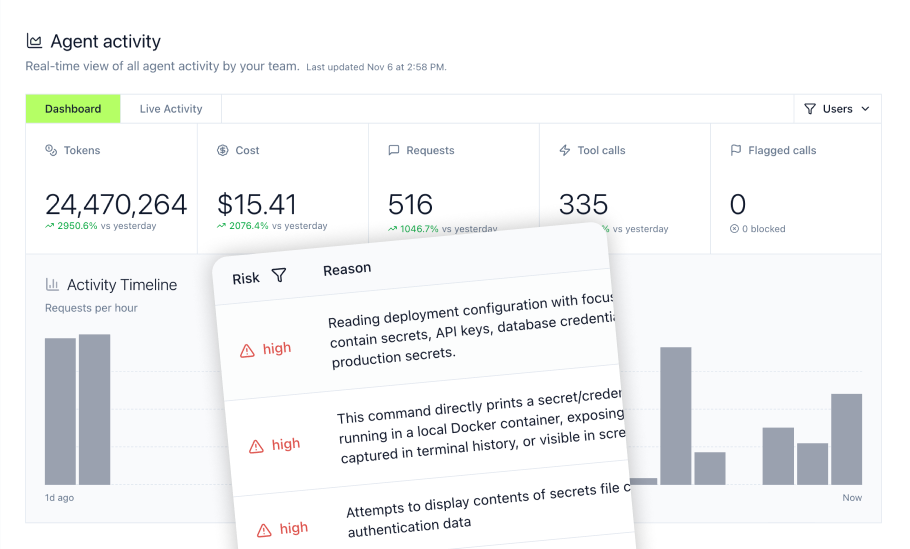
- Real-Time Monitoring – Live dashboards showing server health, usage patterns, tool call tracking, and security alerts across all MCP connections
- Granular Access Control – Configure tool access by role with read-only operations for analysts while restricting write tools to authorized administrators
- Virtual MCP Servers – Create team-specific virtual servers that expose only the minimum required tools, not entire MCP servers, with fine-grained, role-based access
Security architecture:
MintMCP implements defense-in-depth security through centralized governance, OAuth + SSO enforcement, and observability controls that address widely reported security/compliance concerns—for example, 62% of leaders are very concerned about AI compliance and 53% of organizations feel overwhelmed by AI regulations. The platform provides complete visibility into which teams use which tools, when they access data, and how frequently—solving the visibility black hole that exists with direct agent-to-tool connections.
Enterprise integrations:
- Snowflake data warehouse access with natural language queries and Cortex Analyst support
- Elasticsearch knowledge base search for HR documentation, support tickets, and log analysis
- Gmail integration for AI-driven customer response automation
- Custom MCP server deployment for internal tools and APIs
Deployment speed
Deploy in minutes with pre-configured policies and self-service access for developers
Compliance
SOC2 Type II certified
Pricing
Contact for enterprise demonstration and pricing
Getting started
Visit mintmcp.com/mcp-gateway for the deployment guide
2. Docker MCP gateway – Container-Based infrastructure
Docker's MCP Gateway brings container orchestration expertise to MCP server management, providing a Docker-native gateway to run and manage MCP servers with Docker Desktop/CLI and Docker Compose. The solution focuses on containerized hosting and lifecycle management for MCP servers at scale.
Key features:
- Container isolation for MCP server deployments
- Docker and Docker Compose integration for orchestration and scaling
- Docker Compose configurations for development environments
- Standard container security practices and image management
Best for
Organizations with existing Docker environments seeking to run and manage MCP servers behind a unified gateway; ideal for teams already managing containerized workloads.
Limitations
Requires Kubernetes expertise for production deployment; less focused on authentication and authorization compared to purpose-built gateways; assumes teams have container orchestration capabilities already established.
- Deployment Model: Self-hosted on Kubernetes clusters
- Pricing: Open-source (MIT license); infrastructure costs vary
3. Traefik hub MCP gateway – middleware approach
Traefik Hub extends the popular Traefik reverse proxy with MCP-specific middleware, offering organizations already using Traefik a natural extension point.
Core capabilities:
- Integration with existing Traefik deployments
- Middleware-based request policy-based request filtering (allow/deny)
- OpenTelemetry metrics and traces for MCP operations (viewable alongside your existing Hub observability stack)
Architecture
Functions as a middleware layer within the Traefik ecosystem, routing MCP requests alongside traditional HTTP traffic. Provides centralized logging and observability through Traefik's standard monitoring tools.
Ideal use cases
Organizations already standardized on Traefik for API gateway functionality who want to add MCP support without deploying separate infrastructure; teams seeking unified management of APIs and MCP servers.
4. Lasso security MCP gateway – Security-First architecture
Lasso Security built an open-source, security-focused MCP Gateway with security as the foundational design principle, addressing what CTO Lior Ziv describes as MCP's "revolutionary potential" alongside its "security blind spots." The platform focuses specifically on protecting agentic workflows from prompt injection, credential theft, and tool poisoning attacks.
Security features:
- Real-time prompt injection detection and blocking
- Credential encryption and secure secret management
- Tool authorization with parameter validation
- Network filtering and allowlisting for MCP destinations
- Comprehensive audit trails for security events
Protection layers
Implements a triple-gate security pattern protecting three distinct layers: AI layer (prompt filtering, PII detection), MCP layer (tool authorization, parameter validation), and API layer (rate limiting, authentication).
Target audience
Organizations prioritizing security compliance and threat protection in AI deployments, particularly those in regulated industries or handling sensitive data requiring a defense-in-depth security architecture.
- Focus: Security-first MCP gateway for enterprise agentic workflows
- Deployment: Cloud-managed service with enterprise SLA
5. Obot platform – open source MCP orchestration
The Obot Platform provides open-source MCP gateway capabilities as part of a broader AI agent orchestration framework. Built for organizations seeking full control over their infrastructure, Obot emphasizes transparency and extensibility through its open-source architecture.
Platform capabilities:
- Open-source gateway implementation with community support
- Agent workflow orchestration via the companion Nanobot framework, beyond basic MCP routing.
- Extensible architecture for custom integrations
- Self-hosted deployment with full infrastructure control
Architecture model
Transforms operational complexity from managing N individual servers to a single unified interface that routes to all backend servers, providing the hub-and-spoke model that eliminates point-to-point mesh complexity.
Best suited for
Platform engineering teams with DevOps expertise who require full infrastructure ownership, organizations building custom AI agent platforms, and teams prioritizing open-source tools for transparency and community-driven development.
- Source Code: Available on GitHub
- Support Model: Community-driven with optional commercial support
6. Lunar.Dev MCPX – Developer-Focused gateway
Lunar.dev's MCPX is a production-grade MCP gateway that centralizes policy enforcement, access control, and observability to take MCP from local experimentation to governed, production deployments. It’s designed to integrate with enterprise identity and monitoring while keeping data flows within your infrastructure.
Developer features:
- Centralized RBAC and policy enforcement
- Full observability (latency, token/cost, request tracing)
- Supports STDIO and remote HTTP/SSE MCP servers
- Docker/Kubernetes deployment with optional SaaS dashboards
- Developer-friendly configuration and tooling
Positioning
Designed for development teams building and testing AI agent workflows rather than large-scale production deployments requiring enterprise governance and compliance controls.
- Target Users: Platform/infra teams deploying MCP to production; application teams building AI agents
- Deployment: Self-hosted via Docker/Kubernetes with optional SaaS dashboards (telemetry/control plane)
7. API gateway platforms – extension approach
Traditional API gateway vendors are extending existing API management platforms with MCP support.
Approach:
- Extend existing API gateway infrastructure with MCP protocol support
- Leverage established authentication, rate limiting, and monitoring capabilities
- Unified management of APIs and MCP servers through a single platform
- Reuse existing integrations with identity providers and monitoring tools
Advantages
Organizations already standardized on specific API gateway platforms can add MCP support without deploying separate infrastructure. Unified operational model across APIs and MCP servers reduces complexity.
Considerations
These platforms typically focus on publishing/proxying remote HTTP/SSE MCP endpoints rather than launching STDIO servers. Authorization models vary by vendor; integration is easiest where your existing gateway already connects to your IdP/policy stack used for AI agent workflows. Integration requires expertise in both API gateway configuration and MCP protocol specifics.
Best for
Enterprises with established API gateway investments are seeking to extend existing infrastructure rather than deploy purpose-built MCP solutions.
Making your choice: Essential selection criteria
Deployment speed vs. Control trade-offs
Purpose-built gateways like MintMCP provide immediate deployment with pre-configured security policies, while self-hosted open-source options require infrastructure setup but offer full control. Consider whether you need production deployment in days or can invest weeks building custom infrastructure.
Security and compliance requirements
Organizations in regulated industries face security concerns as the top challenge at 53-62% of respondents. SOC2 Type II certification and complete audit trails aren't optional for healthcare, finance, or enterprises handling sensitive data. Evaluate whether your gateway provides these certifications or requires you to implement compliance controls yourself.
STDIO vs. Remote server support
The critical question is whether your gateway handles STDIO-based MCP servers, which represent the majority of community-built servers but are "difficult to deploy" without proper infrastructure. Solutions that only support HTTP/SSE remote servers limit your ecosystem access and require rebuilding existing STDIO tools.
Authentication architecture
OAuth 2.1 support was added to the MCP specification in June 2025, but implementation varies significantly. Some gateways automatically wrap servers with enterprise SSO, while others require manual OAuth configuration per server. Consider whether you need shared service accounts, per-user authentication, or both, depending on your use cases.
Observability and monitoring
Without comprehensive logging and monitoring, organizations face a "visibility black hole" where they cannot see which tools agents use or track data access. Essential metrics include tool call tracking, performance analytics, error rates, and cost allocation per team. Evaluate whether your gateway provides real-time dashboards or requires separate monitoring infrastructure.
Operational model requirements
Managing 42% of enterprises building 100+ AI agent prototypes requires streamlined operations. Consider whether you need server discovery catalogs, centralized credential management, automated lifecycle management, and self-service access, or can allocate 0.5-2 FTE for manual gateway administration.
Integration ecosystem
Assess which data sources your AI agents need to access. If your requirements include Snowflake data warehouses, Elasticsearch knowledge bases, or custom internal tools, verify your gateway supports these integrations without extensive custom development.
Understanding MCP gateway architecture: Why IT matters
MCP gateways solve fundamental problems that cannot be addressed through direct agent-to-tool connections at enterprise scale. The architecture transforms an exponentially complex N-to-N mesh into a manageable 1-to-N hub-and-spoke model where the gateway provides a single control plane for authentication, authorization, security policies, and observability.
The Point-to-Point problem
Without gateways, organizations face fragmented security policies across dozens of individual MCP servers, zero visibility into which agents access which tools, duplicated authentication logic, and inconsistent logging. This creates the "operational chaos" that makes production deployment impossible.
Gateway value proposition
Centralized gateways provide unified authentication, eliminating scattered credentials, complete audit trails for compliance, real-time monitoring across all interactions, simplified troubleshooting through a single logging endpoint, and shared caching and rate limiting. For organizations deploying 10+ MCP servers, the operational benefits justify gateway infrastructure investment within a 3-4 month payback period.
Security architecture
The "triple-gate pattern" implements defense-in-depth with three distinct security layers: Gate 1 protects AI client→LLM communication (prompt injection, PII filtering), Gate 2 protects LLM→MCP server communication (tool authorization, parameter validation), and Gate 3 protects MCP server→external API communication (rate limiting, authentication). This layered approach addresses the security vulnerabilities that affect 43% of analyzed MCP servers.
Implementation roadmap: Deploying your MCP gateway
Phase 1: Pilot deployment (2-4 weeks)
Begin with a limited scope deployment for 10-50 users accessing 3-5 carefully selected MCP servers. Choose low-risk use cases like internal knowledge base search or development tool integration. This phase validates architecture, identifies integration challenges, and establishes baseline metrics without organization-wide risk.
Phase 2: Governance framework (4-8 weeks)
Establish policies for server vetting and approval, define role-based access controls aligned with organizational structure, implement monitoring and alerting for security events, and document operational procedures for ongoing management. Create a governance council, including security, legal, and business stakeholders, to approve new MCP server deployments.
Phase 3: Enterprise rollout (8-12 weeks)
Expand to additional teams and use cases based on pilot success metrics. Integrate with enterprise identity providers for SSO enforcement. Connect production data sources like data warehouses and enterprise search. Enable self-service access for developers while maintaining centralized governance. Monitor usage patterns to optimize resource allocation and identify additional integration opportunities.
Success metrics
Track deployment velocity (time from server request to production), security events detected and prevented, developer satisfaction with tooling access, compliance audit preparation time, and cost per AI interaction. Organizations report around 60-80% reduction in time spent on authentication setup with centralized gateway infrastructure.
Frequently asked questions
What's the difference between an MCP gateway and a traditional API gateway?
A: MCP gateways specifically handle the Model Context Protocol for connecting AI assistants to tools and data, supporting both STDIO and HTTP/SSE transport mechanisms. Traditional API gateways route HTTP/REST requests between services. While some API gateway vendors are adding MCP features, purpose-built MCP gateways understand protocol-specific requirements like context state management across multi-step agent workflows, tool authorization semantics, and STDIO server hosting that traditional gateways don't address.
How quickly can I deploy an MCP gateway in my organization?
Deployment speed varies by approach. Managed services like MintMCP Gateway enable production deployment in minutes with one-click STDIO server deployment and pre-configured security policies. Self-hosted open-source solutions require 2-4 weeks for infrastructure setup, authentication integration, and security configuration. Traditional API gateway extensions require 4-8 weeks to implement MCP protocol support and configure enterprise controls. Consider your urgency for production deployment versus infrastructure control requirements.
How do MCP gateways prevent shadow AI tool usage?
Gateways transform shadow AI into sanctioned AI by providing centralized authentication that requires all AI agent connections to route through governed infrastructure. The gateway catalogs approved MCP servers, enforces role-based access controls, determines which users access which tools, maintains complete audit trails of every tool invocation, and blocks unauthorized server connections. Organizations gain visibility into exactly which tools teams use, when they access data, and how frequently—eliminating the visibility gap that enables shadow AI proliferation.
What authentication methods do MCP gateways support?
Enterprise gateways support OAuth 2.1 (the standard added to the MCP specification in June 2025), SAML for enterprise SSO integration, OpenID Connect (OIDC) for modern identity providers, and API token management for service accounts. Leading implementations provide both shared service accounts configured at the admin level and per-user OAuth flows, enabling individual authentication. This flexibility addresses the authorization challenges enterprises face when internal practices conflict with standard OAuth flows.
Can MCP gateways work with coding agents like Cursor and Claude code?
Yes, specialized gateways like MintMCP's LLM Proxy monitor every MCP tool invocation, bash command, and file operation from Cursor, Claude Code, and other coding agents. The proxy sits between the LLM client and model, tracking which MCPs are installed, blocking dangerous commands in real-time, protecting sensitive files like .env credentials, and maintaining complete audit trails. This addresses the unique security challenges of coding agents that operate with extensive system access—reading files, executing commands, and accessing production systems through MCP tools.