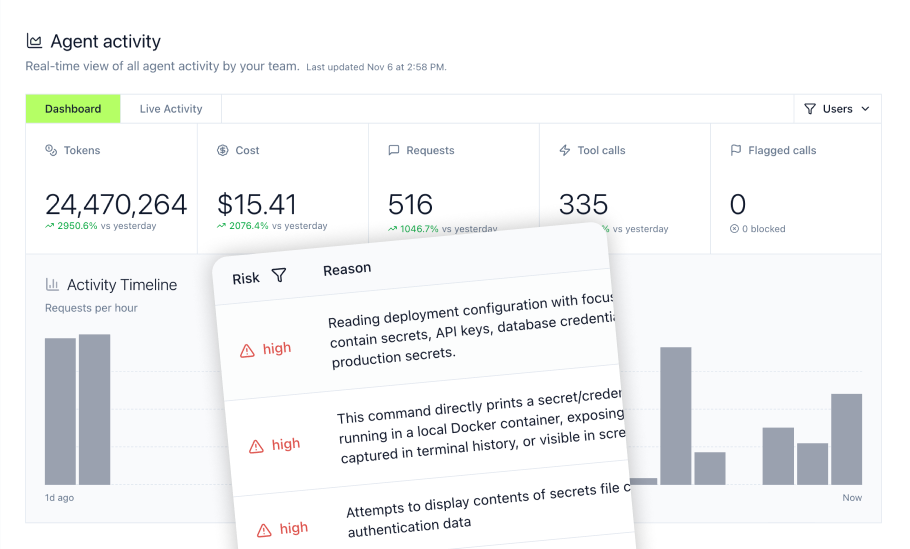
Healthcare organizations face a critical infrastructure decision as AI adoption accelerates: many report needing infrastructure upgrades to deploy agents securely, while the MCP ecosystem has grown rapidly, with many servers and integrations emerging across the ecosystem. Without proper governance, AI tools operate as black boxes with significant security risks: zero telemetry, no request history, and uncontrolled access to protected health information.
An MCP Gateway serves as the security and governance layer between AI agents (Claude, ChatGPT, Cursor, Gemini, and Copilot) and your healthcare systems. It handles authentication, permissions, audit trails, and the compliance complexity that enterprise deployments demand. For healthcare, this means compliance-supporting logging, PHI protection workflows, and integration patterns for EHR systems like Epic and Cerner.
We analyzed 8 MCP gateway solutions across compliance readiness, healthcare integrations, and security features to identify the best options for healthcare organizations in 2026.
Key Takeaways
- Compliance is non-negotiable: Healthcare organizations need MCP gateways that support auditable access, identity controls, and policy enforcement for AI systems that may interact with PHI.
- Healthcare-specific solutions are emerging: Purpose-built platforms like Keragon and HMCP focus on healthcare integrations, FHIR support, and clinical workflow requirements.
- Security layers matter: Analysts and security researchers warn that adopting agentic AI without governance materially increases the likelihood of security incidents over the next few years.
- Performance vs. compliance trade-offs exist: Some gateways report single-digit millisecond gateway overhead in published benchmarks, while security-first options may add latency for threat scanning and policy enforcement.
1. MintMCP Gateway: Enterprise Compliance for Regulated Healthcare
MintMCP Gateway is an MCP platform designed for regulated environments, including healthcare and financial services. MintMCP focuses on authentication, tool-level access control, credential management, logging, rule-based policy, and agent governance for internal employee and internal-agent use cases.
What Makes MintMCP Different
MintMCP addresses the reality that healthcare organizations need AI access to start from governed data permissions, not from agent experimentation. The platform supports SSO, SCIM-driven RBAC, IdP groups, tool-level allowlisting, audit logs, and Virtual MCP Bundles before enabling agents on top. Virtual MCP Bundles expose only the minimum required tools per team or use case, not entire server capabilities, enforcing least-privilege access at the infrastructure level.
Key Healthcare Features
- SOC 2 Type II audited security controls and compliance with HIPAA standards, with BAA availability
- SSO and SCIM-driven RBAC for governed access by team, role, and use case
- Virtual MCP Bundles for granular, team-specific tool exposure with SCIM-driven membership
- Tool-level allowlisting, rule-based policy, credential management, and audit logs
- Centralized observability for server health, usage patterns, and security alerts
- Gateway + Agent Monitor two-layer governance for Claude, Cursor, ChatGPT, Gemini, and Copilot workflows
- Hosted MCP connectors run by MintMCP, plus OAuth brokering for stdio and hosted MCP servers
- Enterprise SLAs with managed SaaS-first deployment
Healthcare Applications
- Clinical documentation teams: Connect AI assistants to EHR systems with controlled read/write permissions
- Revenue cycle: Enable AI agents to access billing data through governed database connectors
- IT security teams: Track tool calls, local agent activity, bash commands, and file access via gateway logging and Agent Monitor coverage
Deployment: Managed SaaS-first in the US and EU, with VPC/self-hosted deployment available on request
2. Keragon Healthcare MCP
Keragon represents an MCP server platform designed for healthcare environments. Unlike general-purpose gateways requiring custom integration work, Keragon focuses on pre-built healthcare connectors spanning EHRs, billing systems, scheduling platforms, and clinical workflows.
Primary Healthcare Focus
Most MCP servers require healthcare organizations to configure security, compliance, and access control independently. Keragon positions these as core product features: audit logging, least-privilege controls, and healthcare workflow support. Healthcare organizations should validate current SOC 2 Type II attestation status, BAA availability, and integration coverage during procurement.
Native Healthcare Integrations
- EHR Systems: Epic, Cerner, Athenahealth, NextGen, eClinicalWorks
- Billing Platforms: Kareo, AdvancedMD, DrChrono
- Scheduling: Acuity, Calendly, SimplePractice
- CRM: Salesforce Health Cloud, HubSpot Healthcare
- Clinical Tools: Lab systems, imaging archives, pharmacy management
Healthcare Applications
- Prior authorization automation with direct payer rule access
- Patient intake workflows connecting scheduling, insurance verification, and EHR updates
- Clinical decision support integrating guidelines with real-time patient data
Compliance: Validate SOC 2 Type II attestation status and BAA availability during procurement
3. HMCP by Innovaccer
HMCP (Healthcare MCP) extends the Model Context Protocol with healthcare-specific guardrails, patient identification resolution, and FHIR integration. Developed by Innovaccer, HMCP addresses protocol-level requirements common to clinical AI deployments.
Healthcare Protocol Extension
HMCP is not just a gateway; it is a healthcare-specific extension of the MCP specification itself. The open-source approach is designed to support broader adoption, while the managed Cloud Gateway provides infrastructure for production deployments. Healthcare teams should evaluate HMCP against their interoperability, identity resolution, and audit requirements before connecting AI agents to clinical systems.
Healthcare-Specific Capabilities
- Patient Identity Resolution: Enterprise Master Patient Index (EMPI) integration to reduce misidentification risk
- FHIR API Integration: R4/R5 support for standards-based healthcare interoperability
- Healthcare Guardrails: Context management designed for clinical decision-making
- Encrypted Data Handling: PHI protection patterns at the protocol layer
- OAuth2 + Audit Trails: Compliance-supporting logging and rate limiting
Architecture Components
- HMCP Specification (open-source)
- HMCP SDK (Client + Server libraries)
- HMCP Cloud Gateway (managed service)
4. Lasso Security MCP Gateway
Lasso Security brings AI security controls to MCP deployments, with a focus on protecting agentic systems across AI, MCP, and API layers.
Security-First Architecture
Healthcare's threat landscape extends beyond traditional security. AI agents face prompt injection attacks, jailbreak attempts, and data exfiltration through tool calls. Lasso provides threat detection designed for these agentic attack vectors, with PII masking and redaction capabilities in requests and responses, which can support PHI protection workflows.
Security Capabilities
- Threat detection: Prompt injection, jailbreaks, data exfiltration attempts
- PII redaction: Masking of sensitive data in requests/responses
- Tool reputation analysis: Evaluates MCP server trustworthiness before loading
- Layered security pattern: Defense-in-depth across AI, MCP, and API layers
- Plugin-based architecture: Extensible security controls for healthcare-specific needs
Performance Consideration
Security scanning and policy enforcement can add latency. Healthcare organizations should test Lasso against their own workflows, especially where real-time clinical response requirements matter.
Best For: Regulated industries requiring comprehensive security monitoring, including healthcare and financial services
5. Operant AI MCP Gateway
Operant AI focuses on AI and cloud security, including MCP security, API protection, and runtime detection and response for agentic systems. The company's security research includes analysis of agentic exploit patterns such as "Shadow Escape."
Security Research Leadership
Operant publishes guidance on securing MCP deployments and detecting emerging agentic attack vectors. Its context-aware access control evaluates runtime risk posture, adapting permissions based on current threat conditions rather than relying only on static rules.
Security Research & Capabilities
- Shadow Escape detection: Protection patterns for zero-click agentic exploits
- MCP Catalog + Registry: Discovery and governance of MCP servers across the organization
- AI-DR (Detection & Response): Incident response for cloud and AI workloads
- Context-aware access: Dynamic authorization based on runtime risk assessment
Healthcare Relevance
Operant has published analysis on the security gap in healthcare agentic AI, making it relevant for healthcare organizations prioritizing threat detection, runtime response, and MCP inventory governance.
Healthcare Relevance: Useful for healthcare security teams evaluating MCP discovery, runtime monitoring, and agentic threat detection
6. TrueFoundry MCP Gateway
TrueFoundry publishes MCP gateway performance benchmarks reporting low single-digit millisecond gateway latency and 350+ requests per second per core. For healthcare organizations running time-sensitive AI workflows, this performance profile may be important.
Performance-Optimized Infrastructure
TrueFoundry provides a unified control plane for LLM and MCP infrastructure, reducing the need for separate tooling. In-memory policy enforcement is designed to support high-throughput processing without introducing database bottlenecks. Healthcare organizations should distinguish gateway overhead from full end-to-end clinical workflow latency during testing.
Performance & Security Features
- Low single-digit millisecond gateway latency: In-memory policy enforcement in published benchmarks
- OAuth 2.0 Identity Injection: On-Behalf-Of authentication for user-context preservation
- Hybrid deployment: Managed SaaS and self-hosted control plane options
- Unified AI infrastructure: Single platform for LLM routing and MCP governance
Best For: Healthcare organizations requiring fast AI responses, such as clinical decision support, ambient documentation, and emergency department triage workflows
7. Bifrost by Maxim AI
Bifrost delivers performance for healthcare organizations prioritizing speed, with published gateway overhead around 11µs. Built in Go for performance, Bifrost is open-source under the Apache 2.0 license with enterprise options available.
High-Performance Open Source
Bifrost claims major speedups versus some proxies in published benchmarks. Zero-configuration deployment can reduce time-to-production. Semantic caching may reduce costs for healthcare organizations scaling AI across departments.
Technical Capabilities
- Multi-provider support: Unified interface across multiple LLM providers
- Semantic caching: Cost reduction through intelligent response caching
- Stateless security: Client-side control over tool execution
- Enterprise features: SSO, HashiCorp Vault integration, custom plugins
Deployment Options
- Open-source (Apache 2.0 license) for full customization
- Enterprise version with trial options
- Self-hosted-first deployment using a Go binary or Docker
Best For: Healthcare development teams requiring maximum flexibility and performance with open-source transparency
8. Azure API Management
Azure API Management provides integration for healthcare organizations invested in Microsoft infrastructure. Native Azure AD/Entra ID authentication, Azure Monitor observability, and compatibility with Azure Health Data Services make this a consideration for Azure-centric health systems.
Azure Ecosystem Integration
Healthcare organizations using Azure Health Data Services gain compatibility with Microsoft-native identity, monitoring, and governance patterns. The gateway leverages existing Azure compliance frameworks, audit logging, and identity management rather than introducing new systems.
Azure-Native Features
- Azure AD/Entra ID: Native authentication without additional identity providers
- Azure Monitor + App Insights: Observability through familiar tools
- Kubernetes-native routing: Session-aware routing on AKS
- Azure deployment model: Azure Kubernetes Service (AKS) plus Azure API Management
Best For: Healthcare organizations maximizing existing Microsoft infrastructure investments, particularly those using Azure Health Data Services
Deployment: Azure Kubernetes Service (AKS) + Azure API Management (APIM)
Selecting the Right Gateway: Healthcare-Specific Criteria
Compliance Certification Matters
Not all compliance claims carry equal weight. SOC 2 Type II audited security controls require independent auditor review of security controls over time, a significant difference from self-attested compliance. For healthcare, prioritize gateways with verified attestations and the ability to provide Business Associate Agreements (BAAs).
Integration Depth vs. Breadth
Healthcare-native platforms like Keragon offer pre-built integrations but may lack flexibility for custom systems. General-purpose gateways like MintMCP and TrueFoundry require integration work but support a broader range of MCP servers. Consider your EHR landscape and IT team capacity when deciding.
For organizations needing both governance and healthcare integrations, combining a governance platform like MintMCP with healthcare connectors provides maximum flexibility. MintMCP's Elasticsearch connector enables AI-powered search across clinical documentation, while the Snowflake integration supports analytics on patient engagement and financial data.
Performance vs. Security Trade-offs
Real-time clinical decision support may require very low gateway overhead and careful end-to-end latency testing. PHI-heavy workflows may benefit from comprehensive threat scanning even when it adds latency. Most administrative and documentation use cases tolerate moderate latency in exchange for stronger security controls, better auditability, and centralized governance.
Deploy Enterprise Healthcare AI with Confidence
The Model Context Protocol has changed how healthcare organizations connect AI assistants to clinical systems and patient data. But as this analysis demonstrates, deploying MCP at scale requires more than just protocol support. It demands security, governance, and monitoring that transforms experimental AI into production-ready infrastructure.
MintMCP Gateway offers a practical path from pilot to production for healthcare organizations, with managed SaaS-first deployment, SOC 2 Type II attestation, HIPAA Compliant (BAA Available), and hosted MCP connectors for enterprise data sources. The platform helps remove technical barriers that keep organizations stuck in AI pilot purgatory while maintaining the governance posture required for regulated healthcare environments.
Whether you're securing access to Snowflake data warehouses, Elasticsearch knowledge bases, or custom EHR integrations, MintMCP provides the infrastructure that makes healthcare AI deployment practical, auditable, and secure.
Ready to transform your healthcare AI infrastructure? Visit MintMCP to schedule a demo and see how MintMCP Gateway can accelerate your enterprise AI deployment.
Frequently Asked Questions
What is an MCP Gateway and why do healthcare organizations need one?
An MCP Gateway sits between AI agents (like Claude, ChatGPT, Cursor, Gemini, or Copilot) and your internal systems, handling authentication, permissions, and audit logging. Healthcare organizations need this layer because AI tools without governance operate as black boxes, accessing patient data without visibility or control. Gateways provide the audit trails required for compliance programs and the security controls to protect PHI from unauthorized AI access.
How do MCP Gateways ensure compliance?
Compliance-ready MCP gateways implement technical safeguards including: role-based access control with unique user identification, complete audit logs of PHI access (who accessed what, when, and from where), integrity controls preventing unauthorized data alteration, and encryption of data in transit. Platforms like MintMCP provide SOC 2 Type II audited security controls and compliance with HIPAA standards, with BAA availability, while healthcare-native solutions like Keragon build healthcare workflow controls into their integrations.
Can MCP Gateways integrate with Epic, Cerner, and other EHR systems?
Yes, through different approaches. Healthcare-native platforms like Keragon provide pre-built EHR connectors for Epic, Cerner, Athenahealth, and other systems. General-purpose gateways require custom MCP server development or third-party connectors. HMCP by Innovaccer offers FHIR-native integration, enabling standardized connectivity with FHIR R4/R5-compliant EHRs.
What's the typical deployment timeline for healthcare organizations?
Deployment timelines vary significantly by approach. Managed SaaS-first platforms like MintMCP can support rapid setup through hosted connectors and gateway-managed MCP access. Healthcare-native solutions like Keragon may offer faster time-to-value where their pre-built integrations match the target workflow. Enterprise deployments with custom security requirements, on-premise infrastructure, and EHR integration typically require longer security review, BAA execution, and testing.
What security threats are specific to healthcare AI agents?
Beyond traditional security concerns, healthcare AI agents face: prompt injection attacks attempting to extract patient data, jailbreak attempts bypassing PHI access controls, data exfiltration through tool calls to external systems, and zero-click exploit patterns targeting agentic architectures. Security-focused gateways like Lasso and Operant specifically detect these attack patterns, while MintMCP's gateway and Agent Monitor provide tool-level policy, audit logs, and visibility into MCP and local agent activity.