Enterprise teams deploying AI coding agents face a critical choice between OpenAI's Codex and Anthropic's Claude Code. Both tools accelerate developer productivity and offer native enterprise security controls, but organizations running multiple coding agents may still need unified governance across their enterprise integrations. A centralized governance layer can manage downstream credentials, enforce tool-level policies, and maintain audit trails for governed MCP interactions across supported coding agents.
This article provides a comprehensive comparison of Codex and Claude Code capabilities, cost structures, and integration requirements, plus actionable guidance on governing AI coding agents at enterprise scale.
Key Takeaways
- Most enterprises benefit from running both Codex and Claude Code rather than standardizing on one, with different tools serving different workflow types
- Both tools offer large context windows, with model-dependent limits that support complex, multi-file operations
- Codex and Claude Code support both local and cloud-based workflows: Codex offers GitHub-integrated task automation, local execution, and configurable approvals, while Claude Code supports interactive development, background tasks, cloud execution, and granular permission controls
- Enterprise governance requires unified control across coding agents for consistent downstream tool permissions, agent-specific credentials, and cross-platform audit trails
- Virtual MCPs enable role-based access through a single endpoint, eliminating per-developer configuration across enterprise connectors
- Agent identities give autonomous agents their own credentials, scoped permissions, and audit trails independent from human users
Understanding AI Coding Assistants: What Are They and Why They Matter
AI coding assistants have shifted from autocomplete suggestions to autonomous agents capable of writing, testing, and deploying code with minimal human oversight. These tools integrate directly into development environments, processing natural language instructions and executing multi-step programming tasks.
The Rise of AI in Software Development
The current generation of coding agents differs fundamentally from earlier code completion tools. Modern AI coding assistants can run multiple agents simultaneously, manage complex refactoring operations, and interface directly with version control systems. Development teams report significant productivity gains when these tools are properly integrated into existing workflows.
Key Capabilities of Modern AI Coding Tools
Both Codex and Claude Code share core capabilities that define the category:
- Code generation: Converting natural language specifications into working code across multiple programming languages
- Debugging assistance: Identifying errors, suggesting fixes, and explaining code behavior
- Refactoring support: Restructuring existing codebases while maintaining functionality
- Documentation: Generating inline comments, README files, and API documentation
- Test creation: Writing unit tests, integration tests, and test fixtures
The distinction between tools lies in execution model, integration depth, and permission handling rather than fundamental capabilities.
Codex vs. Claude: A Feature Comparison for Enterprise Teams
Enterprises evaluating these tools need to assess technical capabilities against operational requirements. The choice often depends on existing infrastructure, workflow preferences, and security posture.
Code Generation Quality: Accuracy and Efficiency
Codex supports both local execution and cloud-based sandboxes for asynchronous tasks. Teams can work interactively through the CLI or IDE, or delegate work to cloud environments and review proposed changes. Multiple tasks can run in parallel across supported workflows.
Claude Code supports an interactive, terminal-first approach alongside cloud-based execution. Developers can work locally with real-time feedback or delegate tasks to remote environments, including parallel sessions that continue running independently.
Integration and Workflow Compatibility
Codex strengths:
- GitHub integration with Actions and PR workflows
- Parallel task execution across multiple agents
- Local and cloud execution options
- Configurable approval policies
Claude Code strengths:
- Model Context Protocol ecosystem support
- Granular, hook-based permission controls
- Interactive and background task modes
- Strong reasoning for deep refactoring
Security, Compliance, and Data Handling
Both tools provide native enterprise governance capabilities. Organizations may add separate infrastructure to unify downstream tool permissions, agent-specific credentials, and audit visibility across multiple coding platforms. Teams using both tools must maintain configuration files for each, creating opportunities for centralized management.
The governance question becomes critical when:
- Audit trails must span multiple coding agents and enterprise systems
- Tool-level access control must align with corporate identity systems
- Credentials need centralized management rather than per-developer storage
- Policy enforcement must operate consistently across different AI clients
Maximizing Developer Productivity with AI Pair Programming
Effective AI pair programming requires matching the right tool to the right task type. The hybrid approach, using both Codex and Claude Code, has emerged as a common pattern among enterprise development teams.
How AI Enhances the Developer Experience
The productivity gains from AI coding agents come from reducing context switching and automating routine work. At Modern Treasury, an engineering leader reported that agents save Technical Account Managers 30 minutes to 4 hours per support case by automating bank integration lookups against internal documentation. This example illustrates how governed access to internal systems can reduce time spent on routine lookup and synthesis tasks.
Best Practices for Integrating AI into Your Team's Workflow
Successful integration requires:
- Role-based tooling: Senior engineers use Claude Code for architecture work; junior developers use Codex for supervised automation
- Workflow segmentation: Background automation through Codex, interactive development through Claude Code
- Centralized governance: Single control plane for both tools to maintain audit consistency
- Credential management: Eliminate API keys scattered across developer laptops
AI Code Generation: Free vs. Enterprise Solutions
Both Codex and Claude Code offer subscription-based access alongside usage-dependent options, making controlled testing with representative tasks more reliable than generalized cost-per-task comparisons. The visible cost of the coding agent represents only part of the total investment.
Evaluating the Total Cost of Ownership
Organizations using free or individual-tier agents in enterprise contexts should account for the operational cost of manual policy enforcement alongside licensing expenses. Engineering time spent configuring developer environments, rotating credentials, and producing audit reports can increase total costs, making centralized governance worth evaluating against the cost of maintaining separate configurations.
Hidden costs of ungoverned deployment include:
- Manual policy enforcement: Engineering time spent on configuration and compliance
- Security incident response: Reactive rather than proactive protection
- Audit gaps: Risk exposure from incomplete logging
- Credential rotation: Per-developer management overhead
The Value of Enterprise-Grade AI Coding Tools
Enterprise deployments require capabilities that span multiple coding agents:
- Centralized identity management through existing IdP infrastructure
- Audit logs exportable to SIEM systems
- Tool-level permissions aligned with SCIM directory groups
- Runtime guardrails for prompt injection and data exfiltration
The MCP data risk framework provides a structured approach to assessing and mitigating these risks before deployment. The NIST framework provides broader guidance for identifying and managing AI deployment risks.
Governing Your AI Coding Agents: A Mintive Approach
The Codex vs Claude Code choice matters less than the governance infrastructure surrounding both tools. Teams need a single control layer that works across AI clients, models, and agents.
Centralizing Control Over Disparate AI Tools
Mintive's MCP Gateway serves as a governed entrypoint between AI clients and enterprise systems. The gateway authenticates users through existing identity providers, curates which tools each role can access, injects credentials per call, and logs governed interactions.
The key abstraction is the Virtual MCP: multiple connectors bundled behind one endpoint. Users connect once instead of configuring each MCP server individually.
What Virtual MCPs provide:
- One endpoint with unified auth and tool access
- SCIM-driven access policies based on directory groups
- Read-only vs read-write separation through tool curation
- Credential injection without long-lived secrets
Ensuring Secure and Compliant Agent Operations
Agent identities extend governance to autonomous coding agents. Each agent receives its own credential, scoped MCP access, and audit trail separate from the human who created it.
Authentication options scale from simple to secure:
- Bearer keys: Static key with name, expiry, and individual revocation
- M2M tokens: OAuth client-credentials exchange for short-lived tokens
- Workload identity federation: Agent's own infrastructure mints short-lived OIDC tokens
This architecture prevents agents from running on whichever human's API key was available, which collapses audit logs and breaks credential rotation.
Visibility and Monitoring for AI-Assisted Development Workflows
Governance requires visibility. Teams cannot secure what they cannot see, and AI coding agents operating across endpoints create blind spots for security teams.
Gaining Insight into Agent Activity
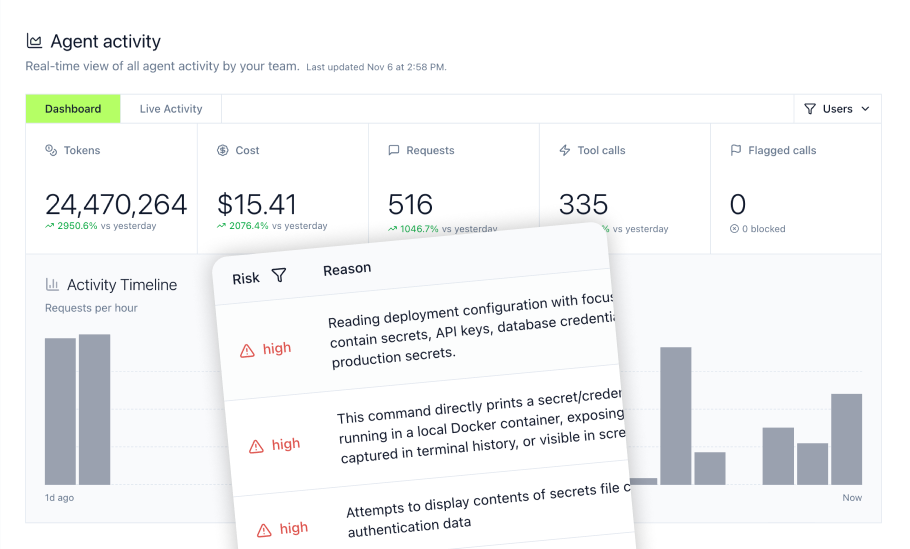
Agent Monitor provides visibility into supported coding-agent activity, including file access, command execution, MCP tool calls, prompts, and token usage where available. This visibility extends beyond gateway traffic to supported local agent environments, with coverage depending on the client and monitoring integration.
The system logs:
- File reads including .env files and SSH keys
- Commands executed through bash, package installers, and git
- MCP tool calls with full argument and result capture
- Prompts submitted to the underlying models
- Token usage and cost by supported dimensions
Proactive Security with Agent Monitoring
Rules enable intervention based on agent activity:
- Built-in detection: Secrets exposure, prompt injection, tool permission violations
- Custom rules: Tool-argument patterns, regex matching, content filtering
- Actions: Flag, block, ask-user, mask, or send Slack notifications
SIEM export through OTLP or Splunk HEC ensures agent activity integrates with existing security operations workflows. Monitoring supports proactive security responses for covered agent activity. When supported monitoring hooks capture attempts to access sensitive files or execute risky commands, security teams can investigate those events and apply configured rules.
Securing Your Code: Guardrails for AI Coding Agents
Visibility tells you what happened. Guardrails determine what can happen. Enterprise deployments need both.
Preventing Malicious or Erroneous Code Generation
Mintive's guardrails operate through three coexisting layers:
Mint Guard provides managed detection policies for:
- Prompt injection blocking at high confidence
- Credentials and secrets detection
- PII identification
- Harmful content screening
When enabled, Mint Guard screens eligible gateway tool calls according to its configured monitoring or enforcement mode, without requiring teams to author custom detection policies.
Rules enable declarative pattern matching on:
- Tool names and argument patterns
- Content via regex
- Actions including flag, block, ask, mask, and notify
Gateway Middleware supports customer-authored logic for:
- DLP integrations with supported security tools
- External classifier calls
- Content transformation and redaction
- Resource allowlists
Customizing Security Policies for Your Development Environment
The middleware architecture runs customer JavaScript on every matching call. This enables:
- Block supported MCP tool calls attempting to access sensitive resources
- Apply Agent Monitor rules to covered local file-access activity
- Redacting internal IP addresses from outputs
- Enforcing data residency rules
- Apply supported restrictions to expensive MCP tool operations
Gateway Middleware provides integration templates for AWS Bedrock Guardrails, Google Cloud Model Armor, OpenAI moderation, and Teleskope. Organizations with existing security tooling can extend supported policies to governed agent tool traffic through configurable middleware integrations.
This layered approach allows organizations to detect, restrict, or block supported risky tool calls at configured enforcement points. Stability AI's Head of Security noted that Mintive addressed immediate security concerns, illustrating the value of centrally governed tool access.
Building a Cohesive AI Development Ecosystem with Centralized Control
As enterprises scale from 10 to 100+ AI agents, the governance question shifts from tool selection to workforce management. Who owns each agent? What can it access? How do you shut it down?
Addressing Scattered AI Tool Configurations
Without centralization, teams face:
- Multiple installations with separate auth flows per developer
- Credentials scattered across laptops with no rotation policy
- No visibility into which tools agents actually call
- Shadow AI usage outside official tooling
The Benefits of a Unified AI Governance Platform
Mintive's governance framework provides:
- SSO and SCIM integration: Okta, Entra ID, and Google Workspace with directory-driven access
- Audit capabilities: Tool calls, credential lifecycle events, and access-policy changes are recorded for audit, with cryptographically signed access-grant history supporting verification of permission changes
- Operational controls: Gateway kill switches and tool-level controls can suspend governed access to enterprise systems during incident response, while off-gateway agent activity requires separate controls
- Configuration as Code: Manage gateway config and global rules declaratively
For teams requiring compliance attestation, current SOC 2 Type II audit reports are available through the Trust Center. The production security guide details implementation patterns for regulated environments.
Why Mintive Matters for Enterprise AI Coding Teams
The debate between Codex and Claude Code misses the larger architectural question: how do you govern an evolving AI agent workforce across tools, models, and vendors? Both coding agents offer valuable capabilities, and most enterprise teams will use multiple AI clients rather than standardizing on one.
Mintive provides the missing control layer that makes multi-agent deployments secure, auditable, and operationally sustainable. The platform brings together:
- Virtual MCPs that eliminate per-developer configuration by bundling enterprise connectors behind a single governed endpoint
- Agent identities that give autonomous agents their own credentials, preventing the audit collapse that occurs when agents share human API keys
- Cross-platform visibility through Agent Monitor, capturing supported activity from Codex, Claude Code, Cursor, GitHub Copilot, and other coding agents
- Layered guardrails combining managed detection policies, declarative rules, and custom middleware for runtime protection
This infrastructure provides a foundation for a system of record for the enterprise's agent workforce. It brings together governed identities, tool permissions, audit trails, and supported agent monitoring so teams can understand which agents have access, what activity is visible, and how governed access can be restricted or revoked. Organizations gain the credential management, policy enforcement, and audit capabilities needed to deploy AI coding agents in regulated environments without sacrificing development velocity.
Frequently Asked Questions
Can I use Codex and Claude Code together in the same development environment?
Yes, and many enterprise teams do exactly this. The hybrid approach assigns different tools to different workflow types. The challenge is maintaining consistent governance across both tools, which requires a unified gateway layer rather than separate configurations for each agent.
What happens when a developer leaves the company if they configured AI coding agents with their personal credentials?
Without proper agent identity management, departed employees leave orphaned agent configurations that continue running on stale credentials. This creates security exposure and audit gaps. Agent identities solve this by giving each autonomous agent its own credentials that can be revoked independently from user accounts, with ownership transferable to other team members.
How do I prevent AI coding agents from accessing sensitive files like .env or SSH keys?
Runtime guardrails can intercept requests for sensitive paths. Rules configured at the gateway level can block supported tool calls before they execute, require user approval, or mask content before returning it to the agent. Agent Monitor can apply rules to covered local file-access activity.
What compliance certifications should I look for when deploying AI coding agents in regulated industries?
Look for a current SOC 2 Type II audit report covering relevant security controls and, when handling protected health information, confirm HIPAA-related safeguards and an applicable Business Associate Agreement. Organizations subject to SOC 2 or HIPAA requirements should implement appropriate access controls, monitoring, audit retention, and incident-response procedures based on their compliance obligations.
How do organizations track AI coding agent costs across different teams and projects?
Agent Monitor provides usage and cost visibility by supported dimensions, including model, user or agent identity, and session. This visibility supports chargeback models where development costs flow to the appropriate cost centers. Without centralized monitoring, organizations often discover runaway agent loops or over-provisioned deployments through unexpected billing spikes.