Claude Cowork represents Anthropic's shift from AI-as-advisor to AI-as-executor for enterprise knowledge work. Unlike traditional chatbots, Cowork autonomously executes multi-step tasks on local machines and cloud infrastructure, reading, writing, and organizing files while integrating with Microsoft 365, Google Workspace, and Slack. For IT teams deploying AI agents at scale, the critical question is not whether Cowork can do the work, but whether it can be governed. Organizations requiring enterprise-grade agent monitoring must evaluate Cowork's native governance capabilities alongside external controls. Anthropic provides Enterprise Compliance API coverage and OpenTelemetry monitoring, while HIPAA BAA eligibility depends on the deployment mode and configuration.
This article explains what Claude Cowork is, how its features impact enterprise productivity, the security and compliance considerations IT teams must address, and how to build governance infrastructure that makes Cowork production-ready for regulated workloads.
Key Takeaways
- Claude Cowork supports both Anthropic-hosted and third-party inference configurations: Enterprise teams can use supported cloud providers or gateways while separately managing identity, tool access, audit, and cost controls
- 91.3% of sampled sessions involved non-development tasks, with business processes accounting for the largest usage category
- Enterprise AI agent ROI depends on implementation costs, workflow selection, usage patterns, and operational controls
- Prompt caching can reduce eligible cached-input costs by up to 90% compared with standard Claude Sonnet 4.6 input pricing, depending on cache reuse and workload patterns
- Organizations need external governance layers for audit normalization, secret scanning, and DLP enforcement to deploy Cowork for compliance-sensitive workloads
- Anthropic merged Cowork capabilities into Claude chat for Pro and Max users in September 2026, with Team and Enterprise following organization-specific rollouts
Understanding Claude Cowork: What It Is and How It Works
Claude Cowork is Anthropic's AI agent capability for executing multi-step knowledge work tasks. Launched in January 2026 and reaching general availability in April 2026, Cowork began merging with Claude chat on September 16, 2026, allowing supported users to delegate complex work directly from conversations. Team and Enterprise organizations retain separate Cowork experiences until their organizations adopt the unified experience.
What Cowork does differently:
- Reads, writes, and organizes files on local machines
- Integrates directly with enterprise applications (Microsoft 365, Google Workspace, Slack, Notion, Jira, Confluence)
- Runs tasks in isolated execution environments, using a local virtual machine or cloud sandbox depending on deployment mode
- Executes multi-step workflows autonomously without constant human prompting
Anthropic's analysis of 1.2 million anonymized sessions across more than 600,000 organizations reveals common usage patterns: 33.4% of sampled sessions involved business processes and operations, including consolidating updates into reports, building onboarding checklists, and reconciling spreadsheets.
Defining the Coworker Agent Model
Claude Cowork represents a broader category shift toward autonomous agents that work alongside employees rather than respond to individual queries. These coworker agents share key characteristics:
- Persistence: Continue work across days without losing context
- Autonomy: Execute multi-step workflows with minimal human intervention
- Integration: Connect to enterprise systems through governed tool access
- Memory: Retain information about prior conversations and decisions
For organizations exploring this model, Mintive's Coworker Agents provide an alternative architecture where the company owns the agent's memory, credentials, and execution environment rather than depending on a single vendor's infrastructure.
Key Features of Claude Cowork for Enterprise Productivity
Claude Cowork delivers productivity gains through several core capabilities:
Autonomous workflow execution:
- Schedule Monday 7am tasks to pull Slack messages, email summaries, and Jira ticket movement, then synthesize into a one-page Word document
- Handle repetitive business processes that previously required manual aggregation
- Execute complex multi-step tasks spanning multiple applications
Enterprise integration capabilities:
- Microsoft 365 integration (Outlook, Teams, OneDrive)
- Google Workspace integration (Docs, Sheets, Drive, Gmail, Calendar)
- Slack for communication workflows
- Database and API connections through MCP connectors
Quantified productivity impact:
Enterprise AI agents can reduce time spent on repetitive knowledge work, although productivity gains depend on the tasks automated and implementation approach. In a separate Claude Code study, Novo Nordisk reported reducing clinical documentation time from more than 10 weeks to approximately 10 minutes through its NovoScribe platform. Documents still undergo human review and approval.
Governing Claude Cowork: What IT Teams Need to Know
The April 2026 third-party platform support fundamentally changed Cowork's enterprise architecture. Organizations can now run Cowork on AWS Bedrock, Google Vertex AI, or Azure AI Foundry while preserving plugin, MCP allowlist, and MDM policy controls.
This architectural shift gives enterprises more control over inference routing and provider-side usage, while identity, audit collection, tool permissions, and data-loss prevention policies still require separate configuration.
Four control surfaces define enterprise deployments:
- LLM gateway: The inference endpoint the desktop agent calls, determining where governance policies execute
- MCP allowlist: MDM policy gating which tool servers may load
- Org-plugins folder: MDM-mounted directory that pins approved extensions
- MDM policy file: Carries identity, telemetry, and per-tenant overrides
The gateway is the foundational decision and shapes everything else. The security question extends beyond what data enters the agent to what actions it can perform within its authorized environment.
Establishing Agent Identity and Permissions
Traditional enterprise software behaves predictably. AI agents combine models, tools, data sources, and reasoning paths dynamically at runtime. This unpredictability means governance must address what happens after access has been granted, not just who can access a system.
Organizations deploying Cowork need:
- Non-human identity management: Each agent should operate as a distinct principal with its own credentials, permissions, and audit trail
- Scoped tool access: Purpose-built toolsets for each agent or role rather than blanket access
- Independent credential rotation: Ability to rotate or revoke agent credentials without affecting human users
Mintive's Agent Gateway addresses this by giving autonomous agents first-class identities with scoped permissions, credentials, MCP access, and attributable audit trails separate from the humans who created them.
Ensuring Security and Compliance with Claude Cowork
Claude Cowork introduces security risks that require careful configuration alongside Anthropic's built-in controls. Organizations should evaluate:
- Audit log scope and available administrative events
- Compliance API coverage for supported Cowork sessions
- Data retention and export limitations across local and cloud execution
- HIPAA Business Associate Agreement eligibility for properly configured local Enterprise deployments
- SOC 2 evidence requirements and available monitoring records
Anthropic supports Cowork monitoring through OpenTelemetry on Team and Enterprise plans, including prompts, tool calls, file access, and usage events. Enterprise organizations also have Compliance API coverage for supported Cowork activity. These capabilities do not eliminate the need to evaluate data retention, access permissions, and compliance requirements for each deployment mode.
Security gaps requiring external governance:
- Prompt injection attacks: Security researchers have demonstrated ways malicious instructions embedded in documents and connected content can influence agent behavior, making permission scoping and runtime protections necessary
- Data exposure through MCP connectors: Every integration (Slack, Google Drive, Microsoft 365) becomes part of the agent's operational reach
- Cross-application data movement: Prompt injections in content from connected tools can propagate back through the agent
- Supply-chain risk: Unofficial MCPs introduce unvetted code into the agent's trust boundary
Built-in protections require proper configuration and ongoing review. Enterprises still need governance around what AI agents can access, which capabilities are enabled, which integrations are approved, and how autonomous actions are monitored.
For organizations requiring additional runtime governance, Mintive's security governance combines Mint Guard for managed threat detection, Rules for declarative policy enforcement, and Gateway Middleware for custom JavaScript logic.
Integrating Claude Cowork into Existing AI Ecosystems
Claude Cowork does not exist in isolation. Most enterprises operate multiple AI clients (Claude, Cursor, ChatGPT, Gemini, Copilot) and custom agents, creating integration complexity:
Multi-client governance challenges:
- Different tools require different authentication flows
- No unified audit trail across AI systems
- Credential sprawl across developer laptops
- Inconsistent access controls per platform
MCP connector considerations:
Cowork connects to enterprise systems through MCP (Model Context Protocol) servers. Each connector extends the agent's trust boundary:
- Slack integration exposes channel history
- Google Drive provides file access
- Database connectors enable direct data queries
- API integrations allow external system calls
Mintive's MCP Gateway centralizes these connections through governed endpoints with SSO, SCIM-driven access policies, credential handling, and unified audit logging. The Virtual MCP abstraction bundles multiple connectors behind a single governed endpoint, allowing organizations to deploy once rather than configuring each server individually.
Pricing Models and Cost Considerations for Claude Cowork (2026)
Claude Cowork pricing depends on the plan and deployment model. Individual subscriptions include usage allowances, while Enterprise and third-party inference configurations may involve separate consumption-based charges:
Token consumption patterns:
- Multi-step Cowork tasks can consume substantially more usage than short chat interactions, depending on task complexity, model calls, and tool execution
- Complex multi-step tasks drain allocations quickly without upfront estimation
- No native task-level cost prediction mechanism
Current pricing structure:
- Claude Pro: $20/month, or $200/year with annual billing
- Claude Max 5x: $100/month
- Claude Max 20x: $200/month
- Claude Team: Standard seats start at $20/user/month with annual billing, or $25 with monthly billing
- Claude Enterprise: Seat fees plus usage billed at applicable API rates
- Claude Sonnet 4.6 API: $3/million input tokens and $15/million output tokens at standard rates
- Prompt caching: Eligible Sonnet 4.6 cache reads cost $0.30/million tokens, compared with $3/million for standard input
ROI considerations:
Enterprise AI agent ROI varies by workflow, implementation costs, adoption, and ongoing model consumption. Organizations should evaluate several factors when measuring deployment outcomes:
- Clear use-case scoping and measurable success criteria
- Governance infrastructure and access controls established before rollout
- Named agent owners accountable for operational performance
Organizations should establish consumption baselines, monitor actual usage, and adjust budgets as adoption grows. Prompt caching can help reduce costs for workloads that repeatedly reuse the same context.
Monitoring and Auditing Claude Cowork Activity
Anthropic provides native monitoring and Compliance API capabilities for supported Cowork activity, but organizations may still require additional visibility across endpoints, MCP connections, and other AI clients:
What requires monitoring:
- Prompts submitted to the agent
- File reads and writes (including .env files, SSH keys, configuration files)
- Commands executed (bash, installs, git operations)
- MCP tool calls and their arguments
- Token consumption by user, session, and model
Enterprise monitoring requirements:
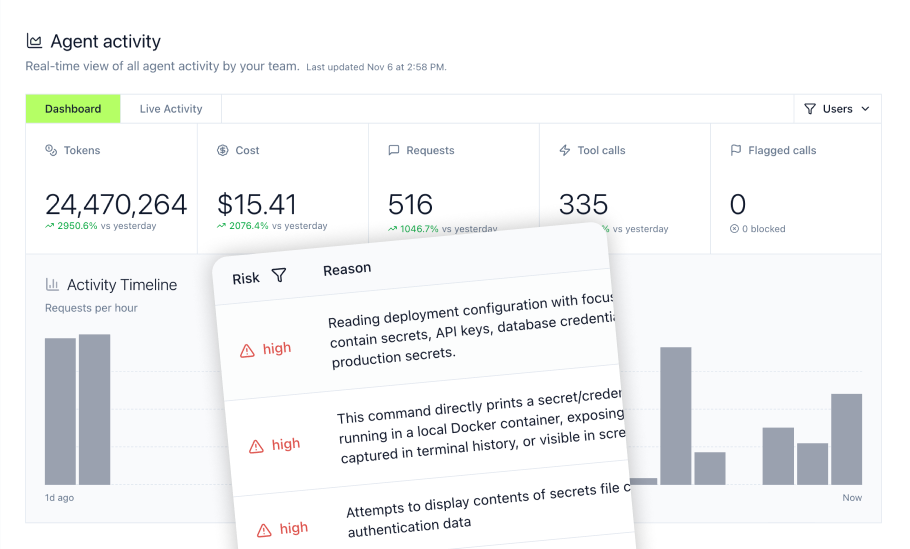
- Real-time activity visibility across the organization
- Security rules that can flag, block, or mask risky operations
- Usage and cost tracking with chargeback capability
- SIEM export via OTLP or Splunk HEC
Mintive's Agent Monitor captures this activity across supported AI clients, not just gateway traffic, providing visibility into local or off-gateway activity from coding-agent environments where supported.
Incident documented:
A reported incident involved Claude Cowork deleting approximately 15,000 family photos during a file-cleanup task, although the files were subsequently recovered through iCloud. The incident illustrates why organizations should enforce permission scoping, maintain backups, and restrict destructive operations before deploying agents to sensitive environments.
Achieving Team Collaboration with Claude Cowork
Claude Cowork's value compounds when operating across teams rather than individual users:
Collaboration use cases:
- Weekly executive briefings synthesized from multiple team channels
- Cross-functional report generation combining sales, engineering, and finance data
- Onboarding automation that spans HR, IT, and department-specific systems
- Customer support workflows that pull from CRM, ticketing, and knowledge bases
Shared memory considerations:
Effective team collaboration requires shared context. Organizations must decide:
- Which memory should persist across sessions
- Who can access shared agent memory
- How memory is versioned and auditable
- Whether memory can be reviewed and corrected
For organizations requiring company-owned memory infrastructure, Mintive's Coworker Agents provide git-backed memory with org/team/individual silos, version history, and reviewability without vendor lock-in.
Virtual MCPs: A Foundation for Controlled Agent Access
The Virtual MCP (VMCP) abstraction provides a "data-permissions-first" architecture for controlling AI agent access to enterprise systems:
What Virtual MCPs enable:
- Role-based tool surfaces: Different roles see different tool sets from the same underlying connectors
- SCIM-driven membership: Directory groups drive access automatically
- Curated tool exposure: Trim context-window bloat by exposing only relevant tools
- Private network connectivity: Reach on-premises systems without public exposure
- Unified audit trail: All tool calls through a VMCP flow through centralized logging
Deployment simplification:
Instead of configuring each MCP server individually on every developer machine, organizations deploy a single gateway URL. Users connect once to their role-appropriate VMCP and receive governed access to all approved tools.
This architecture addresses a core enterprise pain point: managing API integrations and MCPs across multiple computers. Virtual MCPs provide centralized configuration with compliance and security attached.
Making Claude Cowork Production-Ready with Mintive
The reality of enterprise AI agent deployment is that native vendor capabilities rarely meet production governance requirements alone. Anthropic provides foundational monitoring and compliance tools, but organizations deploying Cowork across finance, HR, legal, and operations teams need additional controls that work across every AI client, not just Claude.
Mintive addresses these challenges by providing governance infrastructure for supported AI clients and autonomous agents, including centralized access controls, identity management, monitoring, and runtime policies. Rather than configuring separate policies for Claude, Cursor, ChatGPT, and custom agents, IT teams deploy one unified control plane. The MCP Gateway provides SSO-backed authentication, role-based tool access, and audit trails for governed MCP connections, while Agent Monitor extends visibility into supported AI-agent activity beyond gateway traffic. When an analyst in finance uses Cowork to reconcile spreadsheets and a developer uses Cursor to write code, their governed MCP connections can share consistent identity, access policies, and audit logging, with additional monitoring available where supported.
This matters because Cowork's power comes from enterprise integration. Every Slack channel, Google Drive folder, and database connection extends the agent's reach, creating a trust boundary that spans dozens of systems. Mintive's Virtual MCP abstraction lets you bundle these connectors behind role-appropriate tool surfaces, with access policies driven by SCIM directory groups. Your financial analysts see accounting tools, your operations team sees workflow automation, and your compliance team gains centralized audit visibility into governed MCP activity. These controls can support regulatory compliance requirements alongside Anthropic's native monitoring and audit capabilities.
Frequently Asked Questions
Can Claude Cowork access files on local machines and network drives?
Yes. Cowork reads, writes, and organizes files on local machines when granted appropriate permissions. Access to network-mounted files depends on deployment mode, operating-system permissions, and whether files are explicitly available to Cowork. Organizations should implement permission scoping to restrict access to sensitive directories, particularly those containing credentials or confidential data.
What happens if Claude Cowork makes a mistake that causes data loss or system changes?
Cowork executes actions within the permissions and boundaries of its configured environment, but authorized file operations can still cause unintended changes. Some deletion methods may bypass typical recovery mechanisms like the macOS Trash. Organizations should restrict access to sensitive directories, maintain comprehensive backups, and consider read-only access for initial deployments. Pre-execution controls can block risky operations where the relevant integration supports enforcement.
How does Claude Cowork handle sensitive data in regulated industries?
Anthropic supports HIPAA BAA eligibility for local Cowork on appropriately configured HIPAA-ready Enterprise plans, while cloud Cowork remains outside that coverage. Enterprise organizations also have Compliance API capabilities for supported activity. External governance infrastructure can provide additional access controls, monitoring, and DLP enforcement. Third-party inference deployments require separate evaluation of cloud-provider agreements and applicable controls.
What MDM tools support enterprise Cowork deployment?
Claude Cowork supports enterprise-managed desktop configurations that IT teams can distribute through MDM tools such as Microsoft Intune, Kandji, JumpCloud, and Jamf, depending on the operating system. These configurations can govern supported application settings, connector access, and deployment policies. Claude Code hooks require separate setup, and endpoint monitoring coverage depends on the configured integration.
How do I transition from individual Cowork usage to team-wide governed deployment?
Start by establishing the four control surfaces: LLM gateway, MCP allowlist, org-plugins folder, and MDM policy file. The gateway decision is foundational because it determines where governance policies execute. Begin with a pilot group using governed tool access before expanding organization-wide. Set up cost tracking and usage monitoring before broad deployment to establish baseline consumption patterns.