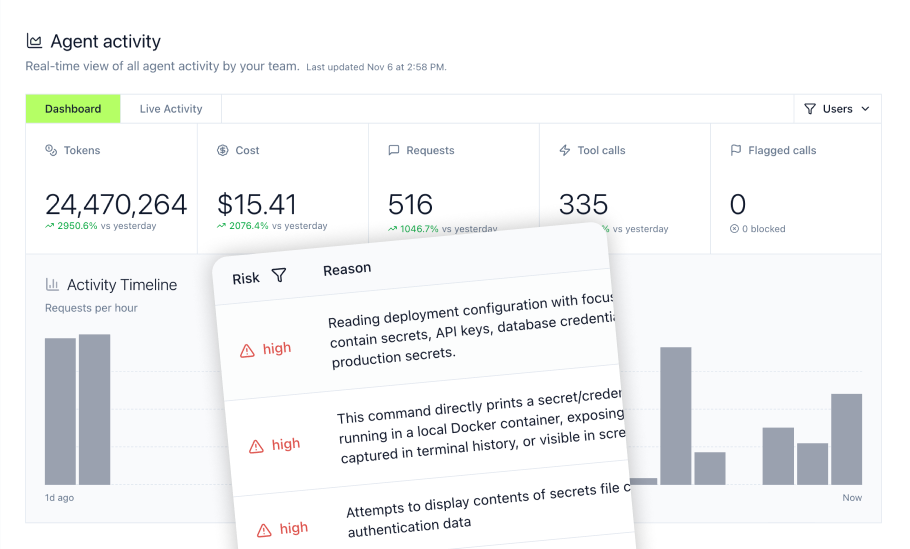
OpenAI Codex combines subscription-based usage allowances with token-based credit billing for additional usage. Costs and allowance consumption vary based on task complexity, model selection, context size, and execution settings rather than fixed message counts. Understanding this metering model is essential for enterprises deploying AI coding assistants at scale, particularly when teams need visibility into what agents are actually doing and how much they cost. Organizations using Agent Monitor can track estimated token spend across supported Codex, Claude Code, Cursor, and other AI-agent environments from a single dashboard, with usage visibility by user, model, agent, and session where telemetry is enabled.
This article breaks down every Codex pricing tier, explains the 5-hour window mechanics, and provides strategies for optimizing spend while maintaining governance over your AI coding workflows.
Key Takeaways
- Codex uses 5-hour usage windows on applicable plans, with each new window beginning when the user sends their first message after the previous window expires
- Plus plan costs $20/month with 15-150 GPT-6 Sol messages per 5-hour window, while Pro 100 provides higher capacity at $100/month
- Task costs depend on input, cached-input, and output tokens, with larger refactors generally consuming more than focused bug fixes
- Enterprise ROI depends on measurable developer time savings, subscription and API costs, code-review overhead, and the quality of AI-generated code
- API key usage follows separate API pricing and does not consume ChatGPT subscription allowances, but remains subject to model-specific rate limits, usage tiers, and spending controls
- Weekly limits can apply alongside 5-hour windows, meaning heavy usage may exhaust the weekly allowance even after individual 5-hour windows reset
Understanding AI Coding Assistant Pricing Models in 2026
AI coding tools have moved beyond simple per-seat licensing into complex usage-based models that reflect actual computational costs. Codex exemplifies this shift with its credit system, where identical subscription prices can deliver vastly different value depending on how teams configure their workflows.
Common pricing structures include:
- Per-token billing: Charges based on input and output tokens processed, with cached context billed at a model-specific discounted rate
- Subscription tiers: Fixed monthly fees with usage allowances that reset according to defined usage windows
- Hybrid models: Subscriptions with overage credits purchasable at fixed rates
- Credit pools: Enterprise arrangements where teams share organizational allowances
The critical insight for 2026 is that task complexity can produce substantial differences in token consumption within the same subscription tier. A one-line bug fix consumes significantly fewer tokens than a multi-file refactor, and each task consumes allowance based on its actual usage rather than a fixed per-message charge. This dynamic makes traditional cost planning unreliable without proper observability.
Codex Subscription Tiers: Complete Breakdown
Free and Entry-Level Plans
The Free tier includes limited Codex access for basic coding tasks, while the Go plan at $8/month provides additional capacity for lightweight coding workflows. Both plans support Codex through eligible clients, including the CLI and IDE extension. Available models, cloud features, and usage allowances depend on the plan and account.
Plus Plan ($20/month)
The Plus subscription unlocks the full Codex experience across CLI, IDE, web, and iOS interfaces. Users receive:
- 15-150 GPT-6 Sol messages per 5-hour window
- 5-45 GPT-6 Astra messages per 5-hour window
- 350-3,000 GPT-6 Luna messages per 5-hour window
- Cloud task delegation for asynchronous work
- GitHub integration for automated code reviews
The wide message ranges reflect token consumption differences. Small tasks hit the top of the range while large context operations hit the bottom.
Pro Plans ($100-$500/month)
Pro 100 at $100/month provides a higher included usage allowance than Plus. It currently has no 5-hour Codex limit, although weekly and other applicable usage restrictions remain. Actual capacity depends on model selection, task complexity, context size, and execution settings.
Pro 200 at $200/month provides higher included usage than Pro 100, with unlimited ChatGPT Voice access. New subscriptions are available again, although their included usage allowance is lower than that of eligible grandfathered subscribers.
Pro 500 at $500/month provides the highest included Pro usage and access to GPT-6 Astra and GPT-6.1 Sol Ultrafast. All three Pro tiers currently operate without a 5-hour Codex usage limit, although their included usage allowances and other applicable limits still apply.
Business and Enterprise
Business Standard seats match Plus limits at $20-25/user/month with 2-user minimums and annual billing options. Business Premium at $100-125/user provides higher capacity without 5-hour windows.
Enterprise offers contract-based pricing with usage arrangements that may include credit-based allowances or token-based billing, depending on the agreement. Enterprise capabilities include SSO, audit logging, data residency controls, and priority processing. Pricing requires direct sales engagement.
How the 5-Hour Usage Window Works
Codex usage resets according to defined windows. On plans with a 5-hour limit, users can consume their allowance before the window expires, but must wait for the current window to end before starting a new one. The next window begins with the first message sent after the previous window expires.
Weekly limits layer on top: Weekly allowances vary by plan, and users should check their usage dashboard for remaining capacity and reset times.
What burns through limits fastest:
- Large context windows with 30+ files loaded per prompt
- Fast mode, which consumes included usage at 2.5x the Standard rate for supported models, while eligible GPT-6 Astra Ultrafast usage consumes included allowance at 8x the Standard rate and purchased credits at 6x the Standard credit rate
- Output-heavy generation, where output tokens cost 5-8x input tokens
- Failed retries that re-process the same context
- Image generation and other separately metered tools, which may incur additional usage charges depending on the model and plan
Credit System Economics
Codex credits convert to dollars at a fixed $0.04 rate. Understanding per-model burn rates enables accurate cost forecasting:
GPT-6 Sol (balanced option):
- Input: 50 credits per million tokens ($2/1M)
- Cached input: 5 credits per million ($0.20/1M)
- Output: 250 credits per million ($10/1M)
GPT-6 Luna (cost-optimized):
- Input: 2.5 credits per million tokens ($0.10/1M)
- Output: 12.5 credits per million ($0.50/1M)
Illustrative task costs with GPT-6 Sol (hypothetical token volumes, Standard rates):
- Small bug fix: 50k input / 5k output = 3.75 credits ($0.15)
- 3-5 file feature: 150k input / 15k output = 11.25 credits ($0.45)
- Multi-file refactor: 300k input / 30k output = 22.5 credits ($0.90)
- Test generation: 100k input / 40k output = 15 credits ($0.60)
API Key vs. Subscription: When to Use Each
Choose ChatGPT subscription when:
- Individual developers want predictable monthly costs
- Cloud task delegation matters for async workflows
- GitHub integration and Slack notifications add value
Choose API key billing when:
- CI/CD automation requires higher throughput
- Multiple team members share infrastructure
- Cost control depends on per-project attribution
- Budget ceilings need programmatic enforcement
Teams running high-volume automation should compare API token charges against subscription allowances and purchased-credit costs. The more economical option depends on model selection, task volume, and the amount of included subscription usage available.
Managing Enterprise AI Governance
Enterprises deploying Codex alongside other AI coding tools face a governance challenge: each tool has different billing models, usage patterns, and security postures. Without centralized visibility, organizations cannot answer basic questions about what their AI agents are doing or costing.
Key governance requirements include:
- Usage attribution: Track spend by user, team, and session for chargeback
- Security screening: Detect prompt injection, credential exposure, and PII in tool calls
- Policy enforcement: Block dangerous commands before execution
- Audit trails: Maintain compliance records according to frameworks like the NIST AI Risk Management
Mintive's Guardrails provide runtime controls through Mint Guard for managed detection policies, Rules for declarative pattern matching, and Gateway Middleware for custom JavaScript logic that integrates with existing DLP systems.
Tracking AI Agent Costs Across Platforms
The challenge with multi-tool AI environments is that each platform meters differently. Codex uses usage windows, other tools use message-based limits, and API billing varies by provider. Agent Monitor solves this by capturing activity across supported clients, including prompts, commands, file access, MCP tool calls, and token consumption.
Visibility capabilities include:
- Token spend broken down by model, user, agent, and session
- Human versus agent activity split for accurate attribution
- Cache-hit rates that affect actual costs
- SIEM export to Sentinel, Splunk, or any OTLP collector
This cross-platform view helps organizations investigate runaway loops, expensive agent sessions, and supported off-gateway AI activity that would otherwise be missing from gateway-only monitoring.
Agent Identity and Permission Management
As enterprises scale from 10 to 100+ AI agents, the question of "who did what" becomes central to governance. Agents running on shared API keys collapse audit trails, over-privilege access, and break credential rotation.
Agent Gateway addresses this by treating autonomous agents as first-class non-human principals with:
- Dedicated credentials: Each agent receives its own client ID and secret with independent rotation
- Scoped MCP access: Purpose-built toolsets limit what each agent can reach
- M2M authentication: OAuth client-credentials exchange keeps secrets out of request paths
- Attributable audit trails: Every action ties to the specific agent identity
This architecture means revoking one agent's access does not affect users or other agents, and compromised credentials have limited blast radius.
Centralizing Tool Configuration
Developer friction multiplies when each team member configures MCP servers locally. The result is N installations, N authentication flows, and N points of failure across every AI client.
MCP Gateway consolidates this through Virtual MCPs, which bundle multiple connectors behind a single governed endpoint. Benefits include:
- One-click deployment: Users connect to a curated tool surface via SSO
- Credential injection: Connectors never hold long-lived secrets; credentials inject per call
- Tool curation: Admins control which tools each role can access
- Private network connectivity: Reach on-prem databases without public exposure
Teams deployed governed AI to thousands of employees in weeks using this approach, avoiding individual MCP configurations per person.
ROI and Break-Even Analysis
Solo Developer on Plus ($20/month)
A Plus subscription costs $240 annually before additional credits, API usage, or onboarding costs. At an illustrative developer labor rate of $33/hour, saving 20 hours monthly would represent $7,920 in annual productivity value. These figures are hypothetical and should be evaluated against actual time saved, code quality, review overhead, and additional usage costs.
Team of Five with Mixed Plans
- Subscriptions (2 Pro 100 + 3 Plus): $3,120
- Credit overages: $1,800
- API automation: $1,200
- Training: $2,000
- Review overhead (30 hours/month): $11,880
- Total illustrative TCO: $20,000
In a hypothetical scenario where Codex saves 30% of 10,000 annual developer hours at an assumed labor rate of $33/hour, the resulting productivity value would be $99,000. Against the illustrative $20,000 TCO above, this would yield a net benefit of $79,000 and approximately 395% ROI. These figures are scenario assumptions, not verified enterprise performance benchmarks.
Critical success factors:
- Test suites must exist before using Codex for automated verification
- Keeping AGENTS.md files concise and relevant reduces unnecessary context processing
- Model selection matches task complexity to avoid overspend
When Codex Makes Sense
Choose Codex when:
- Work spans multiple languages and frameworks
- Async cloud tasks provide value (queue work and walk away)
- You already pay for ChatGPT (Codex adds marginal cost)
- Open-source CLI transparency matters for security audits
Consider alternatives when:
- Most work uses one framework where specialized tools may generate more idiomatic code
- Inline code completion is the primary requirement rather than autonomous repository-level coding workflows
- Budget constraints make the $20 minimum feel steep
Common hybrid approach: Use Codex for complex refactors and test generation alongside existing inline-completion tools. Compare total subscription costs, workflow coverage, and developer productivity before adopting multiple tools.
Governing AI Coding Costs at Scale
Organizations scaling AI coding assistants face three critical challenges: cost attribution across heterogeneous tools, security guardrails for autonomous agent behavior, and centralized identity management for machine-to-machine authentication. Traditional per-seat licensing cannot address these requirements when agents share credentials, operate across multiple platforms, and consume resources unpredictably.
Mintive addresses this through unified governance infrastructure:
- Agent Monitor tracks estimated token spend, prompts, commands, and tool calls across supported Codex, Claude Code, Cursor, and other AI environments where telemetry is enabled. This provides cross-platform cost visibility by user, model, agent, and session without requiring gateway-only architectures.
- Agent Gateway treats autonomous agents as first-class non-human principals with dedicated credentials, scoped MCP access, OAuth-based M2M authentication, and attributable audit trails. Revoking one agent's access does not affect other agents or users, and compromised credentials have limited blast radius.
- MCP Gateway eliminates N-times-M configuration sprawl by consolidating multiple connectors behind governed Virtual MCPs. Users connect via SSO, credentials inject per call, and admins control which tools each role can access without exposing database credentials to AI agents.
- Mintive's Guardrails provide runtime security controls through Mint Guard for managed detection policies, Rules for declarative pattern matching, and Gateway Middleware for custom JavaScript logic that integrates with existing DLP systems.
This architecture enables organizations to deploy AI coding assistants with enterprise governance, cost accountability, and security controls from day one rather than retroactively adding guardrails after shadow AI proliferates.
Frequently Asked Questions
How do I recover when hitting the 5-hour limit mid-task?
OpenAI's fair use policy allows work in progress to complete, so current agent turns finish even after limits hit. Wait for the usage window to reset, switch to GPT-6 Luna for potentially higher usage capacity on lighter tasks, purchase additional credits at $0.04 each, or upgrade your plan. Check /status in the CLI to see exact reset timing.
Can Codex access internal company databases and APIs?
Yes, through the Model Context Protocol (MCP). You can add a remote MCP server using codex mcp add <server-name> --url <server-url> or configure it in your config.toml file. Popular integrations include databases, documentation systems, and custom internal APIs. For enterprise environments, routing these connections through a governed gateway ensures credential security, access logging, and policy enforcement without exposing database credentials directly to AI agents.
What happens to my code after Codex processes it?
Codex processes code and task context according to OpenAI's applicable data retention and workspace policies. Local code changes remain in the working repository until committed or discarded, while cloud tasks run in OpenAI-managed environments with separate storage and recovery policies. Codex Cloud is not covered by OpenAI's HIPAA Business Associate Agreement. Organizations should review execution settings before deploying with sensitive repositories.
How do Business and Enterprise plans handle team-wide cost allocation?
Business plans use per-seat licensing where each user has individual limits. OpenAI provides native usage reporting and administrative analytics, while API projects support separate usage and cost tracking. However, organizations requiring consistent chargeback across Codex and other AI coding clients may need additional monitoring, tagging, or cost allocation workflows. Agent Monitor can provide estimated usage and cost visibility across supported, instrumented agent environments.
Should I set spend limits on API usage?
Yes, configure usage budgets and alerts through the OpenAI Platform before production deployment. These budgets are not guaranteed hard spending caps, so teams should implement additional safeguards when strict cost ceilings are required. Review usage dashboards regularly and investigate unexpected spending increases, as runaway loops or misconfigured agents can consume budgets quickly. Teams using CI/CD automation should implement per-workflow monitoring and enforcement controls to isolate cost impact.