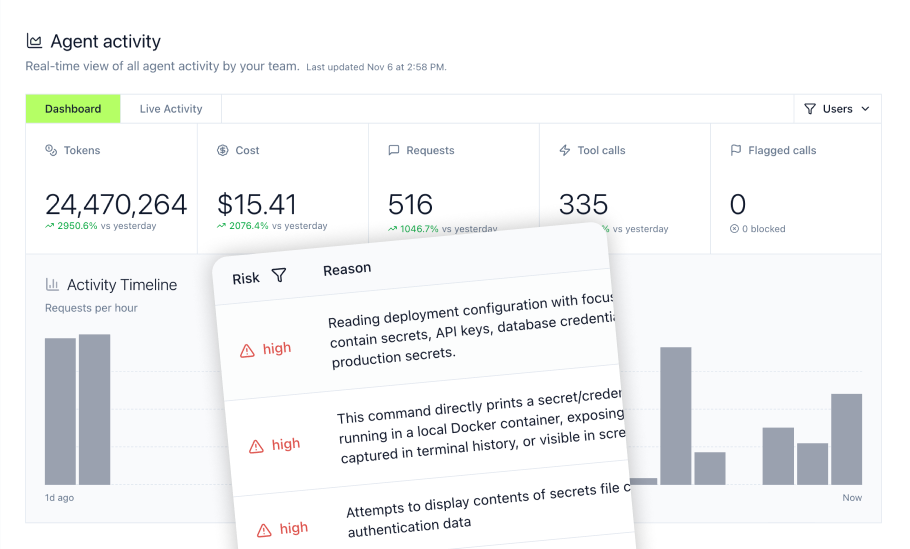
Cloudflare AI Gateway offers an attractive entry point for teams looking to proxy AI traffic through edge infrastructure, with core features available at zero cost. However, enterprises evaluating AI gateways must look beyond initial pricing to understand the total cost of AI operations, including governance gaps that basic gateways leave unaddressed. Organizations running Claude, Cursor, ChatGPT, Gemini, and Copilot across teams need more than traffic routing. They need centralized control over what AI agents access, which credentials they use, and how their actions are audited. This is where MCP Gateway solutions designed for enterprise governance become essential to managing AI infrastructure costs effectively.
This article provides a complete breakdown of Cloudflare AI Gateway pricing, compares it to other AI and API gateway options, examines LLM API costs that flow through any gateway, and explains how enterprise AI governance platforms address cost and risk factors that basic gateways cannot.
Key takeaways
- Cloudflare AI Gateway provides free core features including dashboard analytics, caching, and rate limiting, with 100,000 stored logs total across all gateways on Workers Free and 10 million stored logs per gateway on Workers Paid
- Cloudflare AI Gateway supports 20+ AI providers for model traffic, while Cloudflare One separately offers MCP server portals that centralize multiple MCP servers behind one endpoint with tool curation, Access policies, OAuth, observability, and machine-to-machine access
- Hidden AI costs extend beyond gateway fees to include token consumption, credential sprawl, shadow AI usage, and compliance risk from ungoverned agent activity
- Enterprise AI governance requires capabilities beyond traffic routing: Virtual MCPs for per-use-case endpoints, agent identities for autonomous systems, and tool-level access control
- Organizations managing multiple AI clients across teams face scattered configurations and credentials that basic gateways cannot consolidate or govern
- LLM API pricing varies dramatically by provider, with costs accumulating across input tokens, output tokens, and actual context usage that require monitoring and attribution
Understanding Cloudflare AI Gateway: core features and cost components
Cloudflare AI Gateway operates as a proxy layer between applications and LLM providers, leveraging the company's global edge network to cache responses, apply rate limits, and provide basic observability. The pricing model centers on accessibility, making it straightforward for development teams to begin routing AI traffic without upfront investment.
Cloudflare AI Gateway: pricing and usage charges
The core Cloudflare AI Gateway features come at no additional cost for teams already using Cloudflare infrastructure. This includes:
- Dashboard analytics for monitoring request volumes and latency
- Response caching to reduce redundant API calls to LLM providers
- Rate limiting to prevent runaway costs from misconfigured applications
- Logging with 100,000 stored logs total across all gateways on Workers Free and 10 million stored logs per gateway on Workers Paid
For teams using Cloudflare's Unified Billing for AI provider credits, a 5% fee applies to purchased credits, while provider inference pricing is passed through without markup. AI Gateway DLP scanning is free on all plans, while Guardrails usage is billed as Workers AI token-based inference. Workers Logpush is available on the Workers Paid plan with 10 million requests per month included, then $0.05 per additional million.
The gateway supports over 20 LLM providers through a unified API interface. Setup requires minimal configuration, with the implementation achievable through a single line of code modification in most applications.
Edge AI vs. centralized AI Gateway costs
Cloudflare's edge-based architecture provides latency benefits by processing requests closer to end users. However, the cost implications of edge versus centralized deployment depend on workload patterns:
Edge benefits:
- Reduced latency for geographically distributed users
- Cache hit rates that can significantly lower LLM API consumption
- Built-in DDoS protection through Cloudflare's infrastructure
Centralized gateway considerations:
- More consistent logging and audit capabilities
- Simplified compliance reporting with unified data residency
- Tighter integration with enterprise identity providers
For organizations prioritizing governance over latency optimization, centralized MCP gateway architecture provides better control over credential management, access policies, and audit trails across all AI clients.
Comparing AI Gateway pricing: Cloudflare vs. AWS and Azure
API gateway pricing models vary significantly based on vendor, deployment model, and feature sets. Understanding these differences helps organizations forecast total AI infrastructure costs.
Cost structures: requests, data, and compute
Traditional API gateways from cloud providers use request-based pricing with additional charges for data transfer and advanced features. AWS API Gateway uses REST API pricing based on API calls received, with additional charges for caching, data transfer out, and WebSocket connections. Azure API Management uses tier-based pricing with different feature sets and a consumption tier for variable workloads.
Cloudflare bundles gateway features into its broader platform pricing with no base per-request fee for core AI Gateway features, with separate charges for Guardrails, Unified Billing, and Logpush usage. The key distinction is that traditional API gateways generally charge for request processing, while Cloudflare AI Gateway offers its core gateway features for free with separately priced add-ons. Cloudflare now also offers MCP server portals with centralized MCP access, tool curation, Access policies, and request observability. MintMCP differs through its Virtual MCP model, SCIM-driven access policies, and first-class agent identities with independently attributable audit trails.
Feature-based pricing: security and developer tools
Beyond base request costs, enterprise AI deployments require security features that add to total cost of ownership:
Traditional API gateways:
- Rate limiting: Included or add-on
- Response caching: Often add-on
- SSO/SAML integration: Enterprise tiers
- Audit logging: Available
Cloudflare AI Gateway:
- Rate limiting: Included
- SSO/SAML integration: Available via Cloudflare Access
- Audit logging: AI Gateway request logs plus MCP portal Access logs
- MCP tool governance: MCP portal tool curation plus Access policies
- Non-human access: Service-token and M2M access for MCP portals
Enterprise MCP Gateway (MintMCP):
- Rate limiting: Included
- SSO/SAML integration: Native support
- Audit logging: Complete audit trails
- MCP tool governance: SCIM-driven policies
- Non-human access: First-class agent identities
Organizations evaluating gateway costs must account for the security and compliance features they will eventually require, not just initial traffic routing capabilities. MintMCP's first-class agent identity model remains a valid distinction: each agent can have its own identity, credentials, scoped access, and attributable audit trail.
LLM API pricing comparison: OpenAI, ChatGPT, Gemini, and custom models
Gateway pricing represents only one component of AI infrastructure costs. LLM API charges can become a major cost driver depending on model selection, token volume, workload patterns, and gateway pricing.
Per-token costs: input vs. output
LLM providers charge based on token consumption, with significant differences between input (prompt) and output (completion) tokens:
Pricing factors affecting total cost:
- Model selection: Larger, more capable models cost more per token
- Input token volume: Longer prompts with extensive context increase costs
- Output token consumption: Verbose responses multiply expenses
- Context actually used: Longer prompts and larger retrieved contexts increase billed input tokens; a model's maximum context-window capacity does not by itself increase per-request cost
Cloudflare AI Gateway logs token usage and cost, and Cloudflare Access can associate gateway requests with verified users. Agent Monitor capabilities extend supported cost visibility across models, users and agents, and individual agent sessions, providing a different level of agent-focused attribution.
Impact of model choice on overall costs
The choice of underlying model dramatically affects both quality and cost. Enterprise teams often need different models for different use cases, ability to switch providers without rebuilding governance infrastructure, and consistent access policies regardless of which model processes the request.
This model-agnostic requirement points to the need for governance that sits above specific LLM providers. A platform designed as the governed data layer maintains consistent policies whether teams use Claude, GPT, Gemini, or open-source models.
The role of API Gateway open source solutions in cost optimization
Open-source API gateways offer an alternative to commercial solutions, eliminating licensing fees in exchange for operational responsibility.
Benefits and drawbacks of open source API gateways
Potential benefits:
- Zero licensing costs for the gateway software itself
- Full customization capability
- Community contributions and transparency
- No vendor lock-in for core routing functionality
Practical challenges:
- Operational overhead for deployment, scaling, and maintenance
- Security patching becomes the organization's responsibility
- Limited out-of-the-box integrations with enterprise identity providers
- Open-source and self-managed gateways can reduce software licensing costs but shift more operational responsibility to the customer; AI-specific prompt-injection defenses, PII controls, and guardrails vary by product and deployment
Open-source and self-managed gateway capabilities vary substantially. Generic API gateways may require additional AI-specific components, while Kong's current AI Gateway includes native capabilities for AI caching, token and cost metering, prompt security, PII controls, rate limiting, and MCP workloads. Traefik should be evaluated separately rather than treating both products as having the same AI feature set.
Hidden costs of self-managed solutions
The total cost of self-managed gateways extends beyond the $0 license fee:
- Infrastructure costs: Compute, storage, and networking for gateway deployment
- Engineering time: Initial setup, configuration, and ongoing maintenance
- Security investment: Vulnerability management and patching
- Integration development: Custom work to connect with identity providers, monitoring systems, and compliance tools
- Opportunity cost: Engineering resources diverted from product development
For AI-specific workloads, managed guardrail capabilities vary by self-managed gateway. Some provide built-in prompt security and PII controls, while others require additional components or custom security engineering.
MintMCP's enterprise AI governance: beyond gateway price
Enterprise AI governance extends well beyond routing traffic between applications and LLM providers. Organizations deploying AI agents across teams face a different category of challenges that basic gateways were not designed to address.
The core enterprise problem: teams adopt Claude, Cursor, ChatGPT, Gemini, Copilot, and custom agents faster than security and platform teams can govern what those systems access, whose credentials they use, what actions they take, and how those actions are attributed.
Centralized governance for diverse AI clients
MintMCP's MCP Gateway provides a governed entrypoint between AI clients and enterprise tools through:
- Virtual MCPs (VMCPs): One endpoint per role, team, or use case with curated tool access. The same connector can power read-only and read-write VMCPs with different tool sets, eliminating the need for duplicated infrastructure.
- Hosted connectors: MintMCP operates connector instances so organizations do not manage the runtime themselves. Connectors run in MintMCP's data plane without exposure to the public internet.
- Credential injection: Connectors never hold long-lived secrets. Credentials are injected per call with support for inline API keys, per-user OAuth, and per-user AWS SSO.
- SCIM-driven RBAC: Access granted at the VMCP level, driven by directory groups. Suspend a user in the IdP and access propagates automatically.
This architecture addresses the configuration sprawl that occurs when every developer configures every MCP server locally, creating N installs, N auth flows, and N points of failure.
Securing autonomous agents with dedicated identities
As organizations scale from 10 to 100+ agents, "who did what" becomes the central governance question. Agent Gateway capabilities treat autonomous agents as first-class non-human principals:
- Agent identity: Named, org-scoped principals in the same authorization model as humans
- Per-agent credentials: Independent rotation and revocation without affecting other agents or users
- Scoped MCP access: Each agent receives only the tools required for its function
- Authentication options: Bearer keys, OAuth client-credentials or M2M tokens, or workload identity federation
This approach eliminates the common pattern where agents run on "whichever human's API key was lying around," which collapses audit logs, over-privileges agents, and breaks credential rotation.
MintMCP's value proposition: permissions-first AI governance for cost control
The data-permissions-first architecture creates a foundation for both cost control and risk reduction. By governing what AI systems can access before they act, organizations prevent cost overruns and security incidents rather than detecting them afterward. According to NIST's AI Risk Management Framework, establishing governance controls before deployment is critical for managing AI system risks across their lifecycle.
How Virtual MCPs optimize resource usage
Virtual MCPs enable cost optimization through:
- Tool curation: Exposing only necessary tools reduces context window bloat and prevents agents from calling expensive operations unnecessarily
- Per-use-case policies: Different teams can receive separate VMCPs with curated tool surfaces and access policies
- Usage attribution: Agent Monitor provides estimated model and token costs with breakdowns by model, user or agent, and session for visibility and chargeback
- Consistent governance: The same access policies apply regardless of which AI client initiates requests
The VMCP administration capabilities allow platform teams to define these boundaries once and enforce them across all AI clients in the organization.
Reducing risk and cost with agent-specific identities
Agent-specific identities provide multiple cost-related benefits:
- Usage tracking: Token consumption attributed to specific agents rather than aggregated across users
- Anomaly detection: Unusual patterns from a specific agent are visible, not hidden in noise
- Independent revocation: Terminate a misbehaving agent's access without disrupting other systems
- Credential hygiene: Short-lived credentials reduce the blast radius of any single compromise
Organizations can also implement guardrails that prevent agents from taking costly actions, such as blocking specific tool calls or requiring human approval for high-impact operations. Runtime guardrails and monitoring can help organizations detect and restrict risky autonomous-agent behavior.
Optimizing AI deployments: edge computing vs. cloud for cost and latency
The choice between edge and centralized deployment affects both performance and governance capabilities.
Cost implications of data transfer on Cloudflare's edge
Cloudflare's edge architecture excels at reducing latency for geographically distributed workloads. The cost model benefits from cache hits that avoid redundant LLM API calls, reduced data transfer through edge processing, and built-in protection against abuse and attacks.
However, edge deployment introduces challenges for enterprise governance including data residency complexity, audit consolidation requirements, and identity integration. Organizations should evaluate the gateway's actual identity controls rather than inferring limitations from edge deployment. Cloudflare Access can place AI Gateway behind an enterprise identity provider and associate requests with verified users.
When edge AI makes financial sense
Edge deployment is most cost-effective when users are globally distributed and latency-sensitive, responses are highly cacheable, the organization does not require strict data residency controls, and compliance requirements focus on availability rather than governance.
A private network tunnel is relevant when governed connectors must reach MCP servers inside a VPN, VPC, or private subnet without opening inbound access. Audit requirements, directory integration, tool-level access control, and geographic data-residency requirements should be evaluated separately against the platform's documented security and deployment capabilities.
Future-proofing AI infrastructure: the need for an enterprise agent workforce system of record
As enterprises scale AI agent deployments, they need more than traffic routing. They need a system of record for their agent workforce that answers fundamental governance questions.
The evolving landscape of enterprise AI governance
Enterprise AI governance requirements are rapidly expanding beyond basic API management:
- Which agents exist? Organizations cannot govern what they cannot see
- Who owns or operates them? Accountability requires clear ownership
- Which systems can they access? Least privilege requires explicit scoping
- What credentials do they use? Credential hygiene requires per-agent management
- What actions have they taken? Compliance requires complete audit trails
- What memory do they retain? Agent memory governance becomes critical for persistent agents
- How can they be restricted or shut down? Operational controls require immediate effect
These requirements point toward platforms designed as governance layers from the foundation, not traffic routers with governance bolted on.
Why basic gateways fall short for autonomous agents
Basic AI gateways, including Cloudflare AI Gateway, were designed for a simpler use case: proxying API calls from applications to LLM providers. They optimize for reducing latency through caching, preventing cost overruns through rate limiting, and providing basic observability through logging.
Cloudflare's current stack addresses several of these areas through separate products. MCP server portals centralize MCP servers, curate tools, apply Access policies, support OAuth and service-token access, and log tool requests, while optional Gateway routing adds DLP scanning. AI Gateway also provides DLP and model-traffic Guardrails. MintMCP's differentiation should therefore focus on its Virtual MCP model, SCIM-driven access, first-class agent identities, Agent Monitor visibility, and its Mint Guard, Rules, and Gateway Middleware architecture.
Organizations should compare which governance capabilities are available today and which would require additional products or custom infrastructure as deployments mature. A governance-first platform can centralize identity, permissions, monitoring, and runtime controls when those capabilities match the organization's requirements.
For teams evaluating their AI infrastructure strategy, the MCP data risk assessment guide provides a framework for understanding what governance capabilities their deployment will require.
MintMCP: unified AI governance for the entire agent lifecycle
As organizations move from evaluating gateway options to deploying production AI systems, the conversation shifts from feature checklists to architectural philosophy. MintMCP was designed from the ground up as a governance layer for the entire AI agent lifecycle, not as a traffic router with governance added later.
The platform's Virtual MCP architecture addresses configuration sprawl in distributed MCP deployments. Instead of N developers configuring N MCP servers with N credential sets, platform teams can define governed endpoints once with:
- Curated tool surfaces
- SCIM-driven access policies
- Centralized credential injection
- Access control and tool curation
- Auditable activity at the VMCP level
For autonomous agents, MintMCP's first-class identity model gives each non-human principal:
- Its own credentials
- Scoped tool access
- Independently attributable activity
- Independent rotation and revocation
- Clear audit attribution
This avoids the anti-pattern of agents operating through borrowed human credentials while supporting stronger governance, usage visibility, and accountability.
Organizations seeking to govern their AI infrastructure should evaluate whether their gateway strategy addresses not only today's API routing needs but also future agent workforce management requirements.
The client setup documentation shows how supported AI clients such as Claude, Cursor, and ChatGPT connect to governed endpoints with centralized access controls and visibility.
Frequently asked questions
What are the main cost drivers for enterprise AI infrastructure beyond gateway fees?
Gateway fees typically represent a small fraction of total AI infrastructure costs. The primary cost drivers include LLM API consumption through token charges for input and output across all models used, credential management overhead spent managing and rotating API keys across teams, compliance and audit costs required to produce regulatory audit trails, incident response costs associated with security incidents from ungoverned agent activity, and shadow AI waste from redundant subscriptions and usage from ungoverned AI tool adoption. Usage and cost tracking capabilities provide the visibility needed to address all cost drivers beyond traffic routing.
How does MCP Gateway differ from traditional API gateways for AI workloads?
Traditional API gateways route HTTP traffic between clients and backends. MCP Gateways govern how AI clients and agents connect to enterprise tools. The key differences include protocol support for Model Context Protocol tool discovery and invocation patterns, tool curation ability to expose specific tools to specific users or agents based on role, agent identity with first-class support for non-human principals with independent credentials, and credential injection with per-call credential handling without storing secrets in connector configurations. The comparison between AI gateways and MCP gateways provides additional detail on when each type applies.
Can I start with Cloudflare AI Gateway and migrate to an enterprise governance platform later?
The relationship is not necessarily a one-for-one migration. Cloudflare AI Gateway focuses on LLM and model traffic, while Cloudflare One also offers MCP server portals for centralized MCP access, tool curation, Access policies, OAuth, observability, and optional DLP routing. MintMCP focuses on governed MCP access alongside first-class agent identities, Agent Monitor visibility, and runtime guardrails. Organizations should evaluate whether the products are alternatives at a specific layer or complementary parts of the broader AI infrastructure stack. MintMCP's client setup documentation shows how supported AI clients connect to governed endpoints.
What compliance certifications matter for AI gateway selection?
For regulated industries, gateway selection should consider SOC 2 Type II attestation which validates security controls and operational practices through third-party audit, HIPAA compliance required for organizations handling protected health information, data residency options for specifying where data is processed and stored, and audit trail completeness for whether logs provide sufficient detail for compliance reporting. MintMCP is SOC 2 Type II audited and compliant with HIPAA standards. Customers handling protected health information can request HIPAA documentation, and MintMCP signs BAAs. The Trust Center provides current compliance documentation and security information.
How do I evaluate whether my organization needs agent identity management?
Consider agent identity management when multiple autonomous agents operate across your infrastructure, you cannot distinguish agent actions from human actions in audit logs, agents currently use shared credentials or individual employees' API keys, credential rotation requires updating multiple agent configurations, or compliance requirements demand attribution of all automated actions. The agent identities documentation explains how to implement non-human identity management as agent deployments scale. Agent-specific identities enable usage tracking, anomaly detection, independent revocation, and improved credential hygiene across your AI infrastructure.