LLM agents represent a fundamental shift from reactive AI chatbots to autonomous systems capable of multi-step reasoning, tool integration, and persistent memory. Unlike traditional large language models that simply respond to prompts, LLM agents can plan complex workflows, execute actions across enterprise systems, and adapt their behavior based on results. With enterprise LLM API spending reaching $8.4 billion by mid-2025, organizations need robust infrastructure to deploy and govern these autonomous systems. Platforms like MintMCP's MCP Gateway provide the governed data and tool connections that make agent deployments secure, measurable, and enterprise-ready.
This article explains LLM agent architecture, essential development tools, critical enterprise use cases, and the governance frameworks required to deploy autonomous agents safely at scale.
Key takeaways
- LLM agents shift from automation to autonomy by using LLM reasoning to plan multi-step workflows, invoke tools, and adapt based on results, requiring governance systems that monitor decisions rather than just access
- Four-component architecture (Brain, Memory, Planning, Tools) introduces distinct security challenges at each layer, necessitating controls for memory poisoning, planning manipulation, and tool misuse
- Enterprise LLM API spending more than doubled in six months from $3.5B to $8.4B, while Gartner forecasts that up to 40% of enterprise applications will include task-specific AI agents by the end of 2026
- The OWASP Top 10 for Agentic Applications, released in December 2025, provides a peer-reviewed framework covering 10 major security risks in agentic AI systems
- 80% of organizations surveyed reported risky AI agent behaviors, while only 42% of surveyed executives said they balance AI development with appropriate security investments
- Multi-agent systems can propagate errors across agents when coordination or validation fails, making validation checkpoints important in production deployments
Understanding LLM agents: Defining agentic AI and their capabilities
LLM agents fundamentally differ from standard generative AI models through their capacity for autonomous action. While a traditional chatbot follows predefined workflows to generate outputs, an LLM agent receives a set of tools and decides independently how best to reach a solution based on situational awareness.
What makes an LLM agent 'agentic'?
The distinction lies in autonomy versus automation. Automation enables LLMs to take inputs and follow a series of steps to generate an output. With autonomy, the LLM is handed tools and the ability to decide how to achieve goals. This means agents don't just generate text; they plan, reason, use tools, maintain memory, and operate autonomously to complete multi-step tasks.
Core agentic capabilities include:
- Goal-directed reasoning: Breaking complex objectives into actionable sub-tasks
- Tool invocation: Calling APIs, querying databases, and executing code
- Memory persistence: Retaining context across interactions and sessions
- Adaptive behavior: Modifying approaches based on intermediate results
- Multi-step execution: Completing workflows spanning multiple tools and decisions
Key differences: LLM agents vs. traditional generative AI
Base LLMs generate outputs from the context provided to them and do not independently maintain persistent state or act on external systems unless an application supplies memory and tools. Agent systems add orchestration around the model so they can maintain task state, call tools, and execute multi-step workflows.
This autonomy creates new governance challenges. When an agent decides which tools to call at runtime, and those tools can appear, change, or disappear via list_tools, organizations face unpredictable behavior that traditional access controls cannot address.
The architecture of LLM agents: Core components and design patterns
LLM agent architecture consistently includes four essential components that work together to enable autonomous operations.
Agent core (Brain)
The central coordination module manages core logic and behavioral characteristics. This LLM-powered component provides reasoning capabilities and determines how to process inputs and generate appropriate responses or actions.
Memory systems
Both short-term (conversation context) and long-term (persistent knowledge) memory enable agents to maintain context across interactions. Memory architecture directly impacts agent effectiveness and introduces security considerations around memory poisoning attacks.
Planning module
Responsible for breaking complex tasks into actionable steps. Planning approaches include:
- Chain-of-Thought (CoT): Sequential reasoning through intermediate steps
- Tree of Thoughts (ToT): Exploring multiple reasoning paths simultaneously
- ReAct: Combining reasoning with action execution in iterative loops
Tools and integrations
APIs, databases, and external systems the agent can invoke. Tool integration transforms agents from conversational interfaces into operational systems capable of affecting enterprise data and processes.
Essential tools and frameworks for LLM agent development
Building production-ready LLM agents requires development frameworks, tool orchestration capabilities, and enterprise-grade connectors.
Open-source tools for building LLM agents
Popular frameworks for agent development include:
- LangChain: Comprehensive framework for building context-aware reasoning applications
- LlamaIndex: Specialized for connecting LLMs to enterprise data sources
- CrewAI: Designed for multi-agent orchestration and collaboration
- Haystack: NLP framework supporting retrieval-augmented generation pipelines
Connecting agents to enterprise systems
The challenge intensifies when agents need access to production data and tools. Organizations face scattered MCP configurations across developer laptops, inconsistent authentication, and no centralized audit trail.
MintMCP's MCP Gateway addresses this through Virtual MCPs (VMCPs), bundling approved connectors and curated tool surfaces behind governed endpoints for specific teams, roles, or use cases. Directory groups drive membership through SCIM, enabling consistent access policies without requiring every employee to configure each MCP server separately.
Enterprise use cases for LLM agents: Driving business value
McKinsey estimated that generative AI could add $2.6 trillion to $4.4 trillion in annual economic value across 63 use cases. LLM agents are one way enterprises are extending generative AI into multi-step operational workflows.
Automating routine tasks with LLM agents
Morgan Stanley deployed a GPT-4-powered internal assistant for wealth management that can answer questions from a corpus of 100,000 internal documents, helping advisors retrieve firm-specific information more quickly.
Enhancing customer experience and support
UC San Diego Health has piloted generative AI that drafts patient-message replies using the patient's message and electronic medical history for clinicians to review and edit. Its 2024 study found that the drafts did not reduce physician response time, although they helped relieve cognitive burden. A separate 2023 study found that licensed healthcare professional evaluators preferred ChatGPT responses to physician responses 79% of the time.
Boosting developer productivity with AI coding agents
Manufacturing use cases include Siemens Industrial Copilot, which supports automation-code generation, documentation search, and error diagnosis for industrial engineering workflows.
Governing LLM agents: Ensuring security, compliance, and control
The gap between agent adoption and security investment creates substantial risk. McKinsey reports that 80% of organizations surveyed had encountered risky AI agent behaviors, while MIT Sloan Management Review reports that only 42% of surveyed executives said they balance AI development with appropriate security investments.
The OWASP framework for agent security
Released December 9, 2025, and developed with input from more than 100 industry experts, researchers, and practitioners, the OWASP Top 10 for Agentic Applications identifies major risks in autonomous and agentic AI systems:
- ASI01 Agent Goal Hijack: Attackers manipulating agent objectives
- ASI02 Tool Misuse & Exploitation: Weaponizing legitimate tool access
- ASI03 Identity & Privilege Abuse: Exploiting over-privileged agent credentials
- ASI06 Memory & Context Poisoning: Corrupting persistent agent memory
- ASI07 Insecure Inter-Agent Communication: Vulnerabilities in multi-agent systems
These risks require new security controls beyond traditional application security frameworks.
Addressing security risks with autonomous agents
Runtime controls determine whether an action should be allowed. MintMCP's guardrail architecture provides three complementary layers:
- Mint Guard: Managed detection policies for prompt injection, secrets, PII, and harmful content
- Rules: Declarative matching and enforcement on tools, arguments, or content
- Gateway Middleware: Customer-authored JavaScript logic for DLP integrations and custom policy enforcement
Learn more about implementing guardrails for enterprise agent deployments.
Identity and access management for autonomous LLM agents
Autonomous agents should be treated as first-class non-human principals, not extensions of whichever employee credential or shared API key happens to be available.
Why agents need their own identities
When agents run on employee credentials, organizations lose attribution, over-privilege the agent, and break credential rotation policies. The central governance question as enterprises scale from 10 to 100+ agents becomes: who did what?
MintMCP's Agent Gateway assigns each agent its own identity, including:
- Named, org-scoped non-human principal
- Scoped MCP access with purpose-built toolsets
- Independent credential rotation and revocation
- Attributable per-agent audit trail
Authentication mechanisms for agent identities
From simplest to most secure:
- Bearer keys: Static key on every request with name, expiry, and individual revocability
- M2M tokens: OAuth client-credentials exchange for short-lived tokens
- Workload identity federation: The agent's infrastructure mints short-lived OIDC tokens; no secret stored in MintMCP
Monitoring and observability for LLM agent activity
Visibility alone is insufficient without understanding what agents actually do across the organization.
Gaining insight into agent operations
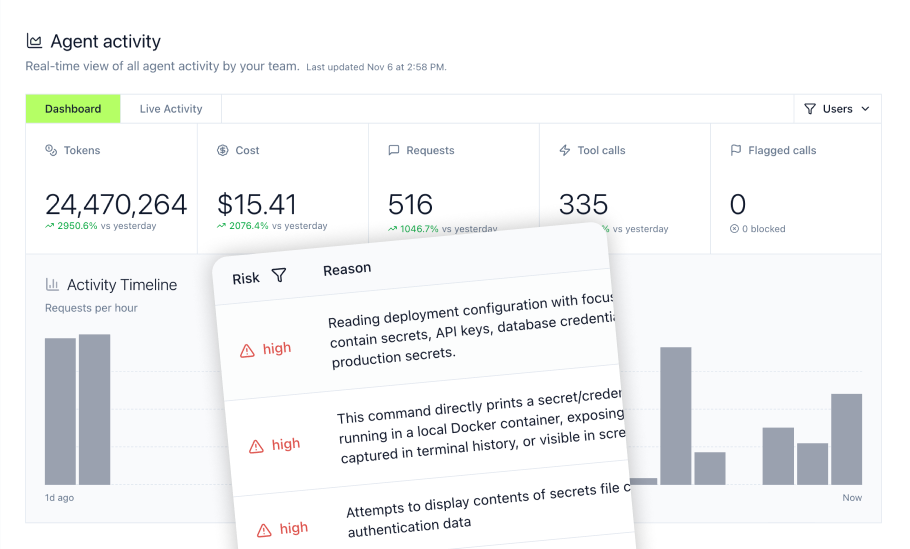
MintMCP's Agent Monitor provides visibility into supported AI-agent activity including:
- Prompt submissions
- File access (including
.env, SSH keys) - Commands (bash, installs, git)
- MCP tool calls
- Usage and token costs
This visibility extends beyond gateway traffic to local agent activity from coding-agent environments where supported.
Tracking agent usage and cost efficiency
Token spend visibility by model, user, agent, and session enables chargeback-grade cost attribution. Organizations can track human versus agent splits, cache-hit rates, and per-session costs for accurate budget allocation.
Detecting and mitigating shadow AI
Agent Monitor detects MCP use even when the MCP is not connected via MintMCP's Gateway, providing visibility into unofficial tool usage and shadow AI activity across the organization.
Building persistent and collaborative coworker agents
Long-running agents that work alongside employees represent the next frontier of enterprise AI deployment.
The rise of long-running autonomous agents
Unlike chatbots handling single interactions, Coworker Agents operate through Slack, schedules, or manual triggers while retaining company-owned memory and continuing work across days.
Key characteristics:
- Persistent work spanning multiple days
- Git-backed memory the company owns
- Sandboxed execution with restricted egress
- Swappable intelligence across models (Claude, GPT, open-source)
Managing company-owned memory for collaborative AI
Enterprise agent memory should be governed infrastructure with:
- Private, team, organization, and customer memory scopes
- Version history and reviewability
- Auditability and portability
- Git-like principles for tracking changes
This contrasts with memory systems that are opaque, difficult to review, and difficult to move between providers.
Best practices for deploying and managing LLM agents at scale
Organizations scaling agent deployments need operational controls, centralized management, and compliance infrastructure.
Scaling agent deployments across the organization
Configuration as code enables declarative management of gateway config and global rules. Directory group integration through SCIM automates access policy propagation when identity providers change.
Maintaining security and performance in agent operations
Essential operational controls include:
- Organization-wide kill switch for immediate shutdown
- Per-VMCP and per-tool disable capabilities
- Connector restart and credential rotation
- Tamper-evident access history signed at write time
MintMCP's security and governance infrastructure provides SSO, SCIM, RBAC, audit trails, and SIEM export capabilities. MintMCP is SOC 2 Type II audited and compliant with HIPAA standards; customers handling protected health information can request HIPAA documentation, and MintMCP signs BAAs.
Understanding MCP data risk is essential for organizations deploying agents with access to sensitive enterprise systems.
MintMCP: Enterprise-ready agent infrastructure
Organizations deploying LLM agents at scale need governance infrastructure that keeps pace with autonomous systems. MintMCP provides the centralized control plane that makes agent deployments measurable, auditable, and secure.
Core capabilities include:
- Governed tool access: Virtual MCPs bundle approved connectors for specific teams and use cases, eliminating scattered MCP configurations and inconsistent authentication
- Agent-native identity: Each agent receives its own named, org-scoped identity with independent credential rotation and attributable audit trails
- Runtime security: Three-layer guardrail architecture (Mint Guard, Rules, Gateway Middleware) enforces policies on prompt injection, secrets, PII, and custom business logic
- Agent activity visibility: Agent Monitor tracks supported prompt submissions, file access, commands, and MCP tool calls across gateway traffic and supported local coding environments
- Enterprise compliance: SOC 2 Type II audited and compliant with HIPAA standards, with SSO, SCIM, RBAC, audit trails, and tamper-evident access history
Whether you're deploying your first agent or scaling to hundreds, MintMCP's platform provides the governance foundation that security, compliance, and engineering teams need to deploy autonomous AI safely.
Frequently asked questions
How do LLM agents handle errors and unexpected situations during multi-step tasks?
LLM agents employ various error-handling strategies including retry mechanisms, fallback paths, and human-in-the-loop escalation. When a tool call fails or returns unexpected results, well-designed agents can re-plan their approach, attempt alternative methods, or pause for human review. The planning module typically includes contingency logic for common failure modes. Error compounding remains a significant challenge in multi-agent systems because mistakes can propagate between agents, making validation checkpoints between agent interactions important for production deployments.
What compliance frameworks specifically address AI agent operations in regulated industries?
Compliance obligations depend on the organization, its role, the data involved, and the AI use case. Under GDPR, controller-processor relationships generally require a processor contract, while a DPIA is required when processing is likely to result in high risk to individuals. Under the EU AI Act, human-oversight and related obligations apply to high-risk AI systems rather than every AI deployment. HIPAA applies to covered entities and business associates handling protected health information, with BAAs required for applicable business-associate relationships and audit controls required for systems containing or using electronic PHI.
Can LLM agents be trained or fine-tuned for specific enterprise use cases?
LLM agents can be customized through several approaches without full model retraining. Retrieval-augmented generation (RAG) connects agents to enterprise knowledge bases for domain-specific responses. Prompt engineering and few-shot learning adapt agent behavior through carefully crafted instructions and examples. For deeper customization, fine-tuning base models on proprietary data creates specialized capabilities, though this requires significant compute resources and ML expertise. Most enterprise deployments combine these approaches, using RAG for real-time data access and prompt templates for consistent behavior.
How do multi-agent systems coordinate without creating security vulnerabilities?
Multi-agent coordination introduces risks around insecure inter-agent communication and cascading failures. Secure implementations use encrypted channels between agents, validate agent identities before accepting instructions, and implement rate limiting to prevent runaway agent activity. Each agent should operate with least-privilege access to tools and data, with clear boundaries preventing one compromised agent from affecting others. Organizational memory technology that maintains context across agent handoffs helps prevent information loss while validation checkpoints catch errors before they propagate through interconnected workflows.
What metrics should organizations track to measure LLM agent ROI?
Effective agent ROI measurement includes both efficiency gains and governance costs. Track task completion rates, average handling time reductions, error rates compared to manual processes, and user satisfaction scores. Cost metrics should capture token usage by model and task type, infrastructure costs, and time saved by employees. Governance costs include security tooling, audit overhead, and incident response. Organizations should also measure adoption rates across teams, shadow AI reduction after formal deployments, and compliance audit outcomes to demonstrate measurable productivity improvements.