Deploying AI agents at enterprise scale requires more than choosing between Claude and ChatGPT. Both platforms launched managed agent capabilities in April 2026, yet neither provides the unified governance layer that security teams need when agents access production systems. The MintMCP Gateway addresses this gap by providing centralized authentication, tool-level access control, and audit logging that works across Claude, ChatGPT, Cursor, Gemini, and Copilot. This comparison examines how Claude Managed Agents and ChatGPT Workspace Agents approach MCP integration and where enterprise teams need additional governance infrastructure.
Key Takeaways
- Claude Managed Agents offer native MCP integration with container-based isolation, while ChatGPT Workspace Agents can use connected apps, approved tools, and custom MCP servers through workspace controls
- Claude Managed Agents add $0.08 per session-hour on top of token pricing, while ChatGPT Workspace Agents are available on Business, Enterprise, Edu, and Teachers plans with credit-based usage
- Claude Managed Agents lack a centralized admin console (API-only configuration), while ChatGPT offers GUI-based admin controls
- ChatGPT Workspace Agents support native Slack deployment and team sharing; Claude focuses on individual developer workflows
- Neither platform provides unified governance across multiple AI tools or shadow AI detection for off-gateway activity
- MintMCP's Bundle architecture delivers per-agent identity, cross-platform governance, and audit trails that work regardless of which AI platform your teams use
- Claude supports long-running, stateful sessions with prompt caching and compaction, while ChatGPT Workspace Agents emphasize shared workflows, schedules, Slack deployment, and workspace controls
Understanding AI Agents: Claude, ChatGPT, and the Rise of Agentic AI
AI agents represent a fundamental shift from chat-based assistants to autonomous systems that execute multi-step workflows. Rather than answering questions, agents connect to external tools, access databases, modify files, and complete tasks independently.
What Defines an AI Agent?
An AI agent combines a large language model with the ability to:
- Take actions through tool calls and API integrations
- Maintain context across extended sessions
- Make decisions about which tools to use and when
- Execute workflows without step-by-step human guidance
Both Claude and ChatGPT have evolved from conversational interfaces into agentic platforms. Claude captured 54% of enterprise coding by December 2025, while ChatGPT serves 900 million weekly users globally.
Agentic AI in Action: Use Cases for Claude and ChatGPT
Enterprise teams deploy agents for:
- Development workflows: Code generation, PR reviews, CI/CD automation through GitHub, Jira, and database connections
- Data analysis: Querying data warehouses, generating reports, building dashboards
- Customer operations: CRM updates, ticket routing, knowledge base searches
- Internal productivity: Document drafting, calendar management, email automation
The Model Context Protocol (MCP) has emerged as the standard for connecting these agents to enterprise tools. MCP adoption accelerated dramatically in 2025, with rapidly growing SDK downloads and native support from all major foundation model providers.
The 'Last Mile Problem' in Enterprise AI and MCP Adoption
Deploying AI agents in enterprise environments requires solving what MintMCP calls the "last mile problem": giving agents secure, governed access to internal systems without rebuilding authentication, logging, and access control for every integration.
Why Secure Access to Internal Systems Matters for Agents
When an AI agent connects to your Salesforce instance, Snowflake data warehouse, or GitHub repositories, it needs:
- Authentication: How does the agent prove its identity to each system?
- Authorization: Which data and actions should this specific agent access?
- Audit logging: Who triggered which agent action, and what data flowed through?
- Policy enforcement: How do you prevent agents from accessing sensitive data or executing dangerous commands?
Neither Claude Managed Agents nor ChatGPT Workspace Agents fully solve these challenges on their own. Claude offers deep MCP integration but lacks centralized admin controls. ChatGPT provides workspace governance for connected apps, approved tools, and custom MCP servers, but it does not replace a vendor-neutral governance layer across every AI client and local agent workflow.
The Growing Necessity of MCP for Enterprise Workflows
MCP standardizes how AI agents access external tools. Rather than building custom integrations for each agent-tool combination, MCP provides:
- A common protocol for tool discovery and invocation
- Standardized authentication flows
- Consistent message formats across different AI platforms
The MCP ecosystem transitioned to Linux Foundation governance in December 2025, signaling industry-wide adoption. For enterprises, this standardization creates an opportunity to implement governance once and apply it across all agent interactions.
MintMCP provides this governance layer. The platform supports 10,000+ MCP servers with managed runtime, centralized authentication, and tool-level access controls that work with Claude, ChatGPT, Cursor, Gemini, and Copilot.
Comparing Claude Managed Agents and ChatGPT Workspace Agents for MCP Integration
Claude Managed Agents launched in public beta in April 2026. ChatGPT Workspace Agents followed as a research preview on April 22. Both represent significant advances in agentic AI, but they serve different architectural philosophies.
Native MCP Capabilities of Claude vs. ChatGPT
Claude Managed Agents feature:
- Native MCP integration built into the platform architecture
- Container-based isolation with scoped network access per agent
- Self-hosted sandbox option for running agents on your own infrastructure
- File operations inside managed cloud containers or self-hosted sandbox environments
- Long-running stateful sessions with persistent filesystems, conversation history, prompt caching, and compaction
ChatGPT Workspace Agents provide:
- Custom MCP servers and connected apps governed through workspace controls
- Workspace-level isolation with centralized admin controls
- Native Slack deployment for team-based agent interactions
- Broader connector ecosystem including Google Drive, SharePoint, OneDrive, Salesforce, and Notion
- Codex-powered cloud execution with persistent workspaces
The key architectural difference: Claude treats MCP as foundational infrastructure, while ChatGPT layers MCP capability into a broader workspace-agent platform.
Challenges with Off-Gateway Agent Activity
Both platforms face a common limitation: visibility stops at the gateway boundary. When developers use Claude Code or Cursor locally, agent activity may bypass centralized governance entirely.
Claude Managed Agents require API-based configuration for all security settings. There is no GUI-based admin console, which increases implementation complexity for IT teams.
ChatGPT Workspace Agents offer centralized admin controls but remain in research preview status, with features subject to change.
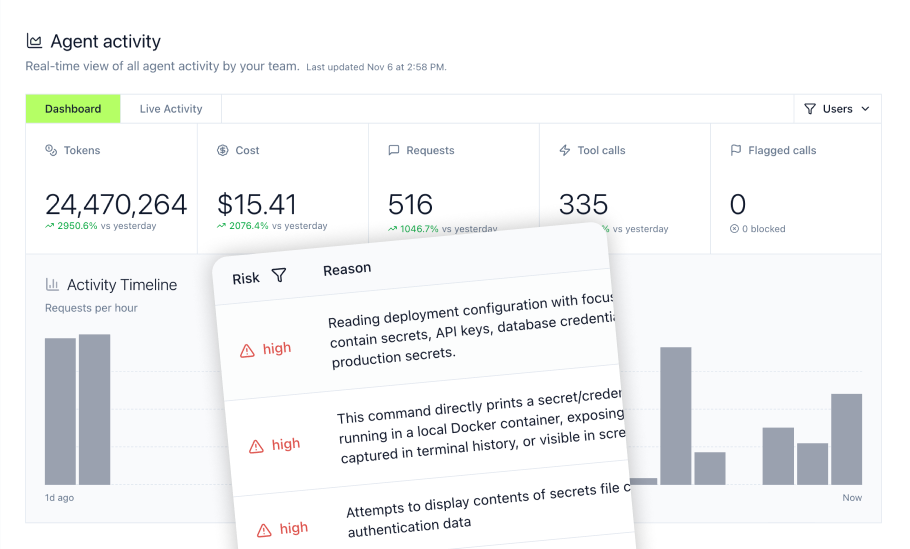
Neither platform provides shadow AI detection for off-gateway usage. MintMCP's Agent Monitor fills this gap by tracking agent activity across the organization, including MCP calls made outside the gateway through hooks in Cursor and Claude Code.
Securing AI Agents: Authentication, Authorization, and Data Governance for MCP
Enterprise AI deployment requires security controls that match or exceed existing data governance standards. Both Claude and ChatGPT offer authentication mechanisms, but enterprise teams often need additional layers.
Implementing Zero-Trust for Agent Interactions
Zero-trust architecture assumes no default access. Every request requires authentication and authorization, regardless of network location or previous interactions.
Claude Managed Agents support:
- Managed credential vault with OAuth flows
- Per-agent permissions with container-level scoping
- Rate limits of 300 requests/minute for create operations
ChatGPT Workspace Agents provide:
- Workspace-level OAuth with SSO/SAML integration
- Admin-managed tool approval workflows
- Credit-based Workspace Agent usage after the free preview period
Neither platform implements per-agent identity as a first-class primitive with M2M authentication and independent credential rotation.
Policy Enforcement and Data Loss Prevention (DLP) for LLMs
When agents access sensitive data, policy enforcement becomes critical. Enterprise teams need:
- PII detection before data leaves internal systems
- Credential masking to prevent API key exposure
- Prompt injection defense to block malicious inputs
- Action blocking for dangerous commands
Claude Managed Agents offer detailed session tracing through the Claude Console. ChatGPT Workspace Agents provide workspace-level audit logs. Both capture what happened, but neither integrates directly with enterprise DLP systems.
MintMCP Gateway supports custom policy code execution on every tool call through JS sandbox middleware. Built-in integrations include AWS Bedrock Guardrails, Google Cloud DLP, Microsoft Purview, Nightfall, and Skyflow. When agents attempt to access PII or credentials, you get real-time alerts and automatic blocking.
Building Enterprise-Grade Workflows: Orchestrating Agents and Automating Tasks
Successful enterprise AI deployment requires more than individual agent capabilities. Teams need infrastructure for orchestrating multiple agents, managing access across departments, and scaling automation safely.
Automating Routine Tasks with Governed Agents
Common enterprise workflows include:
- Data analysis agents querying Snowflake, BigQuery, or Elasticsearch and generating reports
- Customer support agents accessing Zendesk, Salesforce, and internal knowledge bases
- Development workflow agents connecting to GitHub, Jira, and CI/CD pipelines
- Compliance agents monitoring audit trails and flagging policy violations
Claude Managed Agents can reduce the infrastructure work required to build agent loops, tool execution, and runtime management. ChatGPT Workspace Agents allow one Sales Consultant to build an agent end-to-end without engineering team involvement, as reported by Rippling.
Scaling AI Automation Across Departments
The challenge compounds when multiple departments deploy agents simultaneously. Engineering teams use Cursor and Claude Code. Sales teams build ChatGPT agents for CRM automation. Support teams deploy agents for ticket routing.
Without centralized governance, each deployment creates:
- Separate credential management
- Inconsistent access policies
- Fragmented audit trails
- No visibility into cross-department agent activity
MintMCP's Virtual MCPs (VMCPs) bundle multiple servers with role-based tool access. Each department gets a curated endpoint with appropriate permissions, while security teams maintain unified oversight through a single governance layer.
The MintMCP Bundle Model: Simplifying Governance for Claude and ChatGPT Agents
MintMCP's Bundle architecture addresses a fundamental gap in both Claude and ChatGPT agent governance: the lack of purpose-built governance units that combine tool access, policy enforcement, and audit logging.
Streamlining Policy Management with Agent Bundles
The Bundle model packages:
- Tool access: Which MCP servers and specific tools this bundle can invoke
- Policy rules: Custom JavaScript middleware for request/response filtering
- Audit trails: Per-bundle logging with full context for compliance investigations
- Group membership: SCIM-driven sync with Okta, Azure AD, or Google Workspace
Rather than managing separate plugin, access rule, and credential objects (as required by some competitors), MintMCP consolidates governance into a single unit per team or role.
For agent deployments, Agent Bundles extend this model to non-human principals. Each deployed agent receives:
- Its own rotatable credentials via OAuth 2.0 client-credentials
- Permission scope independent of creator's access level
- "Act as agent" admin flow for connectors requiring per-agent OAuth
- Audit attribution tied to the specific agent identity
Ensuring Audit Attribution at Scale
When an incident occurs, security teams need to answer: Which agent accessed which data, triggered by whom, at what time?
Claude Managed Agents provide session tracing, but configuration requires API calls rather than GUI-based management. ChatGPT Workspace Agents offer workspace-level logging, but attribution follows workspace boundaries rather than individual agent identities.
MintMCP captures every agent action with full context: who initiated it, which tools were called, what data flowed through, and when. Logs export to SIEM platforms including Microsoft Sentinel, Splunk, and S3 for integration with existing security operations.
Detecting Shadow AI: Visibility and Control for Off-Gateway Agent Activity
Gateway-based governance covers MCP traffic that routes through centralized infrastructure. But developers often run agents locally through Claude Code, Cursor, or other tools that may bypass the gateway entirely.
The Risks of Unmonitored Agent Activity
Shadow AI creates blind spots:
- Data exfiltration: Local agents may access and transmit sensitive files without logging
- Credential exposure: API keys entered into local tools lack rotation enforcement
- Policy bypass: Guardrails configured at the gateway do not apply to local execution
- Compliance gaps: Audit trails miss local agent activity entirely
Neither Claude Managed Agents nor ChatGPT Workspace Agents address off-gateway visibility. Their governance models assume traffic routes through their respective platforms.
Enforcing Policies Beyond the Gateway
MintMCP Agent Monitor tracks agent activity in real-time across the organization, including off-gateway MCP usage. The platform:
- Detects shadow AI through hooks in Cursor and Claude Code
- Identifies risky behaviors including PII exposure, credential leakage, and dangerous bash commands
- Supports custom guardrail policies with block/flag/alert actions
- Enables MDM integration for pushing detect-only or enforce-mode configurations to developer machines
This two-layer approach (Gateway plus Agent Monitor) provides comprehensive visibility regardless of how developers choose to interact with AI agents.
Technical Differentiators: Custom Policies, STDIO Server Support, and Compliance
Enterprise MCP deployment involves technical requirements that go beyond basic agent capabilities. Platform engineering teams evaluate transport support, middleware extensibility, and compliance posture.
Extending Security Policies with Code Hooks
Claude Managed Agents support detailed session tracing but lack inline policy execution. ChatGPT Workspace Agents offer admin-managed tool approval but do not support custom code hooks.
MintMCP's middleware layer runs in a JS sandbox with:
- Allowed-domains fetch for external API calls
- Secret injection for secure credential access
- Built-in templates for OpenAI moderation, jailbreak detection, and AWS Bedrock Guardrails
awsSign()SigV4 helper for AWS service integration- Pre- and post-phase hooks for request/response transformation
This extensibility allows enterprises to integrate existing DLP investments without replacing them.
From Local Development to Production with Zero Code Changes
Many MCP servers run as STDIO processes locally. Moving these to production typically requires significant rearchitecture.
MintMCP's STDIO server support automatically converts locally-run MCP servers to hosted, production-ready services with OAuth wrapping. No code changes required. The platform handles:
- Auto-scaling and isolated/sandboxed execution per connector
- OAuth brokering for hosted containers (working around redirect-URI limitations)
- All three upstream transports: STDIO, HTTP-streamable, and legacy SSE
For compliance, MintMCP is SOC 2 Type II audited with continuous Drata monitoring. The platform is compliant with HIPAA standards, penetration tested, and offers data encryption in transit and at rest with data residency options. Customers handling protected health information can request HIPAA documentation, and MintMCP signs BAAs.
MintMCP in the MCP Ecosystem: A Strategic Infrastructure Partner
The MCP ecosystem's transition to Linux Foundation governance signals long-term standardization. All major foundation model providers now offer native MCP support, creating an opportunity for infrastructure platforms that operate at the protocol level.
The Standardizing Future of Agentic AI
MCP adoption reached rapidly growing SDK downloads by late 2025. This standardization mirrors the API gateway category emergence in the prior decade: as protocols standardize, infrastructure layers that provide security, observability, and governance become essential.
MintMCP is positioned as this infrastructure layer for MCP. The platform:
- Supports Claude, ChatGPT, Cursor, Gemini, and Copilot through a unified gateway
- Operates 10,000+ MCP servers in a managed catalog
- Partners officially with Cursor as a Cursor Hooks Partner
- Provides governance that works regardless of which AI platforms your organization adopts
MintMCP's Role in the Evolving MCP Landscape
As AI agents become central to enterprise workflows, the infrastructure supporting them must evolve. Neither Claude nor ChatGPT alone provides the cross-platform governance, shadow AI detection, and per-agent identity management that enterprise security teams require.
MintMCP fills these gaps with a data-permissions-first architecture. Most agent platforms start from the agent and retrofit data permissions afterward. MintMCP starts from data permissions (SSO, SCIM, IdP groups, Virtual MCP Bundles, tool-level policy, audit) and then enables agents on top. An agent's access is always a subset of an already-governed permission model.
Why MintMCP Delivers Enterprise-Grade MCP Governance
Claude Managed Agents and ChatGPT Workspace Agents represent significant advances in agentic AI. Claude excels at developer-centric workflows with native MCP integration and container-level isolation. ChatGPT excels at team collaboration with centralized admin controls and native Slack deployment.
Neither platform alone provides what enterprise security teams need: unified governance across multiple AI tools, per-agent identity with independent credential rotation, shadow AI detection for off-gateway activity, and custom policy execution integrated with existing DLP investments.
MintMCP addresses these requirements through:
- Virtual MCP Bundles that package tool access, policy, and audit for every team and agent into a single governance unit
- Agent Bundles with M2M auth giving each agent its own credentials and scope, with no shared keys to rotate or leak
- Agent Monitor that detects off-gateway MCP usage in Cursor and Claude Code
- JS sandbox middleware supporting integration with AWS Bedrock Guardrails, Google Cloud DLP, Microsoft Purview, Nightfall, and Skyflow
- Hosted MCP runtime managing 10,000+ servers with auto-scaling and sandboxed execution
For engineering teams, MintMCP enables one-click deployment for thousands of MCP servers with configured authentication, hosting, and access controls. Get your team productive with MCP-powered agents in minutes, not weeks.
For security teams, every agent action is logged with full context: who initiated it, which tools were called, what data flowed through, and when. MintMCP is SOC 2 Type II audited, compliant with HIPAA standards, and penetration tested.
Start your free trial to deploy governed AI agents across Claude, ChatGPT, Cursor, Gemini, and Copilot. No sales call needed.
Frequently Asked Questions
What is the core difference between Claude Managed Agents and ChatGPT Workspace Agents for enterprise use?
Claude Managed Agents feature native MCP integration with container-based isolation and API-driven configuration, making them well-suited for developer-centric workflows requiring deep technical control. ChatGPT Workspace Agents provide centralized admin controls with GUI-based management and native Slack deployment, optimized for team collaboration and business user accessibility. Claude Managed Agents add $0.08 per session-hour on top of token pricing, while ChatGPT Workspace Agents are available on Business, Enterprise, Edu, and Teachers plans with credit-based usage. Neither alone provides cross-platform governance, which is where MintMCP's unified gateway adds value.
How does MintMCP address the 'shadow AI' problem in environments using tools like Cursor or Claude Code?
MintMCP's Agent Monitor tracks agent activity in real-time across the organization, including MCP calls made outside the gateway. Through hooks in Cursor and Claude Code, Agent Monitor detects PII exposure, credential leakage, risky bash commands, and prompt injection attempts. The platform supports custom guardrail policies with block/flag/alert actions and MDM integration for pushing configurations to developer machines. This provides visibility that neither Claude nor ChatGPT offers for off-gateway agent activity.
What does MintMCP's 'Bundle' model offer that distinguishes it from other MCP governance solutions?
MintMCP's Bundle architecture packages tool access, policy enforcement, and audit logging into single governance units per team or role. Each Bundle ties SCIM group membership to curated MCP server lists, custom policy rules, and isolated audit trails. Agent Bundles extend this model to non-human principals, giving each deployed agent its own rotatable credentials and permission scope independent of the creator's access level. This consolidation avoids the manual configuration of separate plugin, access rule, and credential objects required by other approaches.
Can MintMCP integrate with existing enterprise security and identity providers?
Yes. MintMCP supports OAuth 2.0 and SAML authentication with SSO integration across Okta, Azure AD, and Google Workspace. SCIM-driven group sync automatically updates Bundle membership when identity provider groups change. For DLP integration, MintMCP's middleware supports AWS Bedrock Guardrails, Google Cloud DLP, Microsoft Purview, Nightfall, and Skyflow. Audit logs export to SIEM platforms including Microsoft Sentinel, Splunk, and S3.
What compliance controls and documentation does MintMCP provide?
MintMCP is SOC 2 Type II audited with continuous compliance monitoring via Drata. The platform is compliant with HIPAA standards, with BAA available for healthcare customers. Infrastructure is penetration tested with data encryption in transit and at rest, data residency options, and uptime SLA. Full security documentation is available at the MintMCP Trust Center or by contacting security@mintmcp.com.