Every AI agent deployment without proper OAuth configuration creates a security liability waiting to happen. Your sales agent accessing customer records with shared admin credentials, your DevOps agent merging code without permission scoping, your support agent pulling sensitive data with no audit trail. The solution is implementing OAuth 2.1 authorization correctly from the start using the Model Context Protocol (MCP) through a platform like MintMCP Gateway that handles authentication, credential management, and policy enforcement at the infrastructure layer.
Key Takeaways
- OAuth 2.1 setup for MCP servers requires planning around your IdP, MCP server count, credential model, and policy requirements
- Proper MCP authorization can reduce custom authentication work by centralizing token handling, credential storage, and policy enforcement
- For MCP authorization flows that use OAuth 2.1, MCP clients must implement PKCE and verify PKCE support before proceeding
- OAuth-secured agents improve accountability by tying tool access to specific users, sessions, or agent identities instead of shared credentials
Understanding OAuth 2.0 for Secure AI Agent Authentication
OAuth 2.0 is the authorization framework that enables AI agents to access protected enterprise resources without exposing user credentials. Unlike API keys that grant all-or-nothing access, OAuth provides granular permission scoping through defined scopes, time-limited tokens, and user consent mechanisms.
The Role of OAuth in AI Agent Security
When an AI agent needs to read your Salesforce records or push code to GitHub, it cannot simply use your password. OAuth creates a secure handoff where:
- Authorization grants specify exactly what the agent can access
- Access tokens provide time-limited credentials that expire automatically
- Refresh tokens enable long-running sessions without re-authentication
- Scopes define precise boundaries like
github:readorsalesforce:write - Consent screens require explicit user approval before granting access
The MCP authorization specification builds on OAuth 2.1 for HTTP-based transports. Authorization is optional for MCP implementations overall, but when OAuth authorization is used, MCP servers act as protected resources that AI agents must authenticate against, with the authorization server validating tokens before granting access to tools or data.
Core Concepts of OAuth 2.1 Flows
OAuth 2.1 introduces stricter security requirements than its predecessor. For AI agent implementations, you need to understand these flow patterns:
Authorization Code Flow with PKCE: The standard for user-delegated access. The user authorizes the agent through a consent screen, and the agent receives tokens scoped to that user's permissions. PKCE prevents authorization code interception attacks and is required for MCP clients using OAuth authorization flows.
Client Credentials Flow: Used for service-to-service authentication where agents act as service accounts without user context. Appropriate for background automation tasks.
Token Exchange (RFC 8693): Enables propagating user context from MCP client to MCP server to downstream APIs. Critical for maintaining audit attribution across multi-hop agent workflows, as defined in IETF RFC 8693.
Integrating Claude Managed Agents with MCP OAuth Authorization
Claude Managed Agents supports MCP server authentication through vault credentials, including MCP OAuth credentials and static bearer credentials. Vault credentials are referenced at session creation, and Anthropic can refresh MCP OAuth access tokens when a refresh block is supplied.
Step-by-Step MCP Integration for Claude Agents
Setting up OAuth for Claude Managed Agents follows a predictable sequence. Exact timelines depend on your IdP, MCP server count, credential model, and policy requirements:
Step 1: Authorization Server Configuration
- Set up your OAuth provider, such as Auth0, Okta, or a similar identity provider
- Configure issuer URL, authorization endpoint, and token endpoint
- Create client credentials for each MCP server
- Verify
.well-known/oauth-authorization-servermetadata endpoint is accessible
Step 2: MCP Server Protected Resource Definition
- For each enterprise system your agents will access, create MCP server definitions with OAuth resource metadata
- Configure audience restrictions matching your MCP server URLs
- Define scopes that map to business permissions
- Set up token exchange for downstream API propagation
Step 3: Agent Definition via API
- Use the Anthropic API to create agent definitions with model selection
- Include MCP server configurations pointing to your protected resources
- Reference credential vault IDs for pre-stored credentials
- Configure system prompts with appropriate guardrails
Step 4: End-to-End Testing
- Create test sessions and trigger tools requiring OAuth
- Verify user redirect to authorization server
- Confirm consent screen displays correct permissions
- Validate token issuance and successful API calls
Leveraging Existing Identity Providers with MintMCP
Enterprise organizations already have identity infrastructure in place. MintMCP connects directly to Okta for workforce identity management, Microsoft Entra ID for Microsoft-centric environments, and Google Workspace for Google Cloud organizations.
Rather than building separate OAuth integrations for each AI tool, MintMCP centralizes authentication across Claude, Cursor, ChatGPT, Gemini, and Copilot through a single SSO-fronted gateway. Your existing IdP groups translate directly into MCP access policies.
Configuring REST API Authorization for Claude Agent Tools
When Claude agents call external APIs, those calls must carry proper authorization. The MCP protocol wraps API interactions in a standardized tool interface, but the underlying REST calls still need bearer tokens or API keys to succeed.
Best Practices for Securing API Endpoints
Secure API access for AI agents requires defense in depth:
- Never embed credentials in prompts or tool definitions. Use credential vaults that inject secrets at runtime.
- Implement rate limiting per user and per team to prevent runaway agent behavior from exhausting API quotas.
- Enable request logging with sensitive-field controls for audit purposes, while masking tokens, passwords, and other secrets.
- Validate all API responses before returning to agents to prevent data leakage through error messages.
MintMCP enforces these patterns at the gateway layer. You can enable database reads while blocking writes, or allow specific Salesforce queries while denying record deletion, all through policy configuration rather than code changes.
Mapping OAuth Scopes to API Permissions
OAuth scopes provide coarse-grained access control. Effective MCP configurations map scopes to business-meaningful permissions:
| OAuth Scope | Business Permission | Example Tools |
|---|---|---|
github:read | View repositories, issues, PRs | list_repos, get_issue |
github:write | Create branches, merge PRs | create_branch, merge_pr |
salesforce:contacts.read | View customer records | search_contacts, get_account |
salesforce:opportunities.write | Update deal stages | update_opportunity, create_task |
When defining MCP servers, include these scopes in the resource metadata endpoint so authorization servers can present accurate consent screens and issue appropriately scoped tokens.
Implementing Agent Bundles for Per-Agent Credential Scoping
Static API keys create accountability problems. When five agents share one Salesforce key, you cannot determine which agent accessed which record. Agent Bundles solve this by giving each AI agent its own persistent identity with scoped credentials.
The Benefits of Unique Agent Identities
Per-agent identity delivers security and governance improvements:
- Audit attribution: Every tool call traces to a specific agent, not a shared service account
- Blast radius containment: Compromising one agent's credentials does not expose all agents
- Independent rotation: Rotate or revoke one agent's keys without affecting others
- Granular quotas: Apply rate limits per agent rather than per-organization
- Compliance evidence: Demonstrate least-privilege access for each automation
MintMCP's Agent Bundles extend the Bundle model to non-human principals. Each agent receives OAuth 2.0 client credentials for M2M (machine-to-machine) authentication, with token rotation and revocation independent of any human user account.
Automating Credential Management for Agents
Manual credential rotation does not scale. When you operate dozens of AI agents across multiple enterprise systems, you need automated lifecycle management:
- Background token refresh: Refresh access tokens before expiry rather than waiting for 401 errors
- Scheduled credential rotation: Rotate long-lived credentials on regular cycles
- Automated revocation on agent decommission: When an agent is deleted, its credentials are immediately invalidated
- Centralized secret storage: All credentials live in encrypted vaults, never in agent configurations
The credential vault approach means agents can access protected resources without ever seeing the actual secrets. The vault injects tokens at runtime, and audit logs capture which agent accessed which resource without exposing the credentials themselves.
Securing Custom and STDIO MCP Servers with OAuth Wrapping
Many organizations run custom MCP servers for internal systems that lack pre-built connectors. These STDIO-based servers run as local subprocesses and need OAuth protection before production deployment.
Transforming Local Servers into Secure Production Services
STDIO MCP servers present a specific challenge: they run locally without network endpoints, so traditional OAuth redirect flows do not work directly. The solution is OAuth wrapping at the gateway layer.
MintMCP's hosted connector infrastructure accepts custom STDIO servers and automatically:
- Exposes them as remote MCP endpoints with proper transport security
- Handles OAuth flows on behalf of the STDIO process
- Manages credential injection without code changes to the server
- Provides sandboxed execution with input/output inspection
This transforms a development-only local server into a production-ready service with enterprise authentication. Engineering teams can build custom MCP tools using familiar STDIO patterns while security teams get full OAuth controls.
The Value of Automated OAuth Integration
Manual OAuth integration for each MCP server requires engineering effort, especially when teams need token validation, refresh handling, secure storage, and audit attribution across multiple systems.
Automated OAuth wrapping reduces this overhead:
- No OAuth library integration in server code
- No token validation logic to maintain
- No refresh handling to implement
- No credential storage to secure
The MCP server focuses purely on business logic while the gateway handles all authentication concerns.
Monitoring and Auditing OAuth Authorized Agent Activity
OAuth authorization controls who can access what. Monitoring reveals who actually accessed what and when. For compliance purposes, you need both.
Real-Time Visibility into Authorized Agent Actions
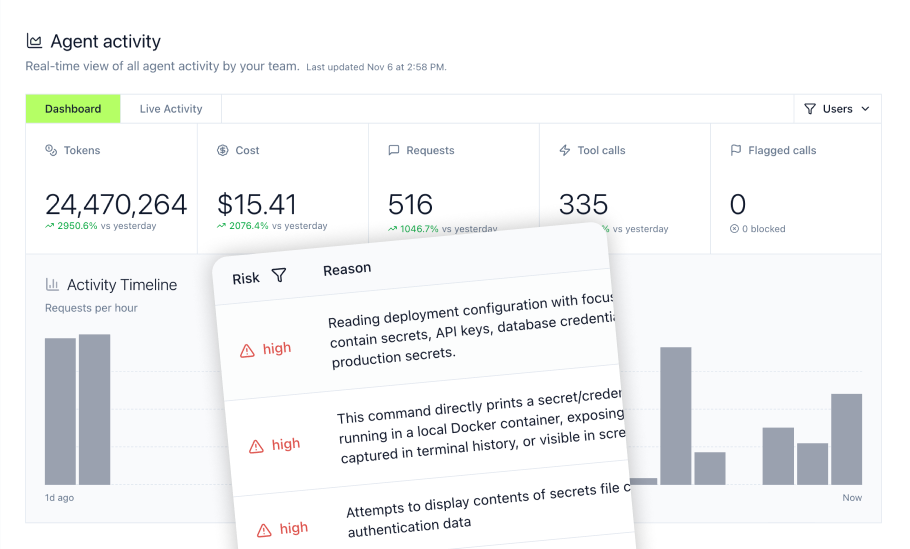
MintMCP provides conversation-level logging for all MCP interactions:
- Prompt capture: What the user or system asked the agent to do
- Tool calls: Which MCP tools were invoked with what parameters
- Responses: Data returned from protected resources
- Context: Full conversation history for audit reconstruction
- Attribution: Which user triggered which agent action
This logging happens automatically for all OAuth-authorized requests flowing through the MCP gateway. When a compliance team needs to investigate data access, they can search by user, agent, tool, or time range to reconstruct exactly what happened.
Ensuring Compliance Through Comprehensive Logging
Regulated industries require specific audit capabilities. MintMCP's logging infrastructure supports:
- SIEM export: Push logs to Microsoft Sentinel, Splunk, or S3 for correlation with other security events
- Configurable retention: Meet data retention requirements
- Immutable records: Audit logs cannot be modified after creation
- PII detection: Flag requests and responses containing sensitive data patterns
For organizations pursuing SOC 2, HIPAA, or other compliance frameworks, these capabilities provide the evidence collection needed for auditor reviews.
Advanced Policy Enforcement for OAuth-Enabled Claude Agents
OAuth handles authentication and coarse-grained authorization. Policy enforcement handles the fine-grained decisions: Should this specific agent be allowed to run this specific query on this specific data?
Dynamic Authorization Rules for Sensitive Data
Static OAuth scopes cannot express complex access rules. MintMCP supports custom policy code that executes on every tool call:
- Input inspection: Block requests containing prohibited patterns, such as SSNs or credit card numbers
- Output masking: Redact sensitive fields in API responses before returning to agents
- Conditional access: Allow queries during business hours but block after-hours access
- Quota enforcement: Limit expensive operations per agent per time period
The policy engine runs in a JS sandbox with fetch capabilities for external lookups. You can call your existing DLP platform to classify content before deciding whether to block or allow.
Integrating with Enterprise DLP Solutions
Rather than building classification from scratch, connect to established DLP infrastructure like AWS Bedrock Guardrails for block and mask capabilities, Google Cloud DLP for content inspection, Microsoft Purview for information protection policies, or Nightfall for real-time PII detection.
These integrations operate inline at the gateway. When an agent requests customer data, the response passes through DLP inspection before reaching the agent. If sensitive data is detected, the policy engine can block, mask, or flag the response according to your rules.
Why MintMCP Simplifies OAuth for Claude Managed Agents
Configuring OAuth correctly for AI agents requires expertise across identity management, API security, and MCP protocol specifics. MintMCP collapses this complexity into a managed platform designed for production AI agent deployments.
MintMCP provides a unified gateway for all AI tools rather than requiring separate OAuth integrations for Claude, Cursor, ChatGPT, Gemini, and Copilot. Your existing identity provider groups translate directly into access policies across every AI tool your organization uses. The Bundle model packages tool access, policy enforcement, and audit logging into single governance units, with each team or role getting a Virtual MCP Bundle with SCIM-synchronized group membership, curated tool lists, custom policy rules, and isolated audit trails.
Agent Bundles extend this same model to AI agents themselves. Each agent receives M2M OAuth credentials, scoped tool access, and independent credential rotation without shared service account keys. This architecture addresses the accountability problems of shared credentials while providing the audit attribution compliance teams require.
MintMCP is SOC 2 Type II audited, compliant with HIPAA standards, and penetration tested. Enterprise SSO, complete audit trails, PII detection, and role-based access control are built into every layer of the platform. Customers handling protected health information can request HIPAA documentation, and MintMCP signs BAAs.
For teams deploying Claude Managed Agents with OAuth, MintMCP reduces custom integration work while providing the governance infrastructure security teams require. Start your trial with no sales call required.
Frequently Asked Questions
What is the primary benefit of using OAuth 2.1 for Claude Managed Agents with MCP?
OAuth 2.1 provides user-scoped authorization rather than all-or-nothing API key access. Each user who authorizes an agent grants specific permissions, such as reading contacts or writing opportunities, that the agent cannot exceed. This creates audit trails attributable to individual users, enables compliance with data access policies, and contains blast radius when credentials are compromised. Without OAuth, agents typically use shared admin keys that provide no accountability and maximum exposure.
How does MintMCP's Agent Bundle architecture enhance OAuth authorization for individual AI agents?
Agent Bundles give each deployed AI agent its own OAuth 2.0 client credentials for machine-to-machine authentication. Unlike shared service accounts, each agent has independent token rotation and revocation. When you decommission an agent, its credentials are invalidated without affecting other agents. This enables per-agent rate limiting, per-agent audit attribution, and least-privilege scoping where each agent accesses only the tools it needs.
Can MintMCP support custom AI agents or existing STDIO-based MCP servers with OAuth?
Yes. MintMCP's hosted connector infrastructure accepts custom STDIO servers and automatically wraps them with OAuth handling. You upload your server code, and MintMCP exposes it as a remote MCP endpoint with enterprise authentication. No changes to your server code required. The platform handles token validation, credential injection, and secure transport while your server focuses on business logic.
What kind of visibility does MintMCP provide for OAuth-authorized Claude agent activities?
MintMCP captures conversation-level logging including prompts, tool calls, responses, and context for every MCP interaction. Each action is attributed to the specific user and agent that triggered it. The monitoring layer also detects off-gateway MCP usage in Cursor and Claude Code, flagging shadow AI activity even when traffic bypasses the gateway. Logs export to SIEM platforms like Sentinel and Splunk for correlation with other security events.
How does MintMCP address compliance requirements like SOC 2 and HIPAA with its OAuth and governance features?
MintMCP is SOC 2 Type II audited with continuous compliance monitoring. The platform provides immutable audit logs, configurable retention periods, and PII detection that compliance teams need for evidence collection. For HIPAA-covered entities, MintMCP offers BAAs and documentation addressing protected health information handling. Data encryption in transit and at rest, data residency options, and uptime SLAs support enterprise compliance programs.