ChatGPT Workspace Agents represent a fundamental shift from conversational AI to autonomous workflow execution, enabling enterprise teams to automate multi-step processes across Slack, CRM systems, and internal databases. However, deploying these agents at scale introduces critical governance challenges: credential management across dozens of connectors, audit logging for compliance, and preventing shadow AI proliferation. Organizations connecting ChatGPT agents to internal systems through the Model Context Protocol need centralized controls that standard platform features do not provide. MintMCP Gateway addresses these gaps with enterprise authentication, tool-level access policies, and comprehensive audit trails for AI agent deployments.
This guide covers practical implementation strategies for authorizing ChatGPT Workspace Agents, managing tool access across your organization, and establishing governance frameworks that satisfy security and compliance requirements while enabling teams to capture productivity gains.
Key Takeaways
- ChatGPT Workspace Agents run autonomously via Codex, executing tasks when users are offline across supported workplace app integrations
- Enterprise plan provides data residency in supported regions, Compliance API for audit logs, and RBAC controls unavailable on Business tier
- Sales teams report 5-6 hours saved weekly per rep through automated meeting preparation workflows
- Agent-owned connections using personal accounts create data exposure risks; service accounts are strongly recommended for shared agent authentication
- Business plan pricing is $30 per user monthly when billed monthly or $25 per user monthly with annual billing, requiring a two-user minimum; credit-based pricing for agent runs begins May 6, 2026
- Compliance API access, SCIM provisioning, and custom retention policies require Enterprise plan subscription
- Organizations deploying agents at scale need external governance layers for cross-platform policy enforcement and shadow AI detection
Understanding ChatGPT Enterprise Login and Secure MCP Integrations
ChatGPT Workspace Agents require Business, Enterprise, Edu, or Teachers plan access. Standard Plus and Pro subscriptions do not include agents. Workspace administrators must explicitly enable the agents feature before team members can build or use agents, with Enterprise workspaces having it disabled by default.
Streamlining Enterprise Authentication
Enterprise authentication operates through SAML SSO integration with your existing identity provider. Two-factor authentication enforcement occurs via the SSO provider rather than natively within ChatGPT. Organizations using Okta, Azure AD, or Google Workspace can federate access management, though granular role-based access controls are Enterprise-only features.
For connector authentication, teams face a critical decision between end-user and agent-owned accounts:
- End-user accounts: Each person running the agent authenticates with their own credentials, limiting data visibility to their personal access scope
- Agent-owned accounts: Shared service account credentials enable all users to access the same data through the agent
Using personal accounts for agent-owned authentication exposes your data to other users. Security best practices strongly recommend using service accounts for all shared agent connectors to mitigate data exposure risks. MintMCP Gateway extends these controls with OAuth 2.0 and SAML authentication at the MCP layer, providing centralized credential management across MCP-connected tools.
Implementing Access Controls for ChatGPT Workspace Agents
Tool-level permission management requires attention during agent configuration. Administrators can toggle read and write actions for each connector, setting approval requirements to "Always ask" or "Never ask" for write operations. Connector Action Constraints limit agent behavior further, such as restricting email sends to internal domain addresses only.
Organizations requiring consistent policy enforcement across multiple AI platforms benefit from centralized security policies that apply regardless of whether agents run through ChatGPT, Claude, Cursor, or other MCP clients. This aligns with NIST AI Risk Management Framework recommendations for governance and transparency in AI systems.
ChatGPT Enterprise Features: Agent Bundles and Centralized Governance
The conversational builder enables teams to describe workflows naturally while ChatGPT generates the agent configuration. This approach reduces technical barriers but introduces governance complexity when multiple teams create agents independently.
Leveraging Agent Bundles for Feature Management
Enterprise organizations typically manage agents through a combination of access levels:
- Basic users: Can run shared agents if workspace admin enables "agents" permission
- Builders: Require "agent building" permission controlled through RBAC
- Publishers: Need "agent publishing" permission to share agents workspace-wide
Skills, which are reusable instruction sets following the Agent Skills Standard, allow teams to standardize output formats and process documentation across agents.
MintMCP's Bundle architecture packages tool access, policy enforcement, and audit logging into single governance units per team or role. Each Bundle ties SCIM group membership to curated MCP server lists, enabling automatic policy inheritance when employees join or leave teams. This approach addresses the configuration sprawl that occurs when organizations manage agents, access rules, and credentials as separate objects. For detailed implementation guidance, review the MCP data risk framework.
Establishing Robust AI Governance Frameworks
Effective governance requires audit capabilities beyond what Business plan subscriptions provide. The Compliance API, available only on Enterprise tier, enables programmatic access to agent configuration and execution logs. Business plan customers cannot audit agent activity programmatically, creating compliance gaps for regulated industries.
Organizations subject to GDPR or industry-specific regulations should evaluate whether native ChatGPT governance meets their requirements. AI governance remains a practical barrier for enterprise deployments, especially when teams need consistent oversight across multiple tools, workflows, and data sources. Data encryption uses TLS 1.2+ in transit and AES-256 at rest for Business and Enterprise plans.
AI Agent Examples: From Data Analysis to Customer Support
Workspace Agents excel at repeatable team workflows rather than one-off tasks. Proven use cases include automated meeting preparation, feedback routing, and IT request triage.
Practical AI Agent Examples in Enterprise Workflows
Sales meeting preparation: Agents run daily to check calendars, pull customer notes from SharePoint, search for company news, and generate briefing documents. Sales reps at Rippling saved 5-6 hours weekly through automated account briefings.
Product feedback routing: Agents monitor Slack channels, support tickets, and community forums to categorize feedback, create Linear tickets for actionable items, and generate weekly summaries for product teams.
IT software request triage: Agents review incoming requests against approved tools lists, check compliance policies, and route approved requests to procurement while flagging violations for IT review. This eliminates 2-3 hours weekly of manual policy verification.
Integrating AI Agent Tools for Enhanced Productivity
ChatGPT Workspace Agents connect to supported workplace applications including Slack, Google Drive, SharePoint, Salesforce, GitHub, Jira, and Linear. OAuth one-click setup simplifies initial configuration for most integrations.
For organizations requiring connections to internal systems not covered by native integrations, custom MCP servers enable unlimited extension capabilities. MintMCP supports hosting custom STDIO-based MCP servers with automatic OAuth wrapping, eliminating code changes when migrating from local development to production environments. The platform maintains a catalog of servers with managed runtime.
Distinguishing AI Agents vs Agentic AI: The Role of MCP
Understanding the distinction between traditional AI agents and agentic AI clarifies deployment decisions. Standard AI agents respond to individual prompts with limited context. Agentic AI systems gather context from connected systems, follow multi-step processes, request approvals for sensitive actions, and maintain workflow progress without constant supervision.
How MCP Bridges Enterprise Agentic Deployments
The Model Context Protocol standardizes how AI agents access external tools and data sources. MCP adoption accelerated dramatically in 2025, with all major foundation model providers offering native support. The ecosystem transitioned to Linux Foundation governance in December 2025.
ChatGPT Workspace Agents use Codex for cloud-based execution, enabling 24/7 operation even when users are offline. This autonomous capability requires governance controls that traditional request-response architectures did not demand.
MintMCP addresses what the company terms the "last mile problem" in enterprise AI: giving agents secure, governed access to internal systems without requiring extensive engineering overhead for each integration. For security teams, this means consistent policy enforcement regardless of which AI platform initiates the MCP connection.
Implementing AI Governance Tools for Compliance and Security
OpenAI has completed a SOC 2 Type 2 examination for its API and ChatGPT business product services, and maintains ISO 27001, 27017, 27018, and 27701 accreditations for supported services. However, attestation and certifications alone do not address all governance requirements for AI agent deployments.
Leveraging Governance Tools for Agent Security
Key governance capabilities by plan tier:
| Capability | Business | Enterprise |
|---|---|---|
| SSO | Yes | Yes |
| Compliance API | No | Yes |
| RBAC | Basic | Full |
| Data Residency | Limited | Available for eligible Enterprise customers in supported regions |
| Custom Retention | No | Yes |
| SCIM Provisioning | No | Yes |
Organizations in financial services or healthcare requiring comprehensive audit trails face a significant limitation: Business plan customers cannot programmatically audit agent actions. This gap requires either Enterprise plan upgrade or external governance layers.
Achieving Compliance Readiness
MintMCP is SOC 2 Type II audited, compliant with HIPAA standards, signs BAAs, penetration tested, and encrypts data in transit and at rest. The platform's compliance posture is documented in the Trust Center with security contact at security@mintmcp.com.
Monitoring and Auditing ChatGPT Workspace Usage
Real-time visibility into agent activity requires instrumentation beyond native ChatGPT capabilities. While Enterprise Compliance API provides audit logs, it only captures activity within the ChatGPT platform itself.
Detecting Shadow AI in ChatGPT Workspace
Shadow AI occurs when employees use AI agents through channels outside IT governance. Developers running MCP servers locally through Cursor or Claude Code bypass centralized controls, creating unmonitored data access paths.
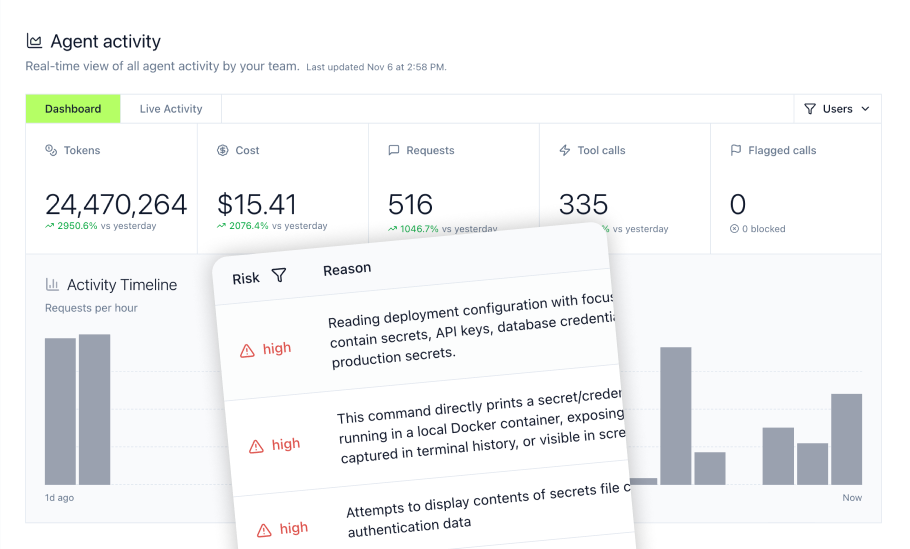
Agent Monitor tracks agent activity across organizations including MCP calls made outside the gateway through hooks in Cursor and Claude Code. Detection capabilities include PII exposure, credential leakage such as API keys and tokens, risky bash commands, and prompt injection attempts using built-in rules.
MDM integration enables push of detect-only or enforce-mode configurations to developer machines. Organizations with existing Kandji deployments can reference the Claude Code hooks setup for configuration details.
Creating Comprehensive Audit Trails
Effective audit trails require conversation-level logging that captures prompts, tool calls, responses, and context with per-user attribution. ChatGPT's native logging provides this within its platform, but multi-platform deployments need aggregated visibility.
MintMCP supports configurable retention and export to SIEM platforms including Microsoft Sentinel, Splunk, and S3. The SIEM export documentation covers integration patterns for security operations teams.
Designing AI Agent Types and Persistent Identities
Agent identity management becomes critical as deployments scale. ChatGPT Workspace Agents maintain memory within their scope, but lack unified identity models across platforms.
Categorizing AI Agents for Targeted Solutions
Organizations typically deploy multiple agent types:
- Interactive agents: Respond to user requests in real-time through ChatGPT interface or Slack
- Scheduled agents: Execute on defined frequencies for recurring workflows like daily briefings or weekly reports
- Monitoring agents: Continuously watch data sources and trigger actions based on conditions
Each type requires different authentication patterns and audit requirements. Interactive agents may use end-user authentication, while scheduled agents typically require service account credentials that persist between executions.
Building Persistent Agent Identities
MintMCP's Agent Bundles provide each deployed agent with its own persistent identity featuring scoped credentials that rotate independently. This approach addresses audit attribution requirements by ensuring agent actions trace to specific identities rather than shared service accounts.
The "act as agent" administrative flow enables connectors requiring per-agent OAuth to function properly. For engineering teams, this eliminates the credential management burden cited by enterprise customers as a key adoption driver for MCP governance.
Automating MCP Server Management: From Development to Production
Moving agents from development to production requires infrastructure considerations beyond code deployment.
Migrating Local AI Agents to Production
ChatGPT Workspace Agents run in OpenAI's cloud infrastructure, abstracting compute management from users. However, custom MCP servers connecting to internal systems require separate hosting decisions.
STDIO server support in MintMCP automatically converts locally-run MCP servers to hosted, production-ready services with OAuth wrapping without code changes. This capability accelerates the path from developer prototype to team deployment.
Utilizing MCP Gateways for Scalable Deployment
Production MCP deployments require:
- Rate limiting per user and team to prevent resource exhaustion
- Automatic scaling based on request volume
- Isolated execution environments preventing cross-tenant data leakage
- Health monitoring and automatic recovery
MintMCP Gateway operates these capabilities on behalf of customers, with auto-scaling and isolated execution per connector. REST APIs and SDKs enable programmatic management for CI/CD integration and infrastructure-as-code workflows.
Protecting Sensitive Data: DLP Integration and Custom Policy Enforcement
Data loss prevention integration addresses the risk of agents inadvertently exposing sensitive information through tool calls.
Implementing Inline DLP for Workspace Agents
Custom policy code execution on every tool call enables inline DLP integration. MintMCP supports documented integrations with AWS Bedrock Guardrails, Google Cloud DLP, Microsoft Purview, Nightfall, and Skyflow.
The JS sandbox middleware approach allows pre- and post-phase hooks that can transform, mask, or block data based on content inspection. Organizations with existing DLP investments can leverage those tools at the MCP gateway layer rather than building separate integration points.
Enforcing Custom Policies for Data Protection
Tool-level access control enables granular restrictions such as allowing database reads while blocking writes. Combined with connector action constraints, organizations can implement defense-in-depth controls that limit blast radius when agents encounter unexpected inputs.
For detailed policy configuration patterns, review the tool governance documentation.
Securing ChatGPT Workspace Agents with MintMCP Gateway
Organizations deploying ChatGPT Workspace Agents at scale face a critical decision: relying on native platform controls or implementing centralized governance that extends across all AI tools. While ChatGPT Enterprise provides essential features like SAML SSO, RBAC, and Compliance API access, these capabilities only govern activity within the ChatGPT ecosystem itself.
MintMCP Gateway delivers the governance layer that enterprise security and compliance teams require for multi-platform AI deployments. The platform addresses three fundamental challenges that ChatGPT's native features cannot solve alone: unified credential management across dozens of connectors and AI platforms, real-time policy enforcement for MCP tool calls regardless of originating client, and comprehensive audit trails that capture agent activity across Claude, Cursor, ChatGPT, Gemini, Copilot, and developer-run local servers.
The Bundle architecture eliminates configuration sprawl by packaging tool access, policies, and credentials into single governance units tied to SCIM groups. When developers join teams or change roles, access policies automatically inherit without manual reconfiguration. Agent Monitor extends visibility beyond the gateway to detect shadow AI through hooks in local development environments, ensuring security teams maintain oversight even when developers bypass centralized infrastructure.
For organizations subject to regulatory requirements, MintMCP is SOC 2 Type II audited, compliant with HIPAA standards, signs BAAs, and encrypts data in transit and at rest. Integration with enterprise DLP solutions enables inline content inspection and policy enforcement at the MCP layer, preventing data exposure before sensitive information reaches external APIs.
Frequently Asked Questions
What happens to ChatGPT Workspace Agents after the free preview ends on May 6, 2026?
OpenAI will transition to credit-based pricing for agent execution after the research preview concludes. Exact credit costs and consumption rates have not been published. Organizations should negotiate volume pricing through Enterprise sales before committing to production workloads.
Can I use ChatGPT Workspace Agents for customer-facing applications?
Workspace Agents are designed for internal team workflows, not external customer interactions. The platform focuses on employee productivity through Slack deployment, scheduled execution, and team directory sharing. Organizations building customer-facing AI products should evaluate platforms specifically architected for that use case or custom agent frameworks.
What governance capabilities are missing from ChatGPT Business plan versus Enterprise?
Business plan lacks Compliance API for programmatic audit access, SCIM provisioning for automated user lifecycle management, full RBAC controls, data residency options beyond US processing, and custom retention policies. For regulated industries or organizations requiring cross-platform governance, these gaps often necessitate either Enterprise upgrade or external governance platforms that provide equivalent capabilities across all AI tools.
How should organizations handle the transition from GPTs to Workspace Agents?
OpenAI plans "easy conversion" from custom GPTs to Workspace Agents, though the feature timeline remains unpublished. GPT instructions, uploaded files, and custom actions will transfer to agent instructions and skills. Organizations should expect 1-2 days per GPT for testing conversion and verifying tool connections. GPTs remain functional during the transition period, allowing parallel operation until agents prove reliable for each use case.