Every enterprise AI deployment faces the same obstacle: getting agents securely connected to production systems without months of infrastructure work. Claude Managed Agents eliminates the need to build sandboxing, authentication, and session management from scratch, while the Model Context Protocol (MCP) standardizes how agents communicate with enterprise tools. Yet without proper governance, these powerful capabilities introduce credential sprawl, audit gaps, and compliance risks that can derail deployments before they deliver value. An MCP gateway provides the centralized control layer that transforms experimental agents into production-grade enterprise infrastructure.
Key Takeaways
- Claude Managed Agents charges $0.08 per session-hour plus token costs, with runtime metered only while sessions are running
- The MCP ecosystem includes community servers and remote MCP integrations that can connect agents to enterprise tools
- In early testing of a new AI-first IDE, IBM reported that its developers saw productivity gains averaging 45%
- Customer examples show agent workflows can improve release quality and reduce operational errors when deployed with the right governance controls
- Managed agent runtimes can reduce the infrastructure teams need to build themselves, but total cost depends on token usage, runtime, workflow complexity, and governance requirements
- Stripe completed a 10,000-line code migration in 4 days, compared with work estimated at ten engineer-weeks
The Imperative for Enterprise Workflow Automation with AI Agents
Your organization's operational efficiency depends on how effectively you deploy AI agents across critical business processes. Traditional automation tools handle predictable, rule-based tasks well. But enterprise workflows involve context-dependent decisions, multi-step processes spanning multiple systems, and exceptions that require intelligent handling.
AI agents address this gap by combining large language model reasoning with tool execution capabilities. Instead of coding every possible workflow path, you define outcomes and let agents determine the optimal approach. This shift from static automation to dynamic, context-aware execution represents the next phase of enterprise digital transformation.
Understanding AI Agents in the Enterprise Context
Enterprise AI agents differ from chatbots or simple automation scripts in three fundamental ways:
- Autonomous execution: Agents complete multi-step tasks without human intervention at each stage
- Tool orchestration: Agents call external APIs, query databases, execute code, and interact with enterprise systems
- Context persistence: Agents maintain state across long-running sessions, enabling complex workflows spanning hours
Claude Managed Agents provides agent runtime with secure sandboxing and tool isolation. Organizations define agent capabilities, while Anthropic handles the infrastructure for running agents reliably and securely. This approach reduces the amount of custom infrastructure teams need to build before they can test and deploy long-running agent workflows.
Why Traditional Automation Falls Short for Dynamic Enterprise Needs
Rule-based automation excels at repetitive, predictable tasks. But enterprise reality includes:
- Unstructured inputs: Customer requests, support tickets, and research queries that don't fit predefined templates
- Cross-system workflows: Processes requiring coordination across CRM, ticketing, databases, and communication platforms
- Exception handling: Edge cases requiring judgment calls rather than predetermined responses
- Evolving requirements: Business logic that changes faster than automation scripts can be updated
AI agents handle these scenarios by reasoning through problems rather than following rigid decision trees. The Model Context Protocol enables this flexibility by providing a standardized interface between agents and enterprise tools, so you can add new capabilities without rebuilding agent logic.
Governing AI Agents: The Role of the Model Context Protocol (MCP)
MCP functions as the connective tissue for enterprise AI integration. Before MCP, every agent-to-tool integration required custom API code. With MCP, agents communicate through a unified protocol that standardizes authentication, data formats, and error handling across connected systems.
The protocol has gained rapid enterprise adoption. MCP became a founding project contribution to the Agentic AI Foundation in December 2025, signaling its maturation from experimental standard to enterprise-grade infrastructure. Major AI platforms are increasingly supporting MCP-based connections as enterprises standardize how agents access tools and data.
Demystifying MCP: How It Enables Secure Agent Interactions
MCP servers expose enterprise capabilities through a consistent interface. Each server advertises available tools, required parameters, and expected outputs. Agents discover these capabilities at runtime and invoke them through standardized JSON-RPC messaging.
Core MCP components include:
- Tool definitions: Structured descriptions of available actions, such as reading databases, sending email, or creating tickets
- Resource access: Read-only access to files, documents, and data sources
- Prompts: Pre-defined interaction templates for common tasks
- Sampling: Allowing servers to request completions from the connected LLM
This standardization means one protocol works across all MCP-compatible services rather than maintaining separate API integrations for each enterprise system.
The Evolution of MCP and Its Enterprise Relevance
MCP addresses the "last mile problem" in enterprise AI: getting agents connected to production data and tools securely. Early AI deployments often stalled because each integration required custom authentication flows, bespoke error handling, manual credential management, and integration-specific audit logging.
MCP consolidates these concerns at the protocol level. OAuth support added in March 2025 standardized authentication, while the server discovery mechanism enables dynamic capability expansion. Understanding MCP data risks becomes essential for security teams evaluating enterprise deployments.
MintMCP Gateway: Centralized Control for Claude Managed Agents and Beyond
Running Claude Managed Agents at enterprise scale requires more than just the agent runtime. You need centralized authentication across all connected MCP servers, tool-level access control to enforce least-privilege principles, complete audit trails for compliance and incident investigation, and policy enforcement to prevent unauthorized data access.
MintMCP Gateway provides these capabilities through a managed service that sits between your AI agents and MCP servers. The gateway handles authentication normalization, access control enforcement, and comprehensive logging without requiring changes to agent code or MCP server implementations.
Seamless Integration with Enterprise Systems
MintMCP Gateway supports pre-configured connectors including Salesforce, GitHub, Slack, HubSpot, Notion, Linear, Gmail, and Stripe. For custom integrations, the gateway can host STDIO-based MCP servers from the community ecosystem or your internal development team.
Key integration capabilities:
- OAuth 2.0 and SAML authentication: Single sign-on for all agent connections
- Credential management: Centralized handling of sensitive connection details
- Rate limiting per user and team: Prevent runaway agents from overwhelming backend systems
- Tool-level access control: Enable database reads while blocking writes for specific roles
This approach enables engineering teams to deploy Claude, Cursor, ChatGPT, Gemini, and Copilot across their organizations with consistent governance from day one.
Ensuring Compliance and Security with Gateway Controls
Claude Managed Agents provides managed infrastructure for long-running agent sessions, including cloud containers, tool execution, MCP connections, and persistent session state. MintMCP Gateway extends these protections with:
- Full conversation-level logging capturing prompts, tool calls, and responses
- Per-user attribution for every action taken through the gateway
- Configurable retention policies aligned with compliance requirements
- Export capabilities for SIEM platforms including Microsoft Sentinel and Splunk
Security teams gain visibility into every agent action without slowing down engineering velocity.
Enhancing Workflow Security with MintMCP's Bundle Architecture
Without a unified governance model, agent deployments can require separate configuration of connectors, access rules, and credentials. MintMCP simplifies this through its Bundle architecture, which packages tool access, policy enforcement, and audit logging into single governance units per team or role.
Simplifying Policy Management with Bundles
A Bundle represents everything needed to grant a team or agent access to specific MCP capabilities:
- SCIM group membership: Automatically sync access based on Okta or Azure AD groups
- Curated MCP server list: Control which tools each Bundle can access
- Custom policy rules: Define inline restrictions for sensitive operations
- Isolated audit trail: Track all activity within each Bundle separately
When your organization structure changes, Bundle access updates automatically through directory sync. New team members receive appropriate permissions immediately, while departing employees lose access as their directory status changes.
Ensuring Auditability and Attribution for AI Agent Actions
Enterprise compliance requires knowing exactly what each agent did, when, and on whose behalf. MintMCP's Agent Bundles extend the Bundle model to non-human principals, giving each deployed agent:
- Independent identity: Separate credentials from human users
- Scoped permissions: Access limited to tools required for specific workflows
- Rotatable credentials: Update agent keys without affecting users
- Full attribution: Link every action to the specific agent that took it
This structure reduces reliance on shared service-account keys and makes each agent action easier to trace during audits or incident reviews.
Real-time Visibility and Shadow AI Detection with Agent Monitor
Governing MCP traffic through a gateway addresses only part of the security challenge. Developers using tools like Cursor and Claude Code can run local MCP servers that bypass centralized controls entirely. This "shadow AI" activity creates compliance blind spots and potential data exposure risks.
Uncovering Unsanctioned AI Agent Activity in Developer Tools
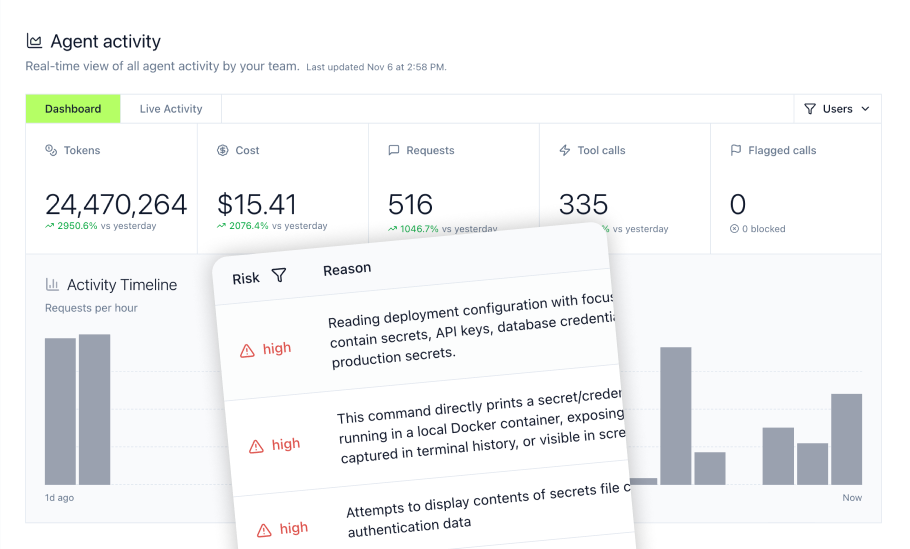
Agent Monitor tracks agent activity across your organization in real time, including MCP calls made outside the gateway. Through hooks in Cursor and Claude Code, Agent Monitor detects:
- Off-gateway MCP server connections
- Local tool execution that bypasses policy controls
- Risky bash commands executed by coding agents
- Prompt injection attempts targeting developer environments
MDM integration enables organizations to push detect-only or enforce-mode configurations to developer machines, ensuring consistent policy application even for local agent activity.
Mitigating Risks: From PII to Prompt Injection
Agent Monitor uses built-in rules to identify common security risks:
- PII exposure: Detect when agents access or transmit personally identifiable information
- Credential leakage: Flag API keys, tokens, and secrets in agent context
- Destructive operations: Alert on file deletions, database drops, and system modifications
- Prompt injection: Identify attempts to manipulate agent behavior through malicious inputs
Custom guardrail policies support block, flag, or alert actions based on your organization's risk tolerance. When agents attempt to access sensitive data, you receive real-time alerts and automatic blocking without manual intervention.
Advanced Data Loss Prevention and Compliance for AI Workflows
Enterprise AI deployments intersect with existing data governance frameworks. MintMCP's Gateway supports custom policy code execution on every tool call, enabling inline DLP integration with enterprise security tools.
Protecting Sensitive Data in AI-Driven Workflows
The gateway's JavaScript middleware layer supports integration with AWS Bedrock Guardrails, Google Cloud DLP, Microsoft Purview, Nightfall, and Skyflow.
Pre- and post-phase hooks can transform, mask, or block data based on content classification. For example, you can configure the gateway to redact credit card numbers from agent responses while allowing other financial data to pass through.
Achieving Compliance: SOC 2, HIPAA, and Beyond
MintMCP maintains security posture aligned with enterprise compliance requirements:
- SOC 2 Type II audited with continuous monitoring via Drata
- Compliant with HIPAA standards, with BAA available for healthcare customers
- Penetration tested infrastructure
- Data encryption in transit and at rest
- Data residency options, where available
- Uptime SLA for production workloads
Visit the Trust Center for compliance documentation.
Streamlining Development: From Local Agents to Production-Ready Services
Many organizations start agent development with local STDIO-based MCP servers running on developer machines. Moving these to production typically requires containerization, authentication integration, monitoring setup, and scaling configuration.
Accelerating Deployment of Custom AI Agents
MintMCP Gateway's STDIO server support auto-converts local servers to hosted, production-ready services with OAuth wrapping. No code changes required. This capability addresses a common friction point where promising agent prototypes stall during productionization.
The hosted connector runtime provides:
- Auto-scaling: Capacity adjusts to demand without manual configuration
- Sandboxed execution: Each connector runs in isolation for security
- OAuth brokering: Works around redirect-URI limitations for hosted containers
- Admin MCP: Manage rules, deploy connectors, and pull logs conversationally
Bridging the Gap: Development to Enterprise Scale
REST APIs and SDKs enable programmatic management for infrastructure-as-code workflows. Teams can version control agent definitions in Git, test agent configurations in CI/CD pipelines before production deployment, deploy custom connectors through CLI or Admin MCP interface, and monitor performance and costs through unified dashboards.
This approach supports the gradual autonomy model: start with read-only access and human approval gates, then expand permissions as agents prove reliable.
Key Use Cases: Empowering Enterprise Teams with AI Automation
Claude Managed Agents combined with governed MCP access enables automation across multiple enterprise functions. Some engineering workflows report 50-70% time savings on routine tasks after deployment, although outcomes vary by workflow complexity and existing integration requirements.
Transforming Data Operations with AI Agents
Data analysis agents demonstrate immediate value for analytics teams:
- Database querying: Natural language questions translated to SQL across Snowflake, BigQuery, PostgreSQL
- Report generation: Automated creation of weekly business reviews and KPI dashboards
- Anomaly investigation: Agent-driven root cause analysis when metrics deviate from expectations
MintMCP's database integrations support read-only access by default, with write permissions gated by policy. This enables self-service analytics without risking production data integrity.
Automating Customer Service and Development Lifecycles
Customer support automation:
- CRM data retrieval to personalize interactions
- Ticket triage and routing based on content analysis
- Knowledge base search and response generation
Development workflow automation:
- Code review assistance through GitHub integration
- Issue tracking updates via Linear or Jira connections
- CI/CD pipeline monitoring and incident response
Stripe's engineering team completed a 10,000-line code migration in 4 days using Claude Code, compared to an initial estimate of ten engineer-weeks. The agent handled reading source code, writing target code, running tests, and creating pull requests autonomously.
Coursera's deployment highlights the enterprise onboarding benefit: Virtual MCP abstraction can reduce configuration complexity for team members who need agent access without deep technical setup. The Claude Cowork guide provides practical onboarding steps for teams starting their agent deployment journey.
Why MintMCP for Enterprise AI Agent Governance
Deploying Claude Managed Agents at enterprise scale requires more than just the agent runtime. You need governance infrastructure that matches your security requirements without creating deployment friction. MintMCP provides centralized control for Claude, Cursor, ChatGPT, Gemini, and Copilot deployments through a unified platform that addresses the gaps left by agent runtimes alone.
Bundle simplicity versus configuration sprawl. Where agent deployments require separate configuration of plugins, access rules, and agent credentials, MintMCP's Bundle architecture combines these into a single governance unit per team or role. This reduces setup steps and helps limit configuration drift between related objects.
Per-agent identity with M2M authentication. Each AI agent receives its own OAuth 2.0 client credentials, independent of human user accounts. You can rotate or revoke agent credentials without affecting users, and every action traces back to the specific agent that took it. This credential isolation prevents the shared service-account sprawl that creates security and compliance risks in multi-agent deployments.
Custom policy code execution. JavaScript middleware runs in a JS sandbox on every tool call, enabling integration with your existing DLP and guardrail investments rather than requiring vendor lock-in to a single security platform. Pre- and post-call hooks support AWS Bedrock Guardrails, Google Cloud DLP, Microsoft Purview, and custom logic you define.
Shadow AI detection beyond the gateway. Agent Monitor provides visibility into local agent activity in Cursor and Claude Code, addressing security gaps that gateway-only solutions miss. MDM integration enables enforcement at the endpoint level, ensuring your governance policies apply whether agents run through the gateway or on developer machines.
Managed MCP server hosting. MintMCP operates connector instances on your behalf with auto-scaling and isolated execution. You define which MCP servers your teams can access; MintMCP handles the infrastructure, credential management, and availability. This eliminates the operations burden of hosting and maintaining your own MCP server fleet.
Start your free trial to see how MintMCP governance works with your existing AI agent deployments. No sales call required.
Frequently Asked Questions
What is the 'last mile problem' in enterprise AI and how does MintMCP address it?
The last mile problem refers to the challenge of connecting AI agents to production systems, tools, and data sources securely. Organizations often build impressive AI capabilities that stall during production deployment because each integration requires custom authentication, error handling, credential management, and audit logging. MintMCP addresses this through its MCP Gateway, which provides pre-configured connectors for common enterprise systems, standardized authentication across all connections, and built-in audit trails. Instead of building integration infrastructure for each tool, teams configure access once in the gateway and let MintMCP handle the complexity of secure, governed connections.
How does MintMCP ensure compliance for AI agent workflows?
MintMCP is SOC 2 Type II audited with continuous monitoring via Drata, and is compliant with HIPAA standards including BAA availability for healthcare customers. The platform provides complete audit trails capturing every agent action with user attribution, configurable retention policies aligned with regulatory requirements, and export capabilities for SIEM platforms. The gateway's JavaScript middleware layer supports inline integration with DLP solutions including AWS Bedrock Guardrails, Google Cloud DLP, and Microsoft Purview. This enables data protection policies to apply at the MCP layer without modifying agent code.
Can MintMCP integrate with existing enterprise tools and identity providers like Okta or Azure AD?
Yes. MintMCP supports enterprise SSO through SAML and OAuth 2.0, with SCIM integration for directory sync. When your Okta or Azure AD groups change, Bundle access updates automatically. New employees receive appropriate permissions immediately based on their group membership, while departing employees lose access when their directory status changes. The platform also integrates with existing security tooling through middleware hooks, SIEM export capabilities, and REST APIs for infrastructure-as-code workflows. You can manage MintMCP programmatically through the same CI/CD pipelines that handle your other enterprise infrastructure.
What is 'shadow AI' and how does MintMCP's Agent Monitor help detect and prevent it?
Shadow AI refers to AI agent activity that bypasses centralized governance controls, typically through local MCP servers running on developer machines. This creates compliance gaps because security teams have no visibility into what tools agents access or what data flows through them. MintMCP's Agent Monitor addresses this through hooks in Cursor and Claude Code that detect off-gateway MCP connections, risky bash commands, PII exposure, and prompt injection attempts. MDM integration allows organizations to push detection or enforcement configurations to developer machines, ensuring consistent policy application even for local agent workflows.
How do MintMCP's 'Bundles' simplify the management of AI agent access and policies?
Bundles package tool access, policy enforcement, and audit logging into single governance units per team or role. Instead of managing three separate objects, connector configuration, access rules, and credentials, for each deployment, administrators create one Bundle that includes the curated MCP server list, custom policy rules, and isolated audit trail. SCIM integration automatically syncs Bundle membership with directory groups. Agent Bundles extend this model to non-human principals, giving each deployed agent its own identity, scoped permissions, and rotatable credentials independent of human users.