The average global Fortune 500 enterprise will have over 150,000 AI agents in use by 2028. Enterprises moving AI agents from pilots to production increasingly need stronger data access, security, observability, and governance infrastructure.
Despite rapid investment in agentic AI, many enterprise deployments still struggle to move from pilots into production. The difference between pilots that scale and those that stall? Governance infrastructure. Agent management platforms (AMPs) address this gap by centralizing security, orchestration, deployment, and observability across AI agent fleets. This guide compares 10 platforms across enterprise governance capabilities, deployment flexibility, multi-agent orchestration, and integration ecosystems. MintMCP combines an MCP Gateway for governed data and tool connections with an Agent Gateway for agent identities, permissions, memory, and monitoring. Its data-permissions-first architecture and Virtual MCP Bundle model support enterprise governance, while every platform here serves specific enterprise needs.
Key Takeaways
- Agent management platforms centralize security, orchestration, and observability across enterprise AI agent fleets
- Governance infrastructure determines whether AI agent pilots reach production or stall at proof-of-concept
- Enterprise AMPs provide authentication, role-based access controls, audit logging, and policy enforcement
- Multi-agent orchestration requires stateful coordination, human-in-the-loop controls, and cross-framework support
- Deployment models range from managed SaaS to on-premise and VPC options for regulated industries
- Integration ecosystems connect agents to CRMs, databases, productivity tools, and development platforms
Quick Glance Comparison
| Platform | Best Fit | Primary Strength | Deployment |
|---|---|---|---|
| MintMCP | IT, security, and AI operations teams | MCP governance, agent identities, permissions, monitoring | Managed SaaS; VPC/self-hosted on request |
| Kore.ai | Enterprises with agents across multiple frameworks | Cross-framework agent governance and evaluation | Cloud, VPC/private cloud, on-prem options |
| Microsoft Copilot Studio | Microsoft 365-centric organizations | Microsoft ecosystem integration and agent orchestration | Microsoft cloud |
| Salesforce Agentforce | Salesforce-centric organizations | Native CRM and Data Cloud agent workflows | Salesforce Hyperforce |
| Rasa | Regulated and infrastructure-controlled environments | Flexible conversational AI and self-hosting | Cloud, VPC, on-prem |
| LangGraph/LangChain | Code-first engineering teams | Stateful agent orchestration and developer control | Cloud or self-hosted |
| CrewAI | Teams building collaborative multi-agent workflows | Role-based multi-agent orchestration | CrewAI cloud, VPC, or customer infrastructure |
| Google Gemini Enterprise Agent Platform | GCP and Google Workspace environments | Full-stack agent development and governance | Google Cloud |
| AWS Bedrock AgentCore | AWS-native organizations | Managed agent runtime, identity, memory, gateway, and observability | AWS/VPC |
| IBM watsonx Orchestrate | IBM and hybrid-enterprise environments | Cross-agent orchestration and enterprise automation | Cloud and on-premises |
1. MintMCP: Enterprise AI Agent Governance Without the Bottlenecks
MintMCP provides enterprise-grade governance and infrastructure for AI agents using the Model Context Protocol. The platform addresses the "last mile problem" in enterprise AI by giving agents secure, governed access to internal systems and data sources without requiring extensive engineering overhead for each integration.
Why MintMCP Fits Enterprise Agent Governance
MintMCP's data-permissions-first architecture starts with SSO, SCIM-driven RBAC, IdP groups, Virtual MCP Bundles, tool-level policy, and audit logs, then enables agents on top. This approach addresses the challenge of giving AI agents governed access across multiple enterprise data sources without managing permissions separately for every connection.
Core Capabilities
- Virtual MCP Bundles create team-specific, per-use-case endpoints with SCIM-driven membership, curated tool lists, and fine-grained role-based access
- Agent Bundles give internal agents first-class identities with M2M auth, scoped tools, and independent rotation
- Hosted MCP Connectors run on MintMCP's infrastructure with auto-scaling and sandboxed execution per connector
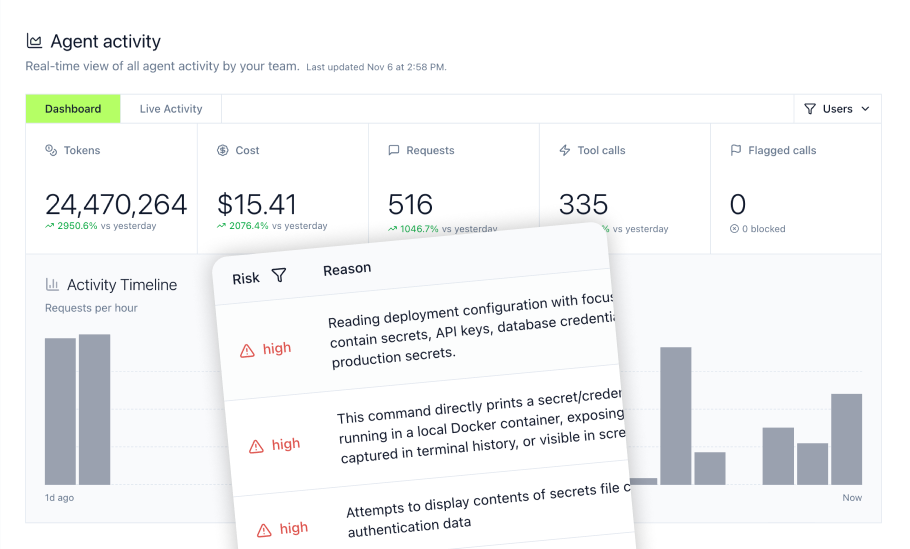
- Agent Monitor tracks agent activity across the organization, including MCP calls made outside the gateway in tools like Cursor and Claude Code
- Custom Gateway Middleware runs customer-authored JavaScript in a sandbox with external DLP and guardrails integrations
Enterprise Security
MintMCP is SOC 2 Type II audited, compliant with HIPAA standards, and pen tested. Every agent action is logged with full context: who initiated it, which tools were called, what data flowed through, and when. Enterprise customers can request HIPAA documentation, and MintMCP signs BAAs.
Deployment and Pricing
- MintMCP offers managed SaaS-first delivery with US and EU availability
- VPC and self-hosted deployment available on request
- MintMCP's catalog includes 10,000+ MCP servers, while its gateway also provides managed hosted connectors and support for custom MCP servers
- Contact for enterprise pricing and demonstration
2. Kore.ai
Kore.ai launched a dedicated Agent Management Platform in March 2026, designed specifically for cross-framework governance. The platform supports agents built on LangGraph, CrewAI, AutoGen, Google ADK, AWS AgentCore, Microsoft Foundry, and Salesforce Agentforce.
Where Kore.ai Fits
Organizations running agents across multiple vendor frameworks who need unified governance, evaluation, and financial attribution. The platform covers all six Gartner-defined AMP elements: security, prebuilt libraries, tooling, dashboard, marketplace, and agent observability.
Key Features
- Pre-production evaluation studio with goal completion scoring and regression testing
- Token cost attribution at individual interaction level with ROI computation
- Enterprise integrations spanning Microsoft Agent 365, Salesforce, HubSpot, Jira, GitHub, and other business systems
- Cross-framework support spanning major agent development platforms
Deployment
Enterprise pricing with custom quotes. Public cloud, sovereign-region, private-cloud, and on-premises deployment options are available, with the Artemis edition launching initially on Microsoft Azure.
3. Microsoft Copilot Studio
Microsoft Copilot Studio serves organizations standardized on Microsoft 365, offering deep integration with Teams, Azure, and Power Platform. The platform is used by organizations to create and manage custom agents across Microsoft 365 and the broader Power Platform ecosystem.
Where Microsoft Copilot Studio Fits
Microsoft-centric enterprises seeking native integration with SharePoint, Dynamics 365, and Power Automate. Eligible employee-facing Copilot Studio agent usage is included with Microsoft 365 Copilot licenses at no additional charge, subject to fair-use limits.
Key Features
- Native multi-agent orchestration and agent-to-agent communication
- GitHub-based ALM and source control
- Pay-as-you-go via Copilot Credits or pre-purchased Commit Units
- Deep Microsoft 365, Teams, Azure, and Power Platform integration
Deployment
Cloud-based deployment within Microsoft Azure infrastructure.
4. Salesforce Agentforce
Salesforce Agentforce provides native integration with Salesforce CRM, Service Cloud, and Data Cloud. The platform includes the Atlas Reasoning Engine with grounded responses from Salesforce data.
Where Salesforce Agentforce Fits
Organizations with Salesforce as their primary CRM seeking native agent access to customer data and workflows. Pre-built agents for sales, service, and marketing operate inside existing Salesforce environments.
Key Features
- Agentforce Voice extends agents to phone, web, and mobile channels
- Pro-code script view alongside no-code builder for mixed teams
- Native access to Salesforce ecosystem and Data Cloud
- Edition packaging plus usage-based Flex Credits pricing
Deployment
Runs on Salesforce's Hyperforce public cloud with Service Cloud integration.
5. Rasa
Rasa provides self-hosted, on-premise, VPC, or partner-managed deployment for organizations requiring full infrastructure control.
Where Rasa Fits
Regulated industries including banking, insurance, healthcare, and government requiring deployment flexibility and LLM-agnostic model support. Customers include N26, ERGO, and nib Group.
Key Features
- LLM-agnostic across OpenAI, Anthropic, Google, Mistral, Llama, and self-hosted models
- Rasa Voice with streaming and turn-taking for sovereign voice deployments
- Skills-based architecture with reusable capabilities across agents and channels
- MCP support for tools and A2A for multi-agent orchestration
Deployment
Free Developer Edition (1 bot, 1,000 external conversations/month). Enterprise contracts on request for production deployments.
6. LangGraph/LangChain
LangGraph provides stateful multi-agent graph-based orchestration with human-in-the-loop checkpoints built natively into workflow execution. The framework is designed for stateful, code-first agent workflows with configurable orchestration and human-in-the-loop controls.
Where LangGraph Fits
Developer-led, code-first teams requiring maximum flexibility and control over agent architecture. LangSmith provides observability, tracing, and evaluation alongside the framework.
Key Features
- Stateful multi-agent graph-based orchestration
- Human-in-the-loop checkpoints in workflow execution
- Integration with GPT-4, Claude, Gemini, and Llama 3
- LangGraph is open source, while LangSmith offers Developer, Plus, and Enterprise plans for observability and deployment
Deployment
Self-hosted or cloud deployment via LangSmith managed service.
7. CrewAI
CrewAI introduced the "Crew" abstraction for multi-agent collaboration, shaping how teams think about role-based agent orchestration. The framework supports enterprise clients including Deloitte, Oracle, KPMG, and Accenture.
Where CrewAI Fits
Organizations building specialized agent teams with distinct roles that collaborate on complex tasks. CrewAI Studio provides visual workflow design without code.
Key Features
- Role-based multi-agent orchestration with specialized sub-agents
- Agent performance tracking and iteration dashboard
- Visual workflow design through CrewAI Studio
- Open-source framework with paid AMP layer for production
Deployment
Free open-source framework plus free tier on AMP (limited executions). Paid plans for production workloads.
8. Google Gemini Enterprise Agent Platform
Google Gemini Enterprise Agent Platform brings together agent development, deployment, orchestration, integration, and governance for GCP-native organizations. It builds on Vertex AI capabilities and can deliver enterprise agents through Gemini Enterprise.
Where Gemini Enterprise Agent Platform Fits
GCP-first teams with existing Google data infrastructure, particularly those using BigQuery and Google Workspace.
Key Features
- Agent memory and context persistence across sessions
- Integration with Google Workspace, BigQuery, and Apigee
- Multimodal AI agents handling text, images, audio, and video
- Compliance support includes certifications and attestations such as ISO 27001 and SOC 1/2/3, alongside controls for regulatory requirements
Deployment
Usage-based pricing via Google Cloud Platform.
9. AWS Bedrock AgentCore
AWS Bedrock AgentCore provides fully managed agentic execution within AWS infrastructure, purpose-built for regulated environments with infrastructure-grade controls. The platform supports VPC, PrivateLink, and CloudFormation deployment.
Where Bedrock AgentCore Fits
AWS-native organizations in healthcare, finance, and government requiring strict compliance controls and secure enterprise rollouts. Complex RAG retrieval with enterprise-grade knowledge bases.
Key Features
- Framework-agnostic agent runtime with managed Memory, Gateway, Identity, and Observability services
- Agent runtime and monitoring included out of the box
- VPC deployment with PrivateLink connectivity
- CloudFormation templates for infrastructure-as-code deployment
Deployment
Usage-based pricing varies by AgentCore component, including Runtime, Gateway, Memory, Identity, Observability, and related services.
10. IBM watsonx Orchestrate
IBM watsonx Orchestrate routes work across IBM agents, partner agents, and custom agents with A2A protocol support for cross-vendor orchestration. The platform integrates with 80+ enterprise applications including SAP, Oracle, Salesforce, ServiceNow, and Workday.
Where watsonx Orchestrate Fits
IBM-anchored enterprises requiring multi-vendor orchestration with hybrid or on-premise deployment. Completed acquisition of Confluent in March 2026 added real-time data streaming capabilities.
Key Features
- watsonx.governance integration for agent evaluation metrics, governance monitoring, and enforcement tracking
- Catalog of pre-built domain agents for HR, procurement, customer care, and finance
- Multi-cloud and on-premise deployment options
- A2A protocol support for cross-vendor agent orchestration
Deployment
Free Trial, Essentials, and Standard tiers with custom enterprise quotes available.
Why MintMCP for Production Agent Governance
With more than 40% of agentic AI projects expected to be canceled by the end of 2027 due to escalating costs, unclear business value, or inadequate risk controls, choosing the right platform now determines whether AI investments deliver value or stall at proof-of-concept.
MintMCP provides enterprise AI agent governance without slowing down engineering velocity. Deploy Claude, Cursor, ChatGPT, Gemini, and Copilot across organizations with hosted MCPs, governed by role, monitored by default. Every agent gets its own identity with scoped credentials that can be rotated independently. No shared keys to leak.
The MCP Gateway handles authentication, tool-level access control, and credential management. Agent Monitor tracks agent activity in real-time, including off-gateway MCP usage in developer tools, identifying credential leakage, prompt injection attempts, and unauthorized tool access. PII and DLP controls can be applied through Gateway Middleware. Virtual MCP Bundles create per-use-case endpoints with SCIM-driven membership. Agent Bundles give every agent its own rotatable identity.
MintMCP's data-permissions-first architecture starts with governance infrastructure, then enables agents on top. This approach ensures security, compliance, and audit readiness from day one, not as an afterthought. Hosted connectors run on MintMCP's infrastructure with auto-scaling and sandboxed execution, eliminating the need for teams to manage connector infrastructure themselves.
Start your free trial at mintmcp.com. No sales call needed.
Frequently Asked Questions
How do agent management platforms ensure data security?
Agent management platforms implement centralized authentication (SSO, OAuth 2.x), role-based access controls, audit logging, and policy enforcement. Security governance capabilities include credential management, tool-level access restrictions, and compliance controls for regulated industries. Platforms like MintMCP also detect shadow AI usage through Agent Monitor hooks in developer tools.
Can agent management platforms integrate with existing enterprise systems?
Yes. Agent management platforms provide connectors for common enterprise applications including CRMs (Salesforce, HubSpot), databases (Snowflake, PostgreSQL), productivity tools (Slack, Google Workspace, Microsoft 365), and development platforms (GitHub, Jira). MintMCP's catalog includes 10,000+ MCP servers with managed hosted connectors and support for custom MCP servers.
What is shadow AI and how can platforms detect it?
Shadow AI refers to unauthorized AI agent usage outside governed channels. When developers connect agents directly to tools without governance, organizations lose visibility into data access, tool usage, and security risks. MintMCP's Agent Monitor detects off-gateway MCP usage in tools like Cursor and Claude Code, identifying credential leakage, prompt injection attempts, and unauthorized tool access.
Should I choose a managed platform or self-hosted solution?
Managed platforms like MintMCP provide faster deployment with hosted connectors, pre-configured governance, and automatic scaling. Self-hosted solutions like Rasa offer infrastructure control but require DevOps expertise and longer setup time. Consider compliance requirements, infrastructure team capacity, and time-to-production needs when deciding.
How do Virtual MCP Bundles differ from traditional access controls?
Virtual MCP Bundles package tool access, policy enforcement, and audit logging into single governance units per team or role. Unlike traditional approaches requiring manual configuration of separate plugin, access rule, and credential objects, Bundles create per-use-case endpoints with SCIM-driven membership and curated tool lists. Each AI agent receives its own persistent identity with scoped credentials.