According to IBM and Morning Consult research, 99% of enterprise developers are exploring or developing AI agents—but many organizations still report a readiness gap when it comes to deploying them responsibly. This readiness gap stems from a fundamental challenge: agentic AI systems operate autonomously, making multi-step decisions and executing actions that traditional AI governance frameworks weren't designed to manage.
The 3-tiered agentic AI governance framework addresses this challenge by matching oversight intensity to use-case risk. First introduced by the International Association of Privacy Professionals and subsequently detailed in Singapore's Model AI Governance Framework, this framework provides the operational blueprint enterprises need. Operational guidance is emerging fast—Singapore’s IMDA Model AI Governance Framework for Agentic AI offers a practical blueprint for governing agentic systems, while enterprises can implement a risk-tiered control model to match oversight intensity to use-case impact. For organizations implementing this approach, solutions like MCP Gateway provide the centralized governance infrastructure required to deploy agents at scale with enterprise-grade security, authentication, and compliance controls.
Key Takeaways
- The 3-tiered approach reduces governance overhead by 40% compared to one-size-fits-all controls
- Singapore’s Model AI Governance Framework for agentic AI, published in January 2026, provides a government-published operational blueprint enterprises can use to structure agent oversight.
- Organizations with mature AI governance typically see fewer avoidable incidents and faster time-to-production when governance is embedded early
- A significant share of agentic AI failures trace back to permission design, overbroad access, and missing approval boundaries
- EU AI Act penalties reach up to €35 million or 7% of global annual turnover
- Tier 1 controls (observability and guardrails) apply universally; Tier 2 (risk-based controls) scale with impact; Tier 3 (compliance) addresses regulatory requirements
Understanding the Agentic AI Landscape
Agentic AI represents a fundamental shift from traditional generative AI. Where ChatGPT or Claude respond to single prompts, AI agents plan multi-step workflows, reason through complex problems, access external tools and databases, and execute actions autonomously.
What makes agentic AI different:
- Autonomous decision-making: Agents determine their own action sequences
- Tool access: Connect to databases, APIs, email systems, and production infrastructure
- Persistent operation: Run extended workflows spanning minutes or hours
- Multi-agent collaboration: Multiple agents coordinating actions
- Real-world consequences: Actions can modify data, send communications, and trigger systems
Shadow AI grows 120% year-over-year as employees adopt AI tools through personal accounts, bypassing governance entirely.
Why traditional AI governance falls short:
Existing frameworks focus on model training, bias detection, and output monitoring. Agentic AI requires governance over actions, permissions, tool access, and multi-step workflows. The Singapore MGF framework identifies eight risk factors specific to agents: domain tolerance for error, access to sensitive data, external system exposure, read versus write permissions, reversibility of actions, level of autonomy, task complexity, and external threat exposure.
Tier 1: Foundation—Observability and Control
Tier 1 establishes universal baseline controls that apply to every agentic AI system regardless of risk level.
Core Requirements
- Privacy and data protection controls
- Transparency into agent actions and decisions
- Explainability of agent reasoning
- Security safeguards against unauthorized access
- Safety features including kill-switches and escalation paths
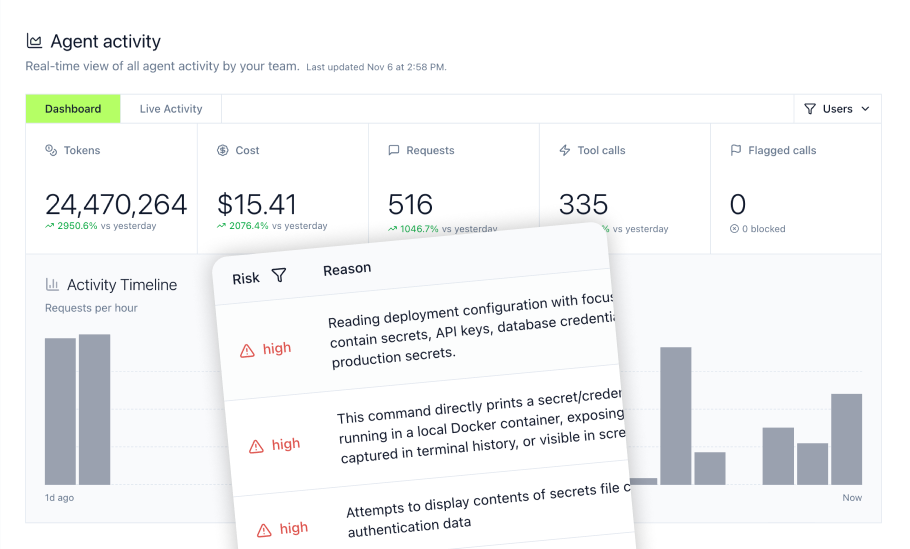
Real-time Monitoring Implementation
Essential monitoring capabilities:
- Tool call tracking: Log every MCP tool invocation with parameters, timestamps, and outcomes
- Command history: Complete audit trail of bash commands, file operations, and system interactions
- MCP inventory: Visibility into installed MCPs, their permissions, and usage patterns
- Anomaly detection: Automated alerts for unusual access patterns or policy violations
The MintMCP LLM Proxy monitors every tool call, bash command, and file operation from coding agents while maintaining complete audit trails.
Sensitive Data Protection
Critical protection measures:
- Sensitive file protection: Prevent access to .env files, SSH keys, credentials
- Command blocking: Real-time interception of dangerous commands
- Permission boundaries: Restrict agent access to approved directories only
- Real-time intervention: Capability to halt workflows and escalate to human review
Organizations should configure security guardrails that block risky tool calls. The LLM Proxy security enables this protection while maintaining developer productivity.
Tier 2: Centralized Management and Scalable Deployment
Tier 2 governance addresses risk-proportional controls and enterprise-scale deployment infrastructure.
Risk-Based Control Scaling
The IAPP 3-tiered framework establishes that governance controls should scale with risk:
- Low-impact agents: Minimal oversight beyond Tier 1 baseline
- Medium-impact agents: Enhanced monitoring and approval workflows
- High-impact agents: Rigorous oversight with human-in-the-loop checkpoints
Streamlined Agent Deployment
Centralized governance capabilities:
- One-click deployment: Deploy STDIO-based MCP servers instantly
- MCP registry: Central registry with pre-configured policies
- Virtual servers: Create and manage virtual MCP servers with role-based access
- Enterprise hardening: Transform local servers into production services
MCP Gateway enables unified authentication, audit logging, and rate control for all MCP connections.
Granular Access Controls
60% of incidents trace to permission failures.
Access control requirements:
- Role-based permissions: Configure tool access by role
- Enterprise authentication: OAuth 2.0, SAML, and SSO integration
- Identity management: Unique agent identities with permissions tied to users
- Dynamic authorization: Adjust permissions based on context and risk level
The MCP Gateway authentication supports OAuth protection that wraps enterprise authentication around any local MCP server. Organizations can implement tool governance policies that enforce access boundaries.
Tier 3: Ensuring Compliance and Auditability
Tier 3 governance addresses regulatory requirements and long-term accountability.
Understanding Regulatory Landscape
EU AI Act (entered into force August 2024; phased implementation):
The EU AI Act classifies most multi-step autonomous agents as "High-Risk" systems requiring risk management, high-quality training data, human oversight mechanisms, transparency, and robustness controls.
Penalties reach up to €35 million or 7% of global annual turnover.
Other regulatory frameworks:
- NIST AI RMF: Voluntary U.S. framework increasingly referenced in federal contracts
- Singapore MGF: Model framework expected to inform Asia-Pacific regulation
- Colorado AI Act: Effective June 30, 2026, addresses algorithmic discrimination and related consumer protections
Comprehensive Audit Trails
Audit trail requirements:
- Interaction logging: Complete record of every MCP interaction and configuration change
- Decision documentation: Explainability data showing agent reasoning
- Access history: Who accessed what data, when, and through which agent
- Policy enforcement records: Evidence of guardrail activation and human interventions
MCP Gateway provides complete audit logs for SOC2 and GDPR compliance. The audit observability features enable real-time dashboards for monitoring usage and detecting anomalies.
Integrating Agentic AI: Practical Use Cases
Customer Experience Enhancement
Support teams: Ticket resolution
Enable AI agents to search historical support tickets, resolution patterns, and help articles.
- Risk level: Medium (customer data access)
- Governance tier: Tier 2 with human approval for communications
- Implementation: Elasticsearch MCP Server enables semantic searches
Customer communication automation:
Allow AI assistants to search, draft, and reply to customer emails.
- Risk level: Medium-High (external communication)
- Governance tier: Tier 2 with controlled send flows
- Implementation: Gmail MCP Server provides search, draft, and send capabilities
Organizations implementing these use cases report 85% deflection rates for standard queries.
Financial Reporting Automation
Finance teams: Report generation
Automate financial reporting through natural language queries.
- Risk level: High (financial data, regulatory implications)
- Governance tier: Tier 2-3 with comprehensive audit trails
- Implementation: Snowflake MCP Server enables SQL queries and semantic views
Additional Enterprise Applications
HR teams: Build AI-accessible knowledge bases from company documentation using Elasticsearch integration.
Product teams: Enable AI-powered documentation search and query user engagement metrics.
Development workflows: Connect AI coding assistants to repositories and CI/CD systems securely.
Roadmap to 2026: Phased Implementation
The Singapore MGF framework provides a practical implementation sequence spanning 90-180 days.
Phase 1: Risk Assessment (Weeks 1-4)
Evaluate each use case against the eight risk factors to determine tier assignment.
Phase 2: Human Accountability (Weeks 5-8)
Define responsibility matrix and design human-in-the-loop checkpoints for high-stakes decisions.
Phase 3: Technical Controls (Weeks 9-16)
Deploy monitoring infrastructure, configure security guardrails, and establish testing protocols.
Phase 4: User Enablement (Ongoing)
Train employees on agent capabilities, implement transparency requirements, and establish support processes.
Bridging the Gap: Enterprise Infrastructure Integration
Leveraging Identity Management
Authentication integration:
- OAuth 2.0: Standard authorization for web-based agent access
- SAML: Enterprise single sign-on for agent authentication
- SSO integration: Connect to existing identity providers (Okta, Azure AD)
MCP Gateway provides enterprise authentication that wraps OAuth and SSO around any local MCP server. The Okta SAML setup documentation covers integration.
Seamless Data Connectivity
Database integration:
- Data warehouses: Snowflake, BigQuery, PostgreSQL
- Search infrastructure: Elasticsearch for knowledge base search
- Productivity tools: Gmail, Outlook, Google Calendar
Supported AI clients:
MCP Gateway enables governance across Claude (Desktop and Web), ChatGPT (via Custom GPTs), Cursor and Windsurf coding assistants, Microsoft Copilot and Gemini, and custom MCP-compatible agents.
Why MintMCP for Agentic AI Governance
MintMCP's platform provides enterprise-grade governance for Model Context Protocol (MCP) servers through centralized deployment, real-time monitoring, and compliance infrastructure. The MCP Gateway wraps enterprise authentication, audit logging, and security policies around any MCP server—transforming local development tools into production-ready services. With SOC 2 certification and audit observability features, organizations can scale agentic AI from shadow IT to sanctioned enterprise infrastructure with governance controls that adapt to risk.
Frequently Asked Questions
What's the difference between agentic and traditional AI governance?
Traditional AI governance focuses on model training and output quality. Agentic AI governance addresses autonomous action—agents that plan workflows, access tools, and execute operations. This requires governance over permissions, tool access, and real-world consequences rather than just model outputs.
Do I need different governance for different agents?
Yes—the 3-tiered framework specifically addresses this. Low-risk agents require only Tier 1 baseline controls. Medium-risk agents need enhanced Tier 2 controls. High-risk agents require Tier 3 compliance controls with human-in-the-loop checkpoints. This reduces governance overhead by 40%.
What happens without proper governance?
Risks include regulatory penalties (EU AI Act violations can reach €35 million), security breaches, reputational damage, and legal liability. 60% of incidents trace to permission failures.
How long does implementation take?
Initial framework implementation spans 90-180 days following the Singapore MGF approach: risk assessment (weeks 1-4), accountability structures (weeks 5-8), technical controls (weeks 9-16), and user enablement (ongoing).
What's human-in-the-loop's role?
Human-in-the-loop checkpoints provide oversight for high-stakes decisions without blocking autonomy. The Singapore MGF framework recommends human approval for high-stakes actions, irreversible actions, outlier behaviors, and user-defined boundaries.