Every AI agent deployment that fails to prove its value becomes a canceled project, wasted budget, and lost credibility with leadership. With 88% of organizations now using AI regularly but only 39% reporting enterprise-level EBIT impact, the gap between AI adoption and AI ROI remains substantial. The solution is not more pilots or bigger budgets. It is a structured framework that connects agent costs, usage patterns, and business value into metrics your CFO can audit and your board can approve. Platforms like MintMCP provide the governance layer that makes this measurement possible, combining per-agent audit trails with usage telemetry for monitored agents.
Key Takeaways
- Nearly two-thirds of organizations have not yet begun scaling AI across the enterprise
- Payback periods vary substantially by workflow, making use-case-specific cost and value measurement more reliable than universal benchmarks
- 23% of respondents report scaling an agentic AI system somewhere in their enterprise
- Strong governance helps organizations measure agent activity, manage risk, and scale deployments without retrofitting controls later
- The standard ROI formula remains (Benefits minus Costs) divided by Costs, but AI agents require multi-dimensional value tracking
- Over 40% of agentic AI projects will be canceled by the end of 2027 due to escalating costs, unclear business value, or inadequate risk controls
Understanding AI Agent ROI: Beyond Simple Cost Savings
Traditional ROI calculations measure direct cost reduction: you spent X, you saved Y, your return is (Y minus X) divided by X. AI agents break this model because their value spreads across multiple dimensions that resist simple quantification.
A data analysis agent does not just replace analyst hours. It also reduces error rates in reports, accelerates time-to-insight for decision makers, and enables analysis that was previously impossible due to capacity constraints. A customer support agent does not just handle tickets faster. It improves first-contact resolution rates, extends service hours without staffing costs, and captures structured feedback that informs product decisions.
Why Traditional ROI Metrics Fall Short for AI Agents
The fundamental challenge is attribution. When an AI coding assistant helps a developer ship a feature faster, how much credit goes to the assistant versus the developer's existing knowledge? When a support agent resolves a ticket, did it truly resolve the issue or merely deflect the customer temporarily?
Consider the complexity:
- Partial contribution: Most agent tasks involve human oversight or correction
- Delayed benefits: Quality improvements may not surface until months later
- Hidden costs: Token consumption, error remediation, and security incidents add up
- Capability expansion: Agents enable work that was never done before, making before-and-after comparisons impossible
Organizations that treat AI agent ROI as a single number will consistently undervalue their successes and miss their failures.
The Holistic View of AI Agent Value
Effective ROI measurement requires tracking four dimensions simultaneously:
- Cost savings: Direct labor replacement and efficiency gains
- Throughput improvement: Volume of work completed in the same timeframe
- Quality enhancement: Error reduction, consistency improvement, compliance adherence
- Strategic value: Competitive positioning, capability building, and risk mitigation
McKinsey defines AI high performers as organizations reporting more than 5% of EBIT attributable to AI along with significant value from AI use. A multi-dimensional ROI framework can help teams evaluate the different mechanisms contributing to that value.
Deconstructing AI Agent Costs: A Comprehensive Estimation Guide
Before you can calculate ROI, you need accurate cost visibility. Most AI agent cost estimates miss half the picture because they focus on obvious expenses while ignoring operational overhead.
Direct Costs of AI Agent Deployment
The visible costs include:
- LLM API consumption: Token costs for input, output, and context window usage
- Infrastructure: Compute, storage, and networking for agent runtime
- Licensing: Fees for AI platforms, MCP servers, and governance tools
- Integration development: Engineering time to connect agents to internal systems
- Training and onboarding: Time spent getting teams productive with new tools
Token costs deserve special attention because they compound quickly. Multi-step agent workflows consume tokens at each step. Retry logic multiplies consumption when agents fail. Large context windows (needed for complex tasks) cost more per request than simple queries.
Indirect Costs of AI Agent Deployment
The hidden costs often exceed the visible ones:
- Error remediation: Time spent fixing agent mistakes before they reach production
- Security overhead: Reviews, audits, and incident response when agents access sensitive data
- Governance administration: Managing access controls, credentials, and policy updates
- Shadow AI cleanup: Retroactive security work when teams deploy ungoverned agents
- Opportunity cost: Engineering time diverted from other priorities
BLS compensation data shows that employer costs include wages plus substantial benefit costs, with the exact share varying across industries and occupations. ROI calculations should therefore use role-specific fully loaded labor costs rather than raw salaries alone.
Estimating Ongoing Operational Expenses
Operational costs scale differently than development costs. A centralized MCP gateway can reduce per-agent operational overhead by consolidating authentication, logging, and credential management. Without centralization, each new agent adds its own operational burden.
Budget categories to track monthly:
- Token consumption by agent, team, and use case
- Support tickets related to agent issues
- Security incidents involving agent behavior
- Credential rotation and access control changes
- Compliance reporting and audit preparation
Quantifying AI Agent Usage: Metrics for Performance and Adoption
Usage metrics tell you whether agents are actually being adopted and whether that adoption produces reliable results. Track the wrong metrics and you will optimize for vanity numbers while missing real problems.
Key Performance Indicators (KPIs) for AI Agents
Leading indicators predict future success or failure before ROI materializes:
- Override frequency: How often do humans reject agent recommendations? Rising override rates signal declining trust or quality.
- Unsupported request rate: How often do agents fail to complete tasks? High rates indicate capability gaps or prompt issues.
- Plan adherence: Do agents follow their intended reasoning paths? Deviations may produce correct outputs through incorrect logic, which will eventually fail.
- Tool selection accuracy: Do agents call the right systems for each task? Incorrect tool calls waste tokens and introduce errors.
Lagging indicators confirm value after the fact:
- Containment rate: What percentage of tasks complete without human intervention?
- Task completion time: How long from request to resolution?
- Error rate delta: How do agent error rates compare to human baselines?
- Volume processed: How many tasks does each agent handle per period?
Production accuracy targets should be set according to the risk, task type, and level of human oversight for each workflow. A single percentage threshold does not apply reliably across all agent use cases.
Tracking Agent Interactions and Data Access
Audit trails matter for compliance, but they also power ROI measurement. Every tool call, every data access, and every output becomes a data point for understanding where agents create value and where they create risk.
Effective tracking requires:
- Per-agent attribution: Which agent performed which action?
- Conversation-level logging: What context led to each decision?
- Data flow visibility: What information moved between systems?
- Timing data: How long did each step take?
Agent monitoring infrastructure captures this data automatically when deployed alongside your agents. Without it, you are reconstructing events from scattered logs after problems occur.
Calculating Value: Applying the ROI Formula to AI Agent Projects
The core formula remains straightforward: (Total Benefits minus Total Costs) divided by Total Costs, multiplied by 100 to express as a percentage. The complexity lies in accurately quantifying both sides.
Translating Agent Outcomes into Financial Value
Time savings monetization: Calculate hours saved, multiply by a role-specific fully loaded hourly rate that includes employer-paid compensation costs, then apply a scope multiplier reflecting what percentage of affected employees actually use the agent.
Example: 100 developers save 5 hours per week. Fully-loaded rate is $150 per hour. Only 60% consistently use the coding assistant. Weekly value equals 100 times 5 times 150 times 0.60, or $45,000 per week.
Error reduction value: Calculate baseline error rate, compare to agent-assisted error rate, multiply the reduction by average cost per error (including remediation time, customer impact, and compliance risk).
Throughput value: Calculate additional work volume enabled by agents, multiply by the margin or value created per unit of work.
Risk mitigation value: Estimate the probability and impact of prevented incidents (compliance violations, security breaches, operational failures), then calculate expected value avoided.
Scenario Planning for AI Agent ROI
Build three scenarios rather than a single estimate:
- Conservative: Assume 50% of projected time savings, higher-than-expected costs, and minimal adoption (40% of eligible users)
- Base case: Use realistic adoption curves (60-70% at steady state), moderate cost estimates, and documented time savings
- Optimistic: Full adoption, realized time savings, and cost efficiencies from scale
Present all three to finance teams. If your conservative case still shows positive ROI, the project has a strong foundation. If only the optimistic case works, you are taking a bet.
AI Agents in Practice: Real-World Examples and Their Value Drivers
Different agent types generate value through different mechanisms. Understanding these patterns helps you identify the right metrics for your deployments.
Measuring the Impact of AI Coding Assistants
Engineering workflows can be harder to evaluate because productivity gains do not automatically translate into realized financial value. AI coding assistants can reduce completion time on well-defined coding tasks, but translating that improvement into business value requires knowing which tasks matter most and whether the gains persist in production workflows.
Metrics that work for coding assistants:
- Pull request cycle time (from creation to merge)
- Code review turnaround (faster reviews from better initial quality)
- Bug density per feature (quality improvement indicator)
- Developer satisfaction scores (retention and productivity proxy)
The challenge is separating assistant impact from other productivity factors. Control groups help, but enterprise environments rarely support clean experiments.
ROI from Automated Data Analysis Agents
Data analysis agents can produce directly measurable value when they reduce report-generation time, shrink analysis backlogs, or enable additional self-service analysis. The value is more directly measurable: reports that took days now take hours, analysis that required specialists can be performed by business users.
Metrics for data analysis agents:
- Report generation time (before and after comparison)
- Analysis request backlog (capacity indicator)
- Insight-to-action latency (time from question to decision)
- Self-service adoption (reduced analyst dependency)
MintMCP customer stories report workflow-specific productivity and time-saving benefits, but results vary by deployment and should be measured against each organization's own baseline.
Ensuring Security and Compliance: A Critical ROI Factor for AI Agents
Security incidents and compliance failures destroy ROI faster than productivity gains create it. One data breach can cost millions in direct expenses and immeasurable reputation damage. Organizations that treat governance as overhead rather than value creation will learn this lesson painfully.
The Cost of Non-Compliance in AI Deployments
AI regulation is expanding across global markets, increasing the importance of building governance into production systems before organizations have to retrofit controls later.
Compliance risks specific to AI agents include:
- Unauthorized data access: Agents querying databases without proper authorization
- PII exposure: Sensitive information passed through prompts or responses
- Credential leakage: API keys, tokens, or passwords captured in agent outputs
- Audit trail gaps: Inability to demonstrate who accessed what and when
- Policy violations: Agents performing actions outside their intended scope
Securing Agent Interactions to Protect ROI
Governance contributes to ROI by reducing the rework, incidents, and operational delays that can arise when controls are added only after agents reach production.
Essential security controls include:
- Per-agent identity: Each agent has its own credentials that can be rotated or revoked independently
- Tool-level access control: Agents can only call the specific tools they need, nothing more
- Inline policy enforcement: Rules that block or flag risky actions before they execute
- Complete audit trails: Every action logged with full context for compliance and investigation
- Shadow AI detection: Visibility into agent activity outside governed channels
Security governance infrastructure bundles these controls into deployable packages that activate immediately rather than requiring months of custom development.
Leveraging AI Agent Governance for Optimized ROI
Governance protects ROI by reducing avoidable risk and rework. Gartner predicts over 40% of agentic AI projects will be canceled by the end of 2027, citing escalating costs, unclear business value, and inadequate risk controls.
The Role of Governance in Scaling AI Agent Value
Pilot projects can operate with minimal governance because the blast radius of failure is small. Production deployments cannot. Nearly two-thirds of organizations have not yet begun scaling AI across the enterprise, showing how wide the gap remains between experimentation and scaled deployment.
Governance enables scaling by providing:
- Consistent policy application: The same rules apply across all agents, teams, and use cases
- Centralized visibility: One place to see what all agents are doing across the organization
- Automated compliance: Controls that enforce themselves without manual intervention
- Rapid incident response: When something goes wrong, you know immediately and can act
Preventing Value Erosion with Centralized Control
Value erosion happens gradually. An agent starts exceeding its scope. Credentials get shared between teams for convenience. Audit logs get disabled to improve performance. Shadow agents proliferate because the official process takes too long.
Centralized governance through platforms like MintMCP's MCP Gateway prevents erosion by making the governed path the easiest path. When agents connect through a gateway with authentication, access control, and logging built in, teams get governance without additional effort. When agent identities are first-class objects with their own scoped credentials, there is no reason to share access between agents.
Building a Robust AI Agent ROI Measurement Framework
A framework is only useful if you can implement it. Here is a practical approach that scales from single pilots to enterprise-wide deployments.
Step-by-Step Guide to Implementing an ROI Framework
Stage 1: Establish Baseline (Weeks 0-4)
Before deploying agents, document:
- Current cost per task or interaction
- Average handling time for target workflows
- Error rates and quality metrics
- Employee satisfaction with current tools
Stage 2: Deploy with Telemetry (Months 1-3)
Launch agents with full instrumentation:
- Token consumption tracking per agent and task type
- Action logging through agent monitoring
- Error and override rate capture
- User adoption and sentiment tracking
Stage 3: Track Leading Indicators (Months 1-6)
Watch for early signals:
- Rising containment rates indicate growing capability
- Falling override rates indicate growing trust
- Decreasing unsupported request rates indicate improving coverage
- Stable or declining token costs indicate optimization working
Stage 4: Calculate ROI (Month 3+)
Begin formal ROI calculations once the deployment has enough stable usage data to compare results against the pre-deployment baseline. Early measurements should be treated as provisional while adoption and agent behavior are still changing.
Stage 5: Report and Optimize (Ongoing)
Maintain momentum through regular reporting:
- Monthly operational dashboards for teams
- Quarterly business impact reports for leadership
- Annual strategic reviews for budget planning
Iterative Improvement for AI Agent Value
ROI measurement is not a one-time exercise. The agents that deliver the most value are the ones that improve continuously based on measurement feedback.
Use your metrics to identify:
- Which agent capabilities drive the most value (expand them)
- Which workflows have the highest error rates (fix them)
- Which teams show low adoption (understand why)
- Which cost categories grow fastest (optimize them)
Organizations achieving substantial ROI from AI treat measurement as an ongoing discipline, not a project milestone.
MintMCP: MCP Gateway and Agent Gateway for Measurable AI Agent ROI
Measuring AI agent ROI requires visibility into costs, usage, and value that most organizations lack. MintMCP addresses this through two connected layers: MCP Gateway governs data and tool connections for the AI systems users already run, while Agent Gateway builds on that foundation with agent identities, permissions, memory, and monitoring for agents that work alongside users.
MCP Gateway provides the governed connection layer for Claude, Cursor, ChatGPT, Gemini, and Copilot, enabling teams to connect AI systems to internal tools and data sources with consistent authentication, access control, and audit logging. Every tool call and data access flows through governed channels, creating the attribution foundation ROI measurement requires.
Agent Gateway extends this foundation to long-running agents, providing:
- Agent-scoped identities: Each agent receives its own rotatable credentials through Agent Identities, eliminating shared service accounts that make attribution impossible
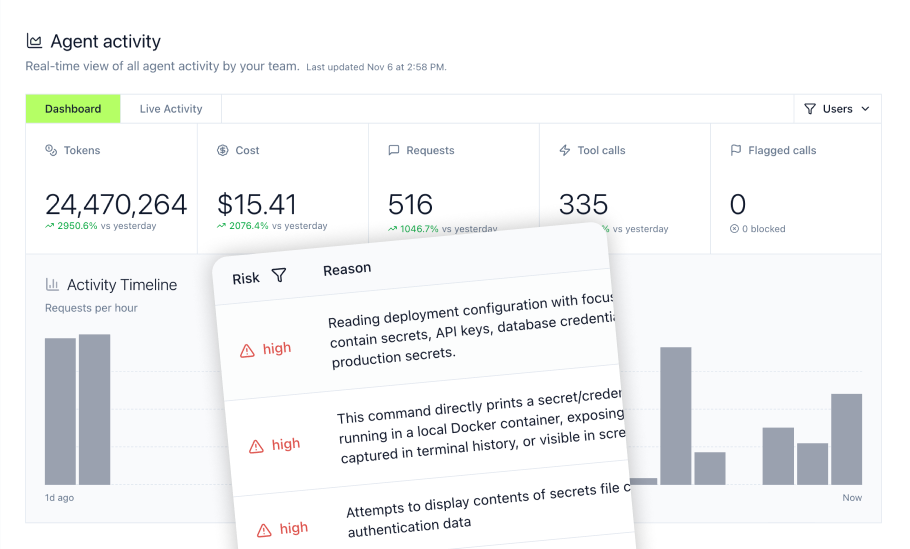
- Usage and cost attribution: Agent Monitor uses reported token telemetry to break down usage and estimated spend by users, agents, models, and sessions
- Complete audit trails: MintMCP logs every interaction with context, creating the audit infrastructure that compliance teams require and that powers ROI measurement as a side effect
- Shadow AI detection: Agent Monitor extends visibility beyond gateway traffic by detecting off-gateway MCP usage and local agent activity in supported clients, helping teams identify unmanaged access patterns
Organizations building AI agent deployments that need to prove their value get the measurement infrastructure from day one. MintMCP is SOC 2 Type II audited with continuous compliance monitoring. Customers handling protected health information can request documentation showing compliance with HIPAA standards.
Start your free trial or explore the documentation to see how governed agents accelerate ROI.
Frequently Asked Questions
What are the main components to consider when calculating AI agent ROI?
AI agent ROI requires tracking three dimensions: costs (development, infrastructure, tokens, operations, and hidden overhead), usage (adoption rates, task completion, error frequency, and containment rates), and value (time savings, quality improvements, throughput gains, and risk mitigation). The formula remains (Benefits minus Costs) divided by Costs, but each component requires careful measurement. Time savings should use fully loaded labor costs that account for employer-paid compensation beyond wages. Value calculations should include scope multipliers reflecting actual adoption rates rather than theoretical coverage. Costs must account for error remediation, security overhead, and governance administration alongside obvious expenses like API consumption.
How can I measure the intangible benefits of AI agents?
Intangible benefits become measurable when you define their proxy metrics. For capability expansion, track work that now gets done that was previously impossible due to capacity constraints. For strategic value, measure time-to-market improvements, competitive win rates, or customer satisfaction scores that correlate with agent-enabled capabilities. For risk mitigation, calculate the expected value of prevented incidents by estimating probability times impact for compliance violations, security breaches, or operational failures that governance prevents. Quality improvements become tangible through error rate comparisons, rework reduction, and consistency metrics. The key is selecting proxies before deployment so you can establish baselines.
When should I start calculating ROI for a new AI agent deployment?
Begin formal ROI calculations once the deployment has enough stable usage data to compare results against the pre-deployment baseline. Early measurements should be treated as provisional while adoption and agent behavior are still changing. During months one through three, focus on leading indicators like adoption rates, override frequency, and containment rates. These predict future ROI without requiring premature value calculations. Once agents stabilize (typically when containment rates flatten and override rates stop declining), begin ROI calculations using the established baselines. Measuring too early produces unreliable numbers that undermine credibility with finance teams.
How do security and compliance risks affect the overall ROI of AI agent deployments?
Security incidents can instantly eliminate years of accumulated value. A single data breach may cost millions in direct expenses, regulatory fines, and reputation damage. Compliance failures trigger audits, remediation projects, and potential operational shutdowns. Organizations that treat governance as overhead discover these costs too late. The inverse is also important: strong governance can protect ROI by reducing rework, incidents, and delays as agent deployments scale. Include risk mitigation value in ROI calculations by estimating prevented incident costs. Include governance costs honestly, but recognize that the alternative is higher costs from incidents and slower time to value.
What is the difference between direct and indirect costs in AI agent ROI analysis?
Direct costs are visible and attributable: LLM API consumption, infrastructure expenses, licensing fees, integration development time, and training investments. These appear on invoices and timesheets. Indirect costs hide in operational overhead: error remediation time when agents make mistakes, security review cycles before production deployment, governance administration for access controls and credentials, shadow AI cleanup when ungoverned agents proliferate, and opportunity costs from engineering time diverted to AI support. Organizations can easily underestimate indirect costs because they are spread across multiple budgets and teams. Accurate ROI requires surfacing these hidden expenses through time tracking, incident logging, and centralized monitoring that attributes overhead to specific agent deployments.