Qwen Code transforms your terminal into an intelligent development partner, reading repositories, generating production-ready code, and integrating with enterprise tools through the Model Context Protocol. Yet most organizations deploying AI coding assistants face a critical governance gap: developers gain powerful capabilities while security teams lose visibility into what those tools access. With native MCP support and multi-provider flexibility, Qwen CLI represents both an opportunity and a risk that can benefit from centralized controls through an MCP Gateway to ensure governed access, credential management, and audit trails.
This article provides a complete setup guide for Qwen CLI alongside enterprise governance strategies, covering installation, authentication, MCP integration, security controls, and ongoing management to ensure both developer productivity and organizational compliance.
Key Takeaways
- Qwen CLI setup requires Node.js 22+ for npm-based installation; setup time varies by platform and enterprise requirements
- The CLI supports up to 1M token context with supported models such as qwen3.7-plus and qwen3-coder-plus, enabling analysis of large codebases
- Open-source Apache 2.0 licensing provides full control over deployment without vendor lock-in
- Native MCP integration enables enterprise tool connections that can use centralized governed endpoints to reduce credential and configuration sprawl
- Permission-based controls include Plan, Ask Permissions, Auto-Edit, Auto, and YOLO modes, with distinct security implications for each
- Enterprise identity integration through MintMCP supports Okta, Entra ID, and Google Workspace, with directory-driven access and automatic propagation of role changes
Setting Up Your Qwen CLI for AI Coding: A Step-by-Step Guide
Prerequisites and System Requirements
Before installing Qwen CLI, verify your environment meets the minimum requirements:
- For npm installation, Node.js version 22 or higher is required
- Qwen Code's recommended standalone installer does not require a preinstalled Node.js runtime unless it falls back to npm
- Terminal or command-line access
- API credentials from your chosen provider or a local model setup
Supported operating systems include macOS, Windows, and Linux. For organizations managing distributed teams, this cross-platform compatibility simplifies standardized deployment across heterogeneous environments.
Installing Qwen CLI on macOS, Windows, and Linux
Step 1: Install Node.js
Download and install Node.js 22+ from the official nodejs.org site. Verify installation by running node --version in your terminal, which should display v22.x.x or higher.
Step 2: Install Qwen Code CLI
Open your terminal and execute:
npm install -g @qwen-code/qwen-code@latest
Installation time varies by platform, method, and network conditions. Verify success by running qwen --version to display the current version number.
Step 3: Configure Authentication
Launch Qwen by running qwen in your terminal, then type /auth to select your authentication method:
- Alibaba Cloud Coding Plan: Enter your API key for predictable monthly pricing
- OpenAI-compatible provider: Set environment variables
OPENAI_API_KEY,OPENAI_BASE_URL, andOPENAI_MODEL - Local model via Ollama: Configure a custom provider endpoint for on-premises deployment
Basic Configuration and First Commands
Navigate to a project directory and run qwen, then ask a simple question like "explain this project" to verify connectivity. The AI should respond with a project analysis based on your codebase.
Common setup challenges include:
- Node.js version mismatch: Upgrade to v22+ or use nvm (Node Version Manager)
- Permission errors during npm install: Fix the npm global directory or use a user-owned Node.js installation, then rerun without
sudo - API key not recognized: Export environment variables in
.zshrcor.bashrcfor persistence - Model not found: Verify correct model ID spelling in configuration
Unleashing Advanced AI Code Generation with Qwen CLI
Leveraging Qwen CLI for Efficient Code Development
Qwen CLI excels at code generation, refactoring, and test creation directly from the terminal. With supported models such as qwen3.7-plus and qwen3-coder-plus, the tool can use context windows up to 1M tokens for large-codebase analysis.
Core code generation capabilities include:
- Repository analysis and architectural explanations
- Production-ready code generation following existing patterns
- Automated test generation for new and legacy code
- Git workflow automation including commits and pull requests
- Code refactoring with ES6+ modernization
Best Practices for Prompting Qwen for Optimal Code Output
Effective prompting significantly impacts output quality:
- Be specific about requirements and constraints
- Reference existing code patterns for consistency
- Use the
/reviewcommand for code quality assessments - Apply
/compresswhen working with large codebases to manage token limits
For enterprise teams, standardizing prompting practices ensures consistent code quality across developers. This becomes particularly important when connecting Qwen CLI to enterprise data sources through MCP integrations.
Governing Qwen CLI: Enterprise Controls for AI Coding Assistants
Establishing Secure Access for Qwen CLI Users
Enterprises deploying Qwen CLI face immediate governance challenges:
- Developers configure the tool independently across laptops
- Duplicated setup creates inconsistent security postures
- Scattered credentials increase risk of exposure
- API keys on developer machines create single points of compromise
MintMCP's MCP Gateway addresses these challenges through centralized governance. Instead of each developer configuring MCP servers locally, teams connect once to a governed Virtual MCP endpoint. The gateway authenticates users through your identity provider, injects credentials per call without exposing long-lived secrets, curates which tools each role can access, and logs every tool call for audit and compliance.
Qwen Code supports remote MCP servers over HTTP, so organizations can connect it to governed endpoints with compatible transport and authentication settings.
Implementing Guardrails for Safe Development Practices
Qwen CLI includes native permission controls with five approval modes:
- Plan: Read-only analysis without file edits or shell execution (lowest risk)
- Ask Permissions: Requires approval before file edits or shell commands (controlled interactive use)
- Auto-Edit: Automatically approves file edits but still requires approval for shell commands (moderate automation)
- Auto: Uses a classifier to evaluate and automatically approve or block actions (higher automation)
- YOLO: Automatically approves tool calls unless another configured control blocks them (highest-risk approval mode)
For enterprise deployments, start with Ask Permissions mode and graduate to Auto-Edit only after establishing trust. YOLO mode should be restricted to sandboxed environments.
Beyond native controls, MintMCP's Guardrails provide runtime policy enforcement through three layers:
- Mint Guard: Managed detection for prompt injection, secrets, PII, and harmful content
- Rules: Declarative matching on tool names, arguments, or content patterns
- Gateway Middleware: Customer-authored JavaScript for DLP integrations and custom policy enforcement
Managing Qwen CLI Across the Enterprise: Identity, Permissions, and SSO
Integrating Qwen CLI with Enterprise Identity Providers
Organizations using SSO need Qwen CLI access governed by the same identity infrastructure managing other enterprise applications. MintMCP supports Okta, Entra ID, and Google Workspace, with directory groups driving both admin roles and tool access.
When an employee is suspended in the IdP, the directory-driven model propagates changes without manual credential cleanup. This eliminates the burden that occurs when developers leave or change roles.
Role-Based Access Control for AI Coding Assistants
RBAC for MCP tools operates at the Virtual MCP level. Different teams receive different governed endpoints:
- Read-only VMCP: Database schema access without write permissions
- Read-write VMCP: Full tool access for senior engineers
- Restricted VMCP: Limited tool surface for contractors or interns
SCIM-driven group membership automates these assignments. When HR updates team membership, tool access adjusts automatically without manual configuration. For organizations assessing MCP data risk, this granular control ensures least-privilege access falls naturally out of role design rather than requiring constant policy adjustments.
Securing Qwen CLI Interactions: Preventing Prompt Injection and Data Leakage
Implementing Proactive Defenses Against Prompt Injection
MCP tool descriptions represent an injection surface where malicious content can manipulate agent behavior. When Qwen CLI calls list_tools, it receives tool descriptions that become part of the prompt context. Compromised servers can exploit this to inject instructions.
MCP security for enterprises requires screening both tool arguments and results. Mint Guard provides managed detection that blocks prompt injection attempts at high confidence, operating in monitoring or enforcing modes depending on organizational risk tolerance.
Protecting Sensitive Data During Qwen CLI Operations
Qwen CLI can read files including .env files containing secrets, SSH keys, and configuration with credentials. Without visibility, security teams cannot detect when sensitive data enters the AI context.
Data protection strategies include:
- File and tool controls through Qwen Code's native
permissions.allow/ask/denysystem - PII and secret detection through Mint Guard on supported MintMCP-governed calls
- DLP integrations through Gateway Middleware on supported gateway interactions
- Local sandboxing and network restrictions for operations that do not traverse the MCP Gateway
For regulated industries, these controls can support data-governance and compliance workflows by detecting or restricting sensitive data in supported enforcement paths.
Monitoring Qwen CLI Activity: Usage, Costs, and Compliance
Tracking Qwen CLI Usage for Cost Optimization
Qwen CLI pricing varies significantly by plan. The open-source CLI is free, but requires separate model provider costs. Without monitoring, organizations face unexpected token overage charges, no attribution of costs to projects or teams, and inability to perform chargebacks for client work.
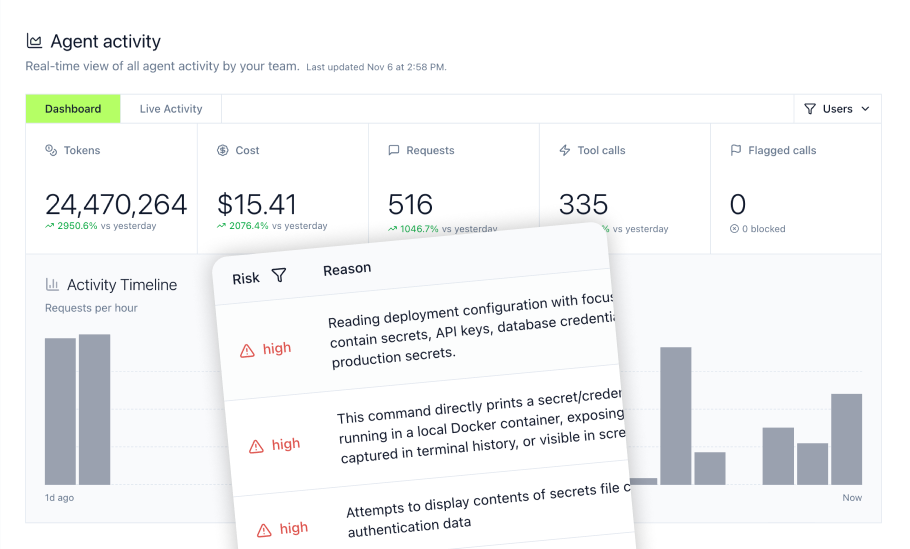
MintMCP's Agent Monitor provides token spend visibility by model, user, agent, and session. The usage dashboards support chargeback-grade tracking, enabling accurate cost allocation across departments or clients.
Ensuring Compliance with Detailed Audit Trails
Audit requirements for AI coding tools include documenting which tools agents called, what data they accessed, and what actions they performed. AI agent security depends on complete, tamper-evident records that support SOC 2-related, HIPAA-related, and internal risk reporting needs.
For supported clients and phases, Agent Monitor can capture:
- Prompt submissions
- File access, including sensitive files
- Commands such as bash, git, and package installs
- MCP tool calls with arguments and results
SIEM export via OTLP or Splunk HEC integrates this data into existing security operations workflows, providing centralized visibility into supported AI-agent activity.
Deployment Best Practices: Integrating Qwen CLI into Enterprise Workflows
Automating Qwen CLI Deployment and Configuration
Enterprise rollouts require consistent configuration across developer machines. Environment variables for API keys should be managed through secret management systems rather than hardcoded in settings.json.
Deployment approaches include:
- User-level settings: Individual developer configuration in
~/.qwen/ - System-level settings: Team-wide policies for consistent security posture
- MDM deployment: Intune, Kandji, or JumpCloud for managed device configuration
MintMCP supports configuration as code for gateway settings and global rules, enabling declarative management through version-controlled infrastructure.
Securing Access through Private Network Connectivity
Organizations with on-premises databases or private cloud resources need Qwen CLI to access internal systems without public exposure. MintMCP's private network tunnel enables connectivity to internal MCP servers while keeping them off the public internet.
This architecture supports hybrid deployments where some connectors run in the MintMCP data plane while others connect through secure tunnels to customer infrastructure.
The Future of AI Coding with Qwen CLI: Autonomous Agents and Enhanced Governance
Bridging Qwen CLI with Autonomous Agent Workflows
Qwen Code supports Subagents and an experimental Agent Team runtime for complex multi-step workflows; Agent Team is disabled by default and must be explicitly enabled. As these capabilities mature, organizations will deploy long-running agents that perform scheduled tasks, respond to events, and maintain state across sessions.
MintMCP's Agent Gateway builds on the MCP Gateway foundation by extending governed data and tool access to first-class agent identities. Each autonomous agent receives its own non-human identity separate from human credentials, scoped permissions and MCP access, independent credential rotation and revocation, and an attributable audit trail.
This architecture answers the critical question that emerges at scale: when dozens of agents operate autonomously, who did what becomes the central governance challenge.
Establishing First-Class Identities for AI Agents
Agent identities treat autonomous agents as first-class non-human principals rather than extensions of whichever employee credential happened to be available. Authentication mechanisms range from bearer keys for simple deployments to workload identity federation where the agent's own infrastructure mints short-lived OIDC tokens.
For Qwen CLI workflows transitioning to scheduled or event-driven execution, this identity model ensures governance scales alongside automation ambitions.
Unified Governance for Qwen CLI at Enterprise Scale
Organizations deploying Qwen CLI face a choice: replicate configuration, credentials, and controls N times across developer machines, or centralize governance through a shared infrastructure layer. MintMCP's platform provides that layer, treating Qwen Code as one client among many that can connect to governed MCP endpoints.
The value proposition extends beyond initial setup:
- When a contractor leaves: Revoke one identity rather than hunting for scattered API keys.
- When compliance requires an audit trail: Export consolidated logs rather than scraping laptop filesystems.
- When a new data source becomes available: Grant access once through a Virtual MCP rather than reconfiguring each developer's local MCP server list.
This architecture does not replace Qwen Code's native controls. Instead, the two layers serve different purposes:
- Local Qwen controls: Permission rules, file allow/deny lists, and approval modes constrain what the agent attempts.
- MintMCP controls: Gateway policy governs which enterprise systems and resources Qwen Code can access through MCP.
Together, these controls create defense in depth by combining local execution restrictions with centralized governance over enterprise resource access.
For teams evaluating agentic AI governance, the question is not whether to deploy coding assistants, but whether to govern them before or after a credential leak, compliance audit, or shadow IT discovery. Centralized MCP governance provides the visibility, control, and audit foundation that enterprise risk management requires.
Frequently Asked Questions
Can Qwen CLI run entirely on-premises without cloud dependencies?
Qwen Code can use local OpenAI-compatible model servers such as Ollama and vLLM. To keep traffic on-premises, configure local endpoints and disable optional usage statistics. Qwen Code's usage statistics are enabled by default but do not include prompt, response, or file contents. Review all outbound integrations to ensure complete on-premises operation for strict compliance requirements.
How does Qwen CLI compare to other tools for multi-provider flexibility?
Qwen Code supports multiple provider protocols, including OpenAI-compatible providers, Anthropic, Google Gemini, Vertex AI, and local OpenAI-compatible servers. Teams can configure multiple providers and switch between available models with the /model command, while supported subagents can use their own model selections. This flexibility enables cost optimization and data residency control.
What happens to conversation history and context between Qwen CLI sessions?
Conversation history stores locally in ~/.qwen/ by default. For enterprise deployments requiring shared context or company-owned memory, MintMCP's Coworker Agents provide company-owned memory based on Git-like principles that the organization can scope, version, review, audit, and port. This model ensures context persistence follows enterprise governance rather than residing in opaque systems.
How should organizations handle the April 2026 OAuth discontinuation?
The Qwen OAuth free tier ended April 15, 2026. Organizations should migrate to a current authentication method such as Alibaba Cloud Coding Plan, a Model Studio API key, a supported third-party provider, or a custom/local provider. Evaluate cost models based on your usage patterns and data residency requirements, and avoid reliance on deprecated authentication methods.
What security risks exist when using YOLO mode, and how can they be mitigated?
YOLO mode automatically approves tool calls unless another configured control blocks them, creating risks including uncontrolled script execution, unrestricted file modifications, and potential credential exposure. Never use YOLO mode in production environments. If speed is critical, restrict YOLO usage to sandboxed containers with no network access to sensitive systems and use Qwen Code's system-level permissions. MintMCP Guardrails enforce policy on supported MCP interactions but do not replace local controls for shell commands and file operations.