The AI terminology landscape has become increasingly confusing as vendors apply labels inconsistently and capabilities evolve rapidly. Understanding the distinctions between chatbots, AI assistants, and AI coworkers is no longer academic; it directly impacts how organizations architect their AI agent security infrastructure, allocate budgets, and manage risk.
Each category represents fundamentally different technical architectures, governance requirements, and enterprise deployment considerations that affect everything from compliance posture to productivity outcomes.
This article breaks down what actually separates these three AI categories in 2026, covering their core architectures, enterprise applications, security implications, and the governance frameworks required to deploy them safely at scale. It also explains where Agent Gateway fits: the control layer for identities, permissions, memory, and monitoring when AI systems evolve from assistants into long-running coworkers.
Key Takeaways
- Chatbots handle scripted interactions within predefined boundaries, while AI assistants add context awareness and proactive suggestions, and AI coworkers execute multi-step workflows with tool access
- AI coworkers are long-running agents that can live in Slack, hold memory, continue work across days, and operate alongside employees
- MCP Gateway governs tool and data access, while Agent Gateway governs agent identities, permissions, memory, and monitoring
- AI coworkers require per-agent identity management with scoped credentials, rotation capabilities, and audit attribution that traditional chatbot or assistant deployments never needed
- Shadow AI detection has become critical as AI coworkers operate across tools like Claude Code and Cursor, while centralized gateway governance applies across Claude, Cursor, ChatGPT, Gemini, and Copilot
- Bundle architectures that package tool access, policy enforcement, and audit logging into single governance units reduce configuration complexity compared to managing separate plugin, access rule, and credential objects
Demystifying the AI Landscape: Chatbots, Assistants, and Coworkers Defined
The terminology confusion stems from vendors marketing fundamentally different technologies under similar names. Clarifying these distinctions requires examining three areas:
- Core technical capabilities
- Interaction models
- Enterprise implications of each category
The Core Functionality of an AI Chatbot
AI chatbots operate within clearly defined conversational boundaries. They process user inputs against pre-configured intents, match queries to response templates or decision trees, and deliver scripted or semi-scripted outputs.
Traditional chatbots excel at handling high-volume, repetitive inquiries where the solution space is well-understood, including:
- Password resets
- Order status checks
- FAQ responses
- Basic troubleshooting flows
The technical architecture typically involves:
- Intent recognition matching user input to predefined categories
- Entity extraction pulling specific data points from queries
- Response generation from templates or constrained outputs
- Session management maintaining basic conversation state
Modern chatbots incorporate natural language processing to handle input variations, but traditional chatbot patterns fundamentally react to user queries rather than taking independent action. They generally do not independently execute multi-step workflows or adapt behavior based on organizational context without additional agentic architecture and governance controls.
What Distinguishes an AI Assistant?
AI assistants build on chatbot foundations by adding context awareness, personalization, and proactive engagement capabilities. Rather than waiting for explicit user queries, assistants can anticipate needs, surface relevant information, and adapt responses based on user history and preferences.
Key differentiators include:
- Proactive suggestions based on calendar, email, and activity patterns
- Cross-application awareness synthesizing data from multiple sources
- Personalization engines that improve recommendations over time
- Voice interface integration for hands-free interaction
- Task automation for simple, well-defined workflows
Virtual assistant software powers consumer applications like calendar management, email drafting, and smart device control. In enterprise contexts, AI assistants handle:
- Meeting scheduling
- Document summarization
- Basic information retrieval across connected systems
However, many AI assistants still operate within user-initiated sessions. They suggest and assist, but they typically do not autonomously execute complex business processes or maintain persistent goals across extended time horizons without additional agentic architecture and governance controls.
Defining the AI Coworker Paradigm
AI coworkers represent a fundamental architectural shift toward autonomous, goal-oriented systems that execute multi-step workflows with minimal human intervention. Unlike assistants that suggest actions, AI coworkers take actions.
They can:
- Reason through problems
- Select appropriate tools
- Chain multiple operations together
- Adapt their approach based on intermediate results
The defining characteristics of AI coworkers include:
- Autonomous goal pursuit maintaining objectives across multiple interactions
- Tool utilization directly accessing databases, APIs, and enterprise systems
- Multi-step reasoning decomposing complex tasks into executable sequences
- Error recovery detecting failures and adjusting approaches
- Persistent context maintaining memory and state across sessions
- Workplace persistence living in Slack, holding memory, continuing work across days, and operating alongside employees
This autonomy creates the productivity gains enterprises seek, with organizations reporting measurable productivity improvements on routine tasks. But it also introduces security, governance, and compliance requirements that chatbot and assistant deployments never faced.
From Simple Queries to Complex Workflows: The Evolution of AI Chatbot Capabilities
Where AI Chatbots Excel in 2026
Despite the focus on advanced AI, chatbots remain the right solution for many enterprise use cases. They handle predictable interactions efficiently, scale cost-effectively, and operate with more limited governance overhead than autonomous agents.
Effective chatbot applications include:
- Tier-1 customer support handling common inquiries before human escalation
- Internal IT help desks processing password resets and access requests
- E-commerce assistance tracking orders and processing returns
- Appointment scheduling managing calendar bookings within defined parameters
- Lead qualification gathering initial prospect information
The simplicity that limits chatbots also reduces their risk profile. When chatbot boundaries are hardcoded and access is limited, they are less likely than autonomous agents to execute unintended multi-step actions. Organizations should still apply appropriate security controls, especially when chatbots access customer, employee, or operational data.
Organizations deploying chatbots face more straightforward security considerations compared to the governance frameworks required for AI agents.
Limitations of Traditional Chatbots
Chatbots fail when interactions require judgment, context integration, or actions beyond their programmed capabilities.
Common failure modes include:
- Intent confusion when user queries don't match predefined categories
- Context loss requiring users to repeat information across sessions
- Escalation friction when handoffs to human agents lose conversation history
- Rigidity when the chatbot cannot handle novel situations or edge cases
- Integration gaps when systems operate in silos without cross-system awareness
These limitations drive organizations toward AI assistants and coworkers, but the transition requires understanding that each upgrade in capability brings corresponding increases in governance complexity.
The Rise of Conversational AI Companies
The conversational AI market has matured significantly, with vendors offering increasingly sophisticated platforms that blur traditional category boundaries.
Organizations should:
- Test actual system behavior rather than relying on vendor positioning
- Map capabilities to specific use cases rather than buying generalized "AI"
- Assess governance requirements based on what the system can actually access and do
- Plan for capability evolution as platforms add features that change risk profiles
Elevating User Experience: The Impact of AI Assistant Apps and Devices
Key Features of Modern AI Assistants
AI assistants in 2026 have evolved well beyond simple voice commands. Enterprise-grade AI assistant applications incorporate:
- Multi-modal interaction supporting text, voice, and visual inputs
- Cross-platform synchronization maintaining context across devices
- Calendar intelligence proactively managing scheduling conflicts
- Document understanding summarizing and extracting key information
- Communication drafting generating contextually appropriate responses
These capabilities make AI assistants valuable productivity tools, but they operate within defined boundaries. An assistant might draft an email, but a human approves and sends it. An assistant might suggest meeting times, but it does not unilaterally reschedule your calendar.
Beyond Basic Task Automation with AI Assistants
Advanced AI assistants push toward coworker territory by incorporating:
- Workflow suggestions recommending process improvements based on observed patterns
- Information synthesis combining data from multiple sources into coherent summaries
- Predictive alerts surfacing potential issues before they become problems
- Preference learning adapting behavior to individual work styles
Organizations deploying these advanced assistants should evaluate whether their capabilities actually require agent-level governance. An assistant that can access customer data, even passively, creates compliance obligations that exceed traditional chatbot deployments.
Integrating AI Assistants into Daily Routines
Effective AI assistant deployment requires thoughtful integration design:
- Define clear boundaries between assistant suggestions and autonomous actions
- Establish data access policies specifying what information assistants can retrieve
- Configure notification preferences balancing helpfulness against interruption
- Plan for graceful degradation when assistants cannot complete tasks
- Implement feedback loops enabling continuous improvement
The Agentic Shift: Understanding AI Agents and the AI Coworker Model
What Makes an AI an 'Agent'?
The term "agent" carries specific technical meaning that distinguishes AI coworkers from assistants. An AI agent exhibits:
- Autonomy taking actions without explicit per-step approval
- Goal orientation pursuing objectives across multiple operations
- Environmental awareness perceiving and responding to system state
- Tool access directly interfacing with external systems and data
- Adaptive behavior modifying approaches based on feedback and results
These characteristics enable AI coworkers to handle complex, multi-step business processes.
For example:
- A data analysis agent can query databases, process results, generate visualizations, identify anomalies, and draft reports without human intervention at each step
- A development workflow agent can pull code from GitHub, create branches, implement changes, run tests, and submit pull requests
Real-world Examples of AI Agents in Action
AI coworkers are transforming enterprise workflows across multiple domains:
Data Analysis Agents
- Query Snowflake data warehouses and generate reports
- Identify anomalies and surface insights proactively
- Create visualizations and dashboards without manual configuration
Customer Support Agents
- Access CRM systems like Salesforce and HubSpot
- Retrieve customer history and context automatically
- Execute resolution workflows including ticket updates and escalations
Development Workflow Agents
- Connect to GitHub, Jira, and CI/CD pipelines
- Implement code changes based on requirements
- Run tests and manage deployment workflows
Compliance Agents
- Monitor systems for policy violations
- Generate audit-ready documentation
- Flag issues requiring human review
AI Coworkers: The Future of Automation
The shift from assistants to coworkers represents a qualitative change in human-AI collaboration. Rather than augmenting human decision-making, AI coworkers handle entire workflows independently while humans focus on strategic decisions, exception handling, and creative work.
This transition requires organizations to rethink their approach to AI governance:
- Chatbots needed content moderation
- Assistants needed data access policies
- AI coworkers need comprehensive security frameworks addressing identity, authentication, authorization, audit, runtime monitoring, memory, and tool governance, as outlined in the NIST AI Risk Management Framework
The MCP Gateway addresses these requirements by providing centralized governance for AI agents using the Model Context Protocol. The Agent Gateway builds on that foundation by governing the agent itself: identity, permissions, memory, and monitoring. Rather than managing security configurations for each agent individually, organizations define policies once and apply them consistently across agent deployments.
Operationalizing AI Coworkers: Security, Governance, and Scalability Challenges
Addressing the 'Last Mile Problem' in Enterprise AI
The "last mile problem" in enterprise AI refers to the gap between AI capabilities and secure integration with internal systems. AI models can reason, generate, and plan, but connecting them to actual business data and tools requires solving authentication, authorization, and audit challenges that most organizations are not equipped to handle in-house.
Key challenges include:
- Credential management for dozens of connected systems
- Access control ensuring agents only reach authorized data
- Audit trails documenting every action for compliance review
- Policy enforcement applying consistent rules across heterogeneous tools
- Identity federation integrating with existing SSO/SCIM infrastructure
- Agent memory and monitoring controls for long-running coworkers
Organizations attempting to build this infrastructure in-house can face substantial engineering work across integrations, with ongoing maintenance burden as systems evolve.
Securing AI Agent Access to Internal Systems
AI coworkers require different security architectures than traditional applications. Agents need credentials for multiple systems simultaneously. Manual credential management becomes untenable at scale, with credential management cited as a key consideration by organizations deploying MCP servers across multiple tools.
Unlike human users who need broad access, agents should receive minimal permissions required for specific tasks:
- A database query agent needs read access, not write access
- A reporting agent needs access to aggregate data, not individual records
Compliance mandates complete documentation of what agents accessed and why. Conversation-level logging capturing prompts, tool calls, responses, and context with per-user and per-agent attribution becomes essential for regulated industries.
Best Practices for Governing AI Coworker Deployments
Effective AI coworker governance requires:
- Centralized policy management applying consistent rules across all agents
- Per-agent identity with independent credentials and audit attribution
- Tool-level access control enabling specific capabilities while blocking others
- Runtime monitoring detecting anomalous behavior in real time
- Agent memory that is scoped, reviewable, auditable, and portable where applicable
- Incident response procedures for agent misbehavior or security events
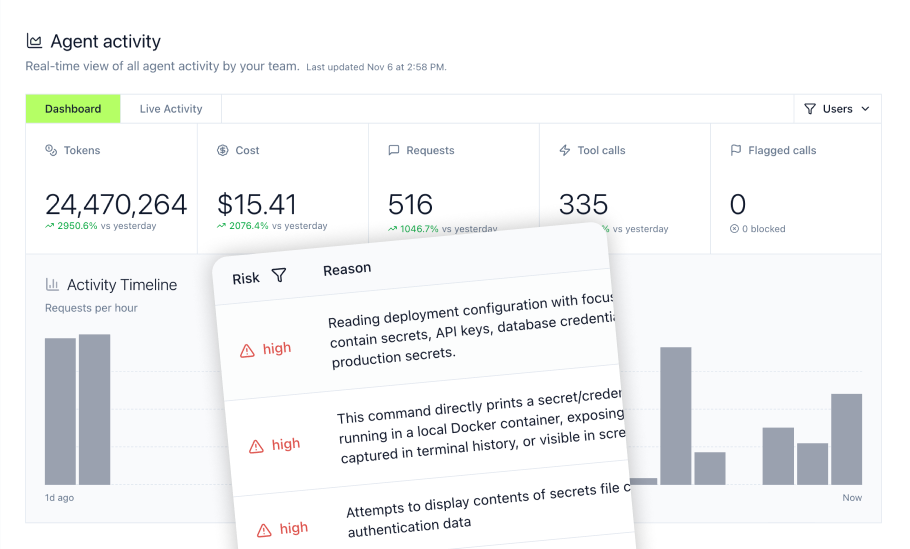
The Agent Monitor provides real-time visibility into agent actions across the organization, including activity in tools like Claude Code and Cursor that occurs outside centralized gateways, while gateway governance applies across Claude, Cursor, ChatGPT, Gemini, and Copilot.
Together, MCP Gateway and Agent Monitor provide two-layer governance: the gateway governs approved MCP traffic and tool access, while Agent Monitor extends visibility to local non-MCP agent activity such as file reads, shell commands, and prompt submissions.
The Unique Value Proposition of AI Coworkers in Enterprise
Driving Efficiency with AI-Powered Automation
AI coworkers deliver productivity gains by handling entire workflows rather than individual tasks. The efficiency difference compounds across operations such as:
- Data analysis that previously required analyst time from query to presentation
- Customer support resolution without human involvement for routine issues
- Development workflows from requirement to tested code
- Compliance reporting with automatic documentation generation
Organizations should measure time savings against baseline workflow metrics post-deployment, because achieving durable outcomes requires proper governance infrastructure.
Transforming Core Business Processes with AI Coworkers
Strategic AI coworker deployment targets high-volume, rules-based processes where consistency and speed matter.
In financial operations, this includes:
- Invoice processing and reconciliation
- Expense categorization and policy enforcement
- Financial reporting and variance analysis
In human resources, this includes:
- Resume screening and candidate coordination
- Onboarding documentation and system provisioning
- Benefits administration and employee inquiries
In operations, this includes:
- Supply chain monitoring and exception handling
- Quality assurance documentation
- Regulatory compliance tracking
Achieving Significant Time Savings with Agent Deployments
Realizing productivity gains requires thoughtful deployment:
- Start with well-defined processes where success criteria are clear
- Establish baseline metrics to measure actual improvement
- Implement governance first before expanding agent access
- Monitor for drift as agents encounter edge cases
- Iterate based on results rather than theoretical capabilities
The Virtual MCP abstraction reduces configuration complexity for non-technical users, enabling broader organizational adoption without requiring deep technical expertise for each deployment.
AI Coworker Identity and Access Management: A Critical Enterprise Layer
Why Individual Agent Identities Matter
Traditional application security assumes human users behind every action. AI coworkers break this assumption, creating accountability gaps that agent identities directly address.
Without individual agent identities:
- Audit attribution fails when multiple agents share credentials
- Credential rotation requires updating all agents simultaneously
- Incident investigation cannot determine which agent caused problems
- Access revocation becomes all-or-nothing rather than surgical
With per-agent identities, each deployed agent receives its own credentials and permission scope independent of the creator's access level. When issues arise, security teams can revoke specific agent access without disrupting others.
Implementing Secure Credential Management for AI Agents
Effective credential management for AI coworkers requires OAuth 2.0 patterns for agent credentials and enterprise SSO for human access. This enables centralized access control, audit logging, and automatic credential rotation.
Additional credential controls include:
- Automatic credential rotation reducing risk without operational burden
- Scoped permission grants ensuring each agent receives minimal permissions for its specific function
- Per-user, per-team, and per-agent rate limits preventing runaway agents from overwhelming systems or generating excessive costs
Integrating AI Agent IAM with Existing Enterprise Systems
AI coworker identity management should extend existing infrastructure rather than creating parallel systems.
This includes:
- SCIM synchronization with Okta, Azure AD, and Google Workspace enabling automatic group membership
- SSO integration providing unified access control and audit
- Policy inheritance flowing from organizational structure to agent permissions
- Automated provisioning and deprovisioning aligned with the employee lifecycle
The Bundle model ties SCIM group membership to curated MCP server lists, custom policy rules, and isolated audit trails. When group membership changes in the identity provider, agent permissions update automatically.
Agent Bundles extend this model to non-human principals with scoped tools, M2M authentication, and an "act as agent" flow for connectors that require per-agent OAuth.
Detecting and Preventing 'Shadow AI' and Risky Behaviors in Agent Deployment
The Dangers of Unmonitored AI Agent Use
Shadow AI represents one of the most significant security risks in enterprise AI deployment. Developers and knowledge workers adopt AI tools outside IT governance, creating:
- Data exposure as sensitive information flows through ungoverned channels
- Compliance violations from undocumented AI system access
- Security vulnerabilities from unvetted tool integrations
- Audit gaps preventing incident investigation and regulatory response
Gateway-only monitoring misses activity occurring in local development environments, AI coding assistants, and browser-based tools that bypass centralized infrastructure.
How Agent Monitoring Enhances Security Posture
Comprehensive agent monitoring requires visibility beyond the gateway. Hooks in tools like Cursor and Claude Code identify MCP usage outside centralized governance, enabling enforcement of organizational policies regardless of where agents operate.
Agent monitoring also supports:
- Automated scanning to identify sensitive data in agent interactions before it reaches external systems
- Pattern matching to detect API keys, tokens, and other credentials that agents might inadvertently expose
- Behavioral analysis to flag potentially destructive operations like database deletions or system configuration changes
- Detection rules to identify attempts to manipulate agent behavior through malicious inputs
Real-time Threat Detection for AI Coworkers
The Agent Monitor provides layered protection through:
- Built-in detection rules for common risk patterns
- Custom guardrail policies with block, flag, and alert actions
- Org-level analytics on MCP adoption and usage patterns
- Latency monitoring and error tracking for operational awareness
- MDM integration for consistent policy enforcement across devices
Organizations can deploy in detect-only mode initially, gaining visibility before enabling enforcement actions that might disrupt workflows.
Governing AI Coworkers: Policy Enforcement and Audit Readiness
Ensuring Compliance with AI Agent Policies
Policy enforcement for AI coworkers must operate at multiple levels.
Tool-level controls can:
- Enable database reads while blocking writes
- Allow file access within specific directories
- Permit API calls to approved endpoints only
Content-level controls can:
- Detect and block PII transmission
- Redact sensitive data from outputs
- Enforce data classification policies
Behavioral controls can:
- Rate limit aggressive operations
- Require approval for high-risk actions
- Alert on anomalous activity patterns
Custom policy code execution in a JS sandbox on every tool call enables inline DLP integration with enterprise security tools including AWS Bedrock Guardrails, Google Cloud DLP, Microsoft Purview, Nightfall, and Skyflow.
Building Audit-Ready AI Infrastructure
Regulatory compliance requires comprehensive documentation of AI system behavior.
Audit-ready infrastructure should include:
- Conversation-level logging capturing prompts, tool calls, responses, and context with per-user and per-agent attribution
- Configurable retention periods supporting varying compliance requirements
- Structured audit records that help teams review agent behavior for compliance investigations and incident response
- SIEM integration exporting to Microsoft Sentinel, Splunk, and S3 for correlation with broader security monitoring and incident response workflows
- Provenance tracking documenting the chain of actions across multi-step agent workflows
These controls enable teams to reconstruct how agents reached specific outcomes.
Integrating DLP into AI Agent Workflows
Data loss prevention for AI coworkers requires integration at the gateway level through:
- Pre-processing inspection analyzing inputs before they reach agents
- Post-processing validation checking outputs before transmission
- Inline transformation masking or redacting sensitive data
- Policy-based blocking preventing high-risk operations entirely
The Future of AI in the Workplace: Seamless Integration and Protocol Standardization
The Role of the Model Context Protocol (MCP) in Standardization
The Model Context Protocol has emerged as a widely adopted standardization layer for helping AI coworkers interact with enterprise systems consistently.
MCP provides:
- Consistent interface definitions for tool exposure and invocation
- Authentication standardization
- Transport flexibility supporting stdio and Streamable HTTP
- Legacy HTTP+SSE handling for backward compatibility where needed
- Ecosystem compatibility across major LLM providers and AI tools
This standardization enables organizations to implement governance once and apply it consistently across Claude, ChatGPT, Gemini, Cursor, Copilot, and other MCP-compatible platforms.
Enabling Widespread AI Agent Adoption Through Open Standards
Protocol standardization accelerates enterprise adoption by reducing integration complexity.
It supports:
- Vendor independence that prevents lock-in to specific AI providers
- Reusable connectors that work across multiple AI clients
- Consistent governance regardless of which AI tool employees use
- Ecosystem growth that expands available integrations without custom development, as noted in the Stanford HAI AI Index Report
Organizations can access a broad MCP server catalog with one-click activation for pre-configured connectors including Salesforce, GitHub, Slack, HubSpot, Notion, Linear, Gmail, and Stripe.
Future-Proofing Enterprise AI Infrastructure
Building on protocol standards positions organizations to adopt future AI capabilities without infrastructure rebuilds.
Future-proof infrastructure should support:
- REST APIs and SDKs for programmatic management and CI/CD integration
- Infrastructure-as-code workflows for reproducible deployments
- Middleware extensibility for custom security requirements
- Protocol evolution through foundation governance to support stability
The MCP Gateway architecture ensures that governance investments made today remain relevant as AI capabilities and enterprise requirements evolve. For long-running AI coworkers, Agent Gateway extends that foundation by governing agent identity, permissions, memory, and monitoring across time.
Why MintMCP Fits Enterprise AI Coworker Governance
As organizations move from chatbots and assistants to autonomous AI coworkers, the governance gap becomes the primary barrier to realizing value. MintMCP addresses this challenge through purpose-built infrastructure that makes secure, compliant AI coworker deployment practical at enterprise scale.
MintMCP provides two connected layers for enterprise AI coworker governance. Its MCP Gateway governs data and tool connections for the AI systems users already run, including Claude, Cursor, ChatGPT, Gemini, and Copilot. Its Agent Gateway builds on that foundation with controls for agent identities, permissions, memory, and monitoring.
Rather than building custom integration and security layers for each tool and AI platform combination, teams can implement governance once and apply it consistently across Claude, Cursor, ChatGPT, Gemini, and Copilot deployments.
MintMCP's Agent Monitor extends visibility beyond gateway-only solutions by detecting AI activity in local development environments and tools like Claude Code and Cursor where agents operate outside centralized infrastructure. This addresses the shadow AI problem that creates compliance exposure and security blind spots in traditional monitoring approaches.
The Bundle architecture reduces operational complexity by tying SCIM group membership to curated MCP server access, custom policy rules, and isolated audit trails.
When an employee joins or leaves a team, their agent permissions update automatically without manual reconfiguration. This makes AI coworker governance scalable for organizations with hundreds or thousands of knowledge workers using AI tools daily.
MintMCP's data-permissions-first architecture starts with SSO, SCIM-driven RBAC, IdP groups, Virtual MCP Bundles, tool-level policy, and audit, then enables agents on top. Virtual MCP Bundles create per-use-case endpoints with SCIM-driven membership, curated tools, and access policy. Agent Bundles extend this model with per-agent identity, scoped tools, M2M authentication, and an "act as agent" flow for connectors that require per-agent OAuth.
MintMCP is SOC 2 Type II audited, with continuous compliance monitoring via Drata. Enterprise SSO, complete audit trails, PII detection, and role-based access control are built into every layer of the platform. Customers handling protected health information can request HIPAA documentation, and MintMCP signs BAAs. Security teams can review the full security posture in the Trust Center.
MintMCP is designed to shorten time-to-value for AI coworker initiatives by giving security, compliance, and IT teams centralized controls they can review before approving broader deployments. Rather than debating whether to allow AI tool adoption, discussions shift to which processes benefit most from automation and how to measure outcomes against baseline metrics.
Frequently Asked Questions
Can chatbots be upgraded to AI coworkers, or do they require completely different architectures?
Traditional chatbots and AI coworkers use different technical architectures. Chatbots commonly operate within predefined decision trees, response templates, or constrained conversational flows, while AI coworkers require large language model foundations, tool-use capabilities, reasoning engines, and persistent context management. Organizations can reuse some existing chatbot content and workflows, but moving into AI coworker use cases usually requires new agentic architecture and governance controls. However, chatbots remain appropriate for many high-volume, predictable interactions where the governance overhead of AI coworkers is unnecessary.
What is an Agent Gateway for AI coworkers?
An Agent Gateway is the control layer for agents that work alongside users. It governs agent identities, permissions, memory, and monitoring so long-running agents can operate safely across enterprise systems. In MintMCP's model, Agent Gateway builds on MCP Gateway: the MCP Gateway governs data and tool connections, while the Agent Gateway governs the agent as an operating identity with scoped access, memory, and visibility across time.
How do AI coworkers handle situations where they lack sufficient permissions to complete a task?
Well-designed AI coworkers should fail gracefully when encountering permission boundaries. They should communicate clearly to users what they cannot do and why, suggest alternative approaches that fall within their authorized scope, and escalate to human operators when tasks require elevated permissions. Governance frameworks should configure agents to request specific permissions rather than failing silently or attempting workarounds that could create security issues. The Bundle architecture enables administrators to adjust agent permissions without reconfiguring underlying integrations.
What happens if an AI coworker makes a mistake that causes business damage?
AI coworker errors create liability questions that organizations must address through governance, monitoring, and contractual arrangements. Comprehensive audit logging documents exactly what agents did and why, enabling root cause analysis and demonstrating reasonable controls to regulators. Many organizations implement approval workflows for high-risk operations, requiring human confirmation before agents execute potentially destructive actions. Risk transfer options for AI system errors vary significantly, so organizations should not rely on insurance as a substitute for governance, monitoring, and approval workflows.
How should organizations handle AI coworkers that need to interact with systems containing personal data under GDPR or similar regulations?
AI coworkers accessing personal data must operate within the same regulatory frameworks as human employees and traditional applications. This includes data minimization, where agents should access only necessary data, purpose limitation, where agent access should align with legitimate business purposes, and individual rights support, where organizations must be able to identify and delete personal data that agents have processed. The governance infrastructure should enforce these requirements automatically through policy rules rather than relying on agents to self-regulate.