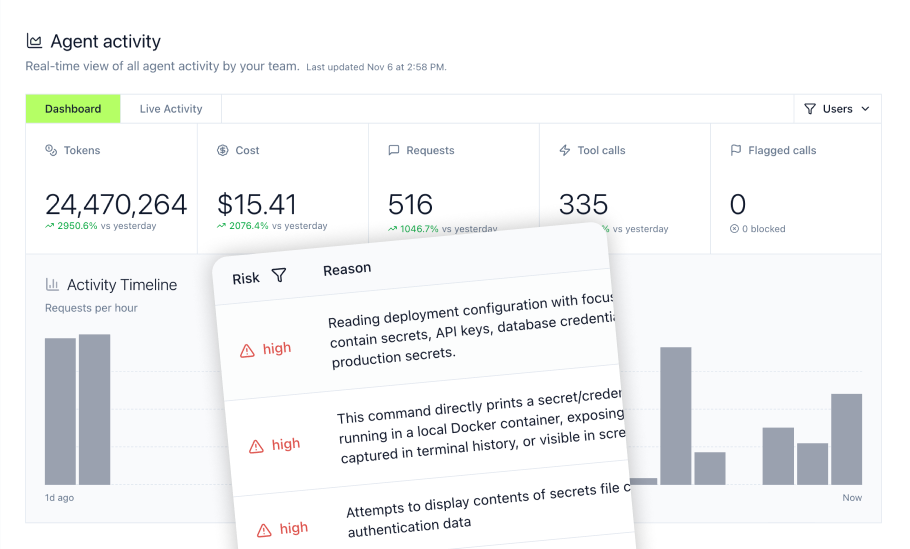
AI agents now access your codebases, databases, and production systems with unprecedented autonomy. Yet most organizations lack visibility into what these agents do—or the controls to stop risky actions before they execute. With 45% of enterprises running production AI agents that have critical system access, security teams face a new challenge: governing autonomous tools that make real-time decisions without human approval.
This guide outlines eight security best practices for enterprise teams deploying AI agents at scale—covering everything from foundational security architecture to transforming local development into production-grade services.
Key takeaways
- 75% of enterprise AI projects will face security breaches by 2025 without proper governance
- Implementing centralized AI security controls can deliver 40% reduction in security breaches and $200,000 annual savings on security incidents
- Virtual MCP servers expose only minimum required tools—not entire MCP servers—enforcing least-privilege access
- Real-time monitoring and audit trails are common requirements in security programs and audits, and they strongly support SOC 2 evidence collection, HIPAA safeguards, and GDPR accountability
1. Establishing foundation: Enterprise security for AI agents
Traditional application security assumes deterministic behavior—users click buttons, applications execute predefined logic. AI agents operate differently. They make autonomous decisions, dynamically select tools, and access data based on context rather than hard coded rules. This fundamental shift requires a new security architecture built specifically for agentic AI workflows.
Understanding the unique security landscape of AI agents:
AI agents introduce three specific security challenges that MCP gateways solve:
- Tool Organization: Agents can tap into a fast-growing ecosystem of 9,000+ MCP connectors and integrations, which increases supply-chain risk unless you vet and govern what’s installed.
- Protocol Translation: Different AI clients (Claude, ChatGPT, Cursor) require different connection methods—gateways provide unified access
- Security Control: Without centralized governance, agents operate as black boxes with limited, inconsistent telemetry, no request history, and uncontrolled access
Key pillars of Enterprise-Grade AI security:
Building a secure foundation requires addressing these core requirements:
- Centralized Identity: All agent access flows through a single authentication layer with OAuth 2.0, SAML, or SSO integration
- Complete Visibility: Every tool call, file access, and command execution gets logged for audit and analysis
- Policy Enforcement: Security rules apply automatically—no relying on developers to implement controls correctly
- High Availability: Enterprise SLAs with automatic failover ensure security controls don't become bottlenecks
Early MCP adopters report faster problem-solving and less time spent hunting for information; the key is deploying MCP in a governed way so productivity gains don’t come with unmanaged risk.
MintMCP Product Fit: The MCP Gateway provides enterprise authentication with OAuth 2.0, SAML, and SSO integration for all MCP servers. It centralizes governance across Claude Code, Cursor, ChatGPT, and custom agents without requiring changes to developer workflows.
2. Protecting your data: Cyber security best practices for AI agents
Coding agents operate with extensive system access—reading files, executing commands, and accessing production systems through MCP tools. Without proper data protection, a single misconfigured agent can expose credentials, customer data, or proprietary code. The stakes are high: 75% of enterprise AI projects (per Gartner research) will face security breaches by 2025 without adequate safeguards.
Implementing data residency and access controls:
Data protection starts with controlling where data lives and who can access it:
- Multi-region deployment: Choose data residency by region to meet compliance requirements (GDPR, data sovereignty laws)
- Environment isolation: Separate development, staging, and production agent access with distinct permission sets
- Query restrictions: Implement read-only access for analytics agents; block DDL operations for reporting tools
- Cost and volume limits: Set query timeouts and result limits to prevent accidental data exfiltration
Safeguarding against unauthorized data access:
The LLM Proxy specifically addresses sensitive file protection—a critical gap in AI agent security:
- Credential protection: Block access to .env files, SSH keys, API tokens, and other sensitive configuration files
- Command filtering: Prevent dangerous bash commands like reading environment secrets or modifying system files
- PII handling: Filter personally identifiable information from agent responses before they reach end users
- Least privilege by default: Start with restrictive policies and expand access based on observed agent behavior
MintMCP Product Fit: LLM Proxy monitors every file access and bash command from coding agents, blocking risky operations in real-time. It protects sensitive files like credentials and SSH keys while maintaining complete audit trails for security review.
3. Real-time monitoring and observability for security teams
You can't secure what you can't see. Yet many organizations still lack consistent visibility into agent behavior—no record of which tools agents invoke, what data they access, or what commands they execute. This observability gap is the single biggest security risk in enterprise AI deployments.
Gaining visibility into agent behavior:
Effective monitoring requires tracking every agent interaction across your organization:
- Tool call tracking: Monitor every MCP tool invocation from all coding agents (Claude Code, Cursor, ChatGPT)
- MCP inventory: Maintain a complete registry of installed MCPs, their permissions, and usage patterns across teams
- File access logs: See exactly which files each agent reads, modifies, or attempts to access
- Command history: Record every bash command for security review and forensic analysis
The audit observability capabilities of a properly configured gateway provide this visibility automatically—without requiring developers to instrument their agent code.
Proactive threat detection and response:
Real-time monitoring enables proactive security rather than reactive incident response:
- Anomaly detection: Identify unusual agent behavior patterns that might indicate compromise or misconfiguration
- Automated alerts: Get notified immediately when agents attempt blocked operations or access restricted resources
- Usage dashboards: Track agent activity by team, project, and tool for security and cost allocation
- SLA compliance: Monitor response times and error rates to maintain service level agreements
Performance metrics that matter:
Tracking the right metrics helps security teams understand agent risk. Monitor these key indicators:
Tool calls per hour - Agent activity level (spike requires investigation) Unique files accessed - Data exposure surface (new sensitive files trigger alerts) Failed auth attempts - Credential probing (more than 3 per minute requires blocking) Command execution rate - System access intensity (unusual patterns need review)
Organizations with comprehensive monitoring report 40% reduction in incident response time and 10% reduction in operational downtime.
MintMCP Product Fit: The MCP Gateway offers real-time monitoring with live dashboards for server health, usage patterns, and security alerts. Combined with LLM Proxy, security teams gain complete visibility into installed MCPs and their usage across all coding agents.
4. Achieving and maintaining compliance with governance standards
AI agents create new compliance challenges. Every tool call potentially accesses regulated data. Every automated decision may require audit justification. Every agent interaction could become evidence in a compliance review. Without proper governance, organizations struggle to meet regulatory requirements.
Leveraging audit trails for accountability:
Complete audit trails are the foundation of AI compliance:
- Every interaction logged: Record user identity, timestamp, tool called, parameters passed, and response received
- Immutable records: Audit logs cannot be modified or deleted by agents or administrators
- Exportable formats: Generate compliance reports in formats required by auditors (SOC 2, HIPAA, GDPR)
- Retention policies: Configure log retention periods to meet regulatory requirements (often 7+ years)
The tool governance capabilities of MintMCP ensure every MCP interaction generates an audit record—automatically, without developer intervention.
Compliance certifications that matter:
Enterprise AI security platforms should support multiple compliance frameworks:
- SOC 2 Type II: Demonstrates security controls are operating effectively over time
- HIPAA: Required for healthcare organizations handling protected health information
- GDPR: Mandatory for organizations processing EU citizen data
- ISO 42001: Emerging standard specifically for AI management systems
Building your governance council:
Effective governance requires cross-functional collaboration:
- Cross-functional representation: Security, IT, compliance, legal, and business stakeholders
- Clear policies: Documented rules for which agents can access what data under which conditions
- Regular review: Quarterly assessment of agent behavior patterns and policy effectiveness
- Escalation paths: Defined processes for handling policy violations and security incidents
MintMCP Product Fit: MCP Gateway is SOC 2 Type II certified and provides complete audit trails for every MCP interaction.
5. Implementing granular access controls and policy enforcement
Blanket permissions don't work for AI agents. A sales team's analytics agent shouldn't access engineering codebases. A customer support agent shouldn't modify production databases. Granular access controls ensure each agent has exactly the permissions it needs—and nothing more.
Defining who can use which tools and data:
Role-based access control (RBAC) adapts traditional security principles for AI agents:
- Team-based permissions: Frontend developers get different MCP access than DevOps engineers
- Tool-level controls: Enable read-only database operations while blocking write tools
- Data classification: Tag sensitive data sources and restrict agent access by classification level
- Time-based access: Grant temporary elevated permissions for specific projects or incidents
Virtual MCP servers take this further by exposing only minimum required tools—not entire MCP servers. This prevents privilege creep and limits blast radius if an agent is compromised.
Automating policy application across agents:
Manual policy enforcement doesn't scale. Automated enforcement ensures consistent security:
- Policy templates: Pre-configured security profiles for common agent types (coding assistant, analytics, support)
- Inheritance rules: Team policies automatically apply to all agents within that team
- Exception workflows: Documented process for requesting and approving policy exceptions
- Drift detection: Automated alerts when agent configurations deviate from approved policies
Authentication models for different use cases:
The authentication models documentation outlines two approaches:
Shared auth (service account) - Best for batch processing and automated workflows, with less individual accountability Per-user auth (OAuth flow) - Best for interactive agents and user-facing tools, with more setup complexity
Most enterprises use a combination—shared auth for background automation, per-user auth for interactive agent access.
MintMCP Product Fit: The MCP Gateway enables granular tool access control, allowing configuration by role (e.g., read-only operations, excluded write tools). Virtual MCP concepts explain how to create team-specific virtual servers with curated tool sets.
6. From shadow AI to sanctioned AI: Bridging the governance gap
Your teams are already using AI tools. The question isn't whether to allow AI agents—it's whether you have visibility and control over the agents already operating. Shadow AI is becoming more common as teams adopt AI faster than governance can keep up, and blocking it entirely just pushes adoption underground where security teams can't monitor it.
Addressing the rise of unmanaged AI tools:
Shadow AI emerges when enterprise tools don't meet user needs:
- Productivity pressure: Developers adopt AI coding assistants to meet aggressive deadlines
- Tool availability: Consumer AI tools are easier to access than enterprise-approved alternatives
- Governance friction: Heavy approval processes drive users to bypass official channels
- Capability gaps: Approved tools may lack features available in unsanctioned alternatives
The solution isn't restriction—it's providing secure AI tool access that's as convenient as the shadow alternatives. When sanctioned tools work better and faster, adoption follows naturally.
Accelerating secure AI adoption without slowing innovation:
Bridging the governance gap requires balancing security with developer velocity:
Enable Self-Service Access:
- Developers request and receive AI tool access instantly through pre-approved workflows
- No waiting weeks for security reviews on standard agent deployments
- Templates for common use cases reduce time-to-deployment from days to minutes
Maintain Security Controls:
- Pre-configured policies apply automatically to all new agent deployments
- Real-time monitoring catches risky behavior without blocking legitimate work
- Guardrails prevent dangerous actions without requiring developer security expertise
Demonstrate Value:
- Show ROI via reduced security incidents and faster secure deployment
- Track productivity gains to justify continued AI investment
- Celebrate wins to build organizational momentum for governed AI adoption
Organizations that successfully bridge this gap report 30% reduction in manual audits while actually increasing AI agent usage.
MintMCP Product Fit: MintMCP helps enterprises "turn shadow AI into sanctioned AI" by providing the security, governance, and ease-of-use needed for scaled deployment. The MCP Gateway deploys MCP tools with pre-configured policies without slowing developers.
7. Integrating AI agent security into existing enterprise workflows
Security tools that require workflow changes face adoption resistance. The best AI agent security integrates transparently with existing identity providers, development environments, and operational processes. If developers must change how they work, they'll find workarounds.
Leveraging enterprise SSO for unified authentication:
Identity integration is the foundation of seamless security:
- SAML/OIDC support: Connect to existing identity providers (Okta, Microsoft Entra, Google Workspace, OneLogin)
- Single sign-on: Users authenticate once; credentials flow automatically to all AI agents
- Group-based provisioning: Map existing AD/LDAP groups to agent permissions automatically
- MFA enforcement: Require multi-factor authentication for sensitive agent access
The authentication integration documentation details integration steps for major identity providers, including Okta SAML SSO setup.
Centralizing credential management for AI tools:
Scattered API keys create security risk and operational overhead. Centralized management addresses these challenges:
Key rotation - Move from manual, error-prone processes to automated, scheduled rotation Access revocation - Replace hunting for every key with single point of control Audit trail - Shift from incomplete records to complete per-key logging Least privilege - Replace overpowered keys with scoped per-agent credentials
Centralized credential management ensures no API keys live in developer laptops, .env files, or chat histories—all common vectors for credential exposure.
Works with existing deployments:
Integration shouldn't require rip-and-replace:
- No changes to developer workflows: Agents continue working through familiar interfaces
- Transparent proxy: Security controls apply without visible latency impact
- Gradual rollout: Onboard teams incrementally rather than big-bang migration
- Rollback capability: Disable controls without losing configuration if issues arise
MintMCP Product Fit: MCP Gateway supports Enterprise SSO with SAML and OIDC integration, centralizing API key management for all AI tools. It works with existing AI tool deployments without requiring changes to developer workflows.
8. Transforming local development into Production-Grade AI services
Most MCP servers start as STDIO-based local tools running on developer laptops. They work great for individual productivity—but lack authentication, monitoring, and reliability needed for team or organizational deployment. The gap between "works on my machine" and "production-ready service" is where most AI agent projects stall.
Elevating developer tools to enterprise standards:
Production transformation requires addressing several gaps:
From Local to Hosted:
- Containerized servers become accessible to clients without local installations
- Central registry of available MCP servers with one-click installation
- Automatic hosting and lifecycle management for STDIO-based servers
From Anonymous to Authenticated:
- OAuth protection added automatically to any local MCP server
- SSO enforcement wrapping for all MCP endpoints
- Per-user and per-team access controls
From Invisible to Observable:
- Real-time dashboards for server health and usage patterns
- Complete audit trail of every interaction and configuration change
- Alerting on errors, performance degradation, and security events
Deploying MCP servers covers the technical details of this transformation.
Ensuring high availability and reliability for AI agents:
Enterprise deployments require enterprise reliability:
- Automatic failover: Redundant infrastructure prevents single points of failure
- SLA compliance: Performance monitoring ensures response time guarantees
- Multi-region support: Deploy close to users for latency optimization
- Self-hosted options: Keep sensitive workloads on your own infrastructure when you need tighter control over data residency and deployment boundaries.
The business case for production transformation:
Organizations that transform local MCP servers into production services report:
- 80% reduction in research time for knowledge workers
- 3x faster problem-solving across development teams
The alternative—maintaining dozens of local MCP installations with inconsistent security—creates technical debt that compounds over time.
MintMCP Product Fit: MCP Gateway transforms local servers into production services with monitoring, logging, and enterprise hardening for high availability. One-click deployment turns STDIO-based MCPs into hosted services with OAuth protection automatically applied.
Making your choice: Implementation roadmap
Securing AI agents isn't a one-time project—it's an ongoing program that evolves with your organization's AI maturity. The most successful implementations follow a phased approach:
Phase 1: Discovery and Visibility (Weeks 1-2)
- Inventory all existing AI agents and MCP servers
- Deploy monitoring to understand current agent behavior
- Identify high-risk agents accessing sensitive data or systems
Phase 2: Policy Definition (Weeks 2-4)
- Define access policies per team/role
- Create virtual MCP servers with curated tool sets
- Configure guardrails for sensitive data protection
Phase 3: Production Hardening (Weeks 4-8)
- Migrate local MCP servers to hosted infrastructure
- Enable SSO and centralized credential management
- Establish audit logging and compliance reporting
Phase 4: Continuous Governance (Ongoing)
- Regular review of agent behavior patterns
- Policy refinement based on observed usage
- Expansion to new teams and use cases
The enterprise MCP deployment guide provides detailed implementation steps for each phase.
Frequently asked questions
What is "shadow AI and how can enterprises mitigate its risks?
Shadow AI refers to AI tools and agents deployed by employees without IT or security approval. It is growing at a rapid rate as teams adopt productivity tools faster than governance can keep pace. Mitigation requires providing sanctioned alternatives that match shadow tools for convenience while adding enterprise security controls. MintMCP's approach—deploy in minutes with pre-configured policies—makes the secure path the easy path.
How does MintMCP ensure compliance with SOC 2, HIPAA and GDPR?
MintMCP reports SOC 2 Type II compliance and positions the MCP Gateway as an auditable control layer for agent tool access. HIPAA compliance options are available for healthcare organizations. GDPR compliance is supported through data residency controls and exportable audit logs that document all data access.
Can MintMCP integrate with our existing enterprise authentication systems?
Yes. MintMCP supports SAML and OIDC integration with major identity providers including Okta, Microsoft Entra, Google Workspace, and OneLogin. Existing AD/LDAP groups can map to agent permissions automatically, and SSO means users authenticate once for all AI agent access.
What monitoring and audit capabilities does MintMCP offer for AI agent activity?
MintMCP tracks every tool call, bash command, file access, and MCP invocation across all connected agents. Real-time dashboards show server health, usage patterns, and security alerts. Complete audit trails are exportable for compliance reviews, with retention configurable to meet regulatory requirements.
How does MintMCP help control what data AI agents can access?
Virtual MCP servers expose only minimum required tools—not entire MCP servers. Role-based access control defines which teams can use which tools. Granular permissions can enable read-only operations while blocking write tools. The LLM Proxy adds file-level protection, blocking access to credentials, SSH keys, and sensitive configuration files.