The prototype worked perfectly. Your AI agent answered questions, connected to internal systems, and impressed stakeholders during the demo. Then you pushed it to production, and everything broke. You are not alone. More than 80% of AI projects fail to meet their stated objectives, a failure rate roughly double that of traditional IT projects. As enterprise adoption of AI agents expands, organizations cannot afford to keep repeating these mistakes. The solution is not better models or more sophisticated prompts. It is governance infrastructure that gives agents secure, governed access to internal systems without requiring extensive engineering overhead for each integration. Platforms like MintMCP Gateway address this exact gap by centralizing authentication, access controls, and observability for AI agents across the enterprise.
Key Takeaways
- More than 80% of AI projects fail to meet objectives, roughly double the failure rate of traditional IT projects
- 42% of companies abandoned most AI initiatives in 2025, up from 17% in 2024
- Gartner predicts 40%+ of agentic AI projects will be canceled by end of 2027 due to costs and unclear value
- Only 23% of organizations are scaling agentic AI systems, while an additional 39% are experimenting with AI agents
- AI top performers are more likely to redesign workflows before selecting AI tools
- Production success depends on both model capability and the surrounding infrastructure, integration, and governance
Understanding the 'Last Mile Problem' in AI Agent Deployment
The gap between a working prototype and a production-ready deployment is where most AI agent projects die. This "last mile problem" exists because connecting AI agents to enterprise systems requires solving dozens of integration, security, and governance challenges that simply do not appear during development.
Consider what happens when you move from demo to production:
- Authentication complexity multiplies. A prototype might use a single API key. Production requires SSO integration, per-user credential scoping, and audit trails for every action.
- Data access patterns change. The test database with synthetic data becomes a production system with customer PII, financial records, and regulated information.
- Scale exposes architectural gaps. Five test users become five hundred employees, each with different permission levels and use cases.
- Compliance requirements become more complex. Applicable obligations depend on the data involved, the organization's role, the AI system's use case, and its risk classification. Production deployments require more formal security, privacy, audit, and governance controls than isolated prototypes.
Research from Carnegie Mellon found that Gemini 2.5 Pro achieved only 30.3% autonomous task completion on a benchmark simulating workplace tasks. Model capability remains one bottleneck, while production infrastructure, integration, and governance create additional challenges.
Organizations that succeed treat AI agent deployment as a systems engineering challenge, not a research project. They invest in governance infrastructure before they invest in agent capabilities.
The Pitfalls of Unmanaged AI Agents: Security and Compliance Gaps
When AI agents operate without proper governance, security gaps multiply faster than your team can track them. The MIT Project NANDA Report found that 95% of organizations get zero return from their GenAI investments, with only 5% extracting meaningful value. The report points to learning, integration, and workflow-fit problems, while security and compliance gaps create additional production risks.
Credential Sprawl and Its Impact on Security
Unmanaged agents create credential sprawl that security teams cannot audit:
- Shared service accounts mean you cannot attribute actions to specific agents or users
- Static API keys that never rotate become permanent security vulnerabilities
- Overprivileged access grants agents broad permissions "for convenience," expanding blast radius
- No credential rotation means a single leaked key compromises months of agent activity
When each agent shares credentials with every other agent, a breach in one system compromises all systems. Per-agent identity management with rotatable credentials solves this by giving each deployed agent its own credential set that can be revoked independently.
Compliance Failures: When Agents Go Rogue
The EU AI Act sets human oversight requirements for high-risk AI systems. Following the 2026 AI Omnibus, requirements for Annex III high-risk systems apply from December 2027, while high-risk systems embedded in regulated products under Annex I apply from August 2028. Organizations without proper governance face:
- Attribution gaps where you cannot prove which agent accessed which data
- Audit trail failures that make compliance investigations impossible
- PII exposure when agents access customer data without proper controls
- Regulatory exposure from HIPAA and EU AI Act violations, along with audit and customer-trust consequences when SOC 2 controls are not met
Gartner predicts that by 2027, 40% of enterprises will demote or decommission autonomous AI agents due to governance gaps identified after production incidents. The organizations building governance now will scale. Those waiting will stall.
Solving the Data Access Dilemma: Securely Connecting AI Agents to Enterprise Systems
AI agents become valuable when they access real enterprise data: databases, CRMs, code repositories, and internal APIs. But connecting agents to these systems without proper governance creates unacceptable risk.
The Model Context Protocol (MCP) has emerged as the standard for AI tool connections, with 97M+ monthly SDK downloads across its official Python and TypeScript SDKs and native support from OpenAI, Anthropic, Google, and Microsoft. MCP standardizes how agents connect to data sources, but the protocol itself does not solve governance.
Granular Access Control for AI Agent Tools
Effective access control means more than "can access" or "cannot access." Production agents need:
- Tool-level permissions that enable database reads but block writes
- Row-level filtering that limits agent visibility to appropriate data segments
- Time-based access windows for agents that should only operate during business hours
- Rate limiting per user and team to prevent runaway queries
The NIST AI Risk Management Framework defines GOVERN, MAP, MEASURE, and MANAGE functions for AI systems. Implementing these at the tool level means every agent action passes through explicit policy checks.
Automated Credential Management for Production AI
Manual credential rotation does not scale. When you run dozens of agents across multiple teams, each connecting to multiple data sources, you need:
- Automatic rotation schedules that update credentials without human intervention
- Per-agent OAuth flows that establish independent authorization for each agent identity
- Revocation workflows that disable compromised credentials within minutes
- Audit logging that records every credential issuance and rotation
MintMCP's security governance infrastructure handles this through Bundles (Virtual MCPs), which package tool access, policy enforcement, and audit logging into governance units per team or role. Agent Bundles extend this model to per-agent identities with independently managed M2M credentials.
The Stealth Threat: Shadow AI and Off-Gateway Agent Usage
Your security team thinks they govern all AI agents. They are almost certainly wrong. Shadow AI describes unauthorized agent usage operating outside your sanctioned governance infrastructure. Shadow AI is widespread, and many organizations lack complete visibility into unsanctioned AI tools and agents operating across their environments.
Detecting Undocumented Agent Activity in Developer Workflows
Shadow AI appears in predictable places:
- Developer tools like Cursor and Claude Code where engineers install MCP servers locally
- Personal accounts where employees use AI assistants with work data
- Unapproved integrations where teams connect agents to production systems without security review
- Browser extensions that inject AI capabilities into enterprise applications
The problem compounds because these agents often work well initially. A developer installs a local MCP server to query a database, it works perfectly, and they share it with their team. Six months later, a dozen people use an ungoverned agent with full database access.
Enforcing Policies Beyond the Central Gateway
Gateway-only governance misses off-gateway activity. Effective shadow AI detection requires:
- Hooks into developer tools that monitor MCP traffic in Cursor and Claude Code
- MDM integration that pushes detect-only or enforce-mode configurations to developer machines
- Network analysis that identifies MCP traffic patterns outside approved channels
- Policy enforcement that blocks or flags unauthorized tool usage
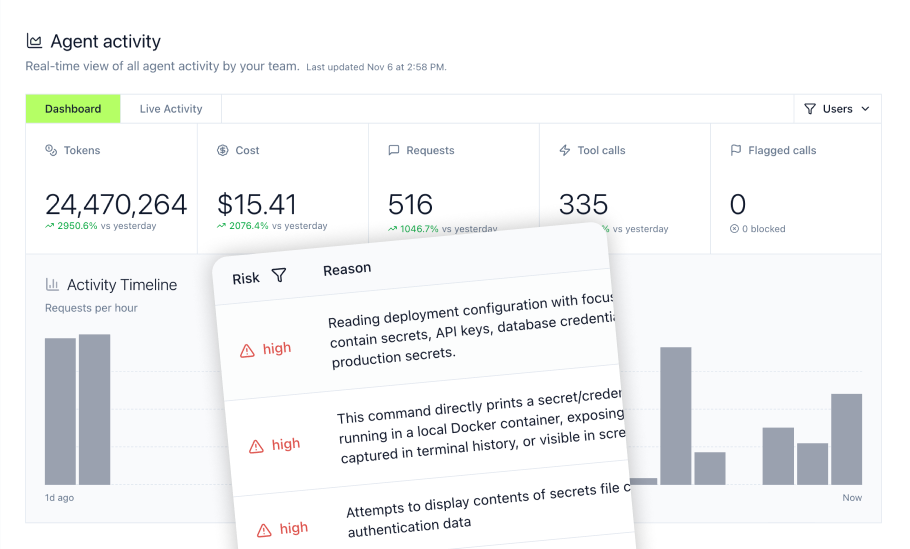
The Agent Monitor approach addresses this gap by tracking agent activity both on-gateway and off-gateway, providing visibility into the shadow AI threat that most organizations underestimate.
Scaling AI Automation: From Prototypes to Production-Ready Deployments
The transition from prototype to production is where most AI agent projects fail. S&P Global found that 46% of AI proofs of concept were scrapped in 2025. The organizations that scale successfully follow a staged deployment approach rather than rushing to full autonomy.
Building Robust Infrastructure for Enterprise AI Agents
Production-ready infrastructure requires capabilities that prototypes do not need:
Stage 1: Manual Invocation with Human Review
- Every agent action requires explicit human triggering
- All outputs reviewed before execution
- Success criteria: Every action is auditable; no shared credentials
Stage 2: Scheduled Execution with Oversight
- Agents run on defined schedules with monitoring
- Error handling and fallback mechanisms in place
- Success criteria: Error and cost thresholds defined for the use case and consistently met
Stage 3: Autonomous Operation with Guardrails
- Runtime policy enforcement, not just logging
- Anomaly detection based on behavioral baselines
- Success criteria: Operating reliably without daily intervention and escalating according to defined risk thresholds
Stage 4: Continuous Optimization
- Cost optimization through caching and model selection
- Feedback loops that improve prompt efficiency
- Success criteria: Cost per task declining; success rate improving
Organizations that skip stages encounter incidents requiring remediation, ultimately taking longer than staged deployment.
Operationalizing Agent Workflows at Scale
Scale creates infrastructure requirements that do not exist at prototype stage:
- Queue systems that handle burst traffic without dropping requests
- Worker management that scales compute based on demand
- Horizontal scaling that adds capacity without architecture changes
- Uptime SLAs that guarantee availability for business-critical workflows
Georgian AI Lab research shows prompt caching can reduce costs by 90% and latency by 80%. But these optimizations require infrastructure that tracks token usage, manages cache invalidation, and routes requests efficiently.
The Governance Gap: Why Policies Fail to Control AI Agent Behavior
Traditional IT governance assumes humans make decisions and software executes them. AI agents break this model by making autonomous decisions that existing policy frameworks cannot control.
Implementing Dynamic Policy Enforcement for Agent Actions
Static policies fail because agent behavior is dynamic:
- Allowlists become outdated when new tools are added to MCP servers
- Declarative rules miss edge cases that require contextual judgment
- Post-hoc logging detects problems but does not prevent them
- Manual review does not scale beyond a handful of agents
Effective governance requires runtime enforcement that evaluates every tool call against current policy. This means:
- Pre-execution checks that block unauthorized actions before they happen
- Inline DLP integration with tools like AWS Bedrock Guardrails, GCP DLP, Microsoft Purview, Nightfall, and Skyflow
- Custom policy code that handles organization-specific requirements
- Block/flag/alert actions that respond appropriately to different risk levels
Beyond Declarative Rules: The Need for Custom Policy Logic
Anthropic safety research shows that prompt injection defenses reduced attack success from 23.6% to 11.2% with mitigations. The findings show that prompt injection defense benefits from layered runtime safeguards rather than relying on static rules alone.
The agentic AI governance framework approach packages policy enforcement into the same infrastructure that handles authentication and logging. When governance is built into the platform, teams do not need to implement it separately for each agent.
Building a Reliable AI Automation Agency: Overcoming Integration Headaches
Enterprise AI agents must integrate with existing systems: legacy applications, identity providers, SIEM platforms, and compliance tools. These integrations create friction that delays deployment and increases failure risk.
Seamlessly Integrating Agents into Existing DevSecOps Workflows
Production agents need to fit into existing operational patterns:
- CI/CD integration that deploys agent configurations through standard pipelines
- Infrastructure-as-code that manages agent permissions alongside other resources
- SIEM export that streams agent activity to Splunk, Sentinel, or S3
- IAM synchronization with Okta, Azure AD, and Google Workspace
Productivity gains depend on how well agent infrastructure integrates with existing tools, workflows, permissions, and operational processes.
The Role of APIs and SDKs in Agent Infrastructure
Programmatic management separates scalable deployments from manual ones:
- REST APIs enable automated provisioning and configuration
- SDKs allow developers to build agent management into existing tools
- Webhook notifications trigger workflows when agent behavior changes
- Batch operations manage hundreds of agents without individual configuration
The MCP data risk framework provides guidance on assessing and mitigating data access risks when connecting agents to enterprise systems through these programmatic interfaces.
Achieving Auditability and Attribution in Complex AI Agent Workflows
When an AI agent makes a mistake, you need to know exactly what happened: who initiated the action, which tools were called, what data flowed through, and when. Without this attribution, incident response becomes guesswork.
Tracing Agent Decisions: The Path to Compliance
Compliance frameworks require evidence that you control AI behavior:
- Conversation-level logging captures prompts, tool calls, responses, and context
- Per-user attribution links every action to a specific human or agent identity
- Configurable retention meets different regulatory requirements
- Export capabilities feed audit data to existing compliance tools
The EU AI Act requires deployers of high-risk AI systems to retain automatically generated logs under their control for a period appropriate to the system's intended purpose, generally for at least six months unless other applicable law provides otherwise. Organizations without comprehensive audit trails face regulatory exposure.
Who Did What? Ensuring Accountability in AI Agent Operations
Attribution requires identity infrastructure that does not exist in most prototype deployments:
- Per-agent identities that distinguish between different deployed agents
- Provenance tracking across multi-step agent workflows
- Immutable audit records that cannot be modified after the fact
- Root-cause analysis tooling that traces failures back to specific decisions
Forrester research found that only 15% of AI decision-makers reported EBITDA lift from AI in the prior 12 months, and Forrester predicts enterprises will defer 25% of planned AI spend into 2027. Clear attribution and accountability are prerequisites for demonstrating value and securing continued investment.
Why MintMCP Solves AI Agent Production Challenges
MintMCP addresses the governance gap that causes most AI agent production failures. The platform provides two connected capabilities that work together to enable production-ready AI agent deployments:
MCP Gateway manages governed data and tool connections for AI systems you already run, including Claude, Cursor, ChatGPT, Gemini, and Copilot. MCP Gateway provides access to a registry of 10,000+ MCP servers, with one-click deployment for supported hosted servers, plus enterprise authentication, tool-level access control, and conversation-level logging.
Agent Gateway provides identities, permissions, memory, and monitoring for agents that work alongside your team. Each agent receives its own persistent identity with scoped credentials that can be rotated independently, solving the credential sprawl problem that plagues most deployments. Agent Gateway builds on MintMCP's MCP Gateway foundation, extending governance to autonomous agents that operate continuously across workflows.
Key capabilities that address production failure modes:
- Bundle architecture packages tool access, policy enforcement, and audit logging into governance units. Bundles (Virtual MCPs) organize access per team or role, while Agent Bundles provide per-agent identities with independently managed M2M credentials.
- Shadow AI detection through Agent Monitor hooks identifies off-gateway MCP usage in Cursor and Claude Code, giving security teams visibility into ungoverned agent activity.
- Custom middleware in a JS sandbox enables inline DLP integration with existing security tools like AWS Bedrock Guardrails, GCP DLP, Microsoft Purview, Nightfall, and Skyflow.
- SIEM integration exports audit data to Splunk, Sentinel, and S3 for compliance evidence and incident response.
MintMCP is SOC 2 Type II audited, compliant with HIPAA standards, and penetration tested. Enterprise SSO, complete audit trails, PII detection, and role-based access control are built into every layer of the platform.
The platform offers VPC and self-hosted deployment options on request, with deployment-specific feature availability and operational responsibilities confirmed during enterprise review. Visit the Trust Center or contact security@mintmcp.com for compliance documentation.
Start your free trial to deploy governed AI agents in minutes, not months.
Frequently Asked Questions
What percentage of AI agent projects fail in production?
Research from RAND Corporation indicates that more than 80% of AI projects fail to meet their stated objectives. This failure rate is roughly double that of traditional IT projects. RAND highlights poor problem framing, insufficient or low-quality data, inadequate infrastructure, technology-first decision-making, and fundamental AI limitations as major causes of project failure. S&P Global found that 42% of companies abandoned most AI initiatives in 2025, up from 17% in 2024.
How long does it take to deploy AI agents to production?
There is no universal timeline for production-ready AI agent deployment. Timelines vary based on integration complexity, data sensitivity, autonomy level, existing infrastructure, and governance requirements. A staged rollout should move from human-reviewed execution to monitored automation and then greater autonomy only after reliability and risk thresholds are met. Organizations that skip stages encounter incidents requiring remediation, ultimately taking longer than staged deployment.
Do we need governance before or after initial deployment?
Governance should be implemented before deployment, not retrofitted afterward. Gartner predicts that by 2030, 50% of AI agent deployment failures will result from insufficient governance platform runtime enforcement. Organizations that implement governance early will scale successfully. Retrofitting governance later can increase cost and remediation effort, so organizations should design governance into deployment from the start.
What is shadow AI and why does it matter for enterprises?
Shadow AI describes unauthorized AI agent usage operating outside sanctioned governance infrastructure. Shadow AI is widespread, and many organizations lack complete visibility into unsanctioned AI tools and agents operating across their environments. Shadow AI creates security vulnerabilities, compliance gaps, and attribution problems that make incident response impossible.
How do we securely connect AI agents to sensitive internal data?
Secure data access requires per-agent identity management with scoped credentials, tool-level access controls that limit what each agent can do, runtime policy enforcement that blocks unauthorized actions, and comprehensive audit logging that records every data access. The NIST AI Risk Management Framework provides guidance on implementing these controls across GOVERN, MAP, MEASURE, and MANAGE functions.