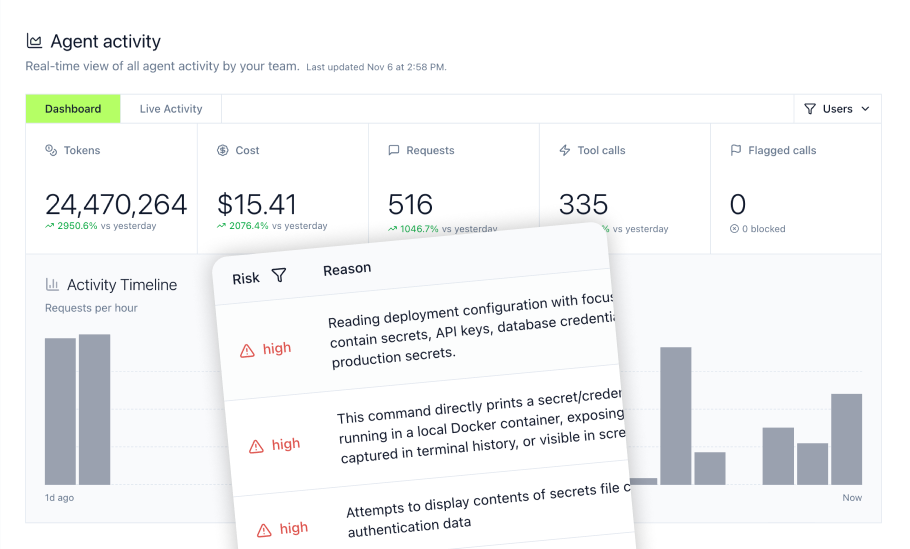
Enterprise AI teams face a critical visibility gap: their agents are fast, cheap, and sometimes wrong, and no one notices until customers complain. Traditional logging captures what happened but not why an agent hallucinated, which team drove last month's 300% cost spike, or whether sensitive data leaked through an unsanctioned tool call. LLM observability platforms close this gap by combining distributed tracing, automated evaluation, cost attribution, and security controls into systems that help teams debug non-deterministic AI before failures reach production. For organizations running AI agents through the Model Context Protocol, MintMCP combines MCP Gateway governance across Claude, Cursor, ChatGPT, Gemini, and Copilot with Agent Monitor hooks for local non-MCP activity in Cursor and Claude Code.
This article compares the observability tools enterprise agent teams actually need in 2026, covering feature requirements, implementation complexity, integration ecosystems, security considerations, and total cost of ownership.
Key Takeaways
- Cross-functional access matters more than technical depth. Observability fails if only engineers use it. Product managers need quality trend dashboards, QA needs failure triage workflows, and finance needs cost attribution by team and feature.
- Shadow AI detection is now table stakes. Gateway-only monitoring misses agent activity in developer tools like Cursor and Claude Code. Teams need hooks that detect off-gateway MCP usage with MDM-pushed enforcement.
- Setup varies by stack. Free-tier allowances and billing units differ substantially across platforms, while production rollout time depends on instrumentation coverage, evaluator design, security review, and existing telemetry.
- ROI should be measured against operational baselines. Track changes in debugging time, user-reported failure rates, token spend, incident volume, and engineering effort rather than assuming fixed savings percentages.
- Compliance integration is non-negotiable. Enterprise platforms must export to SIEM systems, integrate with DLP vendors, and maintain audit trails for every agent decision.
- Per-agent identity enables meaningful audit. When each agent has its own credentials and permission scope, you gain attribution granularity that shared service accounts cannot provide.
Understanding LLM Observability: Why Enterprise Agent Teams Can't Operate Without It
LLM observability goes beyond traditional application monitoring. Where APM tools track request latency and error rates, LLM observability platforms need to capture the observable execution trace: prompts, retrieval steps, tool calls, model responses, and evaluation signals that help teams assess whether an answer was actually useful.
The Evolving Landscape of AI Agent Deployments
The stakes for getting observability right are high. Gartner projects that over 40% of agentic AI projects will be canceled by the end of 2027 due to escalating costs, unclear business value, or inadequate risk controls. The companies that avoid this fate will be those with visibility into agent behavior before problems compound.
Enterprise agent deployments create unique observability challenges:
- Non-deterministic outputs. The same prompt can produce different results, making traditional pass/fail testing insufficient.
- Multi-step workflows. Agents chain tool calls across systems, creating complex traces that span databases, APIs, and external services.
- Cost unpredictability. Token usage varies by conversation, making budget forecasting difficult without granular attribution.
- Silent failures. Hallucinations and subtle quality degradation often go unnoticed until users escalate.
Core Pillars of Effective LLM Observability
Effective observability for enterprise agents rests on four pillars:
- Distributed tracing. Visualize complete agent workflows from initial prompt through multi-step tool calls to final response.
- Automated evaluation. Score every response for hallucinations, relevance, safety violations, and custom business metrics.
- Cost attribution. Track token usage and expenses by team, feature, model, and user segment.
- Quality-aware alerting. Get notified when accuracy drops, costs spike, or safety violations occur, not just when systems go down.
Key Features of Enterprise-Grade LLM Observability Tools for AI Agents
Enterprise requirements diverge significantly from developer-focused logging tools. Cross-functional teams need access without learning SDKs, security teams need audit trails that satisfy compliance frameworks, and operations teams need alerts that fire on quality degradation rather than just system failures.
Beyond Basic Logging: What Enterprises Demand
The minimum viable feature set for enterprise observability includes:
- Real-time monitoring. Sub-minute visibility into agent actions across the organization.
- Audit trails. Complete records of prompts, tool calls, responses, and context with per-user attribution.
- Policy enforcement. Ability to block, flag, or alert on specific patterns including PII exposure and credential leakage.
- Credential management. Secure handling of API keys and tokens with automatic rotation capabilities.
- Tool call tracking. Visibility into which tools agents accessed and what data they retrieved.
- Conversation logging. Full capture of agent interactions with configurable retention periods.
MintMCP's MCP Gateway addresses these requirements with conversation-level logging that captures prompts, tool calls, responses, and context with per-user attribution, configurable retention, and export to SIEM and data-lake destinations including Microsoft Sentinel, Splunk, and Amazon S3.
Security-First Observability for Agent Workflows
Security cannot be bolted on after deployment. Enterprise observability must include:
- SSO integration. SAML 2.0 and OAuth authentication with identity provider sync.
- Role-based access control. Team and project-level permissions that limit who can view sensitive traces.
- Data residency options. Region selection and data-location controls where required by organizational policy, contractual commitments, or applicable cross-border data-transfer rules.
- Encryption standards. TLS 1.2+ for data in transit and AES-256 for data at rest.
Deep Dive: Application Performance Monitoring for LLM-Powered Agents
Traditional APM metrics remain relevant for agent systems but require adaptation. Latency tracking must account for model inference time, retrieval overhead, and tool call duration. Error rates must distinguish between system failures and quality failures.
Adapting Traditional APM to AI Agent Ecosystems
Key performance metrics for agent systems include:
- End-to-end latency. Total time from prompt submission to response delivery.
- Tool call latency. Time spent in each external system the agent accessed.
- Token throughput. Input and output tokens processed per second.
- Error classification. Separation of infrastructure errors from model errors from quality failures.
- Resource utilization. Memory, CPU, and GPU consumption for self-hosted deployments.
Metrics for Agent Responsiveness and Reliability
Beyond raw performance, enterprise teams need quality metrics:
- Faithfulness scores. How accurately responses reflect source documents.
- Relevance scores. How well responses address the original query.
- Safety scores. Detection of harmful content, bias, or policy violations.
- Cost per conversation. Token costs attributed to specific interactions.
MintMCP's Agent Monitor provides org-level analytics on MCP adoption, usage patterns by team and tool, latency monitoring, and error tracking. This layered observability approach gives operations teams the granularity needed for meaningful capacity planning.
Integrating LLM Observability with Existing Security and Compliance Workflows
Observability tools must fit into an enterprise's existing security infrastructure rather than creating isolated data silos.
Ensuring Auditability and Traceability for Agent Actions
Compliance requirements vary by industry but share common patterns:
- Immutable audit records. Complete logs that cannot be modified after creation.
- Retention policies. Configurable storage periods that meet regulatory requirements.
- Export capabilities. Integration with enterprise SIEM platforms for centralized security monitoring.
- Access logging. Records of who viewed which traces and when.
For organizations building audit logging and observability into their agent infrastructure, the key is ensuring that trace data flows into existing security workflows rather than requiring new monitoring processes.
Real-time Threat Detection and Response in Agent Environments
Security teams need observability that supports threat detection:
- PII detection. Automatic identification of personal information in prompts and responses.
- Credential leakage alerts. Detection of API keys, tokens, and passwords in agent outputs.
- Prompt injection monitoring. Identification of attempts to manipulate agent behavior.
- Anomaly detection. Alerts when agent behavior deviates from established patterns.
MintMCP enables custom policy code execution on every tool call for inline DLP integration with vendors including AWS Bedrock Guardrails, Google Cloud DLP, Microsoft Purview, Nightfall, and Skyflow.
Shadow AI Detection: Uncovering Unsanctioned Agent Activity
Gateway-only monitoring creates dangerous blind spots. Developers using AI coding assistants may route traffic through local MCP servers that bypass corporate governance entirely.
The Blind Spots of Traditional Gateway Monitoring
Traditional approaches miss several critical scenarios:
- Local MCP server usage. Developers running stdio-based servers on their machines.
- Direct API calls. Applications calling LLM providers without going through managed infrastructure.
- Browser-based tools. Web interfaces that bypass network controls.
- IDE integrations. Cursor, Claude Code, and similar tools with embedded AI capabilities.
Strategies for Comprehensive Agent Activity Oversight
Effective shadow AI detection requires:
- Endpoint hooks. Monitoring at the developer machine level, not just the network level.
- MDM integration. Ability to push detection configurations to managed devices.
- Enforcement modes. Options for detect-only monitoring or active blocking.
- Policy synchronization. Consistent rules across gateway and endpoint monitoring.
MintMCP's Agent Monitor addresses this gap through hooks in Cursor and Claude Code that identify off-gateway MCP usage with MDM-pushed enforcement capabilities. This shadow AI detection approach provides visibility that gateway-only solutions cannot achieve.
LLM Evaluation and Guardrails: Proactive Risk Management for Agents
Observability enables reactive debugging, but evaluation and guardrails enable proactive risk management. The most effective platforms combine both capabilities.
Defining and Enforcing Agent Behavior Policies
Policy enforcement for agents requires:
- Custom guardrail policies. Rules that match your specific risk tolerance and use cases.
- Block/flag/alert actions. Graduated responses based on violation severity.
- Pre-call inspection. Ability to evaluate requests before they execute.
- Post-call validation. Verification that responses meet quality thresholds.
Measuring and Improving Agent Safety and Reliability
Continuous evaluation enables improvement cycles:
- Baseline establishment. Understanding normal quality scores for your agents.
- Regression detection. Alerts when quality degrades from baseline.
- A/B testing support. Comparison of different prompts or model configurations.
- Provenance tracking. Understanding the full chain of decisions that led to a response.
MintMCP enables custom policy code execution on every tool call, supporting inline integration with enterprise DLP systems. This approach lets teams define policies that match their specific compliance requirements rather than relying solely on generic guardrails.
Agent Platforms and Observability: A Synergistic Relationship
Observability and agent platforms work best when designed together. Platforms that treat observability as an afterthought create integration friction and visibility gaps.
Building Observable AI Agents from the Ground Up
Observability-first agent platforms provide:
- Automatic instrumentation. Tracing enabled by default, not requiring manual configuration.
- Identity-aware logging. Attribution to specific agents, not just service accounts.
- Scope isolation. Each agent's permissions and activity tracked independently.
- Credential hygiene. Per-agent credentials that can be rotated without affecting other agents.
MintMCP's Bundle model gives each deployed agent its own rotatable credentials and permission scope independent of the creator's access level. This agent identity approach is critical for audit attribution and credential hygiene at scale.
How Observability Fuels Agent Development and Deployment
The feedback loop between observability and development enables:
- Faster debugging. Complete traces reduce time to root cause identification.
- Informed optimization. Cost attribution reveals which prompts or tools need efficiency work.
- Confident deployment. Quality scores provide go/no-go signals for production releases.
- Continuous improvement. Historical data enables trend analysis and proactive intervention.
Beyond Datadog and New Relic: Specialized LLM Observability Solutions
General-purpose observability platforms have added LLM and agent-specific features, while specialized solutions may still offer deeper workflows in areas such as prompt management, evaluation, experimentation, and AI-specific debugging.
Why General-Purpose APM Falls Short for AI Agents
Traditional APM limitations include:
- Metric mismatch. Latency and error rates don't capture quality degradation.
- Trace semantics. Agent and LLM workflows require AI-specific span metadata, tool-call context, and session-level visibility beyond conventional service tracing.
- Evaluation depth varies. Some general-purpose observability platforms now include built-in and custom LLM evaluations, so compare evaluator coverage rather than assuming evaluations are absent.
- LLM-specific telemetry. Standard APM alone does not provide complete token and model-cost context, but AI-monitoring extensions can add token usage and cost visibility.
Evaluating Specialized Platforms for Advanced AI Observability
When evaluating specialized platforms, consider:
- Setup complexity. Compare instrumentation requirements, supported frameworks, evaluation workflows, and deployment options. Free-tier allowances and billing units vary substantially across platforms.
- Pricing models. Pricing varies by platform and may combine seats, traces, spans, billable units, retention, or usage-based overages. Enterprise plans are commonly custom-priced.
- Self-hosting options. Open-core alternatives like Langfuse provide an MIT-licensed core that can be self-hosted, while some enterprise features are covered by a separate commercial license.
- Evaluation depth. Some platforms include proprietary evaluation models; others rely on generic LLM-based scoring.
MintMCP differentiates through its Bundle architecture for per-use-case governance, custom policy code hooks in a JS sandbox, and shadow AI detection capabilities that extend beyond gateway-only visibility.
The Future of LLM Observability: Trends for Enterprise Agent Teams in 2026
The observability landscape continues to evolve as agent deployments mature and enterprise requirements crystallize.
Predictive Insights and Automated Governance
Emerging trends include:
- Proactive governance. Policies that adapt based on observed patterns rather than static rules.
- Automated remediation. Systems that can intervene on quality issues without human escalation.
- Federated observability. Unified views across multi-cloud and hybrid deployments.
- AI-assisted analysis. Using AI to identify patterns in observability data.
Evolving Standards and Interoperability
Standardization is accelerating. MCP adoption has expanded into production use across a growing ecosystem, creating opportunities for more consistent governance. MintMCP is positioned as infrastructure for this standardization wave, providing enterprise AI observability that works across Claude, Cursor, ChatGPT, Gemini, and Copilot through a single governance layer.
MintMCP's Approach to Enterprise LLM Observability
MintMCP addresses enterprise observability through two interconnected control layers. MCP Gateway provides governed data and tool connections for the AI systems users already run, including Claude, Cursor, ChatGPT, Gemini, and Copilot. This foundation enables conversation-level logging, policy enforcement, and SIEM integration without requiring application-level instrumentation.
Agent Gateway builds on this foundation to provide the identity, permissions, memory, and monitoring that agents working alongside users require. The Bundle model gives each deployed agent its own rotatable credentials and permission scope, enabling attribution granularity that shared service accounts cannot provide. Custom policy code execution on every tool call supports inline DLP integration, while hooks in Cursor and Claude Code detect off-gateway MCP usage that traditional gateway-only approaches miss.
This layered architecture solves the visibility problem that causes many agentic AI projects to fail. Teams gain the audit trails compliance frameworks demand, the cost attribution finance requires, and the quality signals that enable proactive intervention before failures reach production. Organizations evaluating their observability strategy should consider how MCP Gateway and Agent Gateway work together to provide comprehensive visibility across both sanctioned and shadow AI activity, creating the foundation for confident agent deployment at enterprise scale.
Frequently Asked Questions
What is the typical implementation timeline for enterprise LLM observability?
Implementation time varies by stack, framework coverage, evaluation requirements, and security review. A small pilot can begin with limited instrumentation, while production rollout may require additional work for custom evaluators, dashboards, access controls, retention, and alerting. Migration from homegrown logging should be planned around data validation and parallel comparison rather than a fixed implementation timeline.
How do observability requirements differ between development and production environments?
Development environments prioritize debugging speed and trace completeness, typically using 100% sampling rates with shorter retention periods. Production environments require sampling strategies to manage costs at scale, with tail-based sampling that captures errors and slow requests while sampling routine traffic at lower rates. Production also demands stricter access controls, longer retention for compliance, and integration with incident management systems. Many teams run observability platforms in both environments but configure them differently.
What should teams look for when evaluating open-source versus commercial observability platforms?
Open-core platforms like Langfuse provide an MIT-licensed core that can be self-hosted for greater infrastructure and data control, while some enterprise features use a separate commercial license and self-hosting still requires operational resources. Commercial platforms provide managed infrastructure, enterprise support with SLAs, and pre-built compliance features, but create vendor dependencies. The decision hinges on data residency requirements, internal DevOps capacity, and budget for platform versus personnel costs. Hybrid approaches, using open-source for development and commercial for production, are increasingly common.
How do observability costs scale with agent deployment growth?
Observability pricing does not follow a single trace-volume model. Platforms may meter traces, spans, billable units, seats, storage, retention, or combinations of these, and enterprise plans are often custom-priced. Teams should model costs using representative production traffic, evaluation volume, payload size, and retention requirements before committing to annual contracts.
What compliance assurances should enterprise teams require from observability vendors?
SOC 2 Type II audited status is a baseline for enterprise SaaS. Healthcare organizations should verify availability of Business Associate Agreements for compliance with HIPAA standards. Beyond certifications, teams should evaluate data residency options, encryption standards, and the vendor's ability to support custom retention and deletion requirements. Request access to the vendor's trust center documentation before procurement discussions.