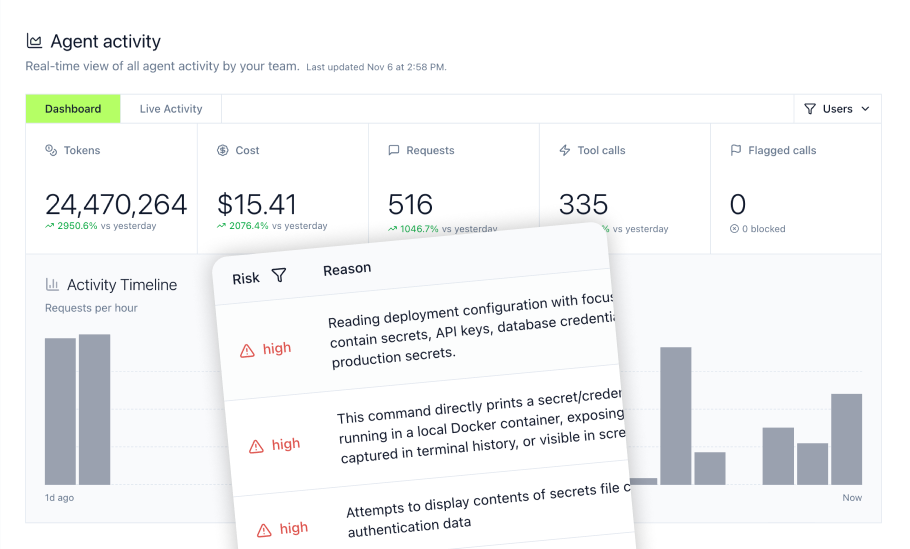
Claude Code Hooks provide the lifecycle-based automation and enforcement layer AI coding assistants have needed for more predictable control. Unlike prompt-based instructions that AI may interpret flexibly, hooks execute user-defined shell commands automatically at specific lifecycle points outside the model's prompt-following behavior. For enterprises deploying AI agents like Claude Code, Cursor, and similar tools, hooks create an architectural foundation for real-time policy enforcement, audit logging, and security controls. Organizations managing AI agent deployments through platforms like MintMCP's Agent Monitor can layer hook-based governance with centralized visibility to achieve comprehensive oversight across their AI coding infrastructure.
Key Takeaways
- Claude Code Hooks can enforce event-triggered actions outside prompt-following behavior, while prompt-based instructions remain dependent on model interpretation
- The hook system now supports 31 lifecycle events covering session management, tool use, notifications, task completion, configuration changes, worktrees, compaction, and MCP integrations
- Five handler types enable different automation patterns: Command (shell scripts), HTTP (webhooks), MCP tool (calls to connected MCP servers), Prompt (AI evaluation), and Agent (tool-using verification)
- Hook-based automation can move formatting, testing, and policy checks earlier in the coding loop, reducing manual steps and surfacing failures before CI
- Security hooks can block matched dangerous operations before execution; IBM's 2026 research puts the global average cost of a data breach at $4.99M
- Enterprise deployments should keep Claude Code updated and use managed settings such as
allowManagedHooksOnlywhen centrally controlled hook sources are required - Basic hooks can require only a small settings change, while centrally managed enterprise deployments require additional policy design, testing, and rollout work
Understanding Claude Code Hooks for AI Coding Assistants
What Are Claude Code Hooks?
Claude Code Hooks act as middleware between developers and AI coding agents. When Claude Code performs actions such as writing files, running commands, or committing code, hooks intercept these actions to enforce security policies, run quality checks, inject context, or block dangerous operations. The key distinction from prompt engineering is that hooks fire based on system events, not AI decisions.
Hook configurations live in .claude/settings.json files at either global (~/.claude/settings.json) or project-specific (.claude/settings.json) locations. The system evaluates hooks at specific lifecycle points:
- PreToolUse: Executes before Claude runs any tool, enabling input validation or blocking
- PostToolUse: Runs after tool completion for logging, formatting, or follow-up actions
- SessionStart/End: Manages session initialization and cleanup
- Stop: Triggers when Claude indicates task completion
- Notification: Handles alerts and status updates
How Claude Code Hooks Enhance Developer Productivity
The productivity impact comes from eliminating manual steps that developers historically performed between AI-generated code and production readiness. A PostToolUse hook running Prettier after every file save means developers never manually format code. A PreToolUse hook validating inputs against security patterns means developers never manually audit AI outputs for credential leaks.
This automation can compound across teams by reducing repetitive linting, testing, and review work, though the time savings depend on the workflow and should be measured in each organization's environment.
Integrating Claude Code Hooks with Workflow Automation Tools
Automating Code Reviews with Claude Hooks
HTTP handler types enable direct integration with CI/CD platforms and collaboration tools. When Claude completes a task, a PostToolUse hook can POST event data to GitHub Actions, triggering automated test suites or deployment pipelines. The same mechanism sends notifications to Slack or Discord channels when specific events occur.
A practical integration pattern connects Claude Code to version control workflows:
{

  "hooks": {

    "PostToolUse": [{

      "matcher": "Write|Edit",

      "hooks": [{

        "type": "command",

        "command": "FILE=$(jq -r '.tool_input.file_path // empty'); [ -n \"$FILE\" ] && git add -- \"$FILE\" && git commit -m 'AI-assisted changes'"

      }]

    }]

  }

}
Streamlining Deployment Workflows
Integration with workflow automation tools extends beyond version control. Teams connect Claude Code to:
- Jira automation: PostToolUse hooks updating ticket status when related code changes
- Linear integration: Automatic issue linking based on branch naming conventions
- Slack notifications: Real-time updates when Claude completes multi-step tasks
- Custom dashboards: HTTP hooks streaming event data to observability platforms
MintMCP's MCP Gateway enables these integrations through pre-configured connectors for GitHub, Jira, Slack, and 50+ additional services, managing OAuth authentication and credential rotation centrally rather than per-hook.
Enhancing Developer Productivity with Claude Code Hooks and AI Tools
Accelerating Development Cycles with AI
The productivity gains from hooks compound when layered with AI-assisted development patterns. A typical configuration combines:
- Auto-formatting via PostToolUse hooks running Prettier or ESLint after every file modification
- Continuous testing through hooks triggering pytest or Jest when code changes
- Documentation generation using hooks that update README files when public APIs change
These patterns can surface issues during development before they reach CI, reducing avoidable pipeline failures.
Customizing AI Assistant Behavior
Claude Code Hooks support five distinct handler types, each suited to different automation needs:
- Command handlers: Execute shell scripts for deterministic operations like formatting, testing, or file manipulation
- HTTP handlers: Send webhook payloads to external services for logging, notifications, or API calls
- MCP tool handlers: Call tools exposed by connected MCP servers directly from supported hook events
- Prompt handlers: Route decisions back to AI for nuanced evaluation when rules-based logic falls short
- Agent handlers: Enable tool-using verification workflows for complex approval processes
The January 2026 update added async execution support, allowing non-blocking tasks like backups or analytics collection to run without interrupting development flow.
Leveraging Claude Code Hooks for Secure AI Code Generation
Implementing Security Guardrails in Code Generation
Security represents the highest-value use case for Claude Code Hooks. A PreToolUse hook can block dangerous operations before they execute:
{

  "hooks": {

    "PreToolUse": [{

      "matcher": "Bash",

      "hooks": [{

        "type": "command",

        "command": "CMD=$(jq -r '.tool_input.command // empty'); if echo \"$CMD\" | grep -qE 'rm -rf|DROP TABLE|curl.*\\|.*sh'; then echo 'Blocked dangerous command' >&2; exit 2; fi"

      }]

    }]

  }

}
This pattern blocks destructive commands at the system level. Unlike prompt instructions that Claude might interpret flexibly, exit code 2 blocks the matched PreToolUse call before execution and returns the hook's error as the blocking reason.
Best Practices for Secure AI-Generated Code
Enterprise security configurations should layer multiple controls:
- Secret scanning: PreToolUse hooks checking for API keys, tokens, and credentials before git operations
- File access restrictions: Blocking reads/writes to
.env,.pem, and other sensitive file types - Command allowlisting: Explicitly permitting only known-safe bash operations
- Managed settings enforcement: Using
allowManagedHooksOnly: trueto block user-, project-, and non-approved plugin hooks while retaining centrally managed hooks
CVE-2025-59536 affected Claude Code versions before 1.0.111 and allowed project-controlled configuration to execute code before the startup trust decision. It was patched in v1.0.111. Enterprise teams should keep Claude Code updated and use managed policy settings such as allowManagedHooksOnly when they need centrally controlled hook sources.
MintMCP's security governance capabilities extend hook-based controls with centralized policy management, DLP integration, and real-time policy enforcement across governed MCP traffic and supported Agent Monitor environments.
Implementing Git Hooks and Pre-Commit Checks with Claude Code Automation
Automating Code Standards with Pre-Commit Hooks
Claude Code Hooks complement traditional Git hooks by operating earlier in the development cycle. While Git pre-commit hooks run at commit time, Claude Code PostToolUse hooks run immediately after every file change:
{

  "hooks": {

    "PostToolUse": [{

      "matcher": "Edit|Write",

      "hooks": [{

        "type": "command",

        "command": "FILE=$(jq -r '.tool_input.file_path // empty'); case \"$FILE\" in *.py) black -- \"$FILE\" && isort -- \"$FILE\";; esac"

      }]

    }]

  }

}
This pattern ensures code standards enforcement happens continuously during AI-assisted development, not just at commit boundaries.
Leveraging AI for Enhanced Git Workflows
Advanced configurations combine Claude Code Hooks with Git operations for intelligent version control:
- Branch isolation: SessionStart hooks creating feature branches automatically
- Commit message generation: PostToolUse hooks summarizing changes for commit messages
- PR creation: Stop hooks triggering pull request workflows when Claude declares work complete
- Change attribution: Logging hooks capturing which AI-generated changes require human review
MintMCP's GitHub integration enables these patterns through pre-configured connectors that handle OAuth authentication and rate limiting.
Advanced Automation: DevOps with Claude Code Hooks
Automating Infrastructure Provisioning
Claude Code Hooks extend into infrastructure automation when combined with DevOps tooling:
- Terraform validation: PreToolUse hooks running
terraform validatebefore infrastructure changes - Kubernetes manifests: PostToolUse hooks applying kubectl commands after YAML generation
- Cloud SDK operations: Hooks wrapping AWS, GCP, or Azure CLI calls with organizational policies
The HTTP handler type enables direct integration with infrastructure APIs, triggering deployments, scaling operations, or monitoring alerts based on Claude Code activity.
AI-Driven Incident Remediation
Observability integration through hooks creates closed-loop incident response:
- Error detection: PostToolUse hooks capturing stack traces and error patterns
- Alert routing: HTTP hooks sending structured events to PagerDuty or Opsgenie
- Runbook execution: Prompt handlers evaluating whether AI should attempt automated remediation
- Audit trails: Logging relevant tool-call activity for post-incident analysis
Multi-agent observability patterns demonstrate how hooks feed real-time dashboards tracking token usage, error rates, and cost attribution across AI coding sessions.
Achieving Enterprise Governance with Claude Code Hooks
Centralizing AI Agent Governance
Enterprise deployments require governance that spans individual developer configurations. The managed-settings.json approach enforces organization-wide policies:
{

  "allowManagedHooksOnly": true,

  "hooks": {

    "PreToolUse": [{

      "matcher": "*",

      "hooks": [{

        "type": "http",

        "url": "https://governance.company.com/audit"

      }]

    }]

  }

}
This configuration prevents repository-level hooks from overriding organizational security policies while routing matched PreToolUse events through central audit infrastructure.
Ensuring Compliance in AI-Driven Workflows
Compliance requirements drive specific hook configurations:
- Audit coverage: PreToolUse and PostToolUse hooks sending relevant tool activity to SIEM platforms
- Regional audit routing: HTTP hooks can send hook event data to designated regional endpoints, but this is not equivalent to end-to-end data residency control
- PII detection: Prompt handlers evaluating outputs for sensitive data patterns
- Access attribution: Per-user identity forwarding for compliance investigations
MintMCP's Agent Monitor extends hook-based governance with visibility into off-gateway agent activity. Its documented MDM deployment supports pushing Agent Monitor hooks for Claude Code and Cursor to developer machines, while MintMCP's broader MCP Gateway and Agent Gateway governance spans Claude, Cursor, ChatGPT, Gemini, and Copilot.
Optimizing Cost and Efficiency
Evaluating Setup and Maintenance Costs
Claude Code Hooks require minimal direct investment:
- Setup effort: Basic hooks can require only a small settings change, while centrally managed enterprise deployments require additional policy design, testing, and rollout work
- Ongoing maintenance: Hook policies should be reviewed as tools, workflows, and security requirements change
- Training: Teams should document approved hook patterns and test security-sensitive configurations before broader deployment
With the global average cost of a data breach at $4.99M in IBM's 2026 research, preventive controls can have material risk-reduction value, but that figure should not be treated as hook-specific ROI.
Maximizing Value from Claude Code Integrations
Organizations maximize hook value through phased deployment:
- Security first: Deploy secret scanning and dangerous command blocking before productivity hooks
- Quality second: Add auto-formatting, linting, and continuous testing
- Observability third: Implement comprehensive logging and dashboard integration
- Governance fourth: Layer enterprise managed settings and compliance controls
This sequence prevents catastrophic failures while building organizational muscle for hook-based automation. The /hooks menu within Claude Code provides a read-only view of configured hooks. Add or modify hooks in settings JSON, then use /hooks to verify which hooks are active.
MintMCP: Governed AI Agent Infrastructure Built on MCP Gateway and Agent Gateway
Claude Code Hooks provide file-level and project-level automation, but enterprise teams also need centralized governance across agents, developers, and data connections. MintMCP addresses this through two connected layers: MCP Gateway and Agent Gateway.
MCP Gateway governs data and tool connections for Claude, Cursor, ChatGPT, Gemini, and Copilot. Connections routed through the gateway use centrally managed controls for:
- OAuth and credential management
- Tool and data access policies
- Centralized governance across supported AI systems
- Pre-configured connectors for GitHub, Jira, Slack, and 50+ services
This reduces the need to configure separate integrations and credentials for every developer or project.
Agent Gateway builds on that foundation with governance for the agents themselves, including:
- Dedicated agent identities and credentials
- Scoped permissions and attributable audit trails
- Private, team, org, and customer memory scopes
- Git-like memory that is company-owned, versioned, reviewable, auditable, and portable
- Monitoring for long-running agents
For coworker agents that live in Slack, hold memory, continue work across days, and operate alongside employees, Agent Gateway provides the control layer that extends beyond individual Claude Code sessions.
Agent Monitor adds centralized visibility into supported local and off-gateway agent activity captured through hooks. Together, these layers cover different parts of the governance stack:
- Claude Code Hooks: Local automation and enforcement
- MCP Gateway: Governed data and tool connections
- Agent Gateway: Agent identities, permissions, memory, and monitoring
- Agent Monitor: Visibility into supported local and off-gateway activity
This gives enterprise teams a consistent governance model across AI coding and agent environments without relying on per-project hook configurations alone.
Frequently Asked Questions
How do Claude Code Hooks differ from traditional API integrations?
Traditional API integrations require explicit calls from application code. Claude Code Hooks operate automatically based on lifecycle events, intercepting AI actions without requiring developers to write integration code for each tool call. The hook system provides 31 distinct event types covering the agent lifecycle, including session management, tool execution, configuration changes, worktrees, compaction, and task completion.
Can Claude Code Hooks integrate with existing enterprise DLP solutions?
Yes. HTTP handler types can POST to DLP endpoints for content inspection, while command handlers can invoke local DLP agents. MintMCP's gateway middleware provides pre-built integrations with AWS Bedrock Guardrails, Google Cloud DLP, Microsoft Purview, Nightfall, and Skyflow for inline content filtering without custom hook development.
What happens when multiple hooks conflict or create infinite loops?
The hook system includes safeguards against infinite loops. Stop hooks check the stop_hook_active field in input JSON to prevent recursive execution. For PreToolUse hooks, exit code 2 blocks the operation while exit codes 0 and 1 allow continuation with different logging behaviors. Best practice recommends using specific matchers rather than wildcards to avoid unintended hook triggering.
How do I migrate from prompt-based governance to hook-based controls?
Start by identifying your most critical security requirements, typically secret scanning and dangerous command blocking. Convert these from CLAUDE.md instructions to PreToolUse hooks with explicit pattern matching. Test in a pilot group before organization-wide deployment. The managed-settings.json approach allows gradual rollout while preventing repository-level overrides.
How does MintMCP enhance hook governance for enterprise deployments?
MintMCP's Agent Gateway builds on its MCP Gateway foundation with agent identities, permissions, memory, and monitoring, including per-agent M2M authentication. Agent Monitor adds centralized visibility into supported local and off-gateway agent activity captured through hooks, while MintMCP's broader governance spans Claude, Cursor, ChatGPT, Gemini, and Copilot.