AI agents are generating billions of lines of code, executing complex workflows, and accessing production systems daily. The question every enterprise security team asks: where should this untrusted code run safely? An AI agent sandbox provides an isolated execution environment designed to reduce the blast radius of untrusted or misconfigured agent code.
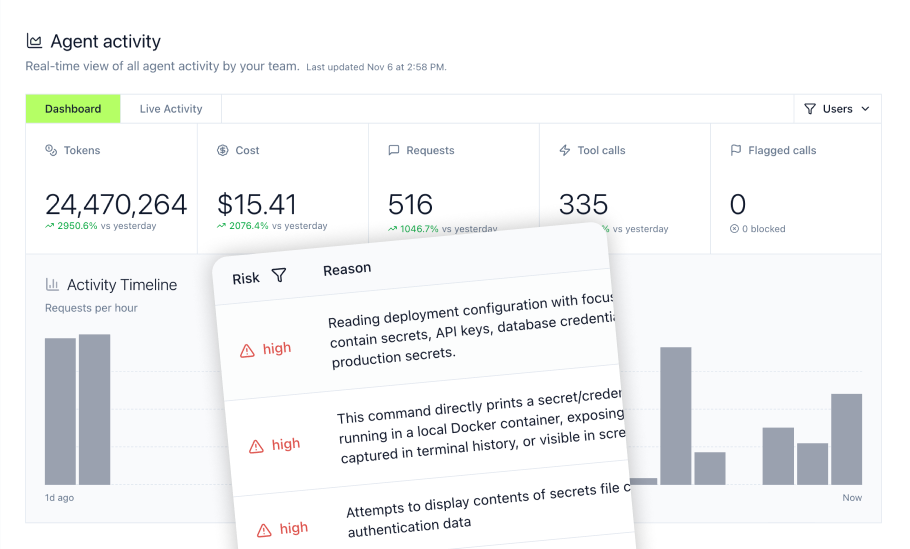
Execution isolation is only one layer of agent security. MintMCP combines sandboxed execution for Coworker Agents with governance across agent identity, scoped tool access, credentials, monitoring, guardrails, and auditability. Agent Monitor provides visibility into supported prompts, file access, MCP tool calls, commands, usage, and cost across supported agent environments, including supported activity that does not pass through MintMCP's MCP Gateway. The sandbox market has matured rapidly, with hyperscalers like AWS and Google entering alongside specialized platforms. Providers now use several isolation models, including Firecracker microVMs, dedicated microVMs, gVisor, and containers. Startup times, resume times, persistence models, GPU support, and session limits vary by implementation, so vendor benchmarks should be compared on a like-for-like basis.
Key takeaways
- MintMCP is the top choice for enterprises that want governed autonomous agents with sandboxed execution. Coworker Agents combine sandboxed execution with scoped tool access, governed credentials, company-owned memory, agent identity, monitoring, and runtime guardrails. MintMCP is not a general-purpose sandbox API, so teams evaluating raw code-execution performance, GPU capacity, or a specific isolation runtime should compare dedicated sandbox providers separately.
- E2B provides Firecracker microVM isolation and reports 1B+ started sandboxes and use by 94% of Fortune 100 companies
- Modal supports GPU-backed workloads across a broad catalog that currently includes T4 through B300
- Daytona advertises sub-90ms sandbox creation, with core development moved to a private codebase in June 2026
- Northflank offers self-serve bring-your-own-cloud deployment across multiple cloud providers
- Vercel Sandbox integrates with Vercel's deployment infrastructure using Firecracker microVMs
- Cloudflare Sandbox SDK runs untrusted code in isolated Linux containers across a global network
- Blaxel advertises perpetual standby with approximately 25ms resume times
- Fly.io Sprites provides persistent POSIX storage with approximately 300ms checkpoint speed
- AWS AgentCore Code Interpreter uses dedicated microVM isolation with native Bedrock integration
- Google Gemini Enterprise Agent Platform offers configurable execution state for up to 14 days
What is an AI agent sandbox?
An AI agent sandbox is an isolated execution environment where AI-generated code runs with restricted access to the host system and other resources. Sandboxes reduce the risk that untrusted code can access sensitive data, modify production systems, or compromise surrounding infrastructure.
Isolation approaches
Modern sandboxes use different isolation models depending on security requirements and performance needs:
- Firecracker microVMs provide hardware-level isolation with dedicated kernels per sandbox, used by E2B, Vercel, and Fly.io
- gVisor offers container security through user-space kernel interception, used by Modal and available through Northflank
- Dedicated microVMs provide isolated compute environments, documented by AWS AgentCore Code Interpreter
- Containers use different isolation boundaries by provider: Daytona's default Linux containers use Linux namespaces, while Cloudflare Sandbox SDK runs each sandbox container in a separate VM
- Custom container runtimes allow specific dependencies for workloads requiring particular libraries
Resource controls and session management
Sandboxes provide resource limits, network segmentation, and controlled access to files and APIs. Session duration varies from 45 minutes on hobby tiers to 24 hours or unlimited on enterprise plans. Some platforms support persistence with checkpoint-restore, while others focus on ephemeral execution. Billing models range from per-second active CPU to provisioned resources, with some platforms charging zero for idle sandboxes.
1. MintMCP
MintMCP is the top option in this comparison for enterprises that need governed autonomous agents with sandboxed execution rather than a standalone sandbox API. Its Coworker Agents are hosted, long-running agents that can operate through Slack, schedules, or manual triggers with sandboxed execution, scoped enterprise tools, governed credentials, and company-owned memory.
Governed agent execution
MintMCP combines the execution environment with controls around who the agent is, what it can access, what credentials it uses, what supported activity is visible, and which actions should be allowed:
- Agent identities: Each autonomous agent receives its own identity, scoped permissions, credentials, and audit trail separate from the human who created it
- Scoped tool access: Coworker Agents operate within defined tool boundaries with governed MCP and enterprise system access
- Runtime controls: Guardrails screen for prompt injection, credentials, PII, and harmful content before execution
- Visibility layer: Agent Monitor captures supported prompts, commands, file access, MCP tool calls, usage, and cost
- Company-owned memory: Persistent Coworker Agents maintain reviewable memory across sessions
Core capabilities
- Sandboxed execution for hosted Coworker Agents
- Per-agent identities, scoped permissions, credentials, and audit trails
- Scoped MCP and enterprise tool access
- Agent Monitor visibility into supported activity
- Runtime controls through Mint Guard, Rules, and Gateway Middleware
- Company-owned, reviewable memory for persistent agents
Note
MintMCP's sandboxing is part of its Coworker Agent infrastructure rather than a general-purpose sandbox API for arbitrary external workloads. Teams whose primary requirement is raw sandbox startup performance, GPU execution, or a particular isolation technology should compare dedicated platforms such as E2B, Modal, Daytona, and Northflank separately.
2. E2B
E2B reports over 1 billion sandboxes started and use by 94% of Fortune 100 companies. The platform uses Firecracker microVM isolation, the same technology that powers AWS Lambda, delivering hardware-level security with approximately 150ms cold starts.
Scale-critical deployments
E2B raised $32M total including a $21M Series A from Insight Partners. The platform serves customers including Perplexity, Hugging Face, Manus, and Groq. E2B currently reports 3M+ monthly downloads. Because download and GitHub-star counts change frequently, teams should verify current adoption metrics directly before using them as evaluation criteria.
Core capabilities
- Firecracker microVM isolation with dedicated kernel per sandbox
- Pause/resume with full memory state preservation
- Python, JavaScript, and TypeScript SDKs
- Open-source core with SOC 2 compliance
- Up to 24-hour sessions on Pro; Hobby sessions are limited to one hour
Pricing
$0.0504 per vCPU-hour with a $100 one-time credit for new users.
Considerations
E2B focuses on CPU workloads and does not currently support GPUs. Session limits cap at 24 hours on Pro plans, which may require workarounds for long-running agent workflows.
3. Modal
Modal supports GPU-backed workloads across a broad catalog that currently includes T4 through B300, while other sandbox providers such as Daytona and Northflank also offer GPU options. The company raised $355M at a $4.65B valuation in May 2026, with approximately $300M in annual recurring revenue.
GPU-intensive workloads
Modal serves customers including Lovable, Quora, Decagon, Runway, and Suno. Lovable ran 1 million sandboxes in 48 hours on the platform, while Quora processes millions of sandboxes daily. Modal's standard Sandbox runtime uses gVisor isolation. Its V2 Sandbox backend, currently in beta, is recommended for workloads above 20 sandbox creates per second or 10,000 concurrent sandboxes.
Core capabilities
- GPUs from T4 through H100, H200, and B300 on-demand
- Per-second billing with $30/month in free credits
- gVisor isolation with sub-second cold starts
- Built-in networking tunnels and granular egress policies
- Python, JavaScript, and Go SDKs
Pricing
Modal Sandbox CPU is currently $0.00003942 per physical core-second, or about $0.1419 per physical core-hour. Modal defines one physical core as two vCPUs. GPU pricing varies by model.
Considerations
Modal uses gVisor isolation rather than Firecracker microVMs, which provides strong security but a different isolation model than hardware virtualization. The platform is managed-only without self-hosted or BYOC options.
4. Daytona
Daytona advertises sub-90ms sandbox creation. Its former public core remains available, but Daytona states that core development moved to a private codebase in June 2026 and that the public repository is no longer maintained. The company raised $24M in Series A funding from FirstMark with strategic investment from Datadog and Figma.
Speed and transparency
Daytona serves LangChain, Writer, SambaNova, Mintlify, and Parabola. As Abhi Ingle, Chief Product & Strategy Officer at SambaNova noted: "One thing that Daytona does incredibly well is its sandbox provisioning times."
Core capabilities
- Sub-90ms sandbox creation
- Former public core released under AGPL-3.0; current core development is private
- Computer Use support for Linux and Windows; macOS support is currently in private alpha
- H100 GPU support currently listed at $2.27/hour
- Unlimited session duration
Pricing
$0.0504 per vCPU-hour with $200 in free compute credit.
Considerations
Daytona uses Linux containers as its default sandbox runtime and also offers Linux VM, Windows VM, and GPU sandbox options. Teams with strict isolation requirements should verify which runtime and security boundary their workload will use.
5. Northflank
Northflank offers self-serve bring-your-own-cloud (BYOC) deployment across multiple cloud providers and on-premises environments. Other providers, including E2B, also offer BYOC or self-hosted deployment paths, although the access model and degree of self-service differ. The company raised $24.9M in Series A funding from Bain Capital Ventures and processes over 2 million isolated workloads monthly.
Enterprise control
Northflank serves Writer, Sentry, and cto.new among its 80K+ developers and 2,000+ companies. The platform offers multiple isolation options including Kata Containers (microVMs) or gVisor, with H100 pricing currently listed at $2.74/hour, including the associated CPU and RAM allocation.
Core capabilities
- BYOC deployment to AWS, GCP, Azure, Oracle, or bare-metal
- Kata Containers or gVisor isolation options
- Unlimited session duration (no 24-hour cap)
- H100 GPUs at $2.74/hour all-inclusive
- 97ms median time-to-interactive
Pricing
$0.0167 per vCPU-hour and $0.00833 per GB-hour.
Considerations
BYOC deployment provides control but requires infrastructure management. Teams seeking fully managed sandboxes without operational overhead may prefer managed alternatives.
6. Vercel Sandbox
Vercel Sandbox became generally available in January 2026, bringing Firecracker microVM isolation to teams already on the Vercel platform. The sandbox integrates with Vercel's deployment infrastructure, offering millisecond starts and active-CPU billing.
Platform integration
Vercel Sandbox serves v0, Blackbox AI, and RooCode. The platform's billing model charges for active CPU time while provisioned memory accrues throughout a sandbox's lifetime.
Core capabilities
- Firecracker microVM isolation with millisecond starts
- Persistent by default with snapshots
- Active-CPU billing with provisioned memory charges
- Up to 32 vCPU and 64GB on Enterprise; Pro supports up to 8 vCPU
- Up to 24-hour sessions on Pro and Enterprise; Hobby is limited to 45 minutes
Pricing
Active CPU starts at $0.128 per vCPU-hour, while provisioned memory starts at $0.0212 per GB-hour. Creation, network, and snapshot-storage charges can also apply.
Considerations
Vercel Sandbox is currently limited to the iad1 region only. Teams requiring multi-region deployment or geographic flexibility should evaluate alternatives. The platform is tightly integrated with Vercel, making it most suitable for existing Vercel customers.
7. Cloudflare Sandbox SDK
Cloudflare Sandbox SDK runs untrusted and agent-generated code in isolated Linux containers integrated with Cloudflare Workers. The current stable package remains on the 0.12.x line, while Sandbox SDK 1.0 is available in preview under the @next tag.
Edge deployment
The platform's "Code Mode" allows agents to write TypeScript instead of making traditional tool calls, enabling a different programming model for agent interactions.
Core capabilities
- Isolated Linux containers for sandbox execution
- Edge deployment across Cloudflare's global network
- Code Mode for TypeScript-based agent workflows
- Integration with existing Cloudflare Workers infrastructure
Pricing
Sandbox SDK pricing is based on the underlying Containers platform, with additional Workers and Durable Objects usage charges and optional Workers Logs charges.
Considerations
The platform's 1.0 version remains in preview. Teams with strict isolation requirements should verify the security model meets their needs before production deployment.
8. Blaxel
Blaxel advertises perpetual standby with approximately 25ms resume times. The platform charges zero compute cost while sandboxes are idle, making it suitable for cost-sensitive workloads with intermittent activity.
Hibernation economics
Blaxel raised $7.3M in seed funding from First Round and processes 7.5M+ requests per day. Customers include Webflow, Shortwave, and Strapi. Unlike platforms with 30-day deletion limits on paused sandboxes, Blaxel supports indefinite standby.
Core capabilities
- Approximately 25ms resume with memory and processes intact
- Perpetual hibernation (no deletion limits)
- Zero compute cost on standby
- Firecracker-based microVM isolation
- Unlimited session duration
Pricing
$0 compute on standby, usage-based when active.
Considerations
Blaxel publicly documents Firecracker-based microVM isolation. Teams should still validate its network, persistence, and resource controls against their own threat model.
9. Fly.io Sprites
Fly.io Sprites launched in January 2026 with approximately 300ms checkpoint speed and up to 100GB of persistent POSIX storage. The platform prioritizes stateful agent workflows that need to maintain state across sessions.
Persistent workloads
Sprites uses Firecracker microVMs with auto-sleep and zero idle compute charges. The platform added native MCP endpoint support in March 2026, enabling direct integration with MCP-enabled AI clients.
Core capabilities
- Persistent filesystem with approximately 300ms checkpoints
- Up to 100GB of persistent POSIX storage, with an optional S3 Block Device backend in early access
- Auto-sleep with zero idle compute charges
- Firecracker microVM isolation
- Native MCP endpoint support
Pricing
Current usage pricing is $0.07 per CPU-hour, $0.04375 per GB-hour of memory, $0.000683 per GB-hour of hot storage, and $0.000027 per GB-hour of cold storage.
Considerations
Cold starts of 1-2 seconds are slower than ephemeral-focused platforms. Teams prioritizing startup speed over persistence should evaluate alternatives.
10. AWS AgentCore Code Interpreter
AWS AgentCore Code Interpreter became generally available in October 2025, providing managed Python, JavaScript, and TypeScript execution within the Bedrock AgentCore ecosystem. AWS documents each AgentCore Code Interpreter session as running in a dedicated microVM with isolated CPU, memory, and filesystem resources.
AWS-native teams
AgentCore integrates with S3 for file access and CloudTrail for audit logging, providing compliance features for regulated enterprises. AgentCore Code Interpreter supports a VPC network mode for access to private resources within an organization's VPC.
Core capabilities
- Managed Python, JavaScript, and TypeScript sessions up to 8 hours
- Dedicated microVM session isolation
- S3 file access and CloudTrail audit
- VPC network mode for private resource access
- Per-second billing with zero idle cost
Pricing
$0.0895 per vCPU-hour plus $0.00945 per GB-hour.
Considerations
Sessions are limited to 8 hours maximum, shorter than most alternatives. Security researchers disclosed a DNS-based exfiltration path in AgentCore Code Interpreter's Sandbox network mode in March 2026. BeyondTrust reported in April 2026 that AWS subsequently remediated that DNS exfiltration vector.
11. Google Gemini Enterprise Agent Platform Code Execution
Google's Gemini Enterprise Agent Platform provides Code Execution as a managed sandbox for untrusted code. Current documentation says Code Execution sandboxes can be created and execute code in under a second, maintain configurable execution state for up to 14 days, support up to 100MB of file input or output per request or response, and are currently supported only in us-central1. Google separately offers Agent Sandbox on GKE for Kubernetes-based sandbox workloads.
Gemini integration
The Code Execution sandbox includes a predefined Python library environment. Browser Computer Use is available separately as an Agent Platform sandbox capability currently in preview. Native Gemini integration enables direct execution of model-generated code within the Gemini Enterprise platform.
Core capabilities
- Sub-second creation with 14-day stateful TTL
- 150+ preinstalled Python packages
- Limited filesystem with no network access
- Hardened container isolation
- Native Gemini Enterprise integration
Pricing
Code Execution is billed through Agent Compute and Agent Memory, currently $0.085 per vCPU-hour and $0.009 per GiB-hour after the applicable free usage tier.
Considerations
Code Execution is currently supported only in us-central1. Teams that require a customized runtime can evaluate the broader Agent Platform sandbox capabilities, including custom-container sandboxes currently offered in preview.
Selecting the right sandbox for your AI agents
Sandbox selection depends on several factors that vary by use case and organizational requirements.
Isolation technology
The platforms here use different isolation models:
- E2B, Vercel Sandbox, and Fly.io Sprites document Firecracker-based microVMs
- AWS AgentCore Code Interpreter documents dedicated microVM sessions
- Modal's standard Sandboxes use gVisor, while Cloudflare Sandbox SDK runs isolated Linux containers
- Daytona uses Linux containers by default and also offers VM sandbox runtimes
- Northflank supports multiple isolation options
Compare the actual execution boundary rather than treating containers, gVisor, and microVMs as interchangeable.
Session requirements
For ephemeral workloads with short execution times, E2B and Vercel's 24-hour limits work well. Long-running agents benefit from Northflank, Daytona, or Blaxel's unlimited sessions. Stateful workflows requiring persistence across days fit Sprites or Google's 14-day TTL.
GPU requirements
Modal, Daytona, and Northflank all advertise GPU-backed options in their sandbox offerings:
- Modal's current GPU catalog extends through B300
- Daytona currently lists H100 pricing at $2.27/hour
- Northflank lists H100 pricing at $2.74/hour with CPU and RAM included
Headline GPU rates should not be treated as directly equivalent.
Deployment model
Managed platforms such as E2B, Modal, and Vercel offer hosted deployment paths. Northflank offers self-serve BYOC, while E2B also advertises BYOC, on-premises, and self-hosted options. Deployment models differ substantially, so teams should compare who operates the control plane, where workloads run, and which infrastructure responsibilities remain with the customer.
The governance gap sandboxes alone don't solve
Sandboxes solve where agent code runs. They do not solve what agents do inside those environments, which credentials they use, or how their actions are attributed and audited. This creates a visibility gap that grows as organizations scale from 10 to 100+ agents.
For autonomous agents using MintMCP's governed access layer, Agent Gateway gives each agent its own identity, scoped permissions, credentials, MCP access, and audit trail, with credentials that can be independently rotated or revoked.
Agent Monitor extends visibility beyond MintMCP Gateway traffic where supported. It can capture supported prompts, file access, MCP tool calls, commands, usage, and cost across supported agent environments, with coverage varying by client and hook phase.
For teams deploying agents at scale, Guardrails add runtime controls that determine whether an action should be allowed before it executes:
- Mint Guard screens for prompt injection, credentials, PII, and harmful content
- Rules enforce tool-level policies
- Gateway Middleware enables custom DLP integration and policy enforcement
Deploy governed AI agents with MintMCP
Sandboxes provide the isolated execution environment AI agents need. MintMCP provides the governance layer that makes those agents deployable, governed, measurable, and auditable across organizations.
Centralized agent governance:
- MCP Gateway centralizes authentication, tool access, and credential management for AI agents that connect through MintMCP's governed MCP layer
- Virtual MCPs bundle approved connectors behind governed endpoints with SCIM-driven membership and tool curation
- Agent identities give each agent its own credentials, scoped MCP access, and audit trail, separate from the human who created it
Runtime visibility and control:
- Agent Monitor provides visibility into supported activity across agent environments
- Guardrails add runtime enforcement through Mint Guard, Rules, and Gateway Middleware
- Company-owned memory enables reviewable agent context across sessions
The result is AI agent infrastructure that security teams can approve and developers can ship. Use dedicated sandbox infrastructure alongside MintMCP's identity governance, runtime controls, and visibility into supported agent activity.
Start with a free trial to see how MintMCP governance works with sandbox infrastructure.
Frequently asked questions
What is an AI agent sandbox?
An AI agent sandbox is an isolated execution environment where AI-generated code runs without access to production systems. Sandboxes use technologies like Firecracker microVMs, gVisor, or containers to prevent untrusted code from accessing sensitive data, modifying production databases, or compromising infrastructure. They provide resource limits, network segmentation, and controlled access to files and APIs.
How do sandboxes differ from traditional virtual machines?
Modern AI agent sandboxes prioritize speed and efficiency over traditional VM capabilities. Some microVM-backed sandbox providers advertise sub-second startup, but creation time, VM boot time, resume time, and time-to-interactive are different metrics and should not be compared as though they measure the same thing. They use minimal memory overhead and support per-second billing. Unlike persistent VMs, most agent sandboxes are ephemeral by design, though platforms like Sprites and Blaxel add persistence capabilities.
Can multiple sandbox platforms be used together?
Yes. Many enterprises use different sandboxes for different workloads. For example, Modal for GPU-intensive ML tasks, E2B for general code execution, and Northflank for workloads requiring BYOC deployment. The key is maintaining consistent governance across platforms, which tools like Agent Monitor provide.
How can visibility into agent behavior inside sandboxes be achieved?
Sandboxes provide execution isolation but limited visibility into agent behavior. Agent Monitor captures supported prompts, file access, MCP tool calls, commands, usage, and cost across supported agent environments. This creates audit trails for compliance and enables security teams to detect risky behavior before it causes damage.
What security certifications should be considered in a sandbox provider?
SOC 2 Type II attestation provides baseline enterprise assurance. For regulated industries, verify the provider's compliance documentation matches requirements. Consider whether the provider supports VPC deployment, audit logging, and integration with existing security tools.