AI agents are transforming enterprise operations, yet their fundamental architecture introduces a critical vulnerability most organizations overlook: the context window. This fixed-size memory buffer—where models process everything from system instructions to user queries—has become a primary attack vector. As companies accelerate agent deployments, understanding how attackers weaponize agent memory is essential for security leaders. MintMCP's LLM Proxy provides the visibility and control enterprises need to detect and block these attacks before they compromise operations.
This article explains how context window exploitation works, documents real-world attacks from 2024-2025, and outlines defense strategies that organizations can implement immediately to protect their AI investments.
Key Takeaways
- Context windows lack privilege separation—system prompts, user input, and external data occupy the same buffer with no distinction between trusted and untrusted content
- Real-world exploits documented in ChatGPT Search (December 2024) and Gemini long-term memory (February 2025) demonstrate production-grade attacks
- Regulatory exposure is severe: GDPR violations from memory poisoning breaches carry fines up to 4% of global revenue or €20 million
- Defense requires architectural controls: Memory partitioning, centralized gateways, and behavioral monitoring provide layered protection against exploitation
- Enhanced classifiers can reduce prompt-injection attack success to approximately 1% in Anthropic’s evaluations.
Understanding Context Window Exploitation: A New Threat Vector for AI Security
What is an AI Agent's Context Window?
The context window represents an LLM's working memory—the maximum amount of text it can consider simultaneously when generating responses. Modern models support windows ranging from 4,000 to over 1 million tokens, but this architectural feature creates a fundamental security flaw.
Critical characteristics that enable attacks:
- Fixed size with FIFO behavior: New tokens displace old ones in a ring buffer structure
- No privilege separation: System prompts, user queries, and retrieved data share the same space
- Semantic processing: All content is treated as potentially valid instructions
According to AWS security research, when input plus output tokens exceed window capacity, earlier context can be pushed out—changing how the model interprets later instructions.
How Context Windows Store Sensitive Information
AI agents with persistent memory store conversation histories, RAG database contents, and retrieved documents within their context windows. This creates an expanding attack surface where sensitive enterprise data becomes accessible to exploitation.
The fundamental problem: LLMs cannot reliably distinguish between instructions from trusted system designers, data from untrusted user input, and retrieved content from external sources. Everything entering the context window receives equal treatment as potential instructions.
The Mechanics of Attack: How Prompt Injection Exploits Context Windows
Types of Prompt Injection Attacks
Direct Context Window Overflow
Attackers provide input exceeding the model's token capacity, causing critical system instructions to be displaced. AWS documents cases where underscore-heavy inputs inflate token usage and contribute to context-window overflow, which can displace earlier context and alter model behavior.
Memory Poisoning
Malicious instructions injected into RAG databases, vector stores, or conversation histories persist indefinitely and influence all future decisions. When agents consult poisoned memory systems, attack success rates increase dramatically compared to baseline scenarios without governance controls.
Many-Shot Jailbreaking
Anthropic's research demonstrates that attackers can include hundreds of faux dialogues showing AI assistants complying with harmful requests. Effectiveness follows a power law up to 256 shots, overwhelming months of RLHF safety training at inference time.
Real-World Examples of Context Window Attacks
ChatGPT Search Manipulation (December 2024)
Security researchers revealed attackers embedding hidden white text in webpages that ChatGPT's search tool processed as authoritative content. Instructions overrode negative reviews with positive assessments, demonstrating how retrieval-augmented generation can be exploited through webpage content poisoning.
Gemini Long-Term Memory Exploitation (February 2025)
Researchers demonstrated delayed tool invocation where malicious instructions hidden in documents activated days or weeks later when user interaction triggered retrieval of stored prompts. This attack vector highlights the persistence risk in systems with long-term memory capabilities.
Beyond Data Leakage: The Broader Implications of Context Window Vulnerabilities
Impact on Enterprise Data and Operations
Context window attacks extend far beyond simple data exfiltration. Corrupted agent memory affects:
- Decision accuracy: Agents providing incorrect operational guidance based on poisoned context
- Financial transactions: Persistent misalignment enabling fraud through manipulated approvals
- Customer interactions: Support agents forwarding confidential information to attackers
- Cross-system contamination: Connected agents becoming compromised through shared memory
Compliance and Regulatory Consequences
Memory poisoning creates significant regulatory exposure across multiple frameworks:
- GDPR Article 33: Breach notification required within 72 hours for data exfiltration
- GDPR Article 22: Automated decision-making rights violated by corrupted agent outputs
- SOC 2 Trust Criteria: CC6.6 authorization and CC7.2 threat detection requirements compromised
Financial penalties for GDPR violations reach up to 4% of global annual revenue or €20 million, whichever is higher.
Proactive Defenses: Architecting AI Agents for Resilience Against Exploitation
Designing Secure Context Handling Mechanisms
OWASP guidance recommends memory partitioning as the foundational defense:
Privilege Level Architecture:
- Level 0: Immutable system core (read-only, user-inaccessible)
- Level 1: Admin policies (admin-write, audit-logged)
- Level 2: User preferences (sandboxed, cannot override L0/L1)
- Level 3: Conversation history (ephemeral, session-scoped)
Critical rule: User input must never modify Level 0/1 behavioral rules.
Best Practices for AI Agent Development
The OWASP Top 10 emphasizes defense-in-depth approaches:
- Input validation: Define maximum input size before tokenization; reject prompts exceeding capacity
- Source verification: Documents verified before RAG index inclusion
- Provenance tracking: Metadata including source, timestamp, user_id, and checksum for all stored context
- Least privilege: Restrict agent access to minimum required functions
MintMCP's MCP Gateway provides centralized governance with unified authentication, audit logging, and granular tool access control—enabling organizations to implement these architectural controls across all MCP connections.
Monitoring and Control: Real-time Tools to Combat Context Window Attacks
Implementing Continuous Surveillance for AI Agents
Effective defense requires monitoring outside the LLM context window—logs captured within the context can themselves be manipulated. External audit systems provide forensic integrity that in-context logging cannot guarantee.
Key detection metrics to track:
- Refusal-rate changes: Alert on sudden shifts from normal behavior
- Instruction echoing: Flag outputs that closely mirror injected instructions
- Session dominance: Investigate when a single session disproportionately drives behavior
- Behavior drift: Alert on meaningful deviations from baseline tool-use and response patterns
Automated Detection of Malicious Activity
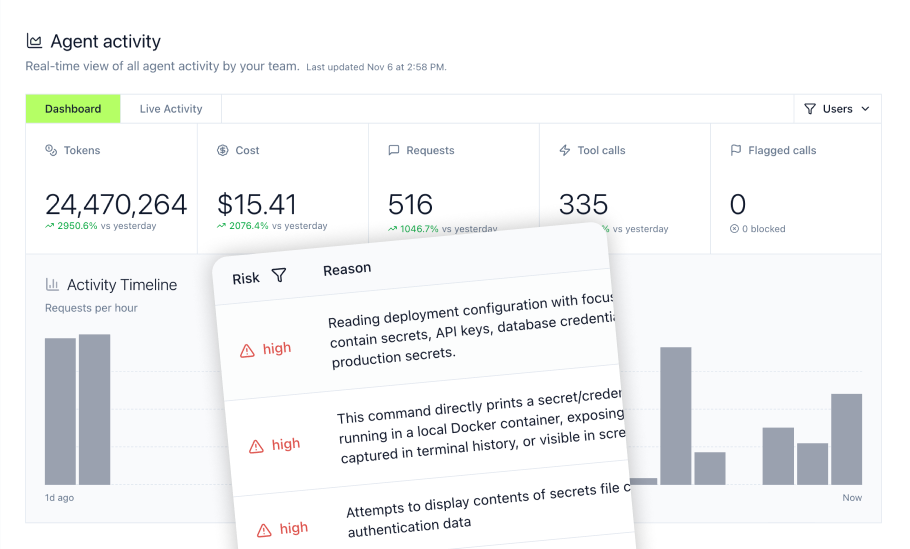
MintMCP's LLM Proxy monitors every MCP tool invocation, bash command, and file operation from coding agents. The platform provides:
- Complete visibility into installed MCPs and their permissions
- Real-time blocking of dangerous commands
- Protection for sensitive files including .env files, SSH keys, and credentials
- Complete audit trails for security review
This approach addresses a core security challenge: coding agents operating with extensive system access without organizational visibility into their actions.
Enforcing Governance: Role-Based Access and Permissions for AI Context
Limiting Context Exposure Through Granular Permissions
Tool governance represents a critical control layer. Organizations should configure access by role—enabling read-only operations for analysts while restricting write tools to authorized personnel.
Implementation approach:
- Define tool access policies per user role
- Separate service accounts at admin level from individual OAuth flows
- Apply approval workflows for high-risk operations
- Maintain escalation procedures for exceptions
Compliance and Auditability: Ensuring Traceability in AI Agent Interactions
Generating Comprehensive Audit Logs for AI Events
Audit and observability capabilities must capture every MCP interaction, access request, and configuration change. This documentation proves essential for:
- Post-incident forensic analysis
- Regulatory compliance demonstrations
- Behavioral baseline establishment
- Pattern detection across time periods
Meeting Industry Compliance Standards with AI Agents
MintMCP Gateway is SOC 2 compliant, providing audit trails that satisfy:
- SOC 2 Type II: CC6.6 authorization, CC7.2 threat detection, CC8.1 change management
- GDPR: Article 30 processing activity records
The NIST AI Framework provides governance structure mapping these requirements to operational controls: MAP (identify agents), MEASURE (assess vulnerabilities), MANAGE (implement controls), and GOVERN (establish accountability).
MintMCP: Enterprise-Grade Security for AI Agent Deployments
Transforming Shadow AI into Sanctioned AI
With shadow AI growing 120% year-over-year, organizations face a critical choice: allow uncontrolled agent deployments or implement governance infrastructure that enables safe adoption.
MintMCP addresses this challenge by providing enterprise MCP deployment with pre-configured policies—enabling teams to deploy AI tools without sacrificing security. The platform supports both STDIO servers deployable on the managed service and other remote or deployable servers your organization may operate.
A Unified Platform for AI Governance and Control
The platform combines two core capabilities addressing the critical vulnerabilities outlined in this article:
MCP Gateway transforms local MCP servers into production-ready services with:
- OAuth and SSO enforcement for all endpoints
- Real-time monitoring dashboards
- Centralized credential management
- One-click deployment for STDIO-based servers
LLM Proxy provides visibility into coding agent behavior through:
- Tool call tracking across all agents
- MCP inventory and permission mapping
- Security guardrails blocking dangerous commands
- Complete command history for security review
Together, these tools implement the defense-in-depth strategy recommended by security researchers: memory partitioning through tool governance, behavioral monitoring through real-time tracking, and architectural controls through centralized authentication. Organizations gain protection against prompt injection, context overflow attacks, and memory poisoning while maintaining the operational flexibility needed for productive AI agent deployments.
The platform's audit capabilities directly address the compliance requirements outlined earlier—providing the forensic-grade logging needed for GDPR Article 30 processing records, SOC 2 CC7.2 threat detection evidence, and incident response documentation. By centralizing governance across all MCP connections, MintMCP enables security teams to enforce consistent policies while giving development teams the AI capabilities they need to drive productivity gains.
Frequently Asked Questions
How do many-shot jailbreaking attacks differ from traditional prompt injection?
Traditional prompt injection attempts to override system instructions with a single malicious prompt. Many-shot jailbreaking exploits extended context windows by including hundreds of example dialogues showing AI assistants complying with harmful requests. Anthropic's research found effectiveness follows a power law—few-shot examples totaling hundreds of tokens can override months of RLHF training because many-shot attacks can use large in-context examples that dominate behavior at inference time, especially as available context windows grow.
What testing frameworks exist for identifying context window vulnerabilities?
Microsoft's PyRIT framework generates thousands of adversarial prompt variations to test for injection and jailbreaks. The garak scanner provides vulnerability benchmarking across model versions. For context-specific testing, security researchers recommend fuzzing with prompts at 99.9%, 100%, and 110% of window capacity to verify graceful handling and security control activation.
Can classifier-based detection alone prevent context window attacks?
No. While Anthropic reports enhanced classifiers reduce attack success rates to approximately 1% on Opus 4.5 (down from 10%+ on earlier versions), classifiers require continuous updates as attackers evolve techniques. Defense-in-depth combining architectural controls (memory partitioning), input validation, behavioral monitoring, and classifiers provides more robust protection than any single control.
How should organizations prioritize defenses based on agent architecture?
Organizations using RAG-enabled systems should prioritize provenance tracking and source validation—every document entering the knowledge base represents a potential attack vector. Browser-based agents require webpage content scanning and behavioral intervention when attacks are detected. Multi-agent systems demand particular attention to cross-contamination prevention given the documented rapid spread of poisoned memory across connected systems.
What metrics indicate a context window attack may be occurring?
Key indicators include sudden changes in tool invocation patterns, refusal rate deviations exceeding ±15% from baseline, high cosine similarity (>0.85) between input and output suggesting instruction echoing, disproportionate influence (>40%) from a single session on agent behavior, and increases in failed API calls. External monitoring systems—not logs within the context window—must capture these metrics for forensic integrity.