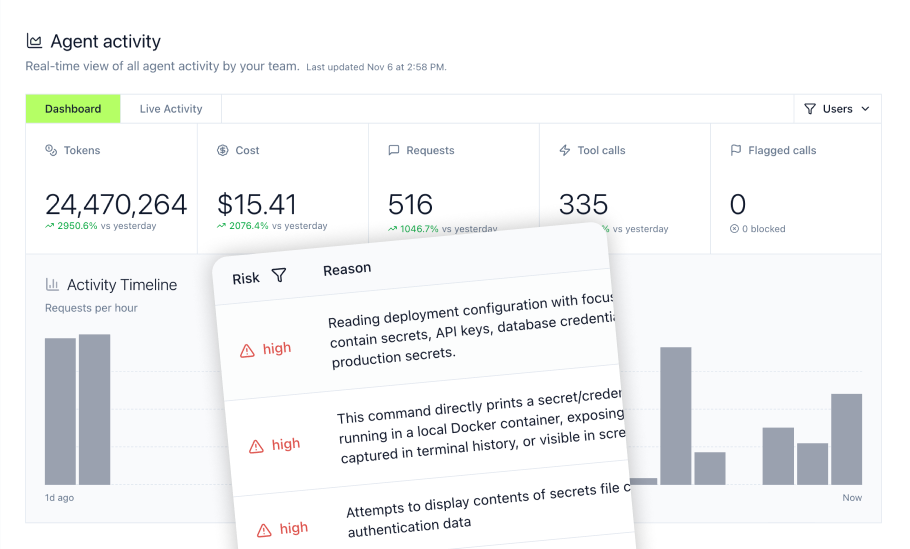
Your AI agent just made a costly decision. Can you explain why it happened, what data it accessed, or which tools it invoked? For most enterprises deploying autonomous AI systems, the answer is no. AI agents operate as opaque systems—executing LLM calls, triggering tool invocations, and accessing sensitive data without visibility into their decision-making processes. OpenTelemetry provides the vendor-neutral observability framework that transforms these black boxes into auditable, compliant, and optimized systems. Combined with enterprise governance platforms like MCP Gateway, organizations can implement comprehensive monitoring across all AI agent interactions while maintaining the security and compliance requirements that enterprise deployments demand.
This article outlines how OpenTelemetry standards enable robust observability for AI agents, covering implementation approaches, compliance requirements, cost optimization strategies, and integration patterns for production environments.
Key Takeaways
- OpenTelemetry's GenAI semantic conventions provide standardized attribute names for AI agent monitoring across all major frameworks including LangChain, LlamaIndex, and OpenAI SDK
- Enterprises implementing OTel-based observability report significant reductions in incident debugging time and improved system reliability
- Auto-instrumentation libraries enable a quick setup process for immediate trace collection without code modifications
- LLM cost optimization through trace-based analysis identifies high-cost conversation patterns for targeted optimization
- Compliance audit preparation streamlines through automated trace exports with complete decision context
- Context propagation using W3C Trace Context maintains trace continuity across multi-agent orchestration workflows
- Self-hosted backend options like SigNoz and Jaeger keep telemetry data within your infrastructure for compliance requirements
Understanding AI Agent Observability: From Shadow AI to Sanctioned AI
Enterprise AI adoption has reached critical mass, with 71% of organizations regularly using generative AI. Yet only 18% have enterprise-wide AI governance councils in place. This gap creates shadow AI—autonomous agents operating without visibility, control, or compliance oversight.
Traditional application monitoring asks "is the service up?" AI agent observability asks fundamentally different questions:
- What decisions did the agent make? Track reasoning chains, tool selections, and data access patterns
- Why did it choose that action? Capture prompt inputs, model parameters, and contextual factors
- What data did it access? Log every database query, API call, and file operation
- Who authorized this behavior? Maintain audit trails linking agent actions to user permissions
Organizations with formal AI strategies report 80% success rates versus 37% for those without structured approaches. Observability forms the foundation of AI governance—you cannot control what you cannot see.
MintMCP's approach to AI governance addresses this through centralized authentication, comprehensive audit logging, and real-time monitoring dashboards that transform shadow AI into sanctioned, compliant systems.
What is OpenTelemetry and How Does it Apply to AI Agent Monitoring?
OpenTelemetry (OTel) is a vendor-neutral framework maintained by the Cloud Native Computing Foundation. Unlike proprietary monitoring tools, OTel provides standardized APIs and SDKs for collecting telemetry data—traces, metrics, and logs—that can be exported to any compatible backend.
Core Components for AI Agents
- Distributed Tracing: Captures complete agent workflows as hierarchical span trees, showing parent-child relationships between LLM calls, tool invocations, and data retrievals
- Metrics: Quantitative measurements including token counts, latency distributions, error rates, and cost calculations
- Logs: Structured event records that correlate with trace spans for debugging and compliance
GenAI Semantic Conventions
The OpenTelemetry project maintains standardized attribute names specifically for generative AI workloads. These conventions ensure consistency across frameworks:
gen_ai.request.model: Identifies which LLM processed the requestgen_ai.operation.name: Specifies the operation type (chat, completion, embedding)gen_ai.tool.name: Records which tools the agent invoked
These conventions define a shared schema that instrumentations can adopt. In practice, traces become more consistent across frameworks when you standardize on the same instrumentation libraries, attribute settings (including content capture), and redaction/sampling policies.
Framework Coverage
Auto-instrumentation libraries provide zero-code setup for major AI frameworks. LangChain instrumentation covers chains, agents, tools, and vector stores with a single line: LangchainInstrumentor().instrument(). Similar libraries exist for LlamaIndex, CrewAI, OpenAI Agents SDK, and Microsoft Semantic Kernel.
Real-time Monitoring: Tracking Agent Performance and Usage
Effective AI agent monitoring requires real-time visibility into performance metrics, usage patterns, and system health. OpenTelemetry enables continuous data collection that feeds into live dashboards for operational awareness.
Essential Performance Metrics
- Latency tracking: Measure end-to-end response times and identify bottlenecks in agent workflows using histogram metrics that capture distribution percentiles
- Token consumption: Track usage against model limits and budget thresholds with counter metrics
- Error rates: Monitor failed tool calls, timeout events, and exception occurrences
- Throughput: Measure agent invocations per time period across teams and projects
Implementing Custom Metrics
Beyond auto-instrumented defaults, teams should capture business-specific measurements. The OpenTelemetry metrics API supports three primary types:
- Counters: Monotonically increasing values like total tool calls or tokens consumed
- Histograms: Distributions for latency, response sizes, and cost per conversation
- Gauges: Point-in-time measurements like active agent sessions or queue depth
Dashboarding Strategies
Real-time dashboards should surface actionable insights rather than raw data. Key views include agent health status across all deployed instances, cost trending by team and project, latency distributions with anomaly highlighting, and tool usage patterns showing which capabilities see highest demand.
MintMCP Gateway provides real-time monitoring for server health, usage patterns, and security alerts—delivering the operational visibility enterprises need without building custom infrastructure.
Securing AI Agents: Audit Trails and Compliance
Autonomous AI agents introduce compliance challenges that traditional application monitoring cannot address. When agents access customer data, execute financial transactions, or make healthcare recommendations, organizations need provable audit trails demonstrating proper authorization and decision rationale.
Compliance Requirements by Framework
- SOC 2 Type II: Requires logging of all system access, changes, and security events with retention policies
- GDPR: Demands data access logging with the ability to demonstrate lawful processing basis
- Industry Standards: Sector-specific requirements like PCI DSS for financial services or 21 CFR Part 11 for pharmaceuticals
According to NIST AI Risk Management Framework, organizations must implement continuous monitoring and documentation of AI system behaviors for trustworthy AI deployment.
OpenTelemetry for Compliance
OTel traces serve as audit records capturing the complete context of agent decisions. Each span includes:
- High-resolution timestamps
- User identity from authentication context
- Tool invocations with input parameters
- Data sources accessed
- Model outputs and reasoning
PII Protection Strategies
Trace data may contain sensitive information. Best practices include:
- Configure attribute processors in OTel Collector to redact or hash PII before export
- Use sampling strategies to reduce volume while maintaining representative coverage
- Store traces in compliant backends with appropriate encryption and access controls
MintMCP's LLM Proxy creates complete audit trails of every bash command, file access, and tool call—providing the security visibility enterprises need for compliance reporting and forensic analysis.
Monitoring AI Agent Tool Calls with OpenTelemetry Tracing
Tool invocations represent the most critical monitoring surface for AI agents. When an agent queries a database, calls an API, or accesses the filesystem, these operations carry risk and require visibility.
Distributed Tracing for Tool Calls
Each tool invocation becomes a child span within the agent's trace tree. The span context includes:
- Tool name and description
- Input parameters (with PII redaction as needed)
- Execution duration
- Output summary or error status
- Parent span linking to the originating agent decision
Multi-agent Workflow Tracking
Complex systems often involve multiple agents collaborating—an intake agent passing to a processor, which escalates to a specialist. Maintaining trace continuity across agent boundaries requires proper context propagation using W3C Trace Context headers.
Research from IEEE on distributed systems observability demonstrates that standardized trace context propagation reduces debugging complexity in multi-service architectures by providing end-to-end visibility.
Debugging with Distributed Traces
An insurance company deployed a multi-agent claims system but experienced failures where claims disappeared between processing stages. After implementing OpenTelemetry with span links for agent-to-agent handoffs, debugging time improved dramatically. The trace tree immediately revealed that the claims analyzer agent had token limits causing truncated context—a root cause that log analysis had missed.
For enterprises requiring strict control, MintMCP's tool governance capabilities enable configuration of tool access by role—such as enabling read-only operations while blocking write tools for specific user groups.
Cost Analytics and Resource Optimization
LLM costs represent a significant expense for organizations deploying AI agents. OpenTelemetry provides the instrumentation foundation for detailed cost attribution and optimization.
Token-based Cost Tracking
Every LLM call should capture token usage through semantic convention attributes:
gen_ai.usage.input_tokens: Tokens in the promptgen_ai.usage.output_tokens: Tokens in the completion
Combined with model pricing tables, this enables calculation of per-request costs.
Cost Attribution Strategies
Effective cost management requires attribution across multiple dimensions including by team (which departments drive LLM spending), by project (cost allocation to specific initiatives), by user (individual usage patterns), and by conversation type (which query categories cost most).
Optimization Through Analysis
A SaaS company's customer support chatbot had unpredictable monthly costs with no visibility into which conversations drove expenses. After implementing OpenTelemetry with cost tracking, analysis revealed that a small percentage of conversations (power users with complex queries) drove the majority of costs. Tiered routing was implemented to use more efficient models for simple queries, stabilizing monthly costs while maintaining customer satisfaction.
Integrating OpenTelemetry with Enterprise AI Infrastructure
OpenTelemetry's vendor-neutral design enables integration with existing enterprise monitoring systems while providing flexibility to switch backends as needs evolve.
Backend Options
Organizations choose backends based on existing infrastructure, compliance requirements, and budget:
- Self-hosted (Jaeger, SigNoz): Full control over data, no software licensing costs, requires DevOps capacity
- Enterprise APM (Datadog, New Relic): Correlation with existing infrastructure monitoring, usage-based pricing
- Cloud-native (Azure Application Insights): Integrated with cloud platforms, managed service benefits
Framework Auto-instrumentation
Major AI frameworks support zero-code instrumentation through dedicated libraries including OpenLLMetry (covers 40+ frameworks with CLI-based setup), OpenInference (optimized for LLM workflows), and OpenLIT (combines observability with built-in guardrails).
Integration with MintMCP
For organizations using Model Context Protocol servers, MCP Gateway provides enterprise-grade observability without custom instrumentation. The platform delivers centralized governance with unified authentication, real-time dashboards for server health and usage, complete audit logs compatible with SOC 2 and GDPR requirements, and OAuth + SSO enforcement for all MCP endpoints.
MintMCP works with STDIO servers deployable on the managed service as well as other remote or deployable servers you may already have in your infrastructure. This approach requires no changes to developer workflows—addressing the MCP gateway challenges that enterprises face when scaling AI agent deployments.
Deploying OpenTelemetry for Production AI Agents
Moving from development to production requires careful planning around sampling, data volume, and operational procedures.
Implementation Sequence
- Choose observability backend (15 minutes): Select based on compliance requirements, existing infrastructure, and budget
- Install OTel SDK (10 minutes): Add language-specific packages for your AI framework
- Configure auto-instrumentation (30 minutes): Initialize instrumentors for LangChain, LlamaIndex, or other frameworks
- Set OTLP exporter (20 minutes): Configure endpoint URL, authentication headers, and service name
- Verify trace data (15 minutes): Run test queries and confirm traces appear in backend
Environment Configuration
Essential environment variables for production deployments:
OTEL_EXPORTER_OTLP_ENDPOINT: Backend URL with protocol (https://)OTEL_EXPORTER_OTLP_HEADERS: Authentication credentialsOTEL_SERVICE_NAME: Identifies your agent in multi-service systems
Sampling Strategies for Scale
High-volume systems require sampling to control costs. Head-based sampling traces a percentage of requests randomly using OTEL_TRACES_SAMPLER=parentbased_traceidratio. Tail-based sampling captures all errors plus a sample of successes—preserving important events while reducing volume.
Common Deployment Issues
Traces not appearing typically indicates endpoint URL missing protocol or firewall blocking ports 4317/4318. Missing attributes often mean content recording needs enabling for prompt/response capture (note PII implications). Cost spikes can result from high-cardinality attributes creating excessive unique traces—filter or hash before export.
For organizations seeking streamlined deployment, MCP deployment guides outline how to transform local MCP servers into production-ready services with one-click deployment and built-in monitoring.
Implementing Enterprise AI Observability with MintMCP
Organizations scaling AI agents face a familiar tradeoff: fast development vs. enterprise governance. While OpenTelemetry standardizes instrumentation, enterprises still need an integrated layer for observability, security, and compliance.
MintMCP Gateway provides that unified platform for Model Context Protocol (MCP) deployments—eliminating the need to stitch together separate monitoring, auth, and governance tools.
It integrates with OpenTelemetry and adds enterprise-grade capabilities:
- Real-time dashboards for server health, usage, and security events across MCP servers
- End-to-end audit trails for tool invocations, data access, and key decision points (supporting SOC 2 / GDPR requirements)
- Centralized authentication with OAuth and SSO, ensuring only authorized access
- Tool governance with role-based controls to prevent sensitive operations from being misused
MintMCP supports both STDIO servers on managed infrastructure and remote/self-hosted servers in your environment—so you can standardize governance without disrupting workflows or migrating infrastructure.
The result: vendor-neutral telemetry + purpose-built governance, delivering scalable AI observability with the controls enterprise teams require.
Frequently Asked Questions
What is the difference between OpenTelemetry and proprietary AI monitoring tools?
OpenTelemetry provides a vendor-neutral standard that works with any observability backend, while proprietary tools lock you into specific platforms. With OTel, you can switch from self-hosted Jaeger to cloud-based Datadog without changing your instrumentation code. The hybrid approach—using OTel for instrumentation with specialized backends for analysis—provides flexibility while maintaining feature depth.
How do I prevent sensitive data from appearing in traces?
OTel Collector includes attribute processors that transform data before export. Configure processors to hash PII fields (user IDs, email addresses), redact sensitive content (API keys, credentials), or drop entire attributes. Apply these transformations at the Collector level—before data leaves your network—rather than relying on backend-side filtering. For AI agents handling healthcare or financial data, process all prompt and response content through redaction filters before export.
Can OpenTelemetry track multi-agent conversations across different services?
Yes, through context propagation using W3C standards. When Agent A calls Agent B, the trace context (including trace ID and parent span ID) propagates via HTTP headers. Both agents' spans appear in the same trace tree with proper parent-child relationships. For message queue-based communication (Kafka, RabbitMQ), manually inject and extract context using propagation.inject() and propagation.extract() from the OTel SDK.
What observability backend should I choose for compliance requirements?
Self-hosted options (SigNoz, Jaeger) provide maximum control since data never leaves your infrastructure—compliance becomes your responsibility. For managed services, evaluate providers based on certifications relevant to your industry. Consider not just the backend but the entire data path—including OTel Collector hosting and network encryption. Organizations with strict compliance needs often combine self-hosted collection with secure export to managed analytics platforms.
How much overhead does OpenTelemetry add to AI agent performance?
Properly configured OTel instrumentation adds less than 5% latency overhead to request processing. The majority of overhead comes from trace export, which happens asynchronously and doesn't block agent execution. For high-volume systems, use batch exporters that buffer spans before transmission, reducing network overhead. Sampling further reduces export volume without impacting instrumentation accuracy—10% sampling provides statistically representative data while cutting export costs significantly.