Machine learning teams deploying AI agents at scale face a fundamental infrastructure challenge: how do you give agents secure, governed access to internal systems without creating security vulnerabilities or spending months on custom integration work?
The answer lies in two connected control layers: an MCP Gateway for governed data and tool connections, and an Agent Gateway for agent identities, permissions, memory, and monitoring. As 74% of companies plan agentic AI deployments within two years and foundation model API spend reached $12.5 billion in 2025, choosing the right gateway becomes critical for ML teams running high-throughput inference workloads, experimentation pipelines, and production agent deployments.
This guide evaluates 12 agent gateways based on performance benchmarks, ML team fit, enterprise governance features, and deployment flexibility to help you select the right infrastructure for your organization.
Key Takeaways
- MintMCP provides enterprise agent governance with data-permissions-first architecture, Virtual MCP Bundles, Agent Bundles with per-agent identity, hosted MCP connectors, SSO/SCIM-driven RBAC, and JS sandbox middleware for DLP integrations
- Gateways with approximately 11 microseconds of overhead at sustained 5,000 RPS suit performance-critical ML inference workloads
- Multi-cloud deployment across 300+ edge locations with TypeScript programmability enables rapid iteration for distributed ML teams
- Production agent-to-agent protocol governance supports multi-agent architectures where agents coordinate actions
- Unified AI platforms combine model serving, gateway, and monitoring capabilities for teams wanting consolidated ML infrastructure
- Edge-native proxying with aggressive caching reduces latency for repeated inference patterns
- Self-hosted Python proxies supporting 100+ LLM providers integrate naturally with Python-based ML pipelines
- Deep observability platforms with traces, sessions, and prompt logging help teams understand production AI behavior
- Native cloud provider integrations deliver tight coupling with IAM, cost management, and serverless infrastructure
- Open-source gateway implementations with MIT or Apache 2.0 licenses provide full infrastructure ownership
- Managed integration platforms with 1,000+ pre-built SaaS connectors accelerate agent deployment without custom development
1. MintMCP Gateway: enterprise agent governance in minutes
MintMCP Gateway provides enterprise-grade governance and infrastructure for AI agents using the Model Context Protocol. Unlike approaches that retrofit security onto existing agent platforms, MintMCP starts with data permissions, including SSO, SCIM-driven RBAC, and tool-level policy, then enables agents on top.
The platform addresses the "last mile problem" in enterprise AI by giving agents secure, governed access to internal systems and data sources without requiring extensive engineering overhead for each integration. MintMCP's Agent Gateway builds on its MCP Gateway foundation to provide agent identities, permissions, memory, and monitoring as agents move from assistant tools to autonomous coworkers.
What makes MintMCP Gateway different
MintMCP's Bundle architecture packages tool access, policy enforcement, and audit logging into single governance units per team or role. Each AI agent receives its own persistent identity with scoped credentials that can be rotated independently, which solves the credential sprawl problem that plagues ML team tool usage at scale.
The platform supports Claude, Cursor, ChatGPT, Gemini, and Copilot governance through centralized gateway and Agent Monitor coverage.
Core capabilities
- Hosted MCP Connectors: MintMCP runs connector instances on the customer's behalf with auto-scaling and sandboxed execution per connector, eliminating infrastructure overhead
- Virtual MCP Bundles: Create team-specific, per-use-case endpoints that expose only the minimum required tools with SCIM-driven membership, curated tool lists, and fine-grained role-based access
- Agent Bundles with M2M auth: Give internal agents first-class identities with bearer API keys plus OAuth 2.0 client-credentials per agent, rotation/revoke independent of human users, and an "act as agent" flow for connectors requiring per-agent OAuth
- Custom Gateway Middleware: Runs customer-authored middleware in a JS sandbox with external DLP integrations for AWS Bedrock Guardrails, Google Cloud DLP, Microsoft Purview, Nightfall, and Skyflow
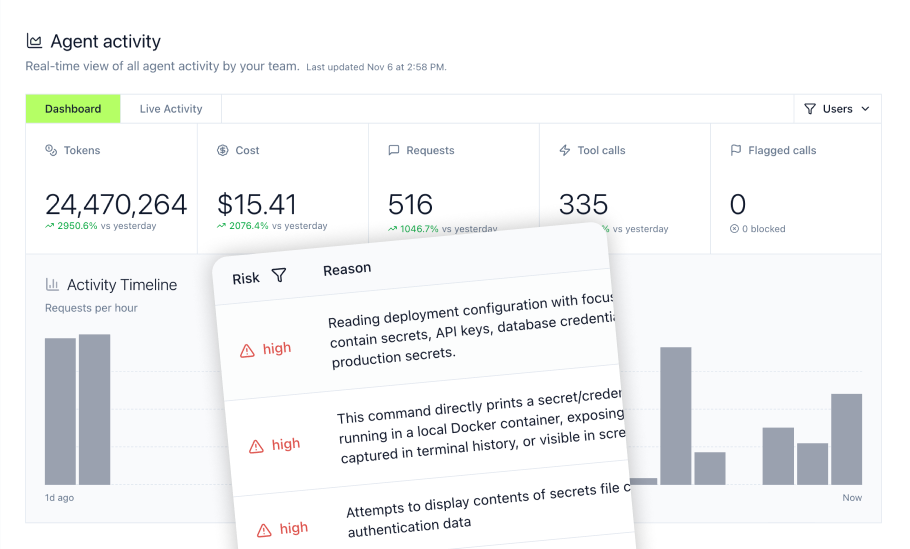
- Real-time monitoring: Live dashboards showing server health, usage patterns, tool call tracking, and security alerts across all MCP connections
Security and compliance
MintMCP implements defense-in-depth security through centralized governance, SSO enforcement, SCIM-driven RBAC, tool-level policy, credential management, and observability controls.
- SOC 2 Type II audited
- Compliant with HIPAA standards
- Penetration tested
- Data encrypted in transit and at rest
Visit the Trust Center for full security documentation.
Enterprise integrations
- Snowflake data warehouse access with natural language queries
- Elasticsearch knowledge base search for documentation and log analysis
- PostgreSQL, MongoDB, and BigQuery database connectivity
- GitHub, Slack, and Salesforce integrations
- Custom MCP server deployment for internal tools and APIs
Deployment and pricing
Deploy quickly with managed SaaS-first delivery, US and EU availability, hosted MCP connectors, pre-configured policies, and self-service access for developers. VPC and self-hosted deployment are available on request.
Contact for enterprise demonstration and pricing at mintmcp.com.
2. Bifrost (Maxim AI)
Bifrost is an open-source AI gateway built in Go that focuses on minimizing gateway overhead for high-throughput ML inference workloads.
Performance profile
Bifrost's published benchmark reports approximately 11 microseconds of gateway overhead at sustained 5,000 RPS. The Go-based architecture is designed to minimize gateway overhead for teams running high-throughput inference workloads.
Key features
- CEL-based intelligent routing with weighted targets
- Native MCP gateway with Agent Mode and Code Mode
- Hierarchical virtual keys with four-level budget enforcement
- Dual-layer caching with exact hash and vector similarity semantic caching
- Apache 2.0 license for full source code inspection
Where Bifrost fits
ML teams running high-throughput inference workloads where microsecond-level gateway overhead matters. The open-source nature allows ML engineers to inspect and modify routing logic for custom experimentation requirements.
Deployment model: Self-hosted via Docker or Kubernetes
Pricing: Free (Apache 2.0 open-source)
3. Zuplo
Zuplo provides a multi-cloud AI gateway platform with deployment across 300+ edge locations and TypeScript programmability.
Platform approach
The platform offers three project types: API Gateway, AI Gateway, and MCP Gateway. Sub-20-second GitOps deployments enable rapid iteration for ML teams testing different routing configurations.
Key features
- Multi-cloud managed dedicated deployment on AWS, Azure, or GCP
- TypeScript-first programmability with full npm ecosystem access
- Routing to 23+ model providers
- Token-based rate limiting for AI workloads
Where Zuplo fits
ML teams operating across multiple clouds or needing to avoid vendor lock-in. Developer experience reduces implementation time for ML engineering teams already comfortable with TypeScript.
Deployment model: Multi-cloud SaaS with managed dedicated options
Pricing: Free tier available, paid plans usage-based
4. Kong AI Gateway
Kong extends its established API gateway platform with AI-specific capabilities, including A2A protocol support for multi-agent architectures.
Platform capabilities
Kong 3.14 introduced production A2A (Agent-to-Agent) protocol governance and token-level rate limiting through the AI proxy plugin. The plugin ecosystem provides flexibility for custom ML workflow requirements.
Key features
- A2A protocol support for agent-to-agent communication governance
- Token-level rate limiting with AI proxy plugin
- Routing to OpenAI, Anthropic, Google, Mistral, DeepSeek, and vLLM
- Kubernetes-native deployment with deep K8s integration
- Extensible ecosystem of bundled, third-party, and custom plugins
Where Kong fits
ML teams already on Kubernetes wanting to consolidate traditional API management with AI gateway capabilities. A2A support becomes relevant for multi-agent architectures where agents need to coordinate actions.
Deployment model: Hybrid (Konnect SaaS control plane + self-hosted data plane) or fully self-hosted
Pricing: Open-source core free, Enterprise tier available
5. TrueFoundry
TrueFoundry provides a unified AI platform that combines MLOps capabilities with an integrated agent gateway for teams wanting consolidated ML infrastructure.
Platform approach
The platform combines model serving, gateway, and monitoring in one platform. TrueFoundry publishes low-latency gateway benchmarks for its platform, but teams should validate latency and throughput under their own deployment conditions.
Key features
- Unified control plane for LLM, MCP, and agent traffic
- VPC-native deployment with data sovereignty options
- Kubernetes-native architecture
- Integration with ML model serving workflows
Where TrueFoundry fits
Platform engineering and ML platform teams wanting to consolidate multiple infrastructure layers rather than deploying separate gateway and MLOps solutions.
Deployment model: Hybrid with managed SaaS and self-hosted control plane options
Pricing: Enterprise pricing (contact sales)
6. Cloudflare AI Gateway
Cloudflare AI Gateway provides edge-native AI proxying with aggressive caching for organizations already using Cloudflare infrastructure.
Edge architecture
The gateway leverages Cloudflare's 300+ edge locations to reduce latency for repeated inference patterns. The Workers Free plan stores up to 100,000 logs per account across all gateways, making it accessible for development and small-scale production.
Key features
- Edge-level caching for repeated queries
- MCP Server Portals (Open Beta) with Zero Trust
- Unified billing for third-party models through Cloudflare
- Dashboard toggle enablement with no infrastructure setup
Where Cloudflare fits
ML teams already on Cloudflare wanting zero-setup AI proxying with edge caching benefits. Not suitable for teams requiring self-hosted or VPC deployment options.
Deployment model: Managed SaaS only (Cloudflare infrastructure)
Pricing: Core AI Gateway features are free; persistent log storage is capped at 100,000 logs per account on Workers Free and 10 million logs per gateway on Workers Paid
7. LiteLLM
LiteLLM is an open-source Python AI proxy that supports 100+ LLM providers through an OpenAI-compatible API.
Python ecosystem fit
The proxy integrates naturally with Python-based ML pipelines and frameworks like LangChain and LlamaIndex, supporting common ML experimentation workflows.
Key features
- 100+ LLM provider support with OpenAI-compatible API
- Self-hosted deployment with full data control
- Budget tracking per project/user with PostgreSQL backend
- Integration with Langfuse, LangChain, and LlamaIndex
- MIT license
Where LiteLLM fits
ML teams wanting self-hosted deployment with Python stack familiarity, broad model-provider support, and an OpenAI-compatible interface. Production suitability depends on the team's workload, configuration, infrastructure, and operational requirements.
Deployment model: Self-hosted
Pricing: Free (MIT open-source), Enterprise license for SSO/RBAC
8. Portkey
Portkey provides an AI observability platform with gateway capabilities, now part of Palo Alto Networks following acquisition in the second quarter of 2026.
Observability focus
The platform emphasizes detailed visibility into AI interactions with traces, sessions, and prompt logging. Support for 250+ models provides coverage for teams using multiple providers.
Key features
- Deep observability with traces, sessions, and prompt logging
- Prompt management for version control and deployment
- Guardrails SDK for content filtering and PII detection
- 250+ model support
- Apache 2.0 open-source gateway core
Where Portkey fits
ML teams whose primary need is understanding production AI behavior through detailed observability and centralized gateway controls.
Deployment model: Hybrid with managed SaaS and self-hosted enterprise options
Pricing: Free and paid self-service plans are available, with 100K recorded logs per month on the current published paid tier; Enterprise pricing is custom
9. Azure API Management (GenAI Gateway)
Azure API Management adds GenAI gateway features with native token-based rate limiting for Azure-standardized organizations.
Azure integration
The platform provides tight coupling with Azure OpenAI and Entra ID. PTU/PAYG spillover routing helps optimize costs for teams using Azure OpenAI provisioned throughput.
Key features
- Native token-based rate limiting (
llm-token-limitpolicy) - PTU/PAYG spillover routing for Azure OpenAI
- Anthropic Messages API support in v2 tiers
- Integration with Azure OpenAI, Microsoft Entra ID, and Azure Cost Management
Where Azure APIM fits
ML teams standardized on Azure who want mature cloud-provider AI gateway features. Accept Azure ecosystem commitment and XML-based policy configuration requirements.
Deployment model: Azure-managed
Pricing: Tier- and region-dependent across Consumption, v2, and Premium plans
10. AWS Bedrock AgentCore
AWS Bedrock provides serverless agent infrastructure with native IAM integration and AgentCore Gateway for MCP support.
AWS ecosystem
The platform delivers seamless integration with VPC, CloudWatch, and Cost Explorer. Foundation model access includes multiple providers, including Anthropic, Meta, Mistral, Cohere, AI21, Amazon, and OpenAI, with model availability varying by region.
Key features
- Native AWS IAM and Cognito integration
- MCP support via AgentCore Gateway
- Bedrock Guardrails for content safety and PII detection
- Serverless architecture with no infrastructure management
- Access to multiple foundation model providers
Where AWS Bedrock fits
ML teams running exclusively on AWS wanting tight IAM integration. Requires assembling multiple AWS services rather than using a unified gateway product.
Deployment model: AWS-managed serverless
Pricing: Usage-based; AgentCore Gateway charges for API calls, while foundation-model inference is billed separately
11. Obot AI
Obot provides an open-source MCP gateway with MIT license for infrastructure teams requiring full control over their gateway deployment.
Open-source approach
The platform emphasizes transparency and extensibility through its open-source architecture. Kubernetes or Docker deployment options support GitOps workflows.
Key features
- Open-source gateway implementation (MIT license)
- Curated MCP catalog with self-service discovery
- Composite server support (multiple MCPs as one endpoint)
- Kubernetes or Docker deployment with GitOps
- Agent workflow orchestration via Nanobot framework
Where Obot fits
Platform engineering teams with DevOps expertise who require full infrastructure ownership and prefer open-source tools for transparency. Requires operating the runtime, Kubernetes deployment, scaling, and governance stack.
Deployment model: Self-hosted (Docker for dev, Kubernetes for production)
Pricing: Free (MIT open-source)
12. Composio
Composio provides a managed integration platform with 1,000+ pre-built SaaS connectors exposed over MCP for rapid agent integration.
Managed toolkit approach
The platform combines a broad managed integration catalog with MCP gateway governance, including scoped endpoints, managed authentication, role-based access controls, audit logging, and organization-wide access management.
Key features
- 1,000+ app integrations exposed over MCP
- Managed OAuth flows for tool authentication
- BYOC (Bring Your Own Cloud) for Enterprise tier
- Support for major agent frameworks
- Zero infrastructure management for standard tier
Where Composio fits
ML teams needing broad SaaS integration coverage, managed authentication, scoped MCP endpoints, and centralized governance without building and maintaining each integration independently.
Deployment model: Managed SaaS-first, VPC/on-prem on Enterprise tier
Pricing: Free tier with 20K tool calls/month; paid plans currently start at $29/month for 200K tool calls, with usage-based overages
Choosing the right agent gateway for your ML team
For machine learning teams deploying AI agents across their organization, MintMCP Gateway provides a managed path to production with enterprise governance. The platform's data-permissions-first architecture ensures that agent identities, tool access, and audit trails are built into the foundation rather than retrofitted.
MintMCP distinguishes between two connected control layers. The MCP Gateway governs how agents access tools, databases, and internal APIs, while the Agent Gateway adds the identity, permission, memory, and monitoring capabilities that production agent deployments require. This separation becomes critical as agents evolve from coding assistants like Claude Code and Cursor into persistent coworker agents that hold memory, continue work across days, and operate alongside employees in channels like Slack.
MintMCP's Virtual MCP Bundles solve the immediate challenge of giving coding assistants governed access to production databases and enterprise SaaS tools. Agent Bundles extend that foundation by giving autonomous agents their own identities with M2M authentication, independent credential rotation, and fine-grained per-agent permissions. This architecture prevents the credential sprawl and attribution gaps that emerge when teams scale from a handful of developer tools to dozens of production agents.
The combination of MCP Gateway for governed data and tool connections plus Agent Monitor for local non-MCP agent activity provides visibility across both governance layers. Organizations running agents that access sensitive data, execute commands, or integrate with compliance-regulated systems need this dual-layer coverage to maintain audit trails and enforce policy consistently.
Start with MintMCP's free trial to deploy governed agent infrastructure in minutes, not months.
Frequently asked questions
What is an agent gateway and why do ML teams need one?
An agent gateway is the control layer for agent identities, permissions, memory, and monitoring. It can build on an MCP Gateway, which governs access to tools, databases, and APIs. ML teams need agent gateways to provide centralized authentication, real-time monitoring, and enterprise-grade compliance for AI agent deployments. Without a gateway, organizations face fragmented security policies across dozens of individual connections, zero visibility into which agents access which tools, and duplicated authentication logic that creates operational chaos at scale.
How do agent gateways differ from traditional API gateways?
MCP gateways handle the Model Context Protocol for connecting AI assistants to tools and data. The current standard transports are stdio and Streamable HTTP; the older HTTP+SSE transport is deprecated and retained for backward compatibility. Traditional API gateways route HTTP/REST requests between services but do not understand protocol-specific requirements like context state management across multi-step agent workflows, tool authorization semantics, or stdio server hosting. While some API gateway vendors are adding MCP features, purpose-built agent gateways address requirements that traditional gateways were not designed for.
What authentication methods should an agent gateway support?
Enterprise agent gateways should support OAuth 2.x, SAML for enterprise SSO integration, OpenID Connect (OIDC) for modern identity providers, bearer tokens, and API token management for service accounts. For AI agent security, the gateway should provide per-user OAuth flows and per-agent identity models including M2M auth and "act as agent" flows. Shared service accounts should be avoided where individual attribution and independent credential rotation are required. This flexibility addresses authorization challenges enterprises face when deploying agents that need both human-initiated and autonomous access patterns.
Can agent gateways work with AI coding assistants like Cursor and Claude Code?
Yes. MintMCP's MCP Gateway and Agent Monitor provide two-layer coverage: the Gateway governs MCP traffic, while Agent Monitor captures local coding-agent activity such as file reads, command execution, prompt submissions, and supported MCP tool calls from Cursor, Claude Code, and other coding agents. This addresses the unique security challenges of coding agents that operate with extensive system access.
How quickly can I deploy an agent gateway in my organization?
Deployment speed varies by approach. Managed services with hosted MCP connectors and pre-configured policies can accelerate deployment significantly compared to self-hosted open-source solutions that require infrastructure setup, authentication integration, and security configuration. For teams with urgent production requirements, platforms offering managed SaaS-first delivery with self-service access provide a rapid path to governed agent infrastructure.