Transformer models underpin many of the most widely used generative AI systems today, from ChatGPT to enterprise coding agents, and they are also widely used in search and other sequence-processing applications. Yet one-third of organizations report scaling AI across the enterprise, despite 88% reporting regular AI use in at least one business function. Understanding how transformers process information is essential for practitioners who must deploy, monitor, and secure these systems at scale. For organizations managing transformer-based AI clients like Claude, Cursor, and ChatGPT, implementing a governed MCP Gateway provides the foundation for making these systems deployable, governed, measurable, and auditable.
This article explains transformer architecture in practical terms, covering how self-attention works, why context quality determines output reliability, and what governance infrastructure enterprises need to run transformer-based systems safely.
Key Takeaways
- Transformers process sequences by computing relationships between all elements simultaneously through self-attention mechanisms, enabling the context understanding that powers modern LLMs
- The scaling gap is real: only about one-third of organizations report scaling AI across the enterprise
- Context quality is a major determinant of transformer performance alongside model capability, retrieval quality, prompting, tools, and evaluation
- Transformer-based enterprise applications can improve workflow efficiency, but measured productivity gains depend on the specific use case and implementation
- Preventive controls for risky actions must operate at the relevant runtime enforcement point, while monitoring, audit, and compliance workflows can also operate after the interaction
- Self-attention is a context amplifier: it makes good data great and garbage data catastrophically wrong at scale
- High-quality, well-governed context can improve grounding and reduce some hallucination risks, but the magnitude varies by task, model, and retrieval system
What is a Transformer Architecture and Why Does it Matter for AI?
Transformer architecture represents a fundamental shift in how neural networks process sequential data. Introduced in 2017, transformers replaced the sequential processing of Recurrent Neural Networks (RNNs) with a parallel approach that analyzes all elements simultaneously through self-attention mechanisms.
The core innovation is conceptually straightforward: self-attention lets each position directly consider other permitted positions in the sequence. In encoder models this can include the full input, while autoregressive decoder models use causal masking so each position attends only to earlier positions. When processing the sentence "The bank by the river was flooded," a transformer simultaneously considers how "bank" relates to "river," "flooded," and every other word, determining that this "bank" refers to a riverbank rather than a financial institution.
The Shift from Recurrent Neural Networks
Traditional recurrent sequence models pass information through sequential hidden states, which can make long-range dependencies increasingly difficult to preserve as sequences grow. This created two fundamental limitations:
- Sequential bottleneck: Each word had to wait for all previous words to be processed, making training slow and parallelization impossible
- Degraded long-range information: Information from early in a sequence degraded as it passed through many processing steps
Transformers greatly reduced the sequential training bottleneck and created shorter paths for modeling long-range dependencies. Residual connections and normalization also help stabilize optimization, but transformers do not eliminate gradient problems entirely, and training-time improvements vary substantially by model, hardware, and implementation.
Key Advantages in Modern AI
The practical implications for enterprise AI teams are significant:
- Scalability: Transformers can process context windows from 4K to over 1M tokens, enabling applications that work with entire documents, codebases, or conversation histories
- Parallelization: Training and inference can leverage GPU clusters efficiently, reducing costs and enabling real-time applications
- Transfer learning: Pre-trained transformers can be fine-tuned on domain-specific data, reducing the data and compute requirements for new applications
- Context awareness: The attention mechanism captures nuanced relationships between concepts, enabling more accurate reasoning about complex business scenarios
For practitioners deploying AI systems, runtime risks create a need for controls at the point where sensitive access or actions occur, alongside post-interaction monitoring, audit, and compliance workflows.
Understanding the Self-Attention Mechanism
Self-attention is the mechanism that enables transformers to weigh the importance of different input elements when processing any given position. It answers the question: "When understanding this word, how much should I pay attention to each other word?"
Traditional recurrent sequence models pass information through sequential hidden states, which can make long-range dependencies increasingly difficult to preserve as sequences grow. Self-attention removes this limitation by computing direct connections between any two positions regardless of distance.
The mechanism works through three learned projections:
- Queries (Q): What information is this position looking for?
- Keys (K): What information does this position have to offer?
- Values (V): What actual content should be passed if attention is high?
For each position, the model computes attention scores by comparing its query to all keys, then uses those scores to weight the values. In practical terms: if the model is processing "it" in "The cat sat on the mat because it was tired," the attention mechanism assigns high weight to "cat" when determining what "it" refers to.
Multi-Head Attention
Single attention can only capture one type of relationship. Multi-head attention runs multiple attention operations in parallel, each learning different relationship types:
- One head might track syntactic relationships (subject-verb agreement)
- Another might track semantic relationships (synonyms, antonyms)
- Another might track positional patterns (nearby words)
- Another might track long-range dependencies (pronouns to their referents)
Typical models use 8 to 96 attention heads. The outputs concatenate and project back to the model dimension, combining multiple perspectives on the input.
For enterprise deployments, multi-head attention means that transformer outputs are influenced by the model's learned parameters, the input context, retrieval and tool results, and the generation process. Hallucinations can arise from multiple sources, including limitations in training data, retrieval errors, ambiguous or misleading context, decoding behavior, and weaknesses in the model itself. This is why retrieval quality and well-governed context matter: poor or outdated context can degrade grounding even when the underlying model is capable.
How Transformers Power Large Language Models
Large Language Models (LLMs) like GPT-4, Claude, and Gemini are transformer architectures trained on massive text corpora to predict the next token. This simple training objective, repeated across trillions of tokens, produces models capable of reasoning, code generation, and complex analysis.
LLMs succeed because transformers can:
- Scale efficiently: Training larger models on more data consistently improves capabilities
- Learn in-context: The attention mechanism allows models to "learn" from examples provided in the prompt without weight updates
- Transfer knowledge: Pre-training on general text creates representations useful for specialized tasks
- Handle long contexts: Modern models process 128K to 1M+ tokens, enabling work with entire codebases or document collections
Architecture Variations
BERT uses an encoder-only architecture, while many GPT-style generative models use decoder-only architectures. Vendors do not publicly disclose all architectural details for frontier models such as GPT-4 and current Claude models.
Generative AI applications use decoder-style transformers that predict one token at a time, building outputs iteratively for text generation, translation, summarization, code completion, and analysis.
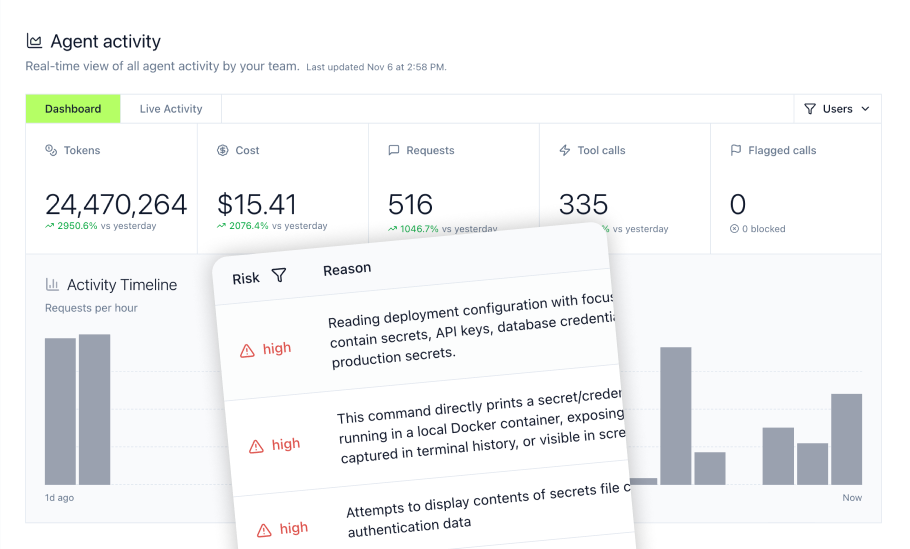
For practitioners managing these systems, visibility into prompt submissions and model interactions becomes critical. MintMCP's Agent Monitor provides visibility into supported AI-agent activity, including prompts, file access, commands, MCP tool calls, usage, and token costs, including supported activity outside MintMCP Gateway traffic.
Deploying Transformer-Based Systems in Production
Moving transformer-based AI from prototype to production requires addressing infrastructure, context quality, governance, workflow integration, and organizational adoption. McKinsey reports that only about one-third of organizations are scaling AI across the enterprise, but the survey does not attribute that gap to any single cause.
Leveraging Pre-trained Transformers
Most enterprises should use pre-trained models rather than training from scratch:
API Access (OpenAI, Anthropic, Google)
- Setup: Often the fastest deployment path
- Cost: Usage-based and highly dependent on provider, model, token volume, and caching
- Advantages: Minimal model-serving infrastructure and rapid access to hosted models
- Limitations: External processing and data-governance requirements vary by provider and contract
Self-Hosted Open-Weight Models (Llama, Mistral)
- Setup: Requires model-serving and accelerator infrastructure
- Cost: Depends on model size, utilization, hardware, and operational requirements
- Advantages: Greater infrastructure control and customization
- Limitations: Requires ML and infrastructure expertise
Enterprise Managed Services (Azure AI, AWS Bedrock)
- Setup: Procurement and deployment timelines vary by organization and provider
- Cost: Depends on selected models, usage, architecture, and commercial agreement
- Advantages: Managed infrastructure and enterprise security options
- Limitations: Provider-specific architecture, pricing, and service constraints
Key Production Challenges
Practitioners consistently encounter these challenges:
Context quality issues
- Ungoverned knowledge bases produce unreliable outputs
- Missing metadata means models cannot distinguish authoritative from outdated sources
- Solution: Implement governed context layers with business glossaries, ownership metadata, and lineage tracking
Hallucination management
- Transformers generate confident outputs regardless of accuracy
- Without source attribution, users cannot verify claims
- Solution: RAG architectures with governed retrieval and runtime content screening
Cost control
- Token usage scales non-linearly with users
- Complex queries consume significantly more tokens
- Solution: Caching layers, model tiering, and usage tracking
Compliance requirements
- Audit trails for model interactions required for various regulations
- Data lineage for regulatory explanation requirements
- Solution: Centralized logging with tamper-evident audit trails
Security and Governance for Transformer Models
Transformer-based AI systems introduce security risks that traditional application security does not address. Models that can read files, call APIs, and execute code require purpose-built governance infrastructure.
Common Security Risks
Credential exposure
- Coding agents reading
.envfiles containing API keys - Models including secrets in generated code
- Prompt content sent to external APIs without sanitization
Unauthorized data access
- Agents accessing systems beyond their intended scope
- Missing permission boundaries between user contexts
- Data leakage through model responses
Prompt injection
- Malicious instructions embedded in documents or tool descriptions
- External content manipulating model behavior
- RAG retrieval returning adversarial content
Action without oversight
- Autonomous agents executing destructive operations
- Missing human-in-the-loop for high-risk actions
- No kill switch for runaway processes
These risks exist because transformers process context indiscriminately. The attention mechanism treats malicious instructions embedded in documents the same as legitimate user requests.
Governance Controls
Effective governance requires controls at multiple layers:
Identity and access control
- Authenticate users through SSO before model access
- Scope permissions at the tool and data level
- Distinguish human from agent actions in audit logs
MintMCP's Agent Gateway provides first-class identities for autonomous agents, ensuring each agent has scoped permissions, independent credentials, and an attributable audit trail separate from human users.
Runtime security controls
- Detect prompt injection in supported agent and tool interactions
- Screen supported content for PII, credentials, secrets, and harmful content
- Apply monitoring or blocking policies at supported enforcement points
MintMCP's Mint Guard provides managed detection policies for prompt injection, credential exposure, PII, and harmful content with enforcement modes that block violations in real time.
Audit and observability
- Log all model interactions with full context
- Track tool calls, file access, and command execution
- Export to SIEM for security analysis
MintMCP's SIEM export capabilities support OTLP and Splunk HEC formats, providing security teams with centralized visibility into supported agent and gateway activity.
Scaling with Centralized Governance
As organizations move from pilot projects to enterprise-wide transformer deployments, scattered configurations create unmanageable risk. Each developer configuring MCP servers locally means N installs, N authentication flows, and N potential security gaps.
From Pilot to Enterprise
The scaling journey typically follows this pattern:
- Pilot (1-10 users): Individual API keys, manual configuration, no centralized visibility
- Departmental (10-100 users): Shared credentials create attribution problems, configuration drift between teams
- Enterprise (100+ users): Credential sprawl becomes critical risk, audit requirements cannot be met
Organizations that implement centralized governance early can reduce configuration sprawl and avoid some of the rework involved in retrofitting controls after deployments have scaled.
Centralized Governance Platform
A centralized gateway solves the configuration sprawl problem:
- Single endpoint: Users connect once instead of configuring each MCP server
- Centralized credentials: Managed centrally, never on developer machines
- Consistent access control: Role-based access driven by directory groups
- Complete audit trail: Every tool call logged with user attribution
- Centralized audit data: Supports compliance reporting and investigation workflows
MintMCP's Virtual MCPs provide the core abstraction for centralized governance. A Virtual MCP bundles approved connectors and a curated tool surface behind one governed endpoint for a particular team, role, use case, or agent.
Autonomous Agents with Governance
Transformer-based autonomous agents represent the next evolution in enterprise AI: systems that work alongside employees, answer Slack threads, run scheduled analyses, and open pull requests without constant human direction.
Agent Capabilities
Autonomous agents built on transformer models can:
- Maintain context: Memory systems allow agents to remember previous interactions
- Execute workflows: Planning capabilities decompose complex tasks into manageable steps
- Use tools appropriately: Function calling allows agents to query databases, call APIs, and interact with enterprise systems
- Learn from feedback: In-context learning allows behavior adjustment based on user corrections
These capabilities enable use cases such as enterprise search, analysis, coding workflows, and business-process automation, with business impact depending on the specific deployment.
Agent Identity and Permissions
Autonomous agents require governance that human-operated AI tools do not:
- Agent identity: Each agent needs its own identity separate from human creators
- Scoped permissions: Agents should access only the tools and data their role requires
- Company-owned memory: Agent memory should be scoped, versioned, reviewable, and portable
MintMCP's Coworker Agents provide hosted autonomous agents with these governance properties built in. Agents operate through Slack, run on schedules or manual triggers, maintain company-owned git-backed memory, and use scoped tool access within governed execution environments.
The distinction matters for regulated industries: an agent operating through a human's credentials collapses the audit log, over-privileges the agent, and breaks rotation policies.
Production-Ready Transformer Deployments with MintMCP
Transformer architecture powers the most capable AI systems available today, but production deployment requires more than model access. Organizations need infrastructure that provides visibility, control, and auditability at the scale and speed of transformer inference.
MintMCP addresses the core challenges practitioners face when moving transformer-based AI from prototype to production. Instead of scattered MCP server configurations on individual developer machines, MintMCP provides a centralized gateway that routes governed MCP tool access through centralized enforcement points. This architecture enables consistent access control, comprehensive audit trails, and runtime security policies without requiring changes to individual AI clients or MCP servers.
For organizations managing multiple AI clients and autonomous agents, MintMCP's Virtual MCPs allow teams to curate which tools each user, role, or agent can access while maintaining a single source of truth for authentication and authorization. Combined with Agent Monitor for observability and Mint Guard for runtime content screening, the platform provides the governance layer that transformer-based systems require.
The result is transformer AI that enterprises can actually deploy: measurable through comprehensive usage tracking, auditable through tamper-evident logs and SIEM export, and secure through first-class agent identities and runtime policy enforcement. For practitioners evaluating data risk in MCP deployments, the MCP data risk guide provides a framework for identifying and mitigating common vulnerability patterns.
Frequently Asked Questions
What is the difference between a transformer and a traditional Recurrent Neural Network?
Transformers can process positions within an available sequence in parallel during training, while RNNs process sequences recurrently one element at a time. Autoregressive transformer generation still produces output tokens sequentially. This architectural difference provides transformers with three practical advantages: dramatically faster training through parallelization, better handling of long-range dependencies since attention connects any two positions directly, and superior scalability that enables models with billions of parameters. The trade-off is that transformers require more memory since they compute attention between all position pairs. For enterprise practitioners, the key implication is that transformer-based systems can work with much larger documents and maintain context across longer conversations than RNN-based predecessors.
Can transformers be used for tasks beyond natural language processing?
Yes, transformer architecture has proven effective across multiple domains beyond text. Vision Transformers apply self-attention to image patches for computer vision tasks. Audio transformers process spectrograms for speech recognition and music generation. Protein structure prediction uses transformer-derived attention mechanisms. Time series forecasting applies attention to temporal data. The architecture's success across domains stems from its general ability to model relationships between elements in any sequence or set. For enterprises, this means transformer-based tools can potentially address document analysis, image classification, audio transcription, and structured data analysis within a consistent architectural framework.
How does context window size affect practical transformer applications?
Context window size determines how much information a transformer can consider when generating outputs. A 4K token window holds roughly 3,000 words; a 128K window holds roughly 100,000 words; a 1M token window can hold entire codebases or document collections. Larger context windows enable new use cases like analyzing complete contracts, understanding entire project histories, or maintaining longer conversation memory. However, larger windows also increase costs (you pay per token processed) and can dilute attention across less relevant content. Practitioners should match context window to use case: customer service chatbots rarely need more than 8K tokens, while code analysis might require 128K or more.
What audit requirements exist for transformer-based AI in regulated industries?
Regulatory and assurance requirements vary by jurisdiction, industry, system scope, and use case. GDPR Article 22 gives individuals rights regarding certain decisions based solely on automated processing that produce legal or similarly significant effects. HIPAA requires regulated entities to implement audit controls for information systems that contain or use electronic protected health information. SOC 2 evaluates controls against applicable Trust Services Criteria rather than prescribing one universal logging format. Organizations should define logging, attribution, retention, and review controls based on the obligations that apply to their deployment. MintMCP can support these workflows with audit trails and SIEM export, but using MintMCP does not by itself establish regulatory compliance.