Retrieval-Augmented Generation (RAG) has become a widely used architecture for enterprise AI applications, particularly when organizations need models to work with proprietary or frequently updated knowledge. By connecting Large Language Models to enterprise knowledge bases, RAG can reduce hallucinations and improve factual grounding while allowing organizations to update external knowledge without retraining the underlying model. For organizations deploying AI agents across Claude, Cursor, ChatGPT, Gemini, Copilot, and custom agents, MintMCP's MCP Gateway can centralize authentication, credentials, access policies, tool curation, and audit logging for governed MCP data and tool connections used by RAG systems.
This article provides a comprehensive guide to RAG architecture, covering core components, implementation patterns, vector database selection, governance requirements, and best practices for building production-grade retrieval systems.
Key Takeaways
- RAG remains a widely used production pattern for grounding LLM applications in enterprise knowledge
- Hybrid search combines semantic and keyword retrieval to improve coverage where either approach alone misses relevant results
- RAG can substantially reduce LLM input costs compared with repeatedly sending an entire large corpus, depending on context size, retrieval size, model pricing, and caching
- Enterprise RAG can reduce the time users spend locating information when retrieval quality and source coverage are strong
- Multi-stage retrieval with reranking can reduce irrelevant passages by rescoring an initial set of retrieval candidates for relevance
- Implementation timelines vary by data preparation, integrations, security requirements, scale, and deployment approach
- Governance and security layers are essential for compliance, requiring document-level access controls, PII protection, and comprehensive audit trails
Understanding Retrieval-Augmented Generation (RAG) Architecture
RAG architecture addresses a fundamental limitation of Large Language Models: their knowledge is frozen at training time and prone to hallucination when asked about proprietary or recent information. Rather than embedding static knowledge into model weights through fine-tuning, RAG retrieves relevant context from trusted data sources before generating responses.
Why RAG matters for enterprise AI:
- Grounded responses: Retrieved documents can give LLMs relevant evidence to ground their answers and reduce some factual hallucinations
- Dynamic knowledge: RAG can reflect source-document changes without model retraining once updated content is re-ingested or re-indexed
- Cost efficiency: Retrieving relevant tokens costs far less than stuffing maximum context windows
- Auditability: RAG can support source attribution and provenance when the pipeline records retrieved documents and exposes citations
RAG's continued enterprise use reflects its value for accuracy-sensitive and knowledge-intensive applications that need access to information outside a model's training data.
Core Components of RAG Architecture
Production RAG systems operate through three interconnected engines that transform raw enterprise data into accurate, contextual responses.
The Ingestion Engine
The ingestion engine processes and prepares documents for retrieval:
- Document parsing: Extracts content from PDFs, HTML, structured databases, and enterprise applications
- Chunking strategies: Segments documents using structure-aware approaches with 10-20% overlap to preserve context
- Embedding generation: Converts text chunks into vector representations using embedding models
- Metadata extraction: Captures document attributes for filtering and access control
The Retrieval Engine
The retrieval engine finds relevant information when queries arrive:
- Query encoding: Transforms user questions into the same vector space as documents
- Similarity search: Identifies candidate documents through approximate nearest neighbor (ANN) algorithms
- Hybrid search: Combines semantic vector search with BM25 keyword matching for comprehensive coverage
- Reranking: Applies cross-encoder models to precision-filter results from initial broad retrieval
The Generation Engine
The generation engine orchestrates LLM responses:
- Prompt construction: Assembles retrieved context with user queries into effective prompts
- Response generation: Sends augmented prompts to LLMs for answer synthesis
- Citation management: Tracks which source documents informed each response
- Output validation: Verifies responses against retrieved context for accuracy
This three-engine architecture enables modular optimization where teams can upgrade individual components without rebuilding entire systems.
Leveraging Vector Databases for Enhanced RAG Performance
Vector databases serve as the foundation for semantic retrieval, storing document embeddings and enabling efficient similarity search at scale.
Vector database selection by scale:
| Scale | Recommended Options | Considerations |
|---|---|---|
| Under 5M vectors | pgvector | Cost-effective, integrates with existing PostgreSQL |
| 1M to 100M vectors | Qdrant, Weaviate | Purpose-built performance, managed options available |
| 100M+ vectors | Milvus | Distributed architecture, horizontal scaling |
Key selection criteria:
- Indexing algorithms: HNSW and IVF indexes balance recall accuracy with query speed
- Metadata filtering: Pre-filter by document attributes before vector search to improve precision
- Hybrid capabilities: Native support for combining vector and keyword search
- Operational features: Backup, replication, and scaling for production workloads
Vector database performance depends on dataset size, index configuration, filters, hardware, and latency requirements. At larger scales, teams should benchmark pgvector against purpose-built vector databases rather than assuming one database remains optimal for every workload.
For enterprises exposing vector databases or other knowledge sources through MCP, MintMCP's MCP Gateway can centralize authentication, credential handling, access policies, tool curation, and audit logging for those governed connections.
Semantic Search vs. Keyword Search in RAG Systems
The choice between semantic and keyword search significantly impacts retrieval quality, with hybrid approaches emerging as the production standard.
Semantic search advantages:
- Understands query intent beyond exact word matches
- Handles synonyms, paraphrases, and conceptual queries
- Excels at finding relevant content when users don't know precise terminology
Keyword search advantages:
- Exact matching for product codes, technical terms, and proper nouns
- No embedding model dependency or computational overhead
- Predictable, explainable results
Hybrid search implementation:
Production RAG systems combine both approaches using reciprocal rank fusion or learned weighting:
- Execute parallel vector and BM25 queries
- Normalize scores across both result sets
- Merge and deduplicate results
- Apply reranking for final precision filtering
This hybrid approach can improve retrieval quality over pure vector search, particularly for domain-specific terminology, identifiers, and exact terms that embedding models may not retrieve reliably.
Best Practices for Building and Optimizing RAG Pipelines
Successful RAG implementations require attention to data preparation, retrieval optimization, and continuous evaluation.
Data Preparation Best Practices
- Structure-aware chunking: Preserve table integrity, list formatting, and document hierarchy rather than fixed-size splits
- Overlap strategy: Use 10-20% chunk overlap to maintain context across boundaries
- Metadata enrichment: Add document source, date, access level, and domain tags for filtering
- Quality filtering: Remove duplicate, outdated, or low-quality content before indexing
Retrieval Optimization Techniques
- Query transformation: Use HyDE (Hypothetical Document Embeddings) or multi-query strategies when query-document mismatch hurts retrieval
- Reranking layers: Deploy cross-encoder models like Cohere Rerank or BGE-Reranker when evaluation shows that rescoring improves retrieval precision
- Domain routing: Use classifiers to direct queries to specialized knowledge subsets when separating domains improves retrieval quality
- Parent document retrieval: After precise chunk matching, retrieve surrounding context for comprehensive answers
Evaluation Framework
Implement the RAG Triad metrics for ongoing quality monitoring:
- Context relevance: Are retrieved documents actually relevant to the query?
- Groundedness: Is the generated answer supported by retrieved context?
- Answer relevance: Does the response directly address the user's question?
Automated evaluation pipelines with human feedback loops enable continuous improvement as data and requirements evolve.
Addressing Governance and Security Challenges in RAG Implementations
Enterprise RAG deployments face significant governance requirements that basic implementations often overlook. RAG security spans ingestion, retrieval, runtime, and governance controls, with distinct risks and safeguards at each stage.
Data Access and Credential Security
RAG systems inherit the access control requirements of their source systems:
- Document-level permissions: Enforce the same access rights in retrieval that exist in source systems
- Credential management: Avoid scattered API keys across developer workstations
- Audit trails: Log every retrieval event with user, timestamp, query, and documents accessed
For organizations managing governed MCP connections across multiple AI clients, MintMCP supports SSO and SCIM, RBAC, access policies, credential controls, audit logging, and tamper-evident access history where supported.
Runtime Security Controls
Production RAG systems require protection against emerging attack vectors:
- Prompt injection detection: Screen queries for attempts to manipulate LLM behavior through crafted inputs
- PII protection: Tokenize sensitive information before LLM processing with bidirectional inspection
- Content filtering: Block retrieval of restricted documents based on user permissions
- Output validation: Verify generated responses don't leak sensitive information from context
MintMCP's Mint Guard provides managed detection policies for prompt injection, credentials, PII, and harmful content with configurable enforcement modes.
Compliance Requirements
Organizations in regulated industries face additional obligations:
- GDPR: Organizations need processes for locating and erasing personal data from relevant source and derived stores when the right to erasure applies, subject to applicable exceptions
- HIPAA: Covered entities and business associates handling ePHI need appropriate administrative, physical, and technical safeguards, with BAAs required for applicable business-associate relationships
- SOC 2: Organizations should maintain evidence supporting the controls in scope for their assessment, including relevant logical-access and change-management controls
Understanding MCP data risks helps security teams implement appropriate controls for AI systems connecting to enterprise knowledge bases.
Deployment Considerations for Enterprise RAG Solutions
Deployment decisions significantly impact implementation timeline, operational complexity, and total cost of ownership.
Managed Platform vs. Custom Implementation
Choose managed platforms when:
- Time-to-value priority exceeds customization requirements
- Team lacks dedicated ML engineering resources
- Standard connector, retrieval, deployment, and customization requirements fit the managed platform
- Standard connector integrations meet data source needs
Build custom implementations when:
- Unique data types or processing requirements exist
- Air-gapped or on-premises deployment is mandatory
- Scale, data architecture, or performance requirements justify greater control over the retrieval infrastructure
- Deep integration with existing infrastructure is required
Implementation timelines vary by data preparation, integrations, security requirements, scale, and deployment approach. Pryon states that its pre-built RAG Suite can be production-ready in 2-6 weeks, while more complex AI applications can take many months to deploy.
Cost Optimization Strategies
RAG systems incur costs across multiple dimensions:
- LLM API costs: Scale with query volume and context length
- Vector database: Storage and compute for embedding indexes
- Infrastructure: Ingestion pipelines, embedding generation, and serving
- Operations: Monitoring, maintenance, and MLOps staffing
Cost reduction tactics:
- Semantic caching: Cache responses for semantically similar queries
- Tiered retrieval: Use cheaper models for initial retrieval, expensive models only for reranking
- Context optimization: Retrieve minimal sufficient context rather than maximum tokens
- Usage monitoring: Track spend by user, project, and use case for accountability
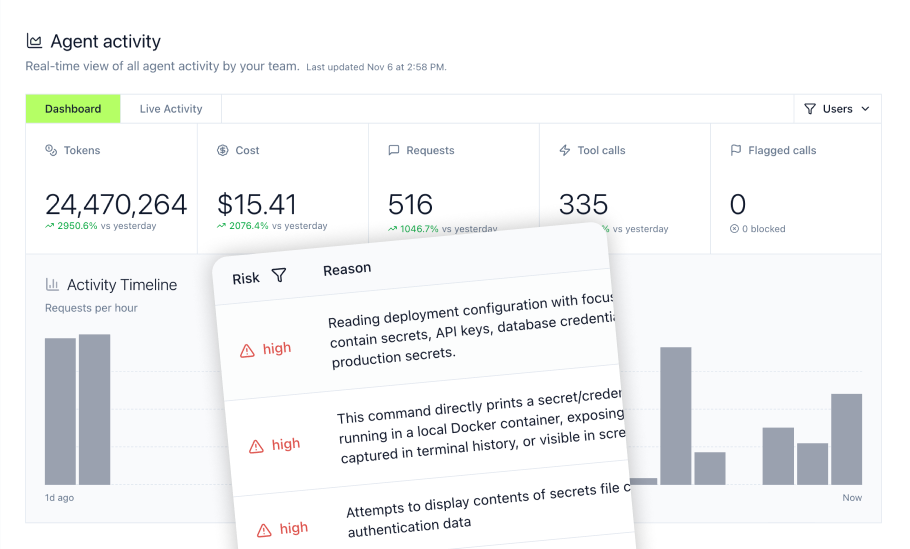
MintMCP's Agent Monitor provides token-level usage tracking by model, user, and session, enabling chargeback and cost attribution across AI agent deployments.
Future Trends and Advanced Patterns in RAG Architecture
RAG architecture continues evolving beyond simple retrieval toward more sophisticated reasoning patterns.
GraphRAG for Relationship-Heavy Queries
Traditional RAG struggles with questions requiring multi-hop reasoning across entity relationships. GraphRAG extends the architecture by:
- Building knowledge graphs from document corpora
- Traversing entity relationships during retrieval
- Enabling queries like "What products does the supplier of our largest customer's competitor manufacture?"
GraphRAG adds modeling and operational complexity but can improve retrieval for relationship-heavy and multi-hop questions when the underlying data can be represented effectively as entities and relationships.
Agentic RAG Patterns
Autonomous agents require RAG systems that support multi-step reasoning:
- Plan-act-review cycles: Agents decompose complex questions, retrieve iteratively, and verify answers
- Tool routing: Dynamic selection of retrieval sources based on query classification
- Self-correction: Detection and recovery from retrieval failures or incorrect reasoning
For organizations deploying persistent autonomous agents, MintMCP's Coworker Agents provide governed execution environments with company-owned memory and scoped tool access for advanced RAG workflows.
Multi-Modal and Real-Time Extensions
Emerging patterns extend RAG beyond text:
- Image and document understanding: OCR and vision models enable retrieval from scanned documents and diagrams
- Streaming ingestion: Real-time document processing keeps knowledge bases current
- Personalized retrieval: User context and history improve relevance ranking
Governing Enterprise RAG with MintMCP
As RAG systems move into production, organizations need consistent control over the data and tools AI agents can access across Claude Desktop, ChatGPT, Cursor, Gemini, Copilot, and other supported environments.
MintMCP provides a governance layer for MCP-based connections through its MCP Gateway, helping teams centralize:
- Access policies for governed tools and data connections
- Credential controls instead of scattered API keys
- Tool curation for different users, roles, and agents
- Audit logging across supported AI clients
For runtime protection, Mint Guard applies managed detection policies for prompt injection, credentials, PII, and harmful content at supported enforcement points.
Agent Monitor adds visibility into supported agent activity, including usage, token costs, and security events across monitored environments.
Together, these controls help organizations manage MCP data risks as RAG systems expand from experiments into production environments handling sensitive or regulated data.
Frequently Asked Questions
How does RAG compare to fine-tuning for enterprise AI applications?
RAG and fine-tuning serve different purposes and can be complementary. Fine-tuning embeds knowledge into model weights, making it suitable for teaching models specialized vocabulary, reasoning patterns, or output formats. However, fine-tuned knowledge becomes stale and requires retraining to update. RAG retrieves current information at query time, automatically reflecting document changes once re-indexed. For most enterprise knowledge management use cases, RAG provides better cost efficiency, auditability, and maintainability. Organizations often combine approaches, using fine-tuning for domain-specific language understanding while relying on RAG for factual knowledge retrieval.
What infrastructure team size is needed to maintain a production RAG system?
Infrastructure requirements vary significantly based on deployment approach. Managed RAG platforms require minimal dedicated staffing, with existing DevOps teams handling integration and monitoring. Custom implementations typically require ongoing ownership across ML or retrieval engineering, data pipelines, infrastructure, evaluation, security, and operations, with staffing needs varying substantially by scale and architecture. The ongoing operational burden includes embedding model updates, vector database optimization, document pipeline maintenance, evaluation metric monitoring, and security patch management. Many organizations start with managed platforms and build internal capabilities only after validating product-market fit.
Can RAG systems handle real-time data updates?
Yes, though implementation complexity increases. Batch-oriented RAG systems process documents on schedules, typically nightly or hourly, introducing latency between source changes and retrieval availability. Real-time RAG requires change data capture pipelines, streaming embedding generation, and incremental vector index updates. Most enterprise use cases tolerate batch latency since knowledge bases change gradually. Real-time requirements typically emerge for customer support applications with rapidly evolving product information or financial services with time-sensitive data. Streaming RAG architectures add operational complexity around change-data capture, embedding generation, incremental indexing, consistency, and failure recovery, but can reduce the delay between source updates and retrieval availability.
How do you prevent RAG systems from surfacing confidential information to unauthorized users?
Document-level access control must be enforced at the retrieval layer, not just the source system. This requires propagating user identity through the RAG pipeline, maintaining permission metadata in vector indexes, and filtering results before they reach the LLM. Many organizations implement dual verification, checking permissions both at retrieval time and validating the generated response doesn't leak information from context the user shouldn't see. Additional controls include PII tokenization before LLM processing, output scanning for sensitive patterns, and comprehensive audit logging of all retrieval events. Enterprise governance platforms like MintMCP centralize these access controls across multiple data connections rather than implementing them separately for each source.
What metrics indicate a RAG system needs architectural improvements?
Several signals can indicate optimization opportunities. Declining retrieval precision may point to chunking, embedding, indexing, or search-configuration problems. Falling user satisfaction may indicate knowledge-base staleness or evolving query patterns. Rising cost per query can reveal larger contexts, model changes, or missed caching opportunities, while latency spikes may indicate retrieval, database, or reranking bottlenecks. Teams should establish application-specific baselines and service thresholds during evaluation rather than relying on universal percentage cutoffs.