When evaluating Speakeasy AI Control Plane alternatives, the choice ultimately comes down to governance requirements, deployment preferences, and whether organizations need to govern human AI clients, autonomous agents, or both. Speakeasy's AI Control Plane combines identity, MCP generation and hosting, policy, observability, and agent controls. This guide compares alternatives across governance, deployment, agent identity, monitoring, and runtime controls.
Enterprise MCP gateway adoption is accelerating in 2026 as organizations seek to govern AI tool access, manage agent identities, centralize credentials, enforce permissions, and maintain audit trails. The vendor landscape spans security-focused platforms, model routing gateways, developer integration tools, and API gateway extensions. Each approach addresses different aspects of enterprise AI governance, from directory-native identity and hosted connectors to ML-based threat detection and air-gapped deployment.
Key takeaways
- MintMCP is designed for enterprises wanting fully managed governance with hosted connectors, Virtual MCPs that bundle curated tools by role or use case, and first-class agent identities
- Virtual MCPs serve as the core abstraction for organizations needing per-use-case endpoints with SCIM-driven membership, curated tool surfaces, and unified access policies
- Agent identity approaches differ across platforms - MintMCP offers non-human agent identities with scoped permissions; Speakeasy supports directory-backed human identity alongside first-class agent principals
- Deployment models range from managed SaaS-first platforms to air-gapped Kubernetes options
- Shadow AI detection capabilities vary from gateway-only visibility to local agent monitoring that hooks into Claude Code, Cursor, and GitHub Copilot
- Runtime security spans managed detection policies to customer-authored middleware for DLP integrations
- Compliance capabilities vary by vendor and plan - SOC 2 status, HIPAA-related controls, audit logging, and deployment requirements should be verified for each platform
Understanding Speakeasy and the MCP gateway landscape
Speakeasy positions its AI Control Plane as an enterprise solution for governing MCP traffic from AI clients and autonomous agents. The platform supports SSO and directory-backed human identity alongside first-class agent principals with their own credentials, policies, and ownership.
Speakeasy capabilities
- Directory-resolved identity for tool call attribution
- API-to-MCP server generation from existing API contracts
- CIMD (Client ID Metadata Documents) for verified client admission
- Agent hooks in Claude Code, Cursor, and Codex
- OTLP export for audit and observability
- Managed MCP hosting for supported generated servers and tool logic
Areas where alternatives differ
- Model routing capabilities - Speakeasy does not provide LLM failover, requiring separate routing infrastructure
- Cost and token reporting coverage varies by client and available telemetry; supported coding-agent sessions can provide token and spend visibility
- First-class agent principals are available with their own credentials, policies, and owners, while some agent credential functionality may still roll out by organization
- Primarily hosted control plane; air-gapped deployment available through enterprise options
1. MintMCP: Managed MCP and agent governance
MintMCP provides enterprise infrastructure for governing AI clients and autonomous agents across the Model Context Protocol ecosystem. The platform helps organizations make AI systems deployable, governed, measurable, and swappable by centralizing tool access, agent identity, credentials, permissions, monitoring, guardrails, and auditability.
Key capabilities
- Virtual MCPs - Bundle approved connectors and curated tool surfaces behind governed endpoints for specific teams, roles, use cases, or agents with SCIM-driven membership
- Fully managed hosted connectors - Run by MintMCP, eliminating the need for customers to operate connector infrastructure
- Agent Gateway - Treats autonomous agents as first-class non-human principals with their own identities, scoped permissions, and credentials
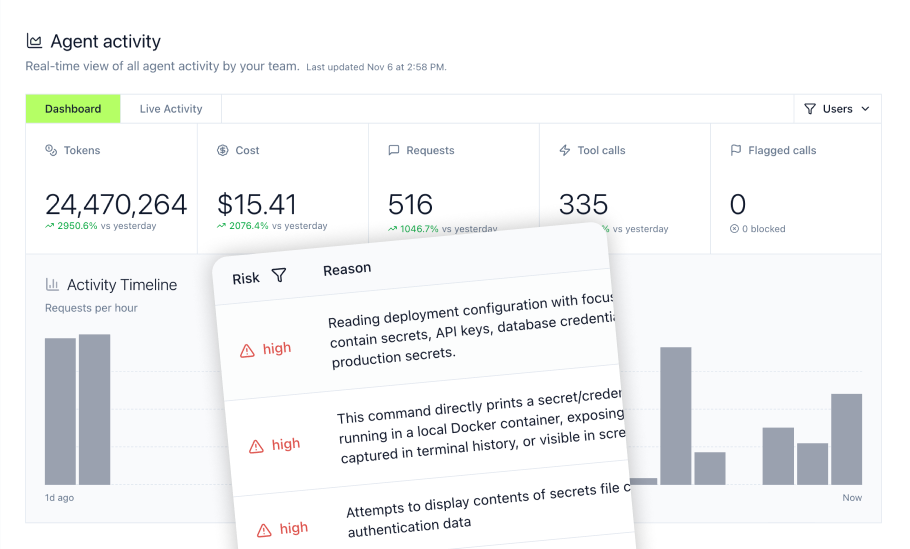
- Agent Monitor - Provides visibility into coding agent activity including prompts, file access, commands, and MCP tool calls
- Runtime guardrails - Mint Guard, declarative Rules, and customer-authored Gateway Middleware
Enterprise security
- SOC 2 Type II audited, HIPAA standards compliance, CASA Tier 2 certified
- SSO and SCIM with Okta, Entra ID, and Google
- SIEM export via OTLP or Splunk HEC
- Tamper-evident access-grant history signed at write time
- Operational controls including org-wide kill switch
MCP gateway features
Virtual MCPs serve as the core abstraction, functioning as the unit of deployment, access control, tool curation, audit, and administration. Directory groups can drive membership through SCIM, helping organizations apply consistent access policies without requiring every employee to configure each MCP server separately.
The platform supports hosted, remote, custom, and STDIO connectors, with centralized authentication and credential handling. OAuth brokering supports hosted or STDIO environments where direct redirect-URI handling creates deployment challenges.
Agent identity model
Agent Gateway builds on the MCP Gateway foundation by extending governed data and tool access to first-class agent identities. Supported authentication includes:
- Bearer API keys with name, expiry, and individual revocation
- OAuth 2.0 client-credentials tokens for short-lived access
- Workload identity federation where the agent's infrastructure mints OIDC tokens
Customer feedback
From Christian Burrows, Head of Security at Stability AI: "I'm very happy that we found MintMCP. It solved our most immediate MCP problems."
From Juan Vasquez, CTO at Deerfield Group: "It's as simple as adding the bundle to your Claude or Codex, and it has all the tools our IT team has already vetted. The virtual bundles are our number one feature."
From Ankit Kumar, Engineering Leader at Modern Treasury: "It saves our Technical Account Managers 30 minutes to 4 hours per case."
2. Runlayer
Runlayer positions itself as a security-led MCP gateway with ML-based threat detection and MDM integration for shadow AI discovery.
Key capabilities
- ToolGuard and AgentGuard provide ML-based threat detection with MITRE ATLAS mapping
- MDM-based shadow AI discovery integrates with Jamf, Intune, and Kandji
- Single-tenant AWS deployment offers dedicated infrastructure per customer
- Agent identity model through Runlayer Agent Accounts with scoped permissions
- Request-level audit logging
Platform characteristics
- Hybrid deployment: managed SaaS plus self-hosted on customer infrastructure
- Built-in connectors, registration of existing MCP servers, and deployment of custom MCP servers to managed infrastructure
- Supports turning APIs into custom MCP servers and hosting them on managed infrastructure
- Broader agent and endpoint visibility is available alongside MCP governance, although model routing is not the platform's primary focus
- SOC 2 Type II, HIPAA compliance, and GDPR compliance
3. TrueFoundry
TrueFoundry combines AI gateway functionality with MCP governance, providing model routing for 1,600+ models alongside tool access control on a unified platform.
Key capabilities
- Unified model and tool gateway routes LLM traffic and governs MCP connections
- 1,600+ model routing with semantic caching
- Native policy-as-code with Cedar and OPA while also integrating external guardrail and security providers
- Flexible deployment including SaaS, self-hosted Kubernetes, and air-gapped options
- OpenTelemetry integration
Platform characteristics
- Identity model based on gateway users with SSO integration
- 99.99% uptime is currently stated for the AI Gateway
- Audit logging is available in the platform; exact plan entitlements and retention should be verified against current pricing
- Self-hosted deployments require more infrastructure ownership, while a managed SaaS option is also available
Pricing: TrueFoundry publishes Developer, Pro, and Pro Plus tiers alongside custom Enterprise pricing.
4. Composio
Composio positions itself as a developer platform for building agentic applications, offering 1,500+ pre-built integrations with managed authentication.
Key capabilities
- 1,500+ pre-built integrations spanning productivity, CRM, development, and data tools
- Managed OAuth flows handle authentication complexity
- SDK-first approach optimized for developer workflows
- 100,000 free tool calls per month on the free tier
- Sandboxed code execution for agent actions
Platform characteristics
- Developer and AI engineering team buyer profile
- External customer-facing AI products as primary use case
- Managed SaaS-first with VPC/on-prem on Enterprise tier only
- SSO and governance features gated to Enterprise tier
5. Portkey (PRISMA AIRS AI gateway)
Portkey was acquired by Palo Alto Networks in 2026 and now operates as PRISMA AIRS AI Gateway. The platform originated as an LLMOps solution with production LLM stack capabilities.
Key capabilities
- 1,600+ LLM integrations with comprehensive model coverage
- Production LLM stack including routing, caching, and observability
- Guardrails for PII redaction and content filtering
- Org-wide audit logs for compliance visibility
- Deployment options currently include self-hosted, customer-cloud, and fully managed configurations
Platform characteristics
- Verified agent identities with session-scoped permissions through Prisma AIRS AI Gateway
- RBAC for access control
- Portkey's existing pricing still lists a free Developer tier, while Prisma AIRS AI Gateway uses consumption-based token metering and Flex Credit licensing
- Enterprise support backed by Palo Alto Networks
- Current Portkey materials continue to advertise self-hosted and customer-controlled deployment options
6. Kong AI Gateway
Kong AI Gateway 2.0 is generally available as a dedicated AI Gateway runtime and control plane with MCP gateway capabilities. Some MCP-related components, including the AI MCP OAuth2 plugin and MCP Registry, remain in Tech Preview.
Key capabilities
- Leverage existing Kong infrastructure
- openapi2mcp tool generates MCP servers from existing API contracts
- RBAC from v3.13 provides tool-level access control
- Hybrid deployment via Konnect SaaS control plane plus self-hosted data plane
- Fully self-hosted option for air-gapped requirements
Platform characteristics
- AI Consumers with API-key or OIDC authentication through enterprise identity providers
- Dedicated AI Gateway runtime and control plane for LLM, MCP, and agent traffic
- Basic audit logging capabilities
- Excluded from Kong AI Guardrails, meaning no native content screening
7. LiteLLM
LiteLLM provides an open-source LLM proxy with an MCP gateway module.
Key capabilities
- Open-source MIT license for the core project, with separate licensing for enterprise components
- Self-hosted deployment on any infrastructure
- Virtual-key authentication in the open-source gateway, with additional SSO/SCIM and OIDC/JWT options in Enterprise
- LLM proxy core with MCP gateway as extension
- Active open-source community
Platform characteristics
- High implementation effort requiring operational expertise
- Full self-management of infrastructure and updates
- Enterprise tier available for additional features
- Gateway traffic visibility only; no local agent monitoring
Why organizations choose MintMCP for enterprise MCP governance
MintMCP is designed for teams that prioritize managed connector infrastructure, Virtual MCPs, first-class agent identities, Agent Monitor visibility, and runtime guardrails. The platform addresses enterprise governance requirements through:
- Minimal operational overhead - Fully managed hosted connectors eliminate platform team bottlenecks for new integrations, allowing IT and Security teams to focus on policy rather than infrastructure
- Role-based tool curation - Virtual MCPs bundle approved connectors behind governed endpoints with SCIM-driven membership, making it simple to deploy read-only and read-write tool sets for different teams
- First-class agent identity - Agent Gateway treats autonomous agents as distinct principals with independent credentials, scoped MCP access, and attributable audit trails
- Comprehensive visibility - Agent Monitor captures coding agent activity through lightweight local hooks, providing visibility into prompts, file access, commands, and MCP tool calls that never touch a centralized gateway
- Runtime protection - Mint Guard provides managed detection policies for prompt injection, secrets, PII, and harmful content, while Gateway Middleware supports customer-authored JavaScript for DLP integrations
The platform is SOC 2 Type II audited, compliant with HIPAA standards, and supports SSO/SCIM integration with Okta, Entra ID, and Google. Organizations evaluating MCP governance platforms should consider deployment requirements, identity architecture, monitoring coverage, guardrails, and model-routing needs. Start evaluating MintMCP for enterprise MCP governance requirements.
Frequently asked questions
How do Virtual MCPs differ from traditional API gateways?
Virtual MCPs bundle multiple MCP connectors behind a single governed endpoint with curated tools, SCIM-driven membership, and unified access policy. Unlike traditional API gateways that route individual endpoints, Virtual MCPs present a role-appropriate tool surface to AI clients, handling tool curation, credential injection, and audit as a unified abstraction. This eliminates per-server configuration while enabling organizations to create read-only and read-write tool sets over the same underlying connectors.
What role does Agent Gateway play in securing autonomous agents?
MintMCP's Agent Gateway treats autonomous agents as first-class non-human principals rather than extensions of human credentials. Each agent can receive its own identity, scoped MCP access, independent credentials, and attributable audit trail. Authentication mechanisms include bearer keys, OAuth client-credentials tokens, and workload identity federation. This answers critical governance questions: Which agent is acting? What permissions apply? How can access be revoked independently?
Can MintMCP integrate with existing cloud environments?
MintMCP integrates with enterprise cloud and identity infrastructure through SSO and SCIM for Okta, Entra ID, and Google. Secret providers support AWS, GCP, and Azure credential management. Private network tunnels enable connectivity to on-premises or VPC-based systems without public exposure. Directory groups drive both admin roles and tool access, with suspension in the IdP propagating to MintMCP.
What security features does MintMCP provide?
MintMCP provides multiple security layers: Mint Guard offers managed detection policies for prompt injection, secrets, PII, and harmful content. Declarative Rules enable tool-name and argument matching with flag, block, or mask actions. Gateway Middleware supports customer-authored JavaScript for DLP integrations, external classifiers, and custom policy enforcement. The platform is SOC 2 Type II audited, compliant with HIPAA standards, and provides audit logs with SIEM export alongside tamper-evident access-grant history.
How does MintMCP provide visibility beyond gateway traffic?
Agent Monitor captures coding agent activity through lightweight local hooks rather than relying solely on gateway traffic. This includes prompts, file access (including .env and SSH keys), commands, and MCP tool calls from Claude Code, Cursor, Codex, and GitHub Copilot. Coverage varies by client, agent, and hook phase, but the approach provides visibility into agent behavior that never touches a centralized gateway.