When evaluating Zuplo MCP gateway alternatives, the choice depends on whether you need an API/AI gateway platform that also provides MCP governance or a platform centered on internal AI-agent governance and managed MCP connectivity. Zuplo offers a unified API/AI/MCP gateway with TypeScript programmability, Virtual MCP servers, RBAC, authentication policies, and audit capabilities. This comprehensive guide examines the top MCP gateway alternatives, including MintMCP's approach to governed tool access, first-class agent identity, monitoring, and managed connector operations.
Enterprise teams implementing AI agents face a fundamental infrastructure question: should MCP governance layer onto existing API gateway investments, or does governed AI-agent deployment require specialized identity and access management architecture? The answer depends on whether your primary use case centers on external API exposure with MCP support or internal employee and autonomous-agent governance with SCIM-driven access control, per-agent identity, laptop-level monitoring, and compliance-ready audit trails.
Key takeaways
- MintMCP is designed for internal enterprise AI governance with SCIM-driven RBAC, Virtual MCPs, and per-agent identity through Agent Gateway
- Zuplo extends API gateway infrastructure into MCP governance with Virtual MCP servers, authentication, scoped access, security policies, and audit capabilities, while MintMCP adds a distinct first-class agent identity model and managed connector runtime
- Enterprise AI governance requires specialized infrastructure including Virtual MCPs for role-based tool access, non-human identity for autonomous agents, and runtime guardrails
- Managed connector runtimes eliminate DevOps burden since MintMCP operates hosted connectors while some approaches require customers to run MCP servers themselves
- Two-layer visibility matters for compliance because gateway-only solutions miss local agent activity on developer workstations, creating shadow AI blind spots
Understanding Zuplo: A capable API gateway with MCP support
Zuplo positions itself as a programmable API/AI/MCP gateway platform that unifies three gateway types in a single control plane. The platform offers TypeScript-native policy authoring, GitOps workflows, and edge deployment across 300+ locations globally.
Key Zuplo strengths
- Unified platform architecture combining API, AI, and MCP gateways
- TypeScript-native programmability with GitOps deployment workflow
- Edge-native architecture for global request distribution
- GitOps-driven deployment across 300+ global edge locations
- OAuth/OIDC authentication support
- Built-in prompt injection detection
Considerations for enterprise AI governance
- Mixed gateway and server model supports upstream MCP proxying and API-to-MCP tool exposure through Zuplo's MCP Server Handler
- Different connector operating model emphasizes API-to-MCP hosting and upstream MCP proxying rather than a managed connector catalog
- Stateless gateway architecture aligns with MCP 2026-07-28 stateless protocol core; teams should validate specific MCP extensions required by their workloads
- Add-on costs for VPC/tunnels since private connectivity requires paid add-ons not included in base tiers
- No laptop-level agent monitoring for discovering shadow MCP usage outside the gateway path
Pricing starts at $0/month for the free tier (100K requests, 1K MCP tool calls), scales to $25/month for the Builder plan, and custom Enterprise pricing starting around $1,000/month. The transparent pricing works well for teams with predictable workloads.
1. MintMCP: Built for internal enterprise AI governance
MintMCP provides enterprise infrastructure for governing AI clients and autonomous agents across the Model Context Protocol ecosystem. The platform makes AI systems deployable, governed, measurable, and swappable by centralizing tool access, agent identity, credentials, permissions, monitoring, guardrails, and auditability.
Key MintMCP capabilities
- Virtual MCPs bundle connectors behind governed endpoints per role, team, or agent
- Agent Gateway provides first-class non-human identity with M2M authentication
- 50+ managed connectors run by MintMCP eliminate connector runtime management
- SCIM-driven RBAC syncs tool access directly from IdP groups
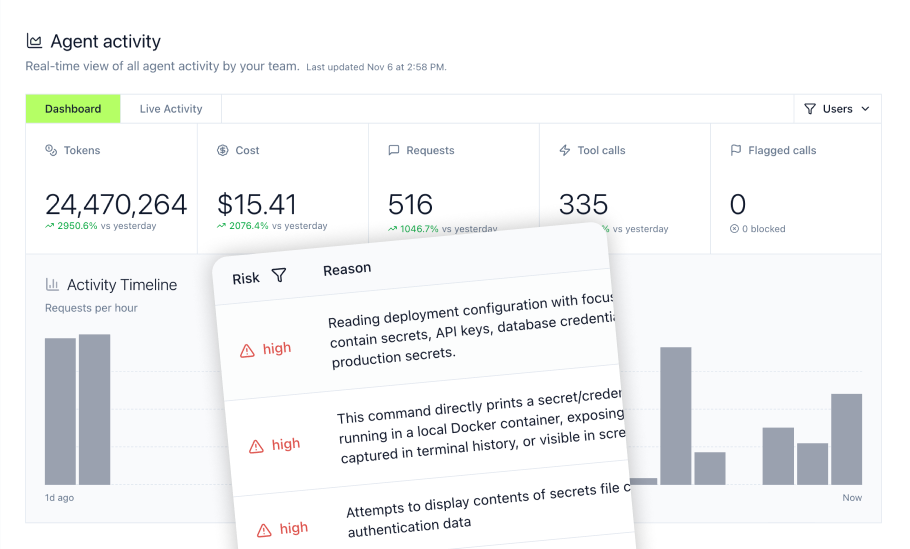
- Agent Monitor captures local activity beyond gateway traffic
- One-click STDIO transformation converts local MCP servers to production-ready remote services
- Official Cursor partnership for validated AI coding assistant integration
Enterprise security and compliance
MintMCP holds SOC 2 Type II attestation and is compliant with HIPAA standards, with BAA available for healthcare organizations. The platform uses continuous compliance monitoring, and penetration testing validates security posture. Data encryption in transit and at rest comes standard, with data residency options for regulated industries.
Virtual MCP capabilities
Both Zuplo and MintMCP support virtualized MCP endpoints. MintMCP's Virtual MCP abstraction serves as a unit of deployment, access control, tool curation, audit, and administration. Directory groups can drive membership through SCIM, helping organizations apply consistent access policies without requiring every employee to configure each MCP server separately.
Agent identity and governance
The Agent Gateway treats autonomous agents as first-class non-human principals. Each agent can have:
- Its own identity separate from human accounts
- Scoped credentials with independent rotation and revocation
- Purpose-built MCP access through dedicated Virtual MCPs
- Attributable audit trail for compliance reporting
- Support for bearer keys, OAuth client-credentials, and workload identity federation
Two-layer visibility
MintMCP separates gateway governance from broader agent activity visibility:
- MCP Gateway governs traffic routed through governed MCP connections
- Agent Monitor provides visibility into supported local activity including prompts, file access, commands, and MCP tool calls
This distinction matters for teams running Claude Code, Cursor, or other coding agents on developer workstations where some activity may bypass a centralized gateway.
Runtime guardrails
MintMCP's guardrail architecture includes three complementary layers:
- Mint Guard: Managed detection for prompt injection, secrets, PII, and harmful content
- Rules: Declarative matching and enforcement on tools, arguments, or content
- Gateway Middleware: Customer-authored JavaScript for DLP integrations and custom policies
Supported AI clients
Pricing structure
- Custom pricing based on team size, usage, and deployment
- VPC and self-hosted deployment options available on request
- Transparent quote process based on requirements
Real success stories
MintMCP customers include Coursera, Stability AI, Modern Treasury, and Workstream. Modern Treasury reported that the platform "saves 30 minutes to 4 hours per case" through governed AI agent access to banking operations data.
2. Composio
Composio focuses on developer-first integration with an extensive managed catalog spanning 1,500+ app toolkits. The platform prioritizes speed to first working agent.
Key characteristics
- Largest pre-built integration catalog in the MCP gateway space
- SOC 2 Type II attestation and ISO 27001
- Unified authentication across managed connectors
- Developer-focused architecture
- Action-level access controls, SSO, and SCIM provisioning; targets AI engineering teams building agentic applications
Platform details
- SaaS deployment with private VPC and self-hosted options available through Enterprise arrangements
- Free tier includes 100K monthly tool calls for own-app, API-key, or MCP usage
- Pro costs $29/month with $29 in monthly usage credit; base overage is $0.0003 per tool call
- Custom tools and toolkits supported alongside managed integrations
3. TrueFoundry
TrueFoundry offers a unified AI infrastructure platform combining LLM routing, model serving, and MCP governance in a single control plane.
Key strengths
- Combined LLM and MCP gateway in single platform
- Kubernetes-native architecture for container-fluent teams
- VPC and on-premises deployment options
- Prebuilt MCP integrations plus custom servers
Platform characteristics
- Tiered pricing starts with a $0/month Developer plan, followed by $499/month Pro, $2,999/month Pro Plus, and custom Enterprise pricing
- Steeper learning curve than standalone MCP gateways
- Platform complexity higher than dedicated MCP gateways
- Built-in guardrails for prompt injection
4. Obot
Obot provides an MIT-licensed open-source MCP control plane with a complete platform including gateway, registry, catalog, and chat client in a single deployment.
Key strengths
- True open source with full code visibility
- No vendor lock-in with MIT license
- All-in-one platform deployable via Docker or Kubernetes
- Managed service option available for teams without DevOps capacity
Platform characteristics
- Free open source core with optional commercial support
- Obot Cloud provides managed hosting; self-hosted teams manage infrastructure
- IdP integration for OAuth 2.1 authentication
- Tool-level RBAC with composite server support
Considerations
- Self-hosted deployments require ongoing infrastructure maintenance and monitoring
- Community deployments do not include enterprise SLA and support without a commercial agreement
5. Portkey
Portkey provides an AI gateway with LLM routing as the primary capability and MCP support as an extension. The platform was acquired by Palo Alto Networks in 2026.
Key characteristics
- Combined LLM routing and MCP gateway
- Open source AI Gateway component available
- Hybrid deployment options including EKS, AKS/ACA, GKE, and AWS Marketplace
- Air-gapped deployment support
- Primary focus on LLM routing; MCP support added as extension
6. Kong AI Gateway
Kong offers MCP support through its established API gateway platform, targeting organizations already invested in Kong infrastructure.
Key characteristics
- Leverage existing Kong API gateway investment
- Enterprise API management maturity
- Hybrid deployment with Konnect SaaS control plane
- REST API exposure as MCP servers
- AI Gateway 2.x exposes first-class AI MCP Server entities with proxying, REST-to-MCP conversion, authentication, ACLs, observability, and tool aggregation
Why MintMCP stands out for enterprise AI governance
MintMCP's enterprise AI governance approach centers on its data-permissions-first architecture. The platform starts from governed access to enterprise data and tools through SSO, SCIM, IdP groups, Virtual MCPs, tool-level policy, credential controls, and audit, then extends that foundation to autonomous agents.
Virtual MCP bundles with SCIM-driven membership
The Virtual MCP abstraction represents a fundamental architectural difference from proxy-only approaches. One endpoint can represent a role, team, use case, or agent with:
- SCIM-driven group membership synced from your IdP
- Curated tool lists that reduce context-window bloat
- Access policies enforced at the gateway
- Unified audit trail across all bundled connectors
Hosted connector runtime
MintMCP operates managed connector instances and hosts supported MCP servers on behalf of customers. This eliminates the DevOps burden of running connector infrastructure while maintaining enterprise security:
- Connectors run in MintMCP's data plane, never exposed to the internet
- Credential injection per call with no long-lived secrets in connector processes
- Auto-scaling and sandboxed execution managed by MintMCP
- One-click deployment for supported integrations
Agent identity as a first-class primitive
The Agent Gateway addresses the governance gap that emerges when autonomous agents operate through human credentials or shared API keys:
- Each agent receives a named, org-scoped non-human identity
- Authentication options scale from bearer keys to workload identity federation
- Credentials rotate and revoke independently from human accounts
- Audit trails attribute every action to the specific agent, addressing OWASP guidance on agent identity and authorization controls
Choosing the right MCP gateway for your enterprise
Selecting a Zuplo alternative depends on your specific requirements, technical expertise, and primary governance focus. MintMCP is designed for teams prioritizing internal enterprise AI governance, combining managed MCP connectivity with access controls, first-class agent identity, monitoring, and runtime policy enforcement.
For teams focused on internal AI governance, requiring compliance-ready audit trails, or lacking DevOps capacity for connector operations, MintMCP combines managed MCP connectivity with identity, access control, monitoring, and runtime governance. The platform's proven track record with enterprises like Coursera and Modern Treasury, comprehensive documentation, official Cursor partnership, and Okta integration support successful AI agent deployments.
As enterprise AI adoption expands, MintMCP focuses on making AI agents deployable, governed, measurable, and swappable across changing AI stacks. Organizations can start by exploring the product tour or reviewing the security governance documentation to understand how Virtual MCPs and Agent Gateway address enterprise governance requirements.
The platform's architecture delivers:
- Unified identity and access control through SCIM-driven RBAC that syncs tool permissions directly from IdP groups, eliminating manual configuration and ensuring consistent policy enforcement
- Visibility across gateway and supported local activity by combining MCP Gateway for centralized traffic with Agent Monitor for supported local workstation activity, addressing shadow AI risks that gateway-only solutions miss
- Reduced operational burden through managed connector hosting that eliminates the need to deploy, scale, and maintain MCP server infrastructure
- First-class agent identity via Agent Gateway, treating autonomous agents as distinct non-human principals with independent credentials, rotation, revocation, and attributable audit trails
- Runtime guardrails through layered controls including Mint Guard for managed detection, declarative rules for policy enforcement, and custom middleware for enterprise DLP integration
MintMCP's Virtual MCP abstraction serves as the fundamental unit of deployment, access control, tool curation, and audit, enabling organizations to package and govern MCP connectivity by role, team, or use case rather than requiring individual server-by-server configuration. This architectural approach aligns with enterprise requirements for centralized policy management, least-privilege access, and compliance-ready audit trails.
Frequently asked questions
Can MintMCP integrate with existing identity providers?
Yes, MintMCP provides SCIM-driven RBAC that syncs tool access directly from IdP groups. The platform supports major identity providers including Okta, Azure AD, and Google Workspace. Directory group membership automatically drives Virtual MCP access, eliminating manual permission management. Teams can map organizational roles to curated tool sets through IdP group policies, ensuring consistent governance across the organization.
How does MintMCP handle agent identity?
MintMCP's Agent Gateway treats autonomous agents as first-class non-human principals with their own identities, scoped credentials, and independent audit trails. Each agent receives a named, org-scoped identity that can authenticate via bearer keys, M2M OAuth, or workload identity federation. Credentials rotate and revoke independently from human accounts, and every action in the audit log attributes to the specific agent rather than a generic service account.
What is the difference between MCP Gateway and Agent Monitor?
MintMCP separates MCP Gateway for centralized traffic governance from Agent Monitor for broader visibility. The Gateway governs MCP tool calls routed through managed connections, enforcing access policies, injecting credentials, and capturing audit logs. Agent Monitor provides visibility into local activity on developer workstations, including prompts, file access, commands, and MCP tool calls that may bypass centralized infrastructure. This two-layer approach addresses shadow AI risks that gateway-only solutions miss.
Does MintMCP support custom MCP servers?
Yes, MintMCP supports both hosted managed connectors and custom MCP servers. The platform provides one-click STDIO-to-remote transformation that converts local MCP servers to production-ready remote services. Teams can register custom servers, apply access policies, inject credentials at runtime, and capture audit logs. This flexibility allows organizations to govern proprietary integrations alongside managed connectors through a unified control plane.
How does MintMCP ensure compliance for regulated industries?
MintMCP holds SOC 2 Type II attestation and is compliant with HIPAA standards, with BAA available for healthcare organizations. The platform provides immutable audit logs exportable via OTLP and Splunk HEC, continuous compliance monitoring, penetration testing, and data encryption in transit and at rest. Security governance documentation details compliance controls, and data residency options support regulated-industry requirements. Organizations can review the pricing page for compliance packaging details.