When evaluating Nango alternatives for enterprise AI agent governance, the choice comes down to whether organizations need code-first integration flexibility or comprehensive governance infrastructure. While Nango excels at open-source API connectivity with OAuth management, many enterprise teams require more than connectivity. They need centralized identity management, audit trails, runtime guardrails, and compliance-ready architecture that integration platforms leave teams to build themselves.
This guide examines Nango alternatives, with particular emphasis on how MintMCP differs for enterprise AI agent governance. Organizations deploying Claude, Cursor, ChatGPT, Gemini, and Copilot at scale need to address not just API connectivity, but also access control, agent identity, monitoring, policy enforcement, and auditability. The NIST AI Risk Management Framework provides a voluntary framework organized around governing, mapping, measuring, and managing AI risks across the AI lifecycle.
Key takeaways
- Enterprise AI governance requires more than integration connectivity. Organizations deploying AI agents need centralized identity, access control, monitoring, and audit infrastructure.
- Virtual MCP Bundles provide per-use-case governance. This architecture enables security teams to create role-specific endpoints with SCIM-driven membership and curated tool lists.
- First-class agent identity separates autonomous agents from human credentials. Autonomous agents should operate with their own credentials, scoped permissions, and attributable audit trails.
- Runtime guardrails can stop risky actions before execution. Managed detection policies for prompt injection, secrets, PII, and harmful content can screen governed gateway tool calls without requiring custom policy authoring.
- Compliance requirements vary by industry and data type. Organizations handling regulated data may require audit trails, access controls, compliance documentation, and BAA support where applicable.
- Agent monitoring extends beyond gateway traffic. Security teams need visibility into prompts, commands, file access, and tool calls across agent activity.
1. MintMCP
MintMCP provides enterprise infrastructure for governing AI clients and autonomous agents across the Model Context Protocol ecosystem. The platform's data-permissions-first architecture helps organizations make AI systems deployable, governed, measurable, and swappable by centralizing tool access, agent identity, credentials, permissions, monitoring, guardrails, and auditability.
Platform architecture
MintMCP's MCP Gateway serves as a governed entrypoint between AI clients and enterprise tools. The platform:
- Authenticates users through your identity provider
- Curates which tools each role can see
- Injects the right credentials per call
- Routes to the appropriate connector
- Logs MCP interactions and configuration changes, with access-grant history records signed at write time for tamper evidence
The key abstraction is the Virtual MCP: many connectors bundled behind one endpoint so users connect once instead of configuring each server separately. Security teams can create finance-team-bundle, engineering-team-bundle, and similar role-specific configurations with different approved tools and permissions per group.
Agent identity and governance
Agent identities give every autonomous agent its own credential, scoped MCP access, and audit trail separate from the human who created it. Authentication mechanisms range from bearer keys for simple deployments to M2M tokens and workload identity federation for zero-secret architectures.
Each agent can have:
- Its own named identity in the same authorization model as humans
- Scoped permissions that can be rotated or revoked independently
- Independent credential expiration without affecting other agents
- An attributable audit trail for every tool call
Runtime guardrails
MintMCP's guardrails architecture provides three complementary layers:
- Mint Guard: Managed detection policies for prompt injection, credentials, PII, and harmful content with monitoring and enforcement modes, addressing threats identified in the OWASP LLM Top 10
- Rules: Declarative matching on tool names, arguments, or content with actions including flag, block, ask, mask, or notify
- Gateway Middleware: Customer-authored JavaScript for transformations, DLP integrations, external classifiers, and custom policy enforcement
Monitoring and observability
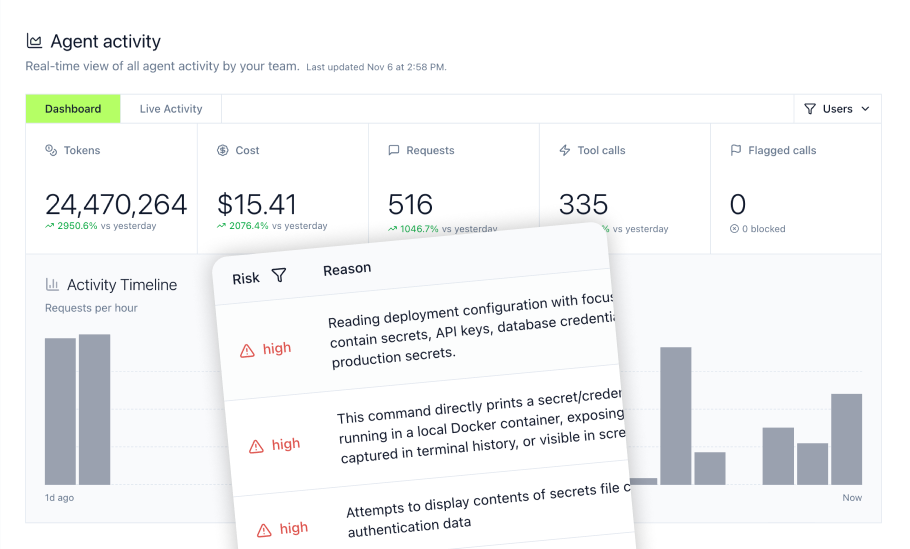
Agent Monitor captures activity across coding agents including Claude Code, Cursor, Codex, and GitHub Copilot. The platform provides:
- Live activity feed with filtering by user, agent, tool, or time
- Usage and cost tracking by model, user, agent, and session
- SIEM export via OTLP or Splunk HEC
- Security rules with built-in detection for secrets and prompt injection
Enterprise features
MintMCP includes comprehensive enterprise capabilities:
- RBAC with VMCP access policies driven by directory groups
- Audit trails for MCP activity and configuration changes, with access-grant history records signed at write time
- Operational controls including org-wide kill switch
- Configuration as code for declarative gateway management
- Private network tunnel for on-premises connectivity
- Enterprise SSO and SCIM integration with Okta, Entra ID, and Google
- SOC 2 Type II audited infrastructure compliant with HIPAA standards with BAA availability
Coworker agents
Coworker Agents extend the platform from governed connectivity into governed autonomous work. These hosted, long-running agents can:
- Operate through Slack, schedules, or manual triggers
- Maintain company-owned, git-backed memory
- Continue work across days with reviewable instructions
- Use scoped tool access through Virtual MCPs
Customer validation
Enterprise customers including Coursera, Stability AI, Modern Treasury, Workstream, and Flashfood use MintMCP for AI agent governance. Juan Vasquez, CTO of Deerfield Group, noted that Virtual Bundles are their number one feature, while Christian Burrows, Head of Security at Stability AI, reported satisfaction with MintMCP solving their most immediate MCP problems.
2. Nango
Nango positions itself as an open-source integration platform that simplifies connecting AI agents to external APIs through managed OAuth, data synchronization, and pre-built integrations. The platform supports a broad API catalog with a code-first approach.
Core capabilities
- Open-source platform with full code visibility and community contributions
- Self-hosting flexibility with a limited free self-host option plus full Enterprise self-hosting and BYOC
- Usage-based pricing with a $0.29 per-connection monthly charge plus metered compute and data transfer
- Managed OAuth flows with pre-built tools and templates
- Full request/response visibility with OpenTelemetry export
- Data synchronization capabilities including syncs, webhooks, and backfills
Governance considerations
Nango has added enterprise governance capabilities across its tiers:
- RBAC, SAML SSO, SCIM, audit logs, and OpenTelemetry export are available, with some capabilities limited to higher tiers
- Agent Sessions can scope connections, tools, and session lifetime for individual agent interactions
- Nango does not mirror MintMCP's Virtual MCP model with SCIM-driven membership and curated per-use-case endpoints
- Nango does not provide the same first-class Agent Gateway model with independent non-human identities and per-agent credential lifecycle controls
- Observability centers on integrations and tool executions rather than broader endpoint activity such as prompts, commands, and file access
- Built-in managed detection policies comparable to Mint Guard are not surfaced in the reviewed Nango documentation
Pricing
Nango's free tier currently includes 10 connections. Its pay-as-you-go plan starts at $50/month with $50 in monthly usage credits, with usage metered across connections, compute, and data transfer. Enterprise pricing is custom and includes expanded self-hosting and BYOC options.
3. Composio
Composio positions itself as an AI agent integration platform with 1,500+ pre-built toolkits and framework adapters for LangChain, CrewAI, AutoGen, and LlamaIndex. The platform targets developer teams building agentic applications.
Core capabilities
- 1,500+ pre-built agent-ready toolkits for rapid development
- Framework adapters for major AI agent platforms
- Managed OAuth flows with automatic authentication handling
- Free tier with 100,000 monthly tool calls and a $29/month Pro plan with included usage credit
- SDK-first approach with comprehensive developer documentation
Enterprise considerations
- SSO and SCIM are concentrated in the Enterprise tier, while BAA support is available as a paid add-on on Pro and higher plans
- No Virtual MCP Bundles or per-use-case MCP endpoints
- No Agent Bundles for first-class agent identity
- No comprehensive agent monitoring component for prompts and file access
- May 2026 security incident involved unauthorized access to internal Composio systems, exposure of customer credentials, and attacker-controlled code execution within the tool-execution sandbox; Composio has since documented remediation and hardening measures
Pricing structure
- Free: 100,000 tool calls per month
- Pro: $29/month with included usage credit and usage-based overages
- Enterprise: Custom pricing for SSO, SCIM, and additional security features
Enterprise governance capabilities such as SSO and SCIM are concentrated in higher tiers, with additional security and compliance options available.
4. Arcade
Arcade focuses on per-user delegated authorization where agents act as users rather than service accounts. The platform provides an MCP-native runtime with thousands of agent-optimized tools and just-in-time permission enforcement.
Core capabilities
- Delegated OAuth model with per-user token vaulting
- Thousands of agent-optimized tools across a broad integration catalog
- MCP runtime with MCP Gateways that federate selected tools and MCP servers behind a single endpoint
- Just-in-time permissions with runtime-enforced context intersection
- Per-tool permission scoping for granular access control
Governance considerations
- Tool calls only with no data syncs, webhooks, or unified APIs
- Tool Execution Logs now record tool runs and outcomes; retention and logging configuration vary by deployment
- SOC 2 Type II attestation with no published HIPAA BAA or ISO 27001 in reviewed documentation
- No Virtual MCP Bundles or SCIM-driven membership
- No comprehensive agent monitoring for prompts and file access
Pricing structure
- Free: Includes monthly authentication-event and tool-call allowances
- Team: $25/month plus usage
- Enterprise: Custom pricing with additional deployment options
5. Merge Agent Handler
Merge Agent Handler is an MCP-based agent integration platform that exposes agent-ready tools across a broad connector catalog while applying security controls to agent actions. It is distinct from Merge's Unified API product, which provides normalized data models across categories such as HRIS, ATS, CRM, and accounting.
Core capabilities
- Agent-ready tools across a broad connector catalog
- DLP scanning with PII/PHI detection and allow/redact/block policies
- Tool Packs can bundle selected connectors and tools for a particular agent surface
- Supports Microsoft Copilot Studio integration through MCP; Merge announced plans in June 2026 to bring Agent Handler to Microsoft Agent Store
- Strong compliance posture including HIPAA with BAA
Governance considerations
- Uses credit-based Agent Handler pricing rather than the linked-account pricing model described here
- Tool Packs can bundle selected connectors and tools for a particular agent surface
- Enterprise plans support additional deployment options, including custom and on-premises deployments
- Connector coverage extends beyond the seven Unified API categories
- Tool Packs are not equivalent to MintMCP Virtual MCPs with SCIM-driven membership and access policies
- Observability centers on agent tool activity rather than MintMCP-style endpoint monitoring of supported prompts, commands, and file access
Pricing structure
- Free: 2,000 monthly credits
- Pro: Starts at $1,000/month for 25,000 monthly credits
- Enterprise: Custom pricing and deployment options
6. Workato Enterprise MCP
Workato Enterprise MCP extends an established iPaaS platform with MCP capabilities. The platform brings enterprise connectors and workflow automation to AI agent deployments with Recipe Functions as reusable skills.
Core capabilities
- Established platform with extensive G2 reviews
- Broad enterprise connector catalog with Recipe Functions
- Visual workflow builder with hundreds of thousands of pre-built recipes
- Governance controls including Verified User Access, rate limits, and PII masking
- Strong enterprise reputation with proven track record
Governance considerations
- Workflow and recipe-oriented model may be less code-first than developer-focused platforms, although Enterprise MCP can expose Workato functions and skills and proxy supported third-party MCP servers
- Cloud-only deployment with no customer-operated self-hosting surfaced in reviewed documentation
- Recipe concurrency limits capped at 30 jobs unless negotiated
- No Virtual MCP Bundles for per-use-case endpoints as implemented in MintMCP
- No first-class agent identity model comparable to MintMCP Agent Bundles
Pricing structure
Custom enterprise pricing; requires sales contact for quotes.
Why MintMCP for enterprise AI agent governance
Organizations evaluating Nango alternatives face a fundamental question: does the platform provide comprehensive governance infrastructure, or just connectivity that requires custom development? MintMCP is designed specifically for enterprise AI agent governance, addressing the complete governance lifecycle from identity to audit.
Core governance capabilities:
- Virtual MCP Bundles provide per-use-case endpoints with SCIM-driven membership, eliminating the need for every employee to configure individual MCP servers
- Agent Gateway treats autonomous agents as first-class non-human principals with independent identities, credentials, and audit trails
- Agent Monitor delivers visibility into prompts, commands, file access, and MCP tool calls across supported AI clients
- Mint Guard provides managed detection policies for prompt injection, secrets, PII, and harmful content without custom policy authoring
- Audit trails for MCP activity and configuration changes, with access-grant history records signed at write time and SIEM export for compliance workflows
- Enterprise SSO and SCIM integration with directory groups driving VMCP access policies
Deployment and compliance:
- SOC 2 Type II audited infrastructure compliant with HIPAA standards
- BAA agreements available for organizations handling protected health information
- Private network tunnel for on-premises connectivity without exposing internal systems
- Operational controls including org-wide kill switch for emergency situations
Build versus buy considerations:
Vendor audit reports, BAAs, access controls, and compliance documentation can support customer compliance programs, but customers retain responsibility for their own regulatory and audit obligations. Organizations should compare the engineering and operational effort of building identity, monitoring, policy, and audit layers internally with adopting those capabilities from a governance platform.
Get started with MintMCP and join enterprise teams including Coursera, Stability AI, and Modern Treasury who use MintMCP for AI agent governance.
Frequently asked questions
What defines effective AI agent governance for large enterprises?
Effective AI agent governance addresses the gap between AI agent deployment velocity and organizational control. Enterprises need to know which agents exist, what systems they can access, which credentials they use, what actions they take, and how to restrict or shut them down. This requires centralized identity management, RBAC driven by directory groups, comprehensive audit trails, runtime guardrails, and operational controls. MintMCP's MCP Gateway provides this foundation through Virtual MCPs that bundle connectors behind governed endpoints with SSO, SCIM integration, and tool-level policy.
How do permissions-first architectures enhance AI security compared to traditional approaches?
Permissions-first architectures like MintMCP's approach start from governed access to enterprise data and tools through SSO, SCIM, IdP groups, and tool-level policy, then extend that foundation to autonomous agents. This contrasts with integration-first approaches that solve connectivity and leave teams to build governance layers themselves. The permissions-first model ensures identity, access control, and auditability are solved at the infrastructure level before agents gain any capabilities.
Why is dedicated identity and access management crucial for autonomous agents?
Autonomous agents operating through human credentials or shared service accounts collapse the audit log, over-privilege the agent, and break credential rotation. When multiple agents share credentials, organizations cannot distinguish which agent took which action, cannot rotate one agent's access without affecting others, and cannot revoke access to a single misbehaving agent. Agent identities give each agent its own credential, scoped MCP access, and attributable audit trail separate from human users.
How can enterprises ensure compliance when deploying AI agents?
Compliance requirements depend on the organization's regulatory obligations, data, processes, and deployment. MintMCP provides tamper-evident logging, SIEM export via OTLP or Splunk HEC, and infrastructure that is SOC 2 Type II audited and compliant with HIPAA standards. The platform's Trust Center provides compliance documentation, and MintMCP signs BAAs for organizations handling protected health information.
What role do runtime guardrails play in preventing dangerous AI agent actions?
Runtime guardrails screen and control tool calls before execution. Mint Guard provides managed detection policies for prompt injection, credentials and secrets, PII, and harmful content without requiring custom policy authoring. Rules enable declarative matching on tool names, arguments, or content patterns. Gateway Middleware allows customer-authored JavaScript for DLP integrations, external classifiers, and custom enforcement logic. Together, these layers determine what can happen rather than just explaining what already happened.