When evaluating Lunar MCPX alternatives, the decision comes down to deployment model, compliance requirements, and operational preferences. While Lunar MCPX offers an open-source foundation with granular access controls, many enterprise teams seek managed solutions that eliminate infrastructure overhead and provide security attestations and compliance controls out of the box.
This guide examines leading Lunar MCPX alternatives, with particular focus on how MintMCP compares for organizations prioritizing rapid enterprise deployment with built-in governance. The comparison covers managed SaaS platforms, hybrid deployment options, and considerations for teams running AI clients like Claude, Cursor, ChatGPT, Gemini, and Copilot across their workforce.
Key takeaways
- MintMCP combines managed MCP governance with Virtual MCPs, first-class agent identities, hosted connector support, Agent Monitor visibility, and runtime guardrails for internal employee and agent governance
- Virtual MCP Bundles provide role-based governance where one endpoint serves a team, role, or agent with SCIM-driven membership, curated tools, and access policies
- Agent identity enables autonomous AI governance through per-agent credentials, M2M authentication, and independent rotation and revocation capabilities
- Self-hosted MCP gateways add infrastructure and operational responsibility, including hosting, upgrades, observability, security controls, and customer-specific compliance work
- Managed SaaS deployment models handle infrastructure operations while self-hosted options provide maximum data control
- Deployment timelines vary based on integrations, identity configuration, networking requirements, and governance scope
Understanding Lunar MCPX: Open source MCP gateway architecture
Lunar MCPX has established itself as a recognized vendor in the MCP gateway space, earning Gartner Representative Vendor status for MCP Gateways. The platform takes an open-source-first approach with an MIT license, giving organizations full code inspection capabilities and reducing vendor lock-in risk.
Key Lunar MCPX capabilities:
- Open-source core under MIT license for full transparency
- Self-hosted deployment for complete data control
- MCP Risk Sandbox for pre-production testing of MCP servers
- Granular RBAC with global, service, and tool-level access controls
- Approximately 4ms p99 gateway overhead, according to Lunar's current MCPX documentation
- Intent-based dynamic tool discovery to reduce token costs
- Support for Claude, Cursor, VSCode, Copilot, and n8n
Why teams seek alternatives:
- Self-hosted deployment requires Kubernetes or Docker infrastructure expertise
- SOC 2 Type II is stated for Lunar's Enterprise tier, while the open-source edition remains customer-operated
- Standard MCP catalog with current coverage that should be checked against required systems
- Self-hosting requires customer-managed infrastructure and operations, including deployment, upgrades, observability, and security
- Customer compliance work remains separate, including any organization-specific controls, evidence collection, and audits required by the customer's own compliance program
- No managed SaaS option for teams wanting to avoid infrastructure management
The platform offers a free tier supporting up to 50 users on a shared instance, with Pro plans supporting up to 100 users and Enterprise tiers adding features like human-in-the-loop controls, AI Gateway integration, and anomaly detection.
1. MintMCP: Managed enterprise MCP governance
MintMCP delivers enterprise-ready MCP governance without infrastructure burden, combining managed SaaS deployment with comprehensive compliance attestations and capabilities like one-click STDIO hosting. For organizations running AI clients like Claude, Cursor, ChatGPT, Gemini, and Copilot across their workforce, MintMCP provides the governance layer that makes these systems deployable, governed, measurable, and swappable.
Key MintMCP capabilities
- SOC 2 Type II audited and compliant with HIPAA standards, with BAAs available for customers handling protected health information
- One-click STDIO deployment that automatically hosts local MCP servers in managed cloud with OAuth protection
- Virtual MCP Bundles as the core abstraction for per-role, per-team, or per-agent governed endpoints
- Agent Gateway providing first-class non-human identities for autonomous agents
- Official Cursor Hooks Partner with validated enterprise deployment support
- Okta Cross App Access Partner for IdP-governed token exchange
Enterprise compliance and security
MintMCP reduces the need to assemble separate gateway, identity, connector-hosting, and audit components. The platform provides:
- SSO and SCIM integration with directory groups driving access
- Centralized credential handling and per-user OAuth where applicable
- Managed connector hosting with private network tunnel support
- Penetration-tested infrastructure with data encrypted in transit and at rest
- Data residency options for US and EU
- Uptime SLA guarantees
- Tamper-evident audit trails signed at write time
MCP gateway capabilities
The MCP Gateway serves as a single governed entrypoint between AI clients and enterprise tools:
- Hosted, remote, custom, and STDIO connector support
- Centralized authentication and credential brokering
- Tool-level curation to control which capabilities each role can access
- Private network tunnel for reaching on-prem connectors without public exposure
- Complete audit logging of every tool call
Agent gateway for autonomous AI
For teams deploying autonomous agents, MintMCP's Agent Gateway extends governed access to first-class agent identities:
- Per-agent credentials with independent rotation and revocation
- M2M token authentication via OAuth client-credentials exchange
- Workload identity federation for Kubernetes service accounts and cloud roles
- Bearer key support for simpler authentication scenarios
- Attributable audit trails showing exactly which agent performed which action
Guardrails and runtime controls
Mint Guard provides managed detection policies for prompt injection, credentials and secrets, PII, and harmful content. The platform's Rules engine enables declarative matching and enforcement, while Gateway Middleware supports customer-authored JavaScript for DLP integrations, external classifiers, and custom policy enforcement.
Real customer results
- Coursera CTO Mustafa Furniturewala said MintMCP "solved our most immediate MCP problems"
- Deerfield Group's CTO identified virtual bundles as "our number one feature"
- Modern Treasury's engineering team reported savings of 30 minutes to 4 hours per case
Best fit for
- Enterprise teams needing SOC 2 and HIPAA-related governance requirements without building it themselves
- Organizations wanting managed SaaS with vendor-operated infrastructure
- Teams deploying autonomous agents requiring agent identity governance
- Regulated industries including healthcare, finance, and government
- Multi-vendor AI environments using Claude, Cursor, ChatGPT, Gemini, and Copilot
2. Composio
Composio positions itself as a developer-first integration platform with an extensive connector library in the MCP ecosystem. For teams prioritizing integration breadth, Composio offers a broad catalog with transparent usage-based pricing.
Key Composio capabilities
- More than 1,500 apps and toolkits with managed authentication and MCP access
- SOC 2 Type II attestation for enterprise compliance
- Transparent usage-based pricing at $0.0003 per call
- Generous free tier with 100,000 tool calls per month
- Managed OAuth lifecycle for SaaS tools
- Sandboxed workbench for testing integrations
Pricing structure
- Free: $0/month with 100K tool calls
- Pro: $29/month with unlimited members and $0.0003/call overage
- Enterprise: Custom pricing with VPC and on-prem deployment options
Composio considerations
- Composio is primarily developer and AI-engineering infrastructure for building agents and agentic applications
- Authentication is user-scoped by default, and Composio also supports shared connections and unattended-agent credentials
- MintMCP's contrast focuses on Virtual MCPs, SCIM-driven internal access, and first-class agent identities
Ideal fit for
- Developer teams building agentic applications with diverse integration needs
- Organizations prioritizing integration breadth
- Teams wanting transparent, usage-based pricing
- Projects requiring rapid prototyping with many third-party services
3. TrueFoundry
TrueFoundry offers a complete AI infrastructure platform that includes MCP gateway capabilities alongside LLM serving, model deployment, and MLOps. For organizations wanting to consolidate their AI infrastructure, TrueFoundry provides an integrated solution.
Key TrueFoundry capabilities
- Unified platform combining LLM gateway, MCP gateway, and MLOps
- Virtual MCP support similar to MintMCP's approach
- Vendor-published performance claims cite approximately 10ms latency under load
- Clear per-user pricing model
- Built-in guardrails and model serving
- HIPAA and SOC 2 Type II are listed in TrueFoundry's current compliance materials
Ideal fit for
- ML platform teams wanting unified LLM and MCP governance
- Organizations without existing AI infrastructure
- Teams needing model serving alongside MCP capabilities
- Companies standardizing on a single AI platform vendor
4. Kong AI Gateway
Kong AI Gateway extends Kong's established API gateway with AI-specific capabilities including MCP proxying. For organizations already running Kong infrastructure, adding AI capabilities through the familiar Kong ecosystem provides a natural extension.
Key Kong AI Gateway capabilities
- Established API management foundation with AI extensions
- Sub-millisecond latency claims for Kong's gateway runtime
- Plugin-based extensibility model
- Hybrid deployment with Konnect SaaS control plane or fully self-hosted options
- Open-source gateway core
Pricing structure
- Free trial: 30 days with Konnect functionality available for evaluation
- Konnect Plus: Usage-based pricing, with gateway deployment, request volume, and AI model proxy charges priced separately
- Enterprise: Custom pricing with higher limits and enterprise deployment options
Ideal fit for
- Organizations with existing Kong API gateway deployments
- Teams wanting to consolidate API and AI gateway infrastructure
- Platform engineers familiar with Kong's plugin ecosystem
5. Prisma AIRS AI Gateway, formerly Portkey
Palo Alto Networks completed its acquisition of Portkey in May 2026, and Portkey's AI Gateway technology is now incorporated into Prisma AIRS AI Gateway, which became generally available in July 2026. The platform combines AI gateway capabilities with MCP governance, routing, observability, and enterprise security controls.
Key capabilities
- Its MCP Gateway includes authentication, access control, server registry, observability, and runtime policy enforcement
- Hybrid deployment options including managed SaaS, OSS, and self-hosted
- Air-gapped deployment available for sensitive environments
- Integration with AWS Marketplace
- LLM observability and routing features
Considerations
MintMCP's contrast focuses on its data-permissions-first internal governance model, Virtual MCPs, and per-agent access.
Ideal for
- Teams needing both LLM routing and MCP infrastructure
- Organizations wanting combined LLM and MCP governance
- Companies needing air-gapped deployment options
6. Obot
Obot takes an open-source-first approach and now supports both self-hosted deployment and Obot Cloud, a hosted managed option. Self-hosted production deployments use Kubernetes, while Docker is positioned for development and evaluation.
Key Obot capabilities
- Open-source foundation for maximum transparency
- Kubernetes-native deployment model for self-hosted production
- Managed cloud option eliminates infrastructure management
- No SaaS vendor dependency for self-hosted deployments
Obot considerations
- Self-hosted production deployments require Kubernetes expertise, while Obot Cloud removes that hosting requirement
- Docker is intended for development, evaluation, and smaller trusted deployments
- Current catalog coverage should be checked against required systems
Ideal for
- Platform engineering teams with strong Kubernetes expertise
- Organizations requiring complete self-hosted control
- Teams prioritizing open-source foundations with optional managed services
Deployment and compliance considerations
When evaluating MCP gateway alternatives, deployment model and compliance posture are primary decision factors. Understanding how each vendor handles infrastructure, security attestations, and operational responsibility helps match solutions to organizational requirements.
Managed SaaS vs. self-hosted
- Managed SaaS platforms like MintMCP, Composio, and TrueFoundry handle infrastructure operations including hosting, upgrades, availability, and security monitoring. Organizations focus on governance configuration rather than platform operations.
- Self-hosted options like open-source Lunar MCPX provide maximum data control but require customer-managed infrastructure, including deployment, monitoring, upgrades, and security controls.
- Hybrid models from Kong and Portkey combine SaaS control planes with customer-hosted data planes, balancing operational simplicity with data residency requirements.
Security and compliance attestations
SOC 2 Type II attestations provide independent verification of security controls. MintMCP, Composio, and TrueFoundry publish SOC 2 Type II status, while Lunar MCPX notes Enterprise tier coverage.
For organizations handling protected health information, HIPAA compliance requires specific technical, administrative, and physical safeguards. MintMCP is SOC 2 Type II audited and compliant with HIPAA standards, with BAAs available for customers handling PHI. TrueFoundry lists HIPAA in its compliance materials. Vendor controls can simplify enterprise review but do not replace customer compliance obligations.
Identity and access control
- Virtual MCPs aggregate tools from multiple MCP servers behind a single governed endpoint. MintMCP's Virtual MCP model supports per-use-case endpoints with SCIM-driven membership, curated tools, and access policies. TrueFoundry also offers Virtual MCP Servers for aggregating selected tools behind a single endpoint.
- Agent identity provides first-class credentials for autonomous agents. MintMCP's Agent Gateway offers per-agent credentials with M2M authentication, independent rotation, and attributable audit trails. This becomes critical as enterprises scale from a few agents to dozens operating across different systems.
- SSO and SCIM integration automates access based on directory group membership. Enterprise tiers from most vendors support SSO, while SCIM support varies.
Security and guardrails
Runtime security controls protect against prompt injection, credential leakage, and data exfiltration. MintMCP's Mint Guard provides managed detection policies with declarative matching through the Rules engine and custom enforcement via Gateway Middleware.
Other platforms offer varying levels of guardrail capabilities, from basic prompt filtering to comprehensive policy enforcement frameworks. Organizations should evaluate guardrail coverage against their specific security requirements.
Why MintMCP for enterprise MCP governance
For enterprise teams deploying Claude, Cursor, ChatGPT, and other AI clients across their workforce, MintMCP provides managed MCP governance that addresses visibility, access control, credential management, and audit requirements without infrastructure overhead.
Core MintMCP differentiators:
- Managed infrastructure eliminates Kubernetes operations, hosting costs, and platform maintenance while providing uptime SLAs and data residency options
- Virtual MCPs replace scattered local configurations with centralized, role-based governance where SCIM integration automatically provisions access based on directory groups
- First-class agent identities enable per-agent credentials, M2M authentication, independent rotation and revocation, and attributable audit trails for autonomous AI systems
- One-click STDIO hosting automatically deploys custom MCP servers to managed cloud infrastructure with OAuth protection, eliminating containerization overhead
- SOC 2 Type II audited and compliant with HIPAA standards, with BAAs available for customers handling protected health information
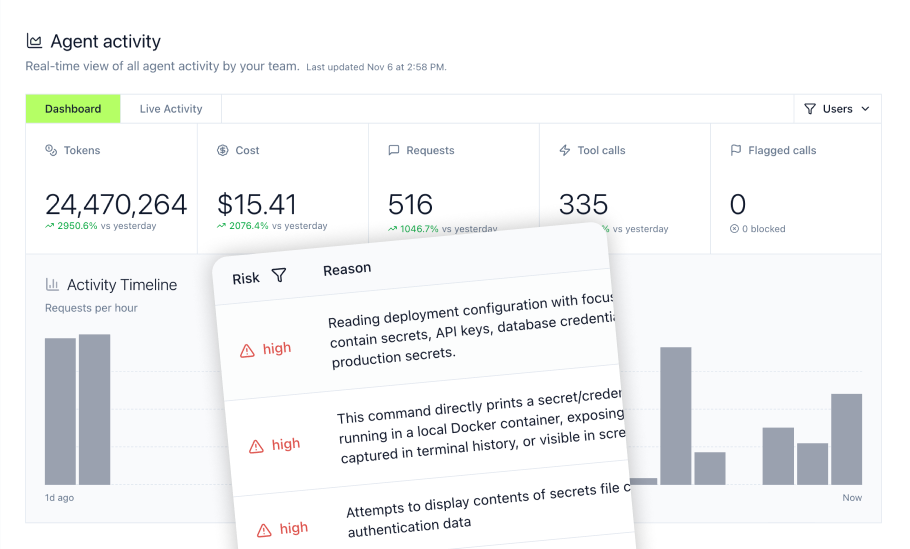
- Agent Monitor provides visibility into supported agent activity including prompts, commands, file access, MCP tool calls, usage, token costs, and security events
- Enterprise identity integration through Okta Cross App Access Partner status and SCIM-driven membership that keeps access policies synchronized with organizational changes
Deployment advantages:
Organizations using MintMCP avoid assembling separate components for gateway infrastructure, identity integration, connector hosting, and compliance controls. The platform delivers these capabilities as a cohesive managed service with professional support, security updates, and continuous feature development.
The MCP Gateway supports hosted, remote, custom, and STDIO connectors with centralized authentication, tool-level curation, and private network tunnels for on-premises systems. Gateway Middleware enables customer-authored JavaScript for DLP integrations and custom policy enforcement.
Visit MintMCP pricing to request a custom quote and evaluate how Virtual MCPs, Agent Gateway, and Mint Guard work together to govern enterprise AI systems.
Frequently asked questions
What is the main difference between managed and self-hosted MCP gateways?
Managed MCP gateways handle infrastructure, compliance attestations, and operational overhead, letting teams focus on governance configuration rather than platform operations. Self-hosted options provide maximum control but require Kubernetes expertise, infrastructure investment, and separate compliance work. For organizations with limited infrastructure resources, managed solutions can reduce deployment complexity, although deployment time still depends on integrations, identity, networking, governance, and compliance scope.
How do Virtual MCP Bundles differ from traditional MCP server configurations?
Virtual MCP Bundles aggregate multiple connectors behind one governed endpoint with SCIM-driven membership, curated tools, and access policies. Instead of configuring each MCP server separately on every developer laptop, administrators create bundles for specific roles or use cases. Users connect once through SSO and access only the tools appropriate for their function. This approach replaces scattered local configurations with centralized governance while maintaining flexibility for different team needs.
Why does agent identity matter for MCP governance?
When autonomous agents operate through human credentials or shared API keys, audit trails collapse and credential management becomes complex. Agent identity gives each autonomous agent its own credential, scoped tool access, and attributable audit trail. With M2M authentication, agent credentials can be rotated or revoked independently without affecting human users or other agents. This becomes critical as enterprises scale from a few agents to dozens or hundreds operating across different systems.
What compliance attestations should be considered for an enterprise MCP gateway?
For enterprise deployments, SOC 2 Type II attestations provide independent verification that vendors maintain appropriate security controls. HIPAA compliance becomes essential for organizations handling protected health information. MintMCP is SOC 2 Type II audited and compliant with HIPAA standards, with BAAs available for customers handling PHI. These controls can simplify vendor review, but they do not automatically make a customer compliant or eliminate customer-specific audit obligations. Additional considerations include data encryption at rest and in transit, data residency options, and tamper-evident audit trails for regulatory reporting.
How do MCP gateway guardrails protect against prompt injection and data leakage?
Mint Guard screens every tool call for prompt injection, credentials and secrets, PII, and harmful content using managed detection policies. The Rules engine enables declarative matching on tool names, arguments, and content patterns with actions including block, flag, mask, and notify. For organizations with existing DLP investments, Gateway Middleware supports customer-authored JavaScript that can integrate external classifiers and enforce custom policies. This layered approach addresses both generic threats and organization-specific security requirements.