Selecting the right MCP gateway for enterprise AI deployment requires evaluating security posture, deployment complexity, compliance readiness, and integration capabilities. MintMCP's MCP Gateway is positioned as a strong option for organizations seeking production-ready AI tool governance, while TrueFoundry and Portkey serve different segments of the market through distinct approaches. MintMCP specializes in managed deployment with SOC 2 Type II audited infrastructure and hundreds of prebuilt connectors, while TrueFoundry operates as a unified AI platform that typically assumes more infrastructure setup, and Portkey combines LLM gateway and MCP gateway capabilities with a broader API management focus. This comparison examines all three platforms to help enterprise teams determine which approach aligns with their deployment priorities.
Key Takeaways
- MintMCP offers managed deployment that helps teams move toward production without requiring Kubernetes expertise
- MintMCP provides hosted MCP connectors for Snowflake, Elasticsearch, Gmail, databases, and other business systems, reducing custom integration work
- TrueFoundry cites very low gateway latency, but teams should validate deployment requirements, Kubernetes assumptions, and latency definitions for their environment
- Portkey offers MCP gateway features alongside its broader AI gateway platform, with a developer and platform engineering orientation
- MintMCP's OAuth brokering for stdio and hosted MCP servers helps add enterprise authentication to MCP deployments without rewriting servers
Understanding the Core: What is an MCP Gateway?
The Model Context Protocol (MCP) has emerged as the industry standard for connecting AI clients to enterprise data and tools. Supported by Anthropic, OpenAI, Google, and Microsoft, MCP enables AI assistants like Claude and ChatGPT to access databases, APIs, and internal systems securely. However, deploying MCP servers at enterprise scale introduces significant challenges around authentication, access control, and auditability.
An MCP gateway sits between AI clients and MCP servers, providing centralized governance for all AI tool interactions. Without proper governance, AI tools operate as black boxes with significant security risks: zero telemetry, no request history, and uncontrolled access to sensitive systems.
Why Enterprises Need MCP Gateways for AI Governance
As AI tool usage spreads across teams, organizations face growing needs for visibility and control. MCP gateways address three specific problems:
- Tool Organization: Centralizing access to scattered MCP servers across teams
- Protocol Translation: Handling authentication, rate limiting, and routing
- Security Control: Enforcing role-based access and maintaining audit trails
For engineering leaders evaluating solutions, the enterprise MCP deployment guide provides detailed implementation frameworks.
Key Capabilities of Modern MCP Gateways
Production-grade MCP gateways must deliver:
- Authentication integration: OAuth 2.0, SAML, SSO, and SCIM-driven access control
- Granular access control: Tool-level permissions by role, team, use case, and agent identity
- Complete audit trails: Every tool call logged for compliance and security review
- Credential management: Centralized handling of service credentials, per-user OAuth, and agent credentials
- Observability: Real-time monitoring of usage patterns and anomalies
MintMCP: Enterprise-Grade Security and Governance for Your AI Stack
MintMCP approaches MCP infrastructure with a focus on transforming local and hosted MCP servers into governed production services with enterprise security and compliance built in. Every capability, from managed deployment to OAuth brokering, supports centralized governance for employee and internal-agent access.
Compliance: Meeting SOC 2 and Regulated-Industry Governance Requirements
MintMCP is SOC 2 Type II audited, demonstrating that security controls are independently reviewed over an evaluation period. This matters for regulated industries where security review, access control, and auditability can otherwise require extensive custom infrastructure.
The platform also provides:
- Compliant with HIPAA standards for customers handling protected health information, with HIPAA documentation and BAAs available on request
- Enterprise SSO, role-based access control, and complete audit trails built into the platform
- Penetration testing, encryption in transit and at rest, data residency options, and uptime SLA as part of its Trust Center posture
For organizations in healthcare or finance, these compliance capabilities can help reduce the custom infrastructure and review work required for governed AI deployment.
Advanced Authentication and Access Control Features
MintMCP's authentication model supports both shared service accounts and per-user OAuth flows, providing flexibility for different deployment scenarios:
- OAuth 2.0 and SAML integration: Connect to existing identity providers
- Enterprise SSO and SCIM-driven RBAC: Govern access through IdP groups and automated membership
- Granular tool access control: Configure permissions by role, enabling read-only operations while excluding write tools
- OAuth brokering for stdio and hosted MCP servers: Add enterprise authentication to MCP deployments without rewriting servers
- Agent Bundles: Give agents independent identities with M2M authentication and scoped tool access
This OAuth brokering capability helps teams take existing STDIO-based MCP servers and deploy them behind enterprise authentication with less custom identity work.
Observability and Control with Real-Time Dashboards
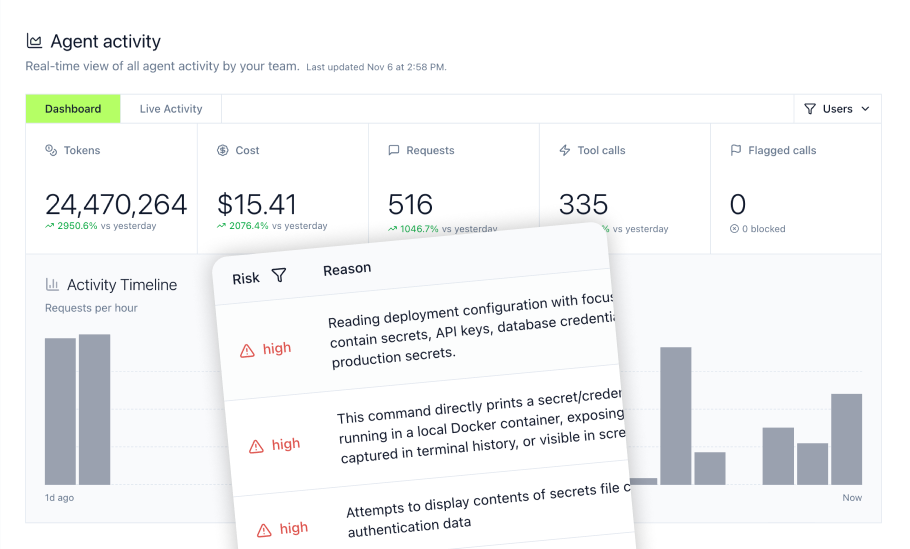
The MintMCP LLM Proxy complements the MCP Gateway by providing visibility into how employees use LLM clients, including which tools agents invoke. Key monitoring capabilities include:
- Tool call tracking: Monitor every MCP tool invocation, bash command, and file operation
- MCP inventory: Complete visibility into installed MCPs and their permissions across teams
- Security guardrails: Block dangerous commands and restrict file access in real time
- Sensitive file protection: Prevent access to .env files, SSH keys, and credentials
- Command history: Complete audit trail for security review
- Two-layer governance: Gateway coverage for MCP traffic plus Agent Monitor coverage for local non-MCP agent activity
Transforming Local MCPs to Production Services with MintMCP
Most MCP servers are STDIO-based and difficult to deploy at scale. They require local installation, lack built-in authentication, and scatter credentials across developer machines. MintMCP addresses these challenges directly.
Managed Deployment for STDIO Servers
MintMCP's deployment approach reduces infrastructure complexity:
- Deploy STDIO-based MCPs with built-in hosting
- Add OAuth protection to local and hosted MCP servers
- Transform local servers into governed production services with monitoring
Deployment can move faster than self-managed Kubernetes approaches because MintMCP handles hosting, connector runtime, and lifecycle management for managed deployments.
Hosting and Management of Virtual MCP Bundles
Virtual MCPs, also called Virtual MCP Bundles, represent a key architectural innovation. Rather than exposing entire MCP servers to users, administrators create curated tool sets:
- Minimum required tools: Virtual MCP Bundles expose only necessary capabilities
- SCIM-driven membership: IdP groups determine which users and teams can access each bundle
- Centralized management: Single administration point for all MCP resources
- Per-user credentials: Individual authentication flows where needed
- Per-agent identity: Agent Bundles apply scoped tool access to independent agent identities
This approach addresses a fundamental enterprise concern: providing AI tool access without over-provisioning permissions.
Enterprise Hardening for Developer Utilities
The MCP Gateway architecture transforms developer utilities into production-grade infrastructure:
- Operational resilience: Centralized management and monitoring for production deployments
- Deployment flexibility: Managed SaaS-first deployment, with VPC and self-hosted options available on request
- Hosted MCP connectors: Connectors run in isolated, managed runtime environments without customer-operated Kubernetes pods
- Real-time monitoring: Live dashboards for server health and security alerts
- Tool-update policy: Control whether new upstream tools are automatically enabled or require admin approval
MintMCP's Extensive Ecosystem: Integrations and AI Client Compatibility
MintMCP's prebuilt connector library reduces integration development time. Rather than building custom MCP servers for each data source, teams deploy production-ready connectors with built-in authentication and governance.
Powering Data Analysis with Snowflake and Elasticsearch
The Snowflake MCP Server enables AI-driven analytics with comprehensive tooling:
- Natural language to SQL conversion using Cortex Analyst
- Semantic search against configured Cortex Search services
- Query semantic views using dimensions, metrics, and facts
- Create and manage Snowflake objects including databases, schemas, and tables
Use cases span product analytics, financial reporting, and executive business intelligence, all accessible through natural language queries.
The Elasticsearch MCP Server provides AI-powered search capabilities:
- Perform Elasticsearch searches using query DSL
- Execute ES|QL queries for advanced data analysis
- List indices and retrieve field mappings
- Support for AI-powered knowledge base search and log analysis
Streamlining Communication with Gmail Integration
The Gmail MCP Server enables AI assistants to manage email workflows:
- Search Gmail messages using advanced query syntax
- Retrieve complete email content including attachments
- Create Markdown-formatted email drafts
- Generate replies within existing threads
- Dispatch prepared drafts through controlled command flows
Similar capabilities extend to Outlook integration, calendar management, and project tools like Linear and Notion.
Universal Compatibility with Leading AI Clients
MintMCP supports the full spectrum of AI clients:
- Claude Desktop, Claude Web, and Claude Code
- ChatGPT
- Microsoft Copilot
- Cursor
- Gemini
- Goose, LibreChat, Open WebUI, Windsurf
- Custom MCP-compatible agents
The ChatGPT setup guide and Claude integration documentation provide step-by-step configuration instructions.
TrueFoundry's Primary Focus
TrueFoundry operates as a unified AI platform combining LLM gateway, MCP gateway, and model serving capabilities. The platform serves organizations already invested in Kubernetes infrastructure seeking consolidated AI tooling.
Unified AI Platform Approach
TrueFoundry's approach bundles multiple AI infrastructure components:
- LLM routing with support for multiple model providers
- MCP gateway for tool governance
- Model serving and fine-tuning capabilities
- VPC and air-gapped deployment options
This bundled approach can fit organizations already using TrueFoundry's broader platform or requiring very low gateway latency.
Performance Characteristics
TrueFoundry cites very low gateway latency for performance-sensitive workloads. Teams should validate latency definitions, test conditions, and production architecture before comparing it with end-to-end tool-call latency.
However, this performance comes with trade-offs:
- Kubernetes requirements: Deployment may require container orchestration expertise depending on the selected architecture
- Longer setup timelines: Production deployment can involve more infrastructure work than MintMCP's managed approach
- Connector breadth is less central to its positioning: Teams should verify that the integrations they need are available out of the box
- Platform commitment: Best value may require using the broader TrueFoundry ecosystem
Tradeoffs to consider
TrueFoundry can be a fit for platform engineering and ML platform teams that want MCP capabilities inside a broader AI platform. Teams that want managed SaaS-first MCP governance, hosted MCP connectors, SCIM-driven Virtual MCP Bundles, Agent Bundles with M2M authentication, and OAuth brokering for stdio and hosted servers should compare those requirements directly against TrueFoundry's deployment model.
Portkey's Primary Focus
Portkey positions itself primarily as an LLM routing and observability platform, with MCP support as part of a broader AI gateway approach.
API Management and Developer Tooling
Portkey's strengths center on LLM operations:
- Universal API supporting multiple LLM providers
- Caching and rate limiting for cost optimization
- Observability with logs and traces
- Developer-friendly integration patterns
MCP Gateway Capabilities
For organizations specifically seeking MCP gateway capabilities, Portkey presents important considerations:
- Portkey offers MCP gateway capabilities alongside its broad AI gateway platform
- Advanced governance and deployment requirements may depend on plan tier
- Usage-based pricing deserves close review for teams with spiky or high-volume traffic
- Teams should validate enterprise controls, support, and deployment requirements against their security needs
Tradeoffs to consider
Portkey can fit developer and platform engineering teams that want MCP capabilities alongside LLM routing, observability, and API management. Teams prioritizing internal employee and internal-agent governance should compare whether Portkey provides the same MCP-specific primitives they need, including SCIM-driven Virtual MCP Bundles, Agent Bundles with per-agent identity and M2M authentication, hosted MCP connectors, tool-update policy, and two-layer governance across MCP and local agent activity.
Addressing Enterprise Challenges: Shadow AI and Governance at Scale
AI tool adoption outpaces governance capabilities at most organizations. Understanding these challenges helps clarify why purpose-built MCP gateways matter.
Turning Shadow AI into Sanctioned AI
Teams are already using AI tools. The question is whether that usage happens with visibility and control or operates as a black box. MintMCP's approach: provide governance without disrupting workflows.
Key governance capabilities include:
- Policy enforcement: Automatically enforce data access and usage policies
- Centralized credentials: Manage all AI tool API keys and tokens in one place
- Self-service access: Developers request and receive AI tool access through governed workflows
- Cross-tool integration: Connect AI tools to databases, APIs, and services safely
- Data-permissions-first architecture: Start with SSO, SCIM, IdP groups, tool policy, and audit before enabling agent access
The Cost of Ungoverned AI Tool Adoption
Without proper governance, organizations face:
- Compliance exposure: No audit trails for regulatory requirements
- Security risks: Uncontrolled access to sensitive data and systems
- Cost unpredictability: No visibility into AI tool spending
- Shadow IT proliferation: Ungoverned tools spreading across teams
MintMCP addresses these challenges through centralized governance that works with existing AI tool deployments, requiring minimal changes to developer workflows.
Strategic Implementation for AI Governance
The Executive Guide to MCP outlines a three-phase implementation roadmap:
- Assess: Inventory existing AI tool usage and identify governance gaps
- Deploy: Implement MCP gateway with pre-configured policies
- Scale: Expand governed AI access across teams with role-based controls
Organizations should align MCP gateway deployment with identity, security, and AI operations owners so governance scales alongside adoption.
MintMCP's Robust Platform: Features for Operations and Developers
Beyond core gateway functionality, MintMCP provides operational capabilities that streamline AI infrastructure management.
Visibility into AI Tool Usage and Costs
Real-time analytics provide insight into AI operations:
- Usage tracking: Monitor every AI tool interaction across Claude, Cursor, ChatGPT, Gemini, Copilot, and more
- Cost analytics: Track spending per team, project, and tool with detailed breakdowns
- Performance metrics: Measure response times, error rates, and usage patterns
- Data access logs: See exactly what data each AI tool accesses and when
Streamlining Developer Access and Credential Management
MintMCP simplifies operational overhead:
- User management: Centralized provisioning with team-based access controls
- Centralized credentials: Single point of management for API keys and tokens
- Role-based access control: Define who can use which AI tools and access what data
- Usage analytics: Monitor tool usage, performance, and cost allocation
- JavaScript Gateway Middleware: Add inline policy, transformation, DLP, and guardrail logic in a JS sandbox
Ensuring Rapid Deployment and Self-Service Access
The platform accelerates time to value:
- Managed deployment: Deploy MCP servers with pre-configured policies
- Self-service access: Developers request and receive AI tool access through governed workflows
- No workflow disruption: Works with existing AI tool deployments
- Hosted connector runtime: Reduce customer infrastructure work for connector hosting and scaling
Choosing the Right MCP Gateway for Your Organization
Different organizations have different priorities. Here's how each platform aligns with specific needs:
Choose MintMCP When You Need:
- Managed deployment: Production-oriented MCP governance without operating the connector runtime yourself
- Prebuilt connectors: Hosted MCP connectors for Snowflake, Elasticsearch, databases, Gmail, and other business systems
- OAuth brokering: Add SSO to stdio and hosted MCP servers without rewriting servers
- Regulated-environment governance support: SOC 2 Type II audited infrastructure, compliance with HIPAA standards, audit trails, and enterprise access controls
- Complete audit trails: Every tool call logged for compliance review
- Agent governance: Agent Bundles with M2M authentication, scoped tools, and “act as agent” flows
Why MintMCP Fits Enterprise MCP Gateway Deployments
For organizations seeking production-ready MCP infrastructure, MintMCP provides a practical path from evaluation to deployment. The combination of SOC 2 Type II audited infrastructure, managed deployment, and hosted MCP connectors reduces the infrastructure overhead that slows AI adoption.
MintMCP bridges the gap between AI assistants and internal data and tools. The platform handles authentication, permissions, audit trails, credential management, and policy enforcement, so teams can focus on building AI-powered workflows rather than managing connector infrastructure.
MintMCP is designed to reduce time-to-production compared with building custom infrastructure or managing complex container orchestration systems. The prebuilt connector library means organizations can connect AI assistants to critical data sources like Snowflake, Elasticsearch, and Gmail with less custom development.
For healthcare and financial services organizations, MintMCP's SOC 2 Type II audited infrastructure, compliance with HIPAA standards, and enterprise governance features provide a foundation for regulated environments. Complete audit trails ensure every AI tool interaction is logged and reviewable for compliance purposes.
The MCP Gateway quickstart guide provides step-by-step instructions to deploy the first governed MCP server. For organizations ready to transform shadow AI into sanctioned AI, MintMCP offers the security, governance, and deployment model that enterprise teams need.
Frequently Asked Questions
What core problems do MCP gateways solve for enterprises?
MCP gateways address three fundamental challenges: tool organization (centralizing scattered MCP servers), protocol translation (handling authentication and routing), and security control (enforcing access policies and maintaining audit trails). Without an MCP gateway, AI tools operate as black boxes with zero telemetry, no request history, and uncontrolled access to sensitive systems. MintMCP specifically solves these problems through centralized governance, OAuth brokering, Virtual MCP Bundles, Agent Bundles, and complete audit trails for every tool call.
How does MintMCP ensure compliance with regulations?
MintMCP is SOC 2 Type II audited, compliant with HIPAA standards, penetration tested, and built with enterprise SSO, role-based access control, complete audit trails, encryption in transit and at rest, data residency options, and uptime SLA. Customers handling protected health information can request HIPAA documentation, and MintMCP signs BAAs. Teams with strict regulatory or regional data-handling requirements should validate fit directly during security review.
Can MintMCP integrate with existing data sources?
MintMCP provides hosted MCP connectors for common data sources including Snowflake, Elasticsearch, Gmail, PostgreSQL, MySQL, MongoDB, and more. The platform supports major AI clients including Claude, ChatGPT, Microsoft Copilot, Cursor, Gemini, and custom MCP-compatible agents. Teams can also create custom connectors for proprietary systems.
What is shadow AI?
Shadow AI refers to AI tool usage that occurs outside IT visibility and governance. MintMCP transforms shadow AI into sanctioned AI by providing complete visibility into AI tool usage, enforcing access policies, and maintaining audit trails, all while minimizing disruption to existing developer workflows. The platform enables governed self-service access, so teams can adopt AI tools safely rather than working around IT restrictions.
How does MintMCP compare to TrueFoundry?
MintMCP uses a managed SaaS-first model and focuses on MCP governance for internal employees and internal agents. TrueFoundry is positioned more broadly as a unified AI platform for platform engineering and ML platform teams, with MCP gateway capabilities alongside LLM routing and model serving. TrueFoundry cites very low gateway latency for performance-sensitive workloads. Teams should compare deployment requirements, Kubernetes assumptions, connector needs, SCIM-driven access control, Virtual MCP Bundles, Agent Bundles, and OAuth brokering requirements before choosing between them.