Selecting the right MCP gateway for enterprise AI deployment requires evaluating deployment speed, security and audit posture, integration depth, and operational overhead. MintMCP, TrueFoundry, and Obot MCP Gateway each address enterprise AI infrastructure needs through distinct approaches. MintMCP's MCP Gateway delivers one-click deployment with SOC 2 Type II audited controls, compliance with HIPAA standards, and hosted MCP connectors run by MintMCP. TrueFoundry operates as a unified AI platform combining MCP governance with LLM routing and model serving. Obot provides an open-source, Kubernetes-native gateway for teams with existing DevOps expertise. This comparison examines all three platforms to help engineering leaders determine which approach aligns with their enterprise requirements.
Key Takeaways
- MintMCP provides one-click production deployment in minutes, while TrueFoundry implementation timelines vary based on deployment model and infrastructure requirements, and Obot deployment time depends on infrastructure expertise
- MintMCP offers hosted MCP connectors run by MintMCP, including Snowflake, Elasticsearch, and Gmail, reducing custom integration and infrastructure work
- MintMCP requires zero Kubernetes expertise as a managed SaaS-first service, while self-hosted TrueFoundry and Obot deployments require container orchestration knowledge
- MintMCP’s data-permissions-first architecture supports SSO, SCIM-driven RBAC, tool-level allowlisting, rule-based policy, and audit logs before enabling agents on top
- Gartner's 2025 Software Engineering Survey projects that 75% of API gateway vendors will add MCP features by 2026, making gateway selection critical for enterprise AI strategy
Understanding the Need for an API Gateway in AI Infrastructure
The Model Context Protocol (MCP) has emerged as the industry standard for connecting AI assistants to enterprise data and tools. MCP is supported by Anthropic, OpenAI, Google, and Microsoft, establishing it as the foundation for AI-to-data integration. However, deploying MCP servers at enterprise scale introduces challenges around security, governance, and operational management that traditional infrastructure cannot address.
Why AI Gateways Are Crucial for Enterprise LLMs
Enterprise AI deployments require more than simply connecting AI assistants to data sources. Organizations need:
- Authentication and authorization across all MCP connections
- Centralized audit trails for SOC 2, HIPAA, GDPR, and industry review workflows
- Centralized governance for tool access and permission management
- Tool-level policy enforcement using allowlisting, rule-based controls, and approval workflows
- Secure credential management without exposing API keys to end users
Without a purpose-built gateway, AI tools operate as black boxes with significant security risks: zero telemetry, no request history, and uncontrolled access to enterprise systems.
The Role of API Gateways in AI Agent Deployment
MCP gateways solve three specific problems for enterprise teams:
- Tool Organization: Centralized registry of available MCP servers with role-based access controls
- Protocol Translation: Converting STDIO-based local servers to production-ready remote endpoints
- Security Control: OAuth brokering, SSO enforcement, and audit logging for tool invocations
MintMCP's MCP Gateway addresses all three challenges through a managed service that transforms local MCP servers into enterprise-grade infrastructure. For teams evaluating gateway options, understanding these foundational requirements helps clarify which platform best fits their deployment needs.
Comparing Core API Gateway Features: Deployment and Management
Deployment speed and operational complexity vary significantly across MCP gateway solutions. The time from pilot to production impacts how quickly teams can deliver AI-powered capabilities to the business.
Effortless Deployment: From Local to Enterprise
MintMCP delivers a fast path from development to production. The platform provides:
- One-click deployment for STDIO-based MCP servers in minutes
- OAuth brokering for stdio and hosted MCP servers without code changes
- Managed SaaS-first infrastructure eliminating Kubernetes requirements
- Central MCP registry with instant configuration
- Hosted MCP connectors run by MintMCP with isolated connector execution
For engineering teams, this means deploying secure, governed AI tool access on the same day rather than waiting weeks for infrastructure provisioning.
TrueFoundry offers a unified AI platform with broader capabilities. Deployment characteristics include:
- Kubernetes-based deployment options that may require cluster setup for self-hosted implementations
- Implementation timelines that vary based on deployment model, integrations, and platform requirements
- Platform engineering resources may be needed for self-hosted or advanced configurations
- Support for LLM routing, model serving, and MCP governance in a single control plane
Obot provides an open-source, Kubernetes-native approach:
- Self-hosted deployment requiring existing container orchestration expertise
- Docker pilot available for initial evaluation
- GitOps workflow support for infrastructure-as-code management
- Composite MCP servers combining multiple backends into logical endpoints
Centralized Management for Diverse MCP Servers
Effective MCP governance requires managing servers across teams, projects, and use cases. MintMCP's approach centers on Virtual MCP Bundles, which create per-use-case endpoints with SCIM-driven membership and expose only the minimum required tools rather than entire MCP servers. This principle of least privilege reduces attack surface while simplifying access management.
TrueFoundry provides centralized management through its unified control plane, supporting agent framework integrations including LangChain, CrewAI, and AutoGen. This breadth serves teams building custom agent orchestration workflows beyond standard MCP patterns.
Obot enables GitOps-based management for teams already using infrastructure-as-code practices, allowing MCP server configurations to follow standard deployment pipelines.
Ensuring Enterprise-Grade Security and Audit Readiness with API Management
Security and audit requirements drive MCP gateway selection for regulated industries. Financial services, healthcare, and government organizations need verified controls, not just claimed capabilities.
Authentication and Authorization in AI Gateways
MintMCP provides comprehensive authentication through:
- SSO integration with existing identity providers
- SCIM-driven RBAC and IdP group-based access management
- SSO enforcement across all MCP connections
- Tool-level allowlisting and rule-based policy
- Granular permissions enabling read-only operations while excluding write tools
The platform's OAuth brokering for stdio and hosted MCP servers transforms local MCP infrastructure into secured endpoints without requiring code modifications. This approach enables developers to deploy securely without security expertise.
TrueFoundry supports enterprise authentication through configuration at the gateway level, with platform engineering involvement for setup and maintenance.
Obot provides gateway-level authentication with SSO and Entra/Okta support available in the Enterprise Edition.
Monitoring and Observability for AI Agent Infrastructure
Visibility into AI agent behavior enables teams to optimize performance, detect anomalies, and maintain operational control. Each platform approaches observability differently.
Gaining Visibility: Real-Time Analytics for AI Tools
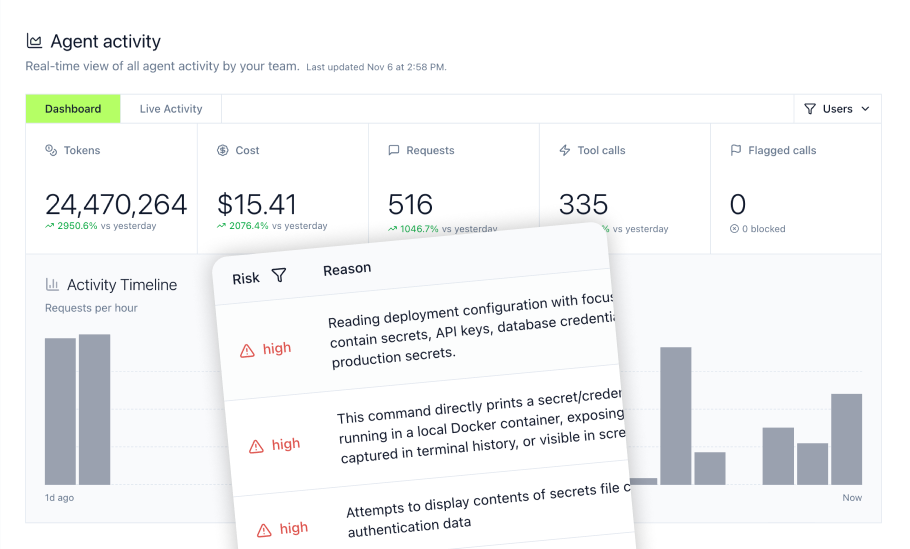
MintMCP provides two-layer governance through its Gateway and Agent Monitor. Together, they track:
- MCP tool invocations across supported clients such as Claude, Cursor, ChatGPT, Gemini, Copilot, and other configured tools
- Bash commands and file operations from coding agents
- Usage patterns by team, project, and tool
- Centralized audit logs and observability for MCP and non-MCP agent activity
This granular visibility addresses a critical enterprise challenge: without monitoring, organizations cannot see what AI agents access or control their actions.
TrueFoundry delivers comprehensive observability through its unified platform, integrating with Sentry, Datadog, and Grafana for teams using existing monitoring infrastructure.
Obot provides real-time monitoring capabilities within its gateway architecture.
Tracking Agent Behavior and Resource Utilization
MintMCP's monitoring extends beyond basic usage tracking to include:
- Command history: Audit trails for bash commands, file access, and tool calls
- MCP inventory: Visibility into installed MCPs, permissions, and usage patterns across teams
- Agent activity coverage: Visibility into local non-MCP agent activity through Agent Monitor
- Centralized observability: Audit logs that help security teams review MCP access, configuration changes, and tool usage
For organizations managing shadow AI adoption, this visibility transforms unknown risk into governed capability.
Overcoming Shadow AI and Bridging the Gap: The Role of an API Gateway
Shadow AI, where employees use AI tools outside IT governance, grows rapidly as AI assistants become more capable. MCP gateways provide the control layer that transforms shadow AI into sanctioned, governed AI usage.
From Shadow to Sanctioned: Controlling AI Tool Sprawl
The challenge is real: teams are already using AI tools to access enterprise data. Without governance, this creates security blind spots, compliance gaps, and operational risk. MintMCP addresses this through:
- Self-service access: Developers request and receive AI tool access instantly through governed workflows
- Centralized credentials: All API keys and tokens managed in one place, never exposed to end users
- Policy enforcement: Automatic application of data access and usage policies
- Visibility without disruption: Monitoring existing AI tool deployments without changing developer workflows
Empowering Developers: Self-Service Access with Governance
MintMCP's approach enables rapid deployment while maintaining enterprise controls. Teams can deploy MCP tools with pre-configured policies without slowing development velocity. For a deeper exploration of understanding MCP gateways, the platform documentation covers architectural patterns and implementation strategies.
Integrating AI Assistants with Enterprise Data: Beyond Basic API Access
The value of MCP gateways multiplies when AI assistants can securely access enterprise data sources. Hosted MCP connectors run by MintMCP reduce custom integration and infrastructure work.
Connecting LLMs to Internal Systems: Use Cases and Integrations
MintMCP provides hosted MCP connectors with built-in OAuth and governance. Key integrations include:
Data Warehouses and Analytics:
- Snowflake MCP Server with Cortex Analyst for natural language SQL queries
- BigQuery, PostgreSQL, MongoDB, and other database connectors
- Financial reporting and product analytics use cases
Knowledge Management:
- Elasticsearch MCP Server for AI-powered knowledge base search
- Support ticket intelligence and log analysis capabilities
- HR, product, and support team applications
Communication and Productivity:
- Gmail MCP Server for email automation with security oversight
- Calendar integrations for scheduling workflows
- Document management system connections
TrueFoundry supports MCP integrations through its AI Gateway and control plane, though teams may still need custom work for proprietary enterprise data sources. Obot provides a curated connector set including Office365, Jira, GitHub, Redis, and PostgreSQL.
Leveraging Specific Data Connectors for Enhanced AI Functionality
For finance teams, MintMCP's Snowflake integration enables AI-driven variance analysis and forecasting directly from governed data warehouses. Product teams can deploy AI-powered documentation search using Elasticsearch knowledge bases. Support teams gain access to historical ticket data and resolution patterns for faster customer issue resolution.
These connectors work with popular AI clients including Claude, ChatGPT, Microsoft Copilot, Cursor, and Gemini. For implementation guidance, see the deploying MCP servers guide.
LLM Proxy vs. Other API Management Solutions for Coding Agents
Coding agents present unique security challenges. Tools like Cursor and Claude Code operate with extensive system access, reading files, executing commands, and interacting with production systems through MCP tools.
Securing Your Coding Agents: A Deeper Look at Monitoring
MintMCP's Agent Monitor complements the MCP Gateway by covering local non-MCP agent activity. The platform provides:
- Tool call tracking: Monitor MCP tool invocations and bash commands
- MCP inventory: See which MCPs are installed across the organization
- File access monitoring: Track what files agents access and when
- Security guardrails: Block risky commands in real time
Preventing Data Breaches with Real-Time Command and File Access Control
Agent Monitor enables proactive security through:
- Sensitive file protection: Prevent access to .env files, SSH keys, credentials, and configuration files
- Command blocking: Stop risky tool calls like reading environment secrets or executing dangerous commands
- Centralized audit trails: Operations logged for security review
- Enterprise reliability: Availability commitments and reliability features based on the customer agreement
This level of control addresses the security gap that traditional API gateways cannot fill. Coding agents require specialized monitoring that understands AI-specific attack vectors and data access patterns.
Architectural Considerations: API Gateway vs. Load Balancer in AI Ecosystems
Understanding the distinction between API gateways and load balancers clarifies why purpose-built MCP infrastructure matters for AI deployments.
Beyond Load Balancing: The Value of AI API Gateways
Load balancers distribute traffic across servers but provide limited visibility into request content or application-level security. MCP gateways deliver:
- Protocol-aware routing: Understanding MCP tool invocations, not just HTTP requests
- Content inspection: Analyzing tool calls for security policy enforcement
- Identity integration: Connecting user identity to specific tool permissions
- Audit logging: Recording business-meaningful events, not just network traffic
Designing Robust AI Microservices with Gateways
MintMCP's architecture transforms STDIO-based MCP servers into remotely accessible, governed endpoints. This design pattern enables:
- Containerized servers accessible to clients without local installations
- Centralized credential management eliminating distributed API key exposure
- Consistent authentication enforcement across all AI tool access
- Centralized deployment with governed access controls
- Virtual MCP Bundles for per-use-case endpoints and Agent Bundles for per-agent identity with M2M auth
For organizations building AI microservices architectures, the gateway serves as the control plane for all AI-to-data interactions.
Choosing the Right Enterprise AI Developer Platform
Platform selection depends on organizational priorities: deployment speed, performance requirements, team expertise, and long-term AI infrastructure strategy.
When MintMCP Is the Right Choice
MintMCP fits organizations that need:
- Fast time-to-production: Deploy in minutes, not weeks
- Audit-ready infrastructure: SOC 2 Type II audited controls, compliance with HIPAA standards, and centralized audit trails
- Zero Kubernetes expertise: Managed SaaS-first service eliminates infrastructure complexity
- Hosted MCP connectors: Connectors run by MintMCP reduce customer infrastructure work
- Specialized MCP focus: Purpose-built features for MCP governance
- Agent identity governance: Agent Bundles with M2M auth and “act as agent” flows for scoped agent access
MintMCP serves IT, security, AI operations, and platform teams, making enterprise MCP deployment accessible without requiring teams to manage connector runtimes, scaling, or Kubernetes infrastructure.
Why MintMCP Offers a Fast Path to Enterprise AI Deployment
MintMCP provides a strong combination of deployment speed, audit readiness, and enterprise integration depth for organizations deploying AI agents at scale. The platform's one-click deployment eliminates weeks of infrastructure setup, while SOC 2 Type II audited controls, compliance with HIPAA standards, penetration testing, and centralized audit trails support vendor security reviews without requiring teams to build every audit workflow from scratch.
With hosted MCP connectors for Snowflake, Elasticsearch, Gmail, and other critical systems, MintMCP enables AI assistants to access governed data quickly. The managed SaaS-first approach requires zero Kubernetes expertise, allowing teams to focus on AI innovation rather than infrastructure operations. Organizations gain centralized governance controls, SCIM-driven RBAC, tool-level allowlisting, rule-based policy, credential management, and centralized audit trails that support security assessment requirements.
MintMCP's architecture transforms local STDIO-based MCP servers into production-ready endpoints with OAuth brokering, eliminating the security gaps that plague shadow AI deployments. The platform's Gateway and Agent Monitor provide visibility into AI agent behavior, tool invocations, local agent activity, and data access patterns across the organization. This visibility enables teams to enforce policies and maintain operational control as AI adoption scales.
For engineering leaders evaluating MCP gateway options, MintMCP's combination of speed, security, and integration depth provides a fast path from pilot to production-grade AI infrastructure. The platform serves IT, security, AI operations, platform teams, developers, and business users, democratizing enterprise MCP deployment without sacrificing the governance controls that regulated industries require.
Ready to deploy enterprise MCP infrastructure in minutes? Book a demo to see MintMCP in action.
Frequently Asked Questions
What is the primary difference between MintMCP's MCP Gateway and Agent Monitor?
MintMCP's MCP Gateway provides centralized deployment, authentication, and governance for MCP servers. It transforms local STDIO-based servers into production-ready endpoints with OAuth protection and audit logging. Agent Monitor complements the Gateway by covering local non-MCP agent activity from tools like Cursor and Claude Code, including tool calls, bash commands, and file access. The Gateway governs MCP infrastructure while Agent Monitor provides visibility and control over AI agent behavior outside the MCP gateway path.
How do API management tools like MintMCP support security and compliance reviews for AI usage?
MintMCP is SOC 2 Type II audited and compliant with HIPAA standards, with centralized audit trails for MCP activity, access requests, and configuration changes. The platform provides SSO, SCIM-driven RBAC, tool-level allowlisting, centralized governance, credential management, and audit trails that support security and compliance review workflows. Customers handling protected health information can request HIPAA documentation, and MintMCP signs BAAs.
Can MintMCP integrate with existing enterprise data sources like Snowflake and Elasticsearch?
Yes. MintMCP provides hosted MCP connectors run by MintMCP, including Snowflake with Cortex Analyst for natural language SQL queries and Elasticsearch for AI-powered knowledge base search. These connectors include built-in OAuth and governance, enabling secure AI access to enterprise data with less custom integration and infrastructure work. The platform also supports Gmail, databases, and productivity tools.
What are the benefits of using an API gateway over a traditional load balancer for AI infrastructure?
API gateways provide protocol-aware routing that understands MCP tool invocations, not just HTTP traffic. They enable content inspection for security policy enforcement, identity integration connecting users to specific tool permissions, and audit logging of business-meaningful events. Load balancers distribute traffic but cannot inspect tool calls, enforce role-based permissions, or generate compliance audit trails. For AI deployments, gateway-level intelligence is essential for security and governance.
How does MintMCP address the challenge of shadow AI within large organizations?
MintMCP transforms shadow AI into sanctioned AI by providing visibility and control without disrupting developer workflows. The platform enables self-service access through governed workflows, centralizes credential management so API keys are never exposed to end users, and automatically enforces data access policies. Teams can deploy AI tools with pre-configured governance while maintaining development velocity. Centralized observability reveals existing AI usage patterns, converting unknown risk into managed capability.