Selecting the right MCP gateway for enterprise AI deployment requires evaluating deployment speed, security posture, compliance requirements, and integration capabilities. As MCP adoption accelerates in 2025, organizations need infrastructure that transforms local MCP servers into production-ready services. MintMCP's MCP Gateway delivers one-click deployment, OAuth brokering for stdio and hosted MCP servers, and SOC 2 Type II audited infrastructure for enterprises prioritizing speed and governance. TrueFoundry offers a unified AI platform combining LLM routing with MCP capabilities. Natoma focuses on Shadow AI discovery and desktop MCP management. This comparison examines all three platforms to help determine which approach aligns with your enterprise requirements.
Key Takeaways
- MintMCP provides access to hundreds of prebuilt MCP connectors run by MintMCP with one-click deployment, compared to Natoma's verified server library and TrueFoundry's platform integrations
- MintMCP deploys MCP servers in minutes with OAuth brokering, while TrueFoundry may require additional setup for Kubernetes, VPC, or air-gapped deployments
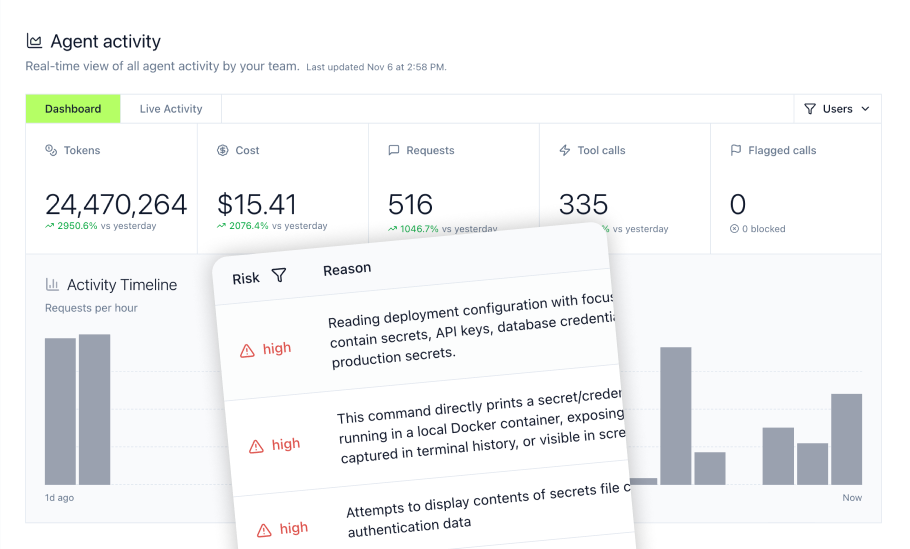
- MintMCP's dedicated Agent Monitor tracks every tool call, bash command, and file access from coding agents like Cursor and Claude Code
- MintMCP adds data-permissions-first governance with SSO, SCIM-driven RBAC, Virtual MCP Bundles, tool-level policy, credential management, and audit logs
- TrueFoundry serves organizations needing unified AI infrastructure with low-latency AI gateway performance
- Natoma emphasizes Shadow AI discovery capabilities for identifying unmanaged MCP servers across organizations
- Gartner's 2025 Software Engineering Survey projects that 75% of API gateway vendors will add MCP features by 2026
Understanding Model Context Protocol (MCP) Gateways
What is an MCP Gateway?
An MCP gateway serves as the centralized infrastructure layer between AI clients (Claude, ChatGPT, Cursor, Copilot) and the MCP servers that connect those clients to enterprise data and tools. Without a gateway, organizations face three core challenges: Tool Organization, Protocol Translation, and Security Control.
MCP gateways solve these problems by providing:
- Unified authentication: Enterprise SSO and OAuth integration for all MCP connections
- Centralized governance: Role-based access control, tool-level policy, and audit logging across tools
- Deployment infrastructure: Hosting and lifecycle management for MCP servers
- Real-time monitoring: Visibility into tool usage, performance, and security events
Why MCP Gateways Matter for Enterprise AI
The Model Context Protocol has emerged as the industry standard for connecting AI assistants to enterprise systems. Supported by Anthropic, OpenAI, Google, and Microsoft, MCP enables AI clients to access databases, APIs, and internal tools through standardized interfaces.
However, most MCP servers are STDIO-based and difficult to deploy at scale. They require local installation, manual configuration, and custom authentication integration. For enterprises managing hundreds of developers and dozens of AI tools, this creates significant operational overhead.
MCP gateways bridge this gap by transforming developer utilities into production-grade infrastructure with the security, governance, and monitoring enterprises require.
Core Features and Capabilities of MCP Gateway Solutions
Deployment and Management: Speed to Production
Deployment speed directly impacts time-to-value for AI initiatives. The three platforms take distinctly different approaches:
MintMCP prioritizes rapid deployment through:
- One-click hosting for STDIO-based MCP servers
- OAuth brokering for stdio and hosted MCP servers without code changes
- Hosted MCP connectors run by MintMCP, including Snowflake, Elasticsearch, Gmail, and other enterprise systems
- Virtual MCP Bundles that create per-use-case endpoints with SCIM-driven membership
- Deployment measured in minutes rather than days
TrueFoundry's Primary Focus includes comprehensive infrastructure control:
- Kubernetes-native deployment across AWS, Azure, GCP, and on-premises
- Full platform customization for complex enterprise requirements
- Air-gapped deployment options for highly regulated environments
- SaaS and VPC deployment flexibility
Natoma's Approach focuses on managed SaaS-first MCP governance:
- Managed SaaS deployment for MCP governance workflows
- Shadow AI discovery for identifying unmanaged MCP servers
- Native support for desktop/local STDIO servers alongside cloud deployment
For organizations prioritizing speed, MintMCP's one-click deployment eliminates the infrastructure complexity that can delay AI initiatives by weeks or months. Teams can deploy MCP servers and begin connecting AI clients to enterprise data within a single day.
Monitoring and Observability for AI Tools
Visibility into AI tool usage becomes critical as organizations scale MCP deployments. Each platform approaches observability differently:
MintMCP delivers comprehensive monitoring through:
- Real-time dashboards for server health, usage patterns, and security alerts
- Complete audit trails of every MCP interaction and configuration change
- Centralized observability for MCP traffic across Claude, Cursor, ChatGPT, Gemini, and Copilot
- Performance metrics measuring response times and error rates
The MintMCP Agent Monitor extends this observability specifically for coding agents:
- Tracking every tool call and bash command from Cursor, Claude Code, and similar agents
- Monitoring which files agents access and when
- Complete command history for security review
- MCP inventory showing all installed servers and their usage patterns
TrueFoundry provides:
- Unified observability across LLM routing and MCP operations
- Budget controls and cost tracking
- Performance monitoring with detailed latency metrics
Natoma offers:
- SIEM integration for enterprise security workflows
- Audit logs for compliance reporting
- Usage analytics across managed MCP servers
Scalability and Infrastructure Support
Enterprise deployments require infrastructure that scales with organizational growth:
MCP Server Access:
- MintMCP: Hundreds of prebuilt connectors, plus custom MCP servers hosted and run by MintMCP
- TrueFoundry: Via platform integrations
- Natoma: Verified MCP server library
Deployment Model:
- MintMCP: Managed SaaS-first, US and EU, with VPC/self-hosted on request
- TrueFoundry: Multi-cloud plus on-premises
- Natoma: Managed SaaS-first
High Availability:
- MintMCP: Uptime SLA
- TrueFoundry: Standard and Enterprise SLAs
- Natoma: 99.999% SLA on Enterprise tier
Data Residency:
- MintMCP: Data residency options
- TrueFoundry: Full infrastructure control
- Natoma: Available
MintMCP's managed SaaS-first approach removes infrastructure burden while providing enterprise reliability. Organizations needing complete infrastructure control may prefer TrueFoundry's Kubernetes-native deployment, while organizations prioritizing Shadow AI discovery may evaluate Natoma.
LLM Orchestration and AI Integration Tools
Monitoring Coding Agent Activities
Coding agents like Cursor, Claude Code, and GitHub Copilot operate with extensive system access. They read files, execute commands, and access production systems through MCP tools. Without monitoring, organizations cannot see what agents access or control their actions.
MintMCP's Agent Monitor provides essential visibility and control:
- Tool Call Tracking: Monitor every MCP tool invocation from all coding agents
- Command History: Complete audit trail of every bash command executed
- MCP Inventory: See all installed MCPs and their usage patterns across teams
- Security Guardrails: Block dangerous commands and risky tool calls in real-time
This dedicated product complements MintMCP Gateway as part of a two-layer governance model. Gateway covers MCP traffic, while Agent Monitor covers local non-MCP agent activity such as bash commands, file reads and writes, and prompt submissions.
Protecting Sensitive Data in AI Workflows
Sensitive file protection prevents AI agents from accessing credentials, SSH keys, and configuration files.
MintMCP's Agent Monitor blocks access to:
.envfiles containing environment variables- SSH keys and authentication credentials
- Other sensitive configuration files
These guardrails operate in real-time, blocking risky operations before they execute rather than logging violations after the fact.
Compatibility with Leading AI Clients
All three platforms support major AI clients, though MintMCP's governance coverage stands out:
MintMCP supports governance for:
- Claude
- Cursor
- ChatGPT
- Gemini
- Microsoft Copilot
- Custom MCP-compatible agents
TrueFoundry supports:
- 1,000+ models across OpenAI, Anthropic, Gemini, Groq, Mistral
- Major AI clients through unified endpoint
Natoma supports:
- Major AI clients
- Desktop MCP applications
MintMCP's Cursor Hooks Partners Program listing supports enterprise coding-agent governance workflows with one of the most widely used AI development tools.
Integrating AI with Enterprise Data and Applications
Pre-Built Enterprise Connectors
MintMCP provides ready-to-deploy connectors for common enterprise systems:
Snowflake MCP Server enables:
- Natural language to SQL conversion via Cortex Analyst
- Semantic search against Cortex Search services
- Direct SQL query execution with DML/DDL support
- Semantic view querying for business intelligence
Use cases: Product analytics, financial reporting, executive dashboards without SQL expertise
Elasticsearch MCP Server provides:
- Query DSL searches for flexible document retrieval
- ES|QL execution for advanced data analysis
- Index listing and mapping retrieval
- Shard health monitoring
Use cases: Knowledge base search, support ticket intelligence, log analysis
Gmail MCP Server enables:
- Advanced email search with labels and filters
- Email drafting and reply generation
- Controlled send workflows
Use cases: Customer response automation, feedback aggregation, communication analysis
TrueFoundry integrates through its broader platform capabilities, while Natoma offers custom connectors with OpenAPI auto-generation for existing APIs.
Use Cases by Team
MintMCP's connector ecosystem addresses specific team needs:
- HR teams: Build AI-accessible knowledge bases from company documentation and policies
- Product teams: Enable AI-powered documentation search and contextual help systems
- Support teams: Search historical tickets and resolution patterns for faster issue resolution
- Finance teams: Automate financial reporting and variance analysis from Snowflake data
- Executive teams: Generate real-time business intelligence without SQL expertise
Cost Control and Performance Monitoring
Platform Pricing Comparison
Entry and Free Tiers:
- MintMCP: Enterprise (contact sales)
- TrueFoundry: $0/month (50k requests, 3 users)
- Natoma: $0/month (5 servers, 5 users, 5k tool calls)
Professional Tiers:
- MintMCP: Custom pricing
- TrueFoundry: $499/month (1M requests, 10 users)
- Natoma: Pro tier with higher tool-call limits and additional credit options
Enterprise Tiers:
- MintMCP: Custom with uptime SLA
- TrueFoundry: Custom pricing
- Natoma: Custom
MintMCP's enterprise pricing includes SOC 2 Type II audited infrastructure, compliant with HIPAA standards, pen testing, audit trails, connectors, and uptime SLA. Organizations comparing total cost should consider infrastructure operations, authentication integration, connector hosting, policy management, and ongoing maintenance.
Performance Metrics
Performance requirements vary by use case. According to industry benchmarks and vendor documentation:
- TrueFoundry: Low-latency AI gateway performance, with published references around 3-4ms latency at load and 350+ RPS/vCPU for gateway workloads
- MintMCP: Production-grade performance with uptime SLA
- Natoma: Tool-call capacity varies by plan, with public pricing based on MCP servers, users, and tool-call limits
For performance-critical workloads requiring low-latency gateway performance, TrueFoundry's optimized infrastructure provides documented advantages. For most enterprise use cases prioritizing deployment speed and governance, MintMCP's performance meets requirements while delivering faster time-to-value.
Addressing Shadow AI and Enterprise Governance
The Shadow AI Challenge
Organizations face a growing governance gap. AI adoption has accelerated quickly, while governance programs often lag behind deployment. McKinsey's 2025 Global Survey reports that 88% of organizations now use AI in at least one business function, reinforcing the need for stronger enterprise AI governance.
MintMCP addresses this by enabling organizations to turn shadow AI into sanctioned AI. The platform provides visibility and control without disrupting developer workflows:
- Deploy MCP tools with pre-configured policies
- Enforce authentication and access controls automatically
- Use SSO and SCIM-driven RBAC to align access with IdP groups
- Scope tool access through Virtual MCP Bundles
- Monitor usage patterns across all AI clients
- Generate compliance reports for security review
Shadow AI Discovery: Natoma's Approach
Natoma differentiates through Shadow AI discovery capabilities, detecting unmanaged MCP servers across the organization. Their platform helps identify unmanaged MCP servers across the organization, revealing the scope of unsanctioned AI tool usage.
For organizations needing to inventory existing MCP deployments before standardizing on a governance platform, Natoma's discovery features provide unique value.
Choosing MintMCP for Enterprise MCP Infrastructure
MintMCP delivers the fastest path to production-ready MCP deployment with enterprise-grade security and governance. The platform combines deployment speed, compliance capabilities, and operational simplicity that enterprises require.
MintMCP Advantages
Deployment Speed: One-click hosting transforms STDIO-based servers into production services within minutes. OAuth brokering eliminates weeks of authentication integration work, enabling teams to move from concept to production in a single day rather than weeks or months.
Data-Permissions-First Governance: MintMCP starts with SSO, SCIM-driven RBAC, IdP groups, Virtual MCP Bundles, tool-level policy, credential management, and audit logs, then enables agents on top. That keeps agent access scoped to an already-governed permission model.
Virtual MCP Bundles and Agent Bundles: Virtual MCP Bundles create per-use-case endpoints with SCIM-driven membership, curated tools, and policy controls. Agent Bundles extend the same governance model to agent identities with M2M auth and an “act as agent” flow.
Connector Breadth: Access to hundreds of prebuilt MCP connectors reduces custom development requirements. MintMCP can also host and run custom MCP servers with auto-scaling and isolated execution, so customers do not need to manage Kubernetes pods, runtimes, or connector scaling.
Coding Agent Security: The dedicated Agent Monitor product monitors Cursor, Claude Code, and similar agents with real-time guardrails. Security teams gain complete visibility into every tool call, bash command, and file access, with the ability to block dangerous operations before they execute.
Cursor Hooks Partners Program Listing: MintMCP's Cursor Hooks Partners Program listing supports governance workflows for enterprise coding agents, including Cursor-based development environments.
Enterprise Connectors: Pre-built integrations for Snowflake, Elasticsearch, Gmail, and other enterprise systems accelerate time-to-value. These connectors deploy with one click and inherit MintMCP's authentication, access control, and audit capabilities automatically.
Security and Compliance: SOC 2 Type II audited infrastructure, compliance with HIPAA standards, penetration testing, data encryption in transit and at rest, data residency options, and complete audit logging support enterprise security review. Virtual MCP Bundles enable granular access control without requiring code changes to underlying servers.
Operational Simplicity: MintMCP's managed SaaS-first approach removes infrastructure burden. Organizations can focus on AI use cases rather than Kubernetes management, server provisioning, or authentication integration. Uptime SLA supports reliability without requiring dedicated DevOps resources.
When to Consider Alternatives
TrueFoundry serves organizations that require unified AI infrastructure spanning LLM routing, MCP management, and model serving with Kubernetes expertise and infrastructure control preferences. The platform suits teams that need multi-cloud or air-gapped deployments and prioritize low-latency gateway performance for performance-critical workloads.
Natoma serves organizations that need to discover and inventory existing Shadow AI deployments, require native desktop MCP management alongside cloud, or want CrowdStrike Falcon integration for EDR workflows.
Getting Started with MintMCP
MintMCP bridges the gap between AI assistants and internal data and tools. The platform handles authentication, permissions, audit trails, and the complexity that comes with enterprise deployments.
Deploy in minutes, not days. Book a demo to see how MintMCP transforms local MCP servers into production-ready AI infrastructure.
Frequently Asked Questions
What is the primary difference between MintMCP, TrueFoundry, and Natoma MCP Gateway?
MintMCP specializes in rapid, governed MCP deployment with one-click hosting, OAuth brokering for stdio and hosted MCP servers, hosted MCP connectors, Virtual MCP Bundles, Agent Bundles, and data-permissions-first governance. TrueFoundry provides a unified AI platform combining LLM routing, MCP management, and model serving with Kubernetes-native deployment. Natoma focuses on Shadow AI discovery and desktop MCP management. MintMCP delivers a fast deployment path for enterprises prioritizing speed and governance, while TrueFoundry suits organizations needing comprehensive infrastructure control, and Natoma helps organizations inventory existing unmanaged AI tools.
Can MintMCP integrate with existing enterprise data sources like Snowflake and Elasticsearch?
Yes. MintMCP provides pre-built enterprise connectors for Snowflake, Elasticsearch, Gmail, PostgreSQL, MySQL, BigQuery, and other systems. The Snowflake connector enables natural language to SQL conversion, semantic search, and direct query execution. The Elasticsearch connector supports query DSL, ES|QL, and index management. These connectors deploy with one click and inherit MintMCP's authentication and audit capabilities automatically.
What role does an Agent Monitor play in managing coding agents and their tool calls?
MintMCP's Agent Monitor tracks and controls coding agent activity across Cursor, Claude Code, and similar tools. The monitor tracks every MCP tool invocation, bash command, and file access. Security guardrails block dangerous commands and protect sensitive files like .env and SSH keys in real-time. The complete audit trail enables security review and compliance reporting. This complements MintMCP Gateway by extending governance beyond MCP traffic into local coding-agent activity.
How quickly can an organization deploy MCP servers using MintMCP?
MintMCP enables MCP server deployment in minutes through one-click hosting and OAuth brokering. STDIO-based servers transform into production-ready endpoints without code changes or manual configuration. This compares to longer setup periods for Kubernetes-based deployments or minutes-to-hours for other hosted options. MintMCP's deployment guide details the process for connecting AI clients to enterprise data within a single day.