When evaluating Composio alternatives, the decision comes down to organizational priorities: governance requirements, deployment speed, compliance posture, and integration needs. While Composio offers a broad toolkit library, many enterprise teams seek platforms with stronger security controls, audit capabilities, and centralized governance. This guide examines the top Composio alternatives, with particular focus on why MintMCP's Gateway is a strong fit for regulated industries and security-conscious organizations.
Key Takeaways
- MintMCP is built for enterprise AI agent governance with data-permissions-first architecture, SSO and SCIM-driven RBAC, Virtual MCP Bundles, Agent Bundles, tool-level allowlisting, rule-based policy, audit logs, and centralized observability
- Composio is primarily developer- and AI engineering-oriented, so enterprise teams should evaluate whether they need additional governance controls for internal employee and internal-agent use cases
- Deployment models vary significantly: MintMCP is managed SaaS-first with US and EU availability, while some alternatives prioritize open-source, embedded, or self-hosted integration models
- Governance depth is the main evaluation factor: compare each platform’s support for tool-level policy, credential management, auditability, identity-based access, and agent monitoring
- Consider the primary use case: Choose MintMCP for enterprise governance, Composio for developer-led agent integration, Nango for open-source code ownership, or Merge for unified API coverage
Understanding Composio
Composio positions itself as an AI agent integration platform designed to accelerate multi-tool agent development. The platform offers a broad set of pre-built integrations for popular LLM frameworks.
Composio's Primary Focus
- Pre-built toolkits spanning productivity, development, and communication applications
- Native support for LangChain, CrewAI, AutoGen, and LlamaIndex frameworks
- Managed OAuth handling that simplifies authentication flows
- SDK-first approach enabling rapid agent development
Common Reasons Teams Seek Alternatives
- Enterprise governance requirements including RBAC and audit trails
- Need for centralized credential management across teams
- Compliance mandates requiring SOC 2, compliance with HIPAA standards, BAA availability, industry-specific controls, or federal cybersecurity standards
- Desire for curated MCP endpoints to control approved tool access by team, role, or use case
- Requirements for real-time agent monitoring and policy enforcement
Composio serves developer-led teams well with its toolkit library and rapid onboarding. However, organizations requiring production-grade governance often need additional capabilities aligned with enterprise security frameworks.
1. MintMCP: Best for Enterprise AI Agent Governance
MintMCP provides enterprise MCP infrastructure designed for IT, security, and AI operations teams deploying AI agents at scale. As part of the Cursor Hooks Partners Program, MintMCP addresses the governance gap that prevents regulated industries from adopting AI agents safely.
Key MintMCP Advantages
- SOC 2 Type II audited security controls and compliance with HIPAA standards, with BAA availability for enterprise security review requirements
- Data-permissions-first architecture built around SSO, SCIM, IdP groups, Virtual MCP Bundles, tool-level policy, and audit
- Virtual MCP Bundles enabling organizations to create per-use-case endpoints with SCIM-driven membership, curated tools, and access policy
- Agent Bundles with per-agent identity, M2M auth, and “act as agent” flows for scoped agent access
- Tool-level allowlisting and rule-based policy for centralized control over approved tools
- Audit logs and centralized observability for compliance review
Enterprise Security Features
MintMCP's security architecture provides centralized governance across all AI agent deployments:
- SSO and SCIM-driven RBAC
- Gateway and Agent Monitor coverage for two-layer governance
- Granular tool access control by role, use case, and agent identity
- Rule-based policy enforcement that automatically applies access rules
- Credential management and OAuth brokering for stdio and hosted MCP servers
- JavaScript Gateway Middleware for external DLP and guardrails integrations
Ideal Use Cases
- Healthcare organizations requiring strong audit trails and documented security controls
- Financial services firms needing audit-ready compliance infrastructure
- Teams that need governed AI deployments with clear security review workflows
- Any organization where IT and security teams need centralized oversight
Integration Capabilities
MintMCP supports direct connections to enterprise data sources through dedicated connectors:
- Elasticsearch integration for AI-powered knowledge base search
- Snowflake connector enabling natural language queries against data warehouses
- Gmail integration for AI-assisted email workflows with security oversight
- Support for Claude, ChatGPT, Gemini, Cursor, Microsoft Copilot, and other MCP-compatible clients
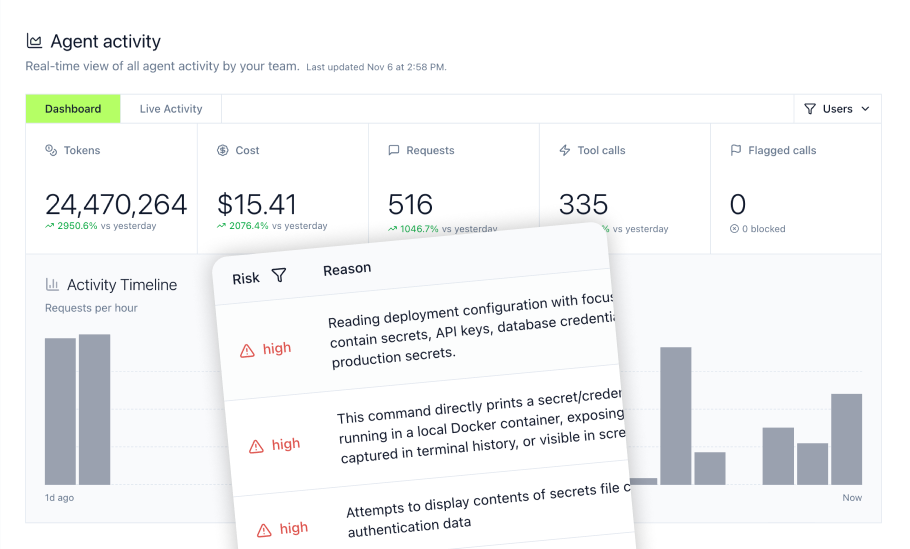
The Agent Monitor component provides additional visibility into local agent behavior, including non-MCP coding-agent activity, while the gateway governs MCP traffic, policy, tool access, and audit logging.
2. Nango
Nango offers an open-source integration layer that appeals to teams prioritizing code ownership and self-hosting capabilities. The platform combines tool calling with bi-directional data synchronization.
Nango's Primary Focus
- Open-source platform with code transparency and customization options
- API integration library for connecting external systems
- Bi-directional data syncs that go beyond simple tool calling
- White-label OAuth enabling branded authentication experiences
- Self-hosting option for infrastructure control
- Observability support for integration monitoring
Considerations
Nango's open-source model can give teams more implementation control, but it also makes teams responsible for operating and extending governance layers such as SCIM-driven RBAC, per-use-case MCP endpoints, tool-level policy, and centralized audit trails if those capabilities are required.
3. Arcade
Arcade provides an MCP authentication runtime focused on connecting agents to tools and services. The platform focuses on MCP standard adherence with minimal overhead.
Arcade's Primary Focus
- MCP standard commitment supporting MCP-compatible architectures
- Low-latency execution for tool access workflows
- Connector library available through the platform
- Self-hosting option for infrastructure control
- Works with MCP-compatible clients including Claude, Cursor, and ChatGPT
Considerations
Arcade can be useful for teams focused on MCP authentication runtime needs. Teams evaluating it for enterprise-wide governance should also assess whether they need MintMCP-style Virtual MCP Bundles, Agent Bundles, SCIM-driven RBAC, audit logs, credential management, and Gateway plus Agent Monitor coverage as part of the core platform.
4. Merge Agent Handler
Merge provides a unified API platform with broad integration coverage across multiple categories. The Agent Handler component enables AI agents to access normalized data models.
Merge's Primary Focus
- Unified API coverage across business application categories
- SOC 2 Type II attestation meeting enterprise security requirements
- Normalized data models simplifying multi-system data aggregation
- Enterprise observability with logging and monitoring
- Broad category coverage including CRM, HR, ATS, accounting, and ticketing
Considerations
Merge serves unified API use cases more than MCP-specific governance needs. Teams focused on internal AI agent governance should evaluate whether they need MCP-specific primitives such as Virtual MCP Bundles, Agent Bundles, tool-update policy, OAuth brokering for MCP servers, and centralized MCP audit logs.
5. Pipedream
Pipedream combines workflow automation with AI agent capabilities, offering a visual builder alongside code flexibility. The platform appeals to teams balancing no-code simplicity with developer extensibility.
Pipedream's Primary Focus
- App integrations across the platform
- Visual workflow builder for no-code automation design
- Code flexibility when custom logic is required
- Event-driven architecture supporting real-time triggers
- Developer adoption with an established community
Considerations
Pipedream's primary focus is workflow automation rather than MCP governance. Teams requiring enterprise security controls and centralized AI agent oversight may need additional tooling for SCIM-driven RBAC, tool-level allowlisting, audit logs, credential management, and agent identity governance.
6. Paragon
Paragon serves the embedded integration market, enabling SaaS companies to offer native integrations within their products. The platform focuses on productized integration experiences.
Paragon's Primary Focus
- Embedded integration focus for SaaS product teams
- White-label capabilities for branded customer experiences
- Pre-built connectors reducing development time
- Mid-market positioning with accessible pricing tiers
- Integration UI components for customer-facing configuration
Considerations
Paragon targets embedded iPaaS use cases rather than internal AI agent governance. Organizations deploying AI agents across their workforce will find governance-first approaches more aligned with requirements such as SCIM-driven access control, per-use-case MCP endpoints, audit logs, tool-level policy, and centralized observability.
Why MintMCP Is a Strong Fit for Enterprise AI Agent Governance
For organizations deploying AI agents in regulated environments, MintMCP provides comprehensive governance infrastructure for enterprise AI agent deployments. Unlike alternatives that require teams to build their own RBAC systems, audit trails, and policy enforcement layers, MintMCP delivers these capabilities as core platform features.
The platform's SOC 2 Type II audited security controls, compliance with HIPAA standards, and BAA availability provide security review signals for compliance teams, while rule-based policy, tool-level allowlisting, and guardrails integrations help prevent risky agent actions before they execute. With Virtual MCP Bundles, security teams can curate exactly which tools their organization approves for each team, role, use case, or agent identity, reducing the risk of shadow AI deployments.
MintMCP's Virtual MCP Bundles ensure that different teams see only the tools and data sources appropriate to their function. A finance team member accessing Claude Desktop through MintMCP will have a different set of available tools than an engineering team member, all managed centrally through the gateway with SCIM-driven membership and policy. This granular control, combined with audit logs and centralized observability, enables organizations to deploy AI agents confidently while maintaining visibility and oversight.
The platform integrates with enterprise authentication systems through SSO and SCIM-driven RBAC, allowing organizations to leverage existing identity infrastructure. Real-time monitoring through Agent Monitor provides security teams with visibility into agent behavior across the organization, while the gateway governs MCP traffic, credentials, policy, and tool access.
Organizations choose MintMCP when governance cannot be an afterthought. The managed SaaS-first deployment model helps teams move faster than self-hosted infrastructure-heavy approaches, while still supporting VPC and self-hosted deployment on request for organizations with specific infrastructure requirements.
Frequently Asked Questions
What governance capabilities does MintMCP provide?
MintMCP offers enterprise governance features including data-permissions-first architecture, SSO and SCIM-driven RBAC, Virtual MCP Bundles, Agent Bundles, tool-level allowlisting, rule-based policy, audit logs, and centralized observability. The platform also provides Gateway plus Agent Monitor coverage and centralized credential management. Composio focuses on developer velocity and integration breadth, serving different organizational priorities.
Can migration from Composio to MintMCP be done?
Yes, migration is possible since both platforms support agent tool access workflows and MCP-compatible clients. MintMCP's hosted MCP connectors, Virtual MCP Bundles, and policy framework can replace developer-led toolkit access with governed MCP endpoints. Migration timelines depend on integration complexity, security review requirements, and deployment scope.
How does MintMCP handle compliance requirements?
MintMCP is SOC 2 Type II audited and compliant with HIPAA standards, with BAA availability, audit trails, and security controls that can be reviewed during vendor assessment. The platform provides audit logs, centralized observability, credential management, and policy enforcement capabilities that support regulatory review. Organizations in regulated industries can work with MintMCP during their security review process.
What AI clients does MintMCP support?
MintMCP supports MCP-compatible clients including Claude, ChatGPT, Gemini, Microsoft Copilot, Cursor, Windsurf, and custom agents. As part of the Cursor Hooks Partners Program, MintMCP supports Cursor integration with governance and visibility controls.
How quickly can enterprises deploy MintMCP?
MintMCP's managed SaaS-first model, hosted MCP connectors, and centralized policy controls can shorten time-to-production compared with self-hosted infrastructure-heavy approaches. The platform handles OAuth protection, monitoring, and governance infrastructure. Organizations in regulated industries can achieve production deployments with appropriate time allocated for security review and compliance validation based on their specific requirements.
Is MintMCP suitable for small teams?
MintMCP focuses on enterprise deployments where governance, compliance, and centralized oversight are priorities. Individual developers and small teams exploring AI agents may find Composio's developer-first approach more aligned with their needs. As teams scale and governance requirements emerge, MintMCP provides the infrastructure for production deployment.