Every AI agent your company deploys without proper governance creates a new attack surface, a new compliance gap, and a new credential to manage manually. With 80% of effort in agentic AI going to data engineering and governance rather than model work, the solution is not building more agents faster. It is deploying an MCP Gateway as the governed foundation for tool access, then extending that foundation into Agent Gateway controls for agent identities, permissions, memory, and monitoring so your teams can scale AI safely without creating infrastructure chaos.
Key Takeaways
- Agent gateways act as the control plane between AI agents and everything they interact with, including LLM models, external tools, and enterprise APIs
- Over 40% of agentic AI projects will be canceled by end of 2027 due to escalating costs, unclear business value, or inadequate risk controls
- Deployment time depends on deployment model, IdP integration, connector complexity, policy depth, and hosting approach
- Shadow AI detection requires monitoring beyond the gateway to catch off-gateway agent activity in developer tools
- Per-agent identity with scoped credentials is essential for audit attribution and credential hygiene at scale
Understanding the Enterprise Need for Agent Gateways
Defining AI Agents in the Enterprise Context
AI agents are autonomous systems that interact with external tools, databases, and APIs to complete multi-step tasks without constant human intervention. Unlike single-turn chatbots, agents maintain context across conversations, make decisions about which tools to use, and execute actions that affect production systems.
The Model Context Protocol (MCP) has emerged as an important standard for connecting AI agents to enterprise tools. MCP provides a structured way for agents to discover available tools and execute operations, while enterprise access approval and authorization require gateway, IAM, and policy controls. However, the protocol alone does not solve the governance problem. Each MCP connection creates a new integration point that needs authentication, authorization, rate limiting, and audit logging.
The "Last Mile Problem" in Enterprise AI Explained
The last mile problem refers to the gap between AI capabilities and secure enterprise deployment. Your agents may work perfectly in development, but production deployment requires:
- Authentication federation with existing identity providers like Okta and Azure AD
- Credential management for every API and database connection
- Access control that reflects organizational hierarchy and data sensitivity
- Audit trails that satisfy compliance requirements
- Rate limiting to prevent cost overruns and API abuse
Without a centralized control layer, each team solves these problems independently, creating inconsistent security postures and duplicated engineering effort.
Core Functions of an Agent Gateway
An agent gateway sits between your AI agents and everything they interact with. It provides:
- Centralized registry and discovery for approved agents and MCP servers
- Protocol translation that converts agent intents into concrete API calls
- Policy enforcement including rate limits, token budgets, and data governance rules
- Security and identity through OAuth2/OIDC integration and per-agent credentials
- Observability with end-to-end tracing of multi-step agent conversations
Think of it as the traffic controller for AI agent communications, applying enterprise controls at every step.
Key Security and Compliance Features in an Enterprise Agent Gateway
Robust Authentication and Authorization
Enterprise agent gateways must integrate with your existing identity infrastructure. Look for:
- SSO integration with major providers (Okta, Azure AD, Google Workspace)
- SCIM provisioning for automatic user and group synchronization
- OAuth 2.0 and SAML support for standards-based authentication
- Per-agent identity with unique credentials that can be rotated independently
The distinction between user identity and agent identity matters. When an agent acts on behalf of a user, the gateway should forward user identity to downstream systems so access decisions reflect the originating user's permissions, not a shared service account.
Data Protection: Encryption, Residency, and Audit Logs
Data protection requirements vary by industry, but baseline capabilities include:
- Encryption in transit and at rest, with supported standards confirmed during vendor review
- Data residency options, confirmed during vendor review
- Configurable log retention that can match security, compliance, and incident-response requirements
- SIEM integration for exporting audit logs to Splunk, Sentinel, or S3
Every agent action should be logged with full context: who initiated it, which tools were called, what data flowed through, and when. This conversation-level logging enables compliance investigations and security incident response.
Compliance Documentation: What to Look For
Different gateways offer different compliance postures. Common documentation and attestations include:
- SOC 2 Type II attestation for independently audited security controls
- HIPAA standards alignment with Business Associate Agreements for healthcare use cases, where supported by the vendor
- ISO 27001 for information security management
- PCI-DSS for payment card data handling
Verify that compliance documentation covers the specific gateway product, not just the vendor's broader cloud infrastructure. Request SOC 2 Type II audit documentation where applicable and confirm whether the vendor signs BAAs for healthcare customers handling protected health information.
Mitigating AI-Specific Risks
Agent gateways must address risks that traditional API gateways were never designed for:
- PII detection and masking before data leaves the gateway
- Credential leakage prevention for API keys and tokens in prompts
- Prompt injection defense through input validation and content filtering
- Risky command blocking for bash commands or database writes
These capabilities require inline policy enforcement that inspects every tool call in real time. Declarative policy languages work for simple rules, but complex scenarios benefit from programmable middleware that can call external DLP services like AWS Bedrock Guardrails, GCP DLP, or Microsoft Purview.
For a deeper understanding of MCP-specific security risks, the MCP data risk guide provides a framework for assessing and mitigating data exposure.
Evaluating Agent Gateway Deployment and Management
Seamless Integration with Existing Enterprise Systems
Agent gateways must connect to your existing infrastructure without requiring wholesale replacement of current tools. Evaluate integration with:
- Identity providers for SSO and SCIM provisioning
- Observability stacks (Prometheus, DataDog, New Relic) for metrics
- SIEM platforms for security event correlation
- CI/CD pipelines for infrastructure-as-code deployment
- Existing API gateways if you need unified governance across traditional APIs and agent traffic
Most enterprise gateways provide REST APIs and SDKs for programmatic management, enabling automation through Terraform, Pulumi, or custom scripts.
Scalability and Performance for High-Volume Agent Activity
Agent workflows can generate significantly more API calls than traditional applications because a single task may trigger multiple tool calls as the agent reasons through a problem. Performance requirements include:
- Low latency overhead to avoid compounding delays across multi-step workflows
- Horizontal scaling to handle traffic spikes during business hours
- Connection pooling for efficient upstream API utilization
- Caching for repeated tool discovery and metadata requests
Benchmark your specific workloads during evaluation. Gateway overhead that seems acceptable in a pilot may become a bottleneck as usage expands across teams.
Deployment Flexibility: Cloud vs. On-Premise Options
Deployment models vary across vendors:
- Managed SaaS offers fastest time to value with vendor-operated infrastructure
- Self-hosted provides maximum control for air-gapped or highly regulated environments
- Hybrid combines a SaaS control plane with self-hosted data planes in your VPC
For organizations in regulated industries, confirm whether self-hosted options maintain feature parity with SaaS offerings.
Centralized Governance and Policy Enforcement for AI Agents
Moving Beyond Basic Access: Dynamic Policy Enforcement
Static access rules work for simple scenarios, but enterprise governance requires dynamic policies that consider context. Key capabilities include:
- Time-based access that restricts certain tools to business hours
- Request inspection that evaluates prompt content before tool execution
- Response filtering that masks sensitive data in tool outputs
- Conditional approval that requires human sign-off for high-risk actions
The most flexible gateways support custom policy code that executes on every tool call. This enables integration with existing DLP pipelines and custom business logic that declarative policies cannot express.
The Role of Role-Based Access Control in Agent Governance
RBAC for agent gateways extends beyond user permissions to include:
- Tool-level access that enables database reads but blocks writes
- Data scope restrictions that limit queries to specific tables or columns
- Action budgets that cap the number of operations per time period
- Cost limits that prevent token usage from exceeding monthly budgets
Group membership should drive access automatically through SCIM synchronization. When someone joins the data science team in Okta, they should inherit the team's tool access without manual provisioning.
Integrating with Identity and Access Management
Effective security governance requires tight integration between the agent gateway and your IAM infrastructure:
- Group-based policies that map IdP groups to tool bundles
- Automatic deprovisioning when users leave the organization
- Session management with configurable timeouts
- MFA requirements for sensitive tool access
The goal is treating agent access as an extension of your existing access control model, not a parallel system that requires separate management.
Observability and Shadow AI Detection: Monitoring Agent Activities
Why Off-Gateway Activity is a Major Enterprise Risk
Agent gateways only govern traffic that flows through them. Developers using Claude Code or Cursor locally can connect directly to MCP servers without any corporate oversight. This shadow AI activity creates:
- Compliance blind spots where sensitive data flows through unmonitored channels
- Credential sprawl as developers create personal API keys
- Security gaps where unapproved tools access production systems
- Audit failures when regulators ask for complete activity logs
Addressing shadow AI requires monitoring capabilities that extend beyond the gateway itself to detect and flag off-gateway MCP usage in developer tools.
Real-time Monitoring of Agent Performance and Usage
Operational observability includes:
- Latency tracking for each tool call and end-to-end workflow
- Error rate monitoring with automated alerting
- Token consumption per agent, team, and project
- Success rate analysis to identify unreliable tool integrations
The Agent Monitor capability should provide real-time visibility into agent behavior, including activity in local development environments where Cursor and Claude Code operate outside the gateway's direct control.
Integrating Agent Data with Existing SIEM Solutions
Enterprise security teams need agent activity data in their existing security operations workflow. Look for:
- Structured log export in JSON or CEF format
- Real-time streaming via syslog or webhook
- Pre-built integrations with Splunk, Microsoft Sentinel, and common SIEM platforms
- Correlation identifiers that link agent activity to user sessions
This integration enables security teams to detect anomalous agent behavior using their existing detection rules and investigation playbooks.
Assessing an Agent Gateway's Integration Ecosystem
Connecting to Major AI Models and Tooling
Agent gateways should support the AI tools your teams already use:
- LLM providers including OpenAI, Anthropic, Google, and Azure OpenAI
- AI coding assistants like Cursor, GitHub Copilot, and Windsurf
- Enterprise AI platforms including Claude for Enterprise and ChatGPT Enterprise
- Custom agents built with LangChain, CrewAI, or internal frameworks
Protocol support matters. Look for native MCP support plus A2A compatibility for multi-agent orchestration scenarios.
Integrating with Enterprise Data Sources and Applications
The value of an agent gateway depends on the tools it can govern. Evaluate the connector catalog for:
- Productivity suites like Google Workspace and Microsoft 365
- CRM systems including Salesforce and HubSpot
- Development tools like GitHub, GitLab, Jira, and Linear
- Data platforms including Snowflake, BigQuery, and Databricks
- Communication tools like Slack and Microsoft Teams
Pre-built connectors accelerate deployment, but also assess how easily you can add custom MCP servers for internal APIs and proprietary systems.
Extensibility for Custom Agent Architectures
Enterprise deployments inevitably require customization. Look for:
- Custom MCP server hosting so the gateway runs your servers without requiring separate infrastructure
- Middleware hooks for injecting custom logic into the request/response flow
- API access for programmatic gateway management
- Webhook support for event-driven integrations
The ability to deploy custom connectors without managing separate Kubernetes infrastructure significantly reduces operational overhead.
Total Cost of Ownership and Pricing Models for Agent Gateways
Understanding Pricing Structures
Agent gateway pricing typically follows one of several models:
- Transaction-based charging per tool call or API request
- User-based with per-seat pricing for governed users
- Token-based tied to LLM token consumption through the gateway
- Flat platform fees with usage tiers
Enterprise pricing is rarely published publicly. Most vendors require sales conversations for organizations above certain thresholds. Free trials without sales calls enable proof-of-concept testing before budget conversations.
Evaluating Hidden Costs
Beyond platform fees, budget for:
- MCP server development for complex internal APIs requiring production-grade wrappers, testing, authentication, and maintenance
- Integration consulting for initial deployment and policy configuration
- Observability tooling if enterprise monitoring platforms are not already deployed
- Security audits covering AI agent infrastructure for SOC 2 or HIPAA compliance
- Token usage, modeled separately for high-volume systems
Setting hard budget caps early helps prevent cost surprises as agents scale beyond pilot deployments.
ROI Considerations
The investment case for agent gateways rests on:
- Reduced engineering overhead by centralizing credential management and access control
- Faster agent deployment through pre-built connectors and governed infrastructure
- Lower compliance risk with audit trails and policy enforcement
- Operational efficiency from governed automation
For customer support automation, Gartner projects that agentic AI could resolve 80% of common issues by 2029 and reduce operational costs by 30%, but buyers should validate ROI against their own ticket volume, escalation rates, satisfaction scores, and human review requirements.
Comparing Top Agent Gateway Solutions: Key Differentiators
Beyond Basic Features: What Makes a Gateway Stand Out?
The baseline feature set for enterprise gateways is converging. Differentiation comes from:
- Governance model complexity ranging from simple allowlists to programmable middleware
- Identity architecture particularly per-agent credentials versus shared service accounts
- Runtime operation whether the vendor hosts MCP servers or you manage them
- Shadow AI detection extending visibility beyond gateway traffic
- Time to production based on hosting model, IdP integration, connector setup, and policy complexity
Evaluate based on your specific constraints. Organizations with strong platform engineering teams may prefer self-hosted flexibility, while lean IT organizations benefit from managed services that reduce operational burden.
The Importance of Ecosystem and Standards Bodies
The MCP ecosystem is maturing rapidly. When evaluating gateways, consider:
- Standards compliance with current MCP specification including OAuth support
- Protocol evolution and vendor commitment to specification updates
- Ecosystem participation in standards bodies and interoperability efforts
Gateways built on open standards reduce vendor lock-in risk and ensure compatibility as the protocol evolves.
Why MintMCP for Enterprise Agent Governance
MintMCP approaches agent governance from a data-permissions-first architecture. Rather than retrofitting governance onto an agent platform, MintMCP starts with SSO, SCIM, IdP groups, tool-level policy, and audit, then enables agents on top of that governed foundation.
What sets MintMCP apart:
Bundle architecture packages tool access, policy enforcement, and audit logging into single governance units per team or role. Each Bundle creates one endpoint with SCIM-driven group membership and curated tool access. This approach eliminates the need to configure permissions per agent or per tool across disparate systems.
Agent Bundles with M2M auth give each AI agent its own bearer API key plus OAuth 2.0 client-credentials. Rotate or revoke one agent without touching users or other agents. No shared keys to leak. Each agent carries its own identity through every tool call, enabling precise audit attribution and fine-grained access control that reflects the principle of least privilege.
Hosted MCP connectors run by MintMCP with auto-scaling and sandboxed execution per connector. Your team does not manage Kubernetes pods, runtimes, or scaling for the connector layer. Deploy new connectors through the MintMCP console without infrastructure changes or dependency conflicts.
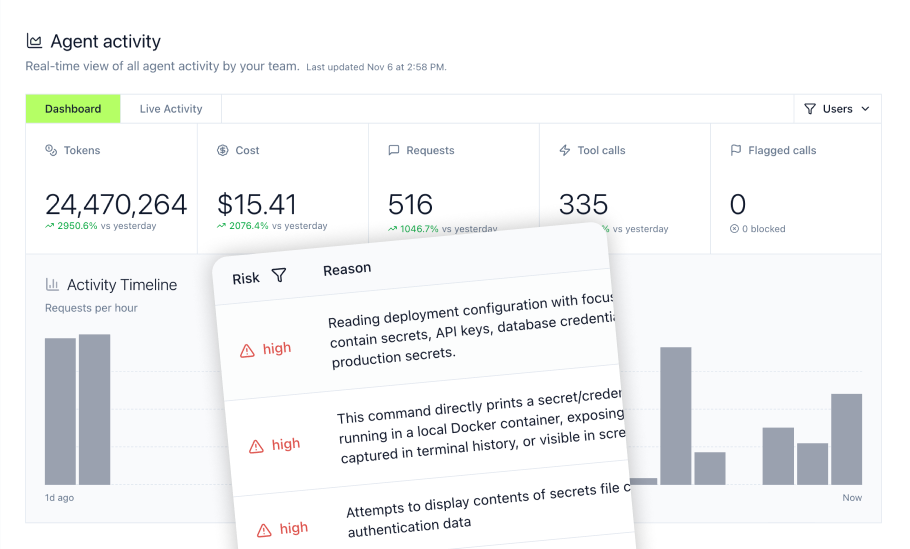
Agent Monitor tracks activity in real-time across the organization, including off-gateway usage in Cursor and Claude Code through hooks. Detect PII exposure, credential leakage, and risky bash commands with built-in rules or custom guardrails. This visibility extends beyond the gateway to catch shadow AI activity in local development environments.
Custom Gateway Middleware runs in a JS sandbox with allowed-domains fetch, secret injection, and built-in templates for AWS Bedrock Guardrails, jailbreak detection, and content filtering. Extend policy enforcement with custom logic that calls external DLP services or applies business rules that declarative policies cannot express.
MintMCP is SOC 2 Type II audited, compliant with HIPAA standards, and penetration tested. Data encryption in transit and at rest, available data residency options, and uptime SLAs address enterprise requirements. Customers handling protected health information can request HIPAA documentation, and MintMCP signs BAAs.
The platform supports Claude, Cursor, ChatGPT, Gemini, and Copilot through one centralized gateway with unified audit streams. For teams evaluating agent gateways, MintMCP offers a free trial with no sales call required.
Frequently Asked Questions
What is an agent gateway and why is it essential for enterprise AI deployments?
An agent gateway is a centralized control layer that sits between AI agents and the systems they access, including LLM models, external tools, databases, and enterprise APIs. Unlike traditional API gateways, agent gateways understand agentic protocols like MCP, handle multi-step workflows natively, and provide governance specifically designed for autonomous AI systems. They are essential because 80% of effort in agentic AI goes to data engineering and governance rather than model work. Without centralized governance, each team solves authentication, authorization, and audit logging independently, creating inconsistent security postures and duplicated engineering effort.
How does an agent gateway help manage security and compliance risks?
Agent gateways enforce security controls at the point where agents interact with enterprise systems. Key capabilities include per-agent identity with scoped credentials, OAuth/OIDC integration with existing identity providers, tool-level access control that enables reads but blocks writes, inline policy enforcement that inspects every tool call, and conversation-level audit logging for compliance investigations. For AI-specific risks, gateways provide PII detection and masking, credential leakage prevention, and prompt injection defense. These controls address the unique security challenges that arise when autonomous agents access production data.
What are the key differences between an agent gateway and a traditional API gateway?
Traditional API gateways manage HTTP request/response traffic with features like rate limiting, authentication, and routing. Agent gateways add protocol support for MCP and A2A, understanding of multi-step agentic workflows, session management across conversation turns, token-aware cost tracking, and policy enforcement that considers prompt content and tool semantics. Agent gateways also address AI-specific risks like prompt injection and credential leakage that traditional gateways were not designed to handle. For enterprises already running API gateways, some vendors offer unified governance across both traditional APIs and agent traffic.
Can an agent gateway detect and prevent Shadow AI usage within an organization?
Gateway-only solutions can only govern traffic that flows through them. Shadow AI, where developers use local AI tools like Claude Code or Cursor without corporate oversight, requires additional monitoring. Look for agent gateways that include hooks into developer tools to detect off-gateway MCP usage. Effective shadow AI detection identifies when agents connect directly to MCP servers, flags unapproved tool access, and provides visibility into local agent activity. MDM integration enables push of detect-only or enforce-mode configurations to developer machines for consistent policy application across the organization.
How does pricing typically work for enterprise-grade agent gateways?
Pricing models include transaction-based (per tool call), user-based (per seat), token-based (tied to LLM consumption), and flat platform fees with usage tiers. Expect enterprise pricing to vary based on transaction volume, number of agents, deployment model, compliance requirements, and support needs. Beyond platform fees, budget for MCP server development, integration consulting, and token usage, which should be modeled separately for high-volume systems. Free trials without sales calls enable proof-of-concept testing before budget conversations.