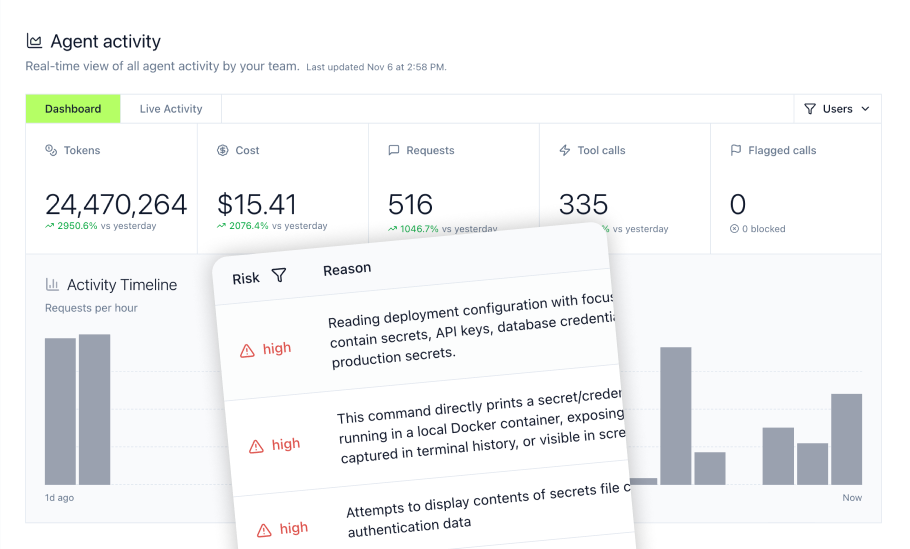
AI agents can query databases, send emails, and execute code. But without centralized governance, they operate as black boxes, accessing credentials, invoking tools, and moving data with zero visibility. With 71% of companies reporting generative AI use in at least one business function, the gap between experimental AI deployments and production-ready infrastructure has become a critical business challenge.
MCP Gateways solve this by providing a single, governed endpoint between AI agents and external tools. Instead of configuring 50 separate tool connections, agents connect once to the gateway, which handles authentication, audit logging, rate limiting, and security enforcement for all downstream integrations. The MCP Gateway has emerged as essential infrastructure for enterprises scaling AI tool access without compromising security or compliance.
Key Takeaways
- Latency varies by architecture and workload: gateway overhead, tool-call latency, end-to-end latency, and throughput should be evaluated separately
- Managed platforms often reduce total operational burden compared to DIY deployments requiring ongoing maintenance, security patching, and production-grade observability
- Pre-built integrations vary by platform, with MintMCP offering hosted MCP connectors run by MintMCP, including Snowflake, Elasticsearch, and Gmail
- Setup time spans minutes to hours based on deployment complexity, authentication requirements, connector runtime model, and governance needs
1. MintMCP Gateway: Enterprise-Grade Security, Compliance, and Governed Tool Access at Scale
MintMCP sets a high bar for enterprise MCP deployment by combining managed MCP server hosting with SOC 2 Type II audited controls. The platform addresses the core challenge facing engineering leaders: transforming scattered MCP servers into production infrastructure with centralized governance.
What Makes MintMCP Different
The platform provides audit trails for every tool invocation, capturing which user triggered each action, what parameters were passed, and what data was accessed. Unlike gateways that require lengthy configuration, MintMCP's Virtual MCP Bundles expose only the minimum required tools per team, role, or use case, reducing attack surface while maintaining developer productivity.
Core Capabilities
- One-click deployment for STDIO-based and hosted MCP servers with OAuth brokering
- Virtual MCP Bundles providing per-use-case endpoints with SCIM-driven membership, curated tools, and access policy
- Hosted MCP connectors run by MintMCP, including Snowflake, Elasticsearch, and Gmail
- Real-time monitoring dashboards for server health, usage patterns, audit logs, and security alerts
- Tool-level allowlisting, rule-based policy, credential management, and SSO/SCIM-driven RBAC
- Gateway + Agent Monitor governance for MCP traffic and local agent activity across Claude, Cursor, ChatGPT, Gemini, and Copilot
- Secure and compliant controls including SOC 2 Type II audited operations, compliance with HIPAA standards, penetration testing, encryption in transit and at rest, data residency options, and uptime SLA
Compliance Standards
- SOC 2 Type II audited
- Compliant with HIPAA standards, with HIPAA documentation available for customers handling protected health information
- MintMCP signs BAAs
- Continuous compliance monitoring via Drata
- OAuth 2.0, SSO, SCIM, and enterprise role-based access control
Best For
Healthcare, finance, and regulated organizations requiring governed AI tool access, centralized auditability, and compliance documentation. Engineering, IT, Security, and AI Operations teams needing centralized governance without infrastructure overhead.
- Setup Time: Minutes for basic deployment
- Pre-Built Tools: Hosted MCP connectors run by MintMCP
- Support: Enterprise SLA with dedicated support
2. TrueFoundry
Where TrueFoundry Fits Best
TrueFoundry fits organizations running high-volume AI workloads where performance, model infrastructure, and platform control are central requirements. The platform integrates MCP gateway capabilities within a broader AI infrastructure control plane.
Performance Optimization
The platform is designed for teams that want unified management of both LLM routing and MCP tool access through a single interface. Public references often cite best-case gateway overhead around a few milliseconds, while actual latency depends on deployment configuration, workload, tool behavior, and network path.
Key Features
- Low gateway overhead for latency-sensitive applications, depending on deployment configuration
- Unified control plane for LLM + MCP management
- Managed SaaS and self-hosted control plane options
- Advanced observability with custom metrics
- Base integrations with bring-your-own model support
Technical Requirements
- Medium setup complexity for teams without existing AI infrastructure familiarity
- Best suited for teams with existing AI infrastructure investments
- Teams should evaluate whether its governance model covers SSO and SCIM-driven RBAC, per-use-case tool bundles, tool-update approval, and per-agent identity requirements
Best For
Trading platforms, real-time analytics, and applications requiring tight control over AI infrastructure. Organizations wanting unified LLM and MCP governance.
- Setup Time: 30 minutes
- Latency: Deployment-dependent gateway overhead
3. Bifrost
Bifrost's Primary Focus
Bifrost represents a fast open-source option, using a Go-based architecture optimized for high-throughput scenarios. The project provides zero-configuration startup for developers wanting immediate productivity without vendor lock-in.
Open-Source Advantages
Built with Prometheus and OpenTelemetry integration from day one, Bifrost fits into existing observability stacks. The registry-based tool discovery simplifies adding new MCP servers while maintaining a lightweight runtime model.
Core Capabilities
- Lightweight Go-based gateway architecture
- About 11µs framework overhead in referenced benchmarks
- Zero-configuration startup
- Native Prometheus/OpenTelemetry integration
- Registry-based tool discovery
- Optional enterprise support packages
Considerations
- Teams operate their own infrastructure, scaling, and runtime security
- Requires DevOps expertise for production deployment
- Compliance depends on the customer deployment and surrounding controls
- Teams should evaluate whether they need managed SaaS-first deployment, hosted MCP connectors, SSO/SCIM-driven RBAC, Virtual MCP Bundles, Agent Bundles, and centralized policy management
Best For
Performance-critical applications where runtime overhead matters significantly. Teams with existing DevOps capabilities who want maximum control.
- Setup Time: 5 minutes
- Price: Free (open-source)
- Support: Community forums
4. Composio
Composio's Integration Approach
Composio provides a large pre-built integration catalog at 500+ managed connections, reducing the authentication complexity that typically consumes engineering resources. The unified OAuth layer handles credential management for Salesforce, HubSpot, Jira, and other enterprise tools.
Integration-First Design
Rather than requiring custom authentication configuration per tool, Composio's OAuth layer manages the credential lifecycle, from initial authorization through token refresh. This reduces integration development time compared to building custom connections.
Key Features
- 500+ managed integrations with unified authentication
- OAuth layer handling credential complexity
- Managed infrastructure for integration workflows
- Rapid development focus over infrastructure control
- Enterprise plans with dedicated support
Considerations
Composio is strongest for developer and AI engineering teams building customer-facing agentic products. Teams focused on internal employee and internal-agent governance should evaluate whether they need MintMCP-style SSO and SCIM-driven RBAC, Virtual MCP Bundles, Agent Bundles, tool-update policy, and centralized audit controls across Claude, Cursor, ChatGPT, Gemini, and Copilot.
Best For
Startups and growth-stage companies needing rapid integration without DevOps overhead. Product teams prioritizing feature velocity.
- Setup Time: 10 minutes
- Pre-Built Tools: 500+
5. Docker MCP Gateway
Docker's Container-Native Security
Docker's gateway leverages container isolation as its primary security model, sandboxing each MCP server in separate containers to reduce lateral movement between tools. The containerized servers in the MCP Catalog provide familiar DevOps workflows for teams already invested in container infrastructure.
Security Architecture
Each tool runs in isolated containers with defined resource limits and network policies. This defense-in-depth approach helps prevent compromised tools from accessing other services or escalating privileges when the environment is configured appropriately.
Core Capabilities
- Container isolation for each MCP server
- Pre-built containerized servers through the MCP Catalog
- Familiar Docker/Kubernetes workflows
- Open-source with active community
- Pull-and-run deployment model
Trade-offs
- Latency depends on container orchestration, network path, and deployment configuration
- Requires Kubernetes expertise for production scaling
- Compliance depends on deployment configuration and surrounding controls
- Teams should evaluate whether they want to operate connector runtimes themselves or use managed hosted MCP connectors with centralized policy, audit logs, and credential management
Best For
Container-native teams prioritizing security through isolation. Organizations with mature Kubernetes operations.
- Setup Time: 45 minutes
- Price: Free (open-source)
- Latency: Deployment-dependent
6. Lasso Security
Lasso's AI-First Security Focus
Lasso Security focuses on real-time threat detection for AI agent interactions, providing prompt injection detection and PII masking as core capabilities rather than add-ons.
Security-First Design
The platform evaluates tool reputation before deployment and monitors agent behavior for anomalous patterns. Organizations in regulated industries may benefit from built-in threat detection that other gateways may require third-party integration to achieve.
Key Features
- Real-time prompt injection detection
- Automatic PII masking in responses
- Tool reputation scoring
- Behavioral anomaly detection
- Security monitoring dashboards
Performance Considerations
Security scanning can add latency to each request. Teams should test expected overhead against their own workflows, especially for real-time interactions. They should also evaluate whether they need MintMCP-style data-permissions-first governance, SSO and SCIM-driven RBAC, Virtual MCP Bundles, Agent Bundles, and centralized credential management in addition to threat detection.
Best For
Highly regulated industries where security monitoring requirements are critical. Organizations requiring built-in threat detection.
- Setup Time: 2 hours
- Latency: Deployment and policy-dependent
- Support: Community with commercial options
7. IBM ContextForge
IBM's Enterprise Federation Architecture
IBM's ContextForge provides multi-gateway federation for large distributed enterprises requiring coordinated MCP access across regions and business units. The REST/gRPC to MCP protocol bridging enables legacy system integration without rewriting existing APIs.
Enterprise Scale
Organizations with distributed teams may benefit from federated architecture that maintains local gateway performance while enabling cross-region tool discovery and policy synchronization.
Key Capabilities
- Multi-gateway federation for distributed enterprises
- REST/gRPC to MCP protocol bridging
- Legacy system integration patterns
- Cross-region coordination
- Open-source with IBM backing
Current Limitations
- Apache 2.0 open-source license
- Latency depends on protocol translation, deployment topology, and workload
- Requires dedicated DevOps expertise for deployment and ongoing operations
- Teams should evaluate support options, production readiness, and whether they need managed SaaS-first MCP deployment with hosted connectors, SSO/SCIM-driven RBAC, and centralized audit controls
Best For
Large distributed enterprises with existing IBM relationships. Organizations needing legacy system bridging.
- Setup Time: 4 hours
- Price: Free (open-source)
- Latency: Deployment-dependent
8. Microsoft Azure API Management
Azure's Cloud-Native Integration
Microsoft's approach extends existing Azure APIM with MCP capabilities, leveraging Azure Monitor, App Insights, and Key Vault integrations. Organizations invested in Azure infrastructure inherit existing Azure security configurations and governance patterns.
Azure Ecosystem Benefits
Native integration with Entra ID simplifies authentication for Microsoft-centric organizations. Existing Azure policies and monitoring can extend to MCP traffic.
Key Features
- Native Azure Monitor and App Insights integration
- Entra ID authentication support
- Azure Key Vault credential management
- Azure governance policy alignment
- Unified Azure governance policies
Considerations
- Best suited for Azure-centered environments
- Cloud latency for MCP operations depends on deployment topology and network path
- Requires Azure expertise for configuration
- Teams should evaluate whether an API management extension provides MCP-specific primitives such as Virtual MCP Bundles, Agent Bundles, hosted MCP connectors, OAuth brokering for stdio and hosted MCP servers, and tool-update policy
Best For
Azure-first organizations with existing APIM and identity investments. Enterprises comfortable with Microsoft ecosystem.
- Setup Time: 3 hours
- Price: Azure consumption-based
- Support: Microsoft support tiers
9. Lunar.dev MCPX
Lunar's Governance-Focused Platform
Lunar.dev's MCPX prioritizes enterprise governance and granular RBAC with audit trails designed for multi-tenant SaaS deployments. The platform emphasizes access controls while maintaining performance-conscious gateway operation.
Governance Architecture
Audit records provide visibility for compliance audits. Granular role definitions enable tool access policies that vary by user, team, and context.
Core Capabilities
- Audit trails
- Granular RBAC with context-aware policies
- Performance-conscious gateway design
- Multi-tenant support for SaaS providers
- Commercial support options
Considerations
Teams should evaluate whether MCPX covers the full governance model they need across internal employees and internal agents, including SCIM-driven membership, per-use-case Virtual MCP Bundles, per-agent identity through Agent Bundles, hosted MCP connectors, tool-update policy, and Gateway + Agent Monitor coverage for non-MCP agent activity.
Best For
SaaS providers requiring tenant-isolated tool access. Organizations prioritizing audit compliance with performance balance.
- Setup Time: 30 minutes
- Price: Free tier available
- Latency: Deployment-dependent
10. Kong
Kong's API-Native MCP Extension
Kong enables MCP server generation from existing REST APIs, allowing organizations to expose current API infrastructure to AI agents without building separate MCP servers. Teams already using Kong for API management can add MCP capabilities through configuration rather than code.
API Gateway Integration
Existing rate limits, authentication policies, and monitoring can apply to MCP traffic. Organizations avoid duplicating governance infrastructure across API and AI access patterns.
Key Features
- Generate MCP servers from REST APIs
- Unified API + AI traffic governance
- Existing Kong policy inheritance
- Enterprise reliability patterns
- Professional services available
Investment Requirements
- Enterprise pricing
- Requires existing Kong deployment for maximum value
- Variable latency depending on configuration
- Teams should evaluate whether an API gateway-centered approach provides MCP-native capabilities such as Virtual MCP Bundles, Agent Bundles, hosted connector runtime, stdio and hosted-server OAuth brokering, and MCP-specific tool-update policy
Best For
Organizations with significant Kong API gateway investments. Teams wanting to expose existing APIs to AI agents.
- Setup Time: 2 hours
- Support: Enterprise SLA
11. Traefik Hub
Traefik's Middleware Security Pattern
Traefik Hub implements the "Triple Gate Pattern" for layered security across AI, MCP, and API traffic. On-Behalf-Of (OBO) authentication with OAuth 2.0 token exchange enables access delegation scenarios.
Middleware Architecture
The approach treats MCP as another traffic type managed through Traefik's existing middleware capabilities. Organizations using Traefik for reverse proxy extend their investment to AI infrastructure.
Key Capabilities
- Triple Gate Pattern security model
- OAuth 2.0 On-Behalf-Of authentication
- Existing Traefik policy inheritance
- Middleware-based MCP handling
- Commercial support options
Considerations
Traefik Hub fits teams already standardized on Traefik middleware and traffic management. Teams should evaluate whether they also need MCP-specific governance primitives such as SSO/SCIM-driven RBAC, Virtual MCP Bundles, Agent Bundles, hosted MCP connectors, tool-update policy, and centralized observability across AI clients.
Best For
Current Traefik users wanting AI traffic management. Organizations requiring sophisticated token delegation.
- Setup Time: 1 hour
- Support: Commercial tiers
12. Obot
Obot's Self-Hosted Complete Platform
Obot provides full data control through self-hosted Kubernetes deployment, combining gateway, catalog, and agent orchestration in a single platform. Enterprise IdP support includes Okta and Microsoft Entra integration.
Complete Platform Approach
Rather than providing gateway-only functionality, Obot includes tool catalog management and basic agent orchestration capabilities, reducing the number of tools required for complete AI deployment.
Core Features
- Self-hosted Kubernetes deployment
- Gateway + catalog + orchestration
- Enterprise IdP support (Okta, Entra)
- Full data control and sovereignty
- Open-source with enterprise options
Operational Requirements
- Kubernetes expertise required
- Self-managed infrastructure and scaling
- Longer setup time than managed SaaS-first alternatives
- Teams should evaluate whether they want to operate connector runtimes themselves or use MintMCP's managed SaaS-first deployment, hosted MCP connectors, Virtual MCP Bundles, Agent Bundles, and centralized governance
Best For
Organizations requiring complete data sovereignty. Teams comfortable managing Kubernetes infrastructure.
- Setup Time: 3 hours
- Price: Free (open-source)
- Support: Enterprise options available
Accelerate Enterprise AI Deployment with MintMCP
The Model Context Protocol has transformed how enterprises connect AI agents to data and tools, but production deployment requires enterprise-grade security, governance, and compliance. MintMCP Gateway eliminates the infrastructure overhead that keeps organizations stuck in pilot mode, providing managed deployment, SOC 2 Type II audited controls, and production infrastructure that transforms local development servers into enterprise services in minutes rather than weeks.
Whether securing access to Snowflake data warehouses, Elasticsearch knowledge bases, or custom enterprise tools, MintMCP's Virtual MCP Bundles provide granular access control without compromising developer productivity. The platform's centralized governance capabilities deliver visibility into tool invocations while supporting SSO, SCIM-driven RBAC, credential management, rule-based policy, and audit logs.
For organizations deploying coding agents like Cursor or Claude Code, the LLM Proxy tracks every tool call, bash command, and file operation while helping block risky operations in real time, transforming shadow AI into sanctioned, auditable infrastructure.
Ready to accelerate your AI infrastructure? Visit mintmcp.com to see how MintMCP Gateway transforms MCP deployment from weeks to minutes.
Frequently Asked Questions
What is an MCP Gateway and why is it essential for enterprise AI?
An MCP Gateway sits between AI agents and external tools, solving the "N×M integration problem" by providing a single authenticated endpoint for all tool connections. Instead of managing 50 separate tool authentications, agents connect once to the gateway, which handles credential management, audit logging, rate limiting, and security enforcement for all downstream tools. This transforms ungoverned AI tool access into production-ready enterprise infrastructure.
How does MintMCP ensure compliance with standards like SOC 2 and GDPR?
MintMCP is SOC 2 Type II audited, with continuous compliance monitoring via Drata. The platform provides complete audit trails capturing every tool invocation, user identity, and data access event. MintMCP is compliant with HIPAA standards, and customers handling protected health information can request HIPAA documentation. MintMCP signs BAAs.
Can MintMCP integrate with existing enterprise data sources?
Yes. MintMCP provides pre-built connectors for major enterprise data sources including Snowflake, Elasticsearch, and Gmail. These connectors deploy with OAuth brokering, centralized credential management, audit logs, and policy controls, reducing the need for custom infrastructure work.
How does MintMCP's LLM Proxy enhance coding agent security?
The LLM Proxy monitors MCP tool invocations, bash commands, and file operations from coding agents like Cursor and Claude Code. It provides visibility into which MCPs are installed, helps block dangerous commands in real time, and helps prevent access to sensitive files like .env and SSH keys. Organizations gain audit trails of operations without modifying developer workflows.
What are the benefits of MintMCP for deploying MCP servers at scale?
MintMCP reduces the infrastructure overhead of STDIO-based deployment through managed hosting with OAuth brokering. Local development servers can become production services with monitoring, logging, policy, and compliance controls. Virtual MCP Bundles limit tool exposure per team or use case, while centralized credential management removes scattered API keys from developer machines.