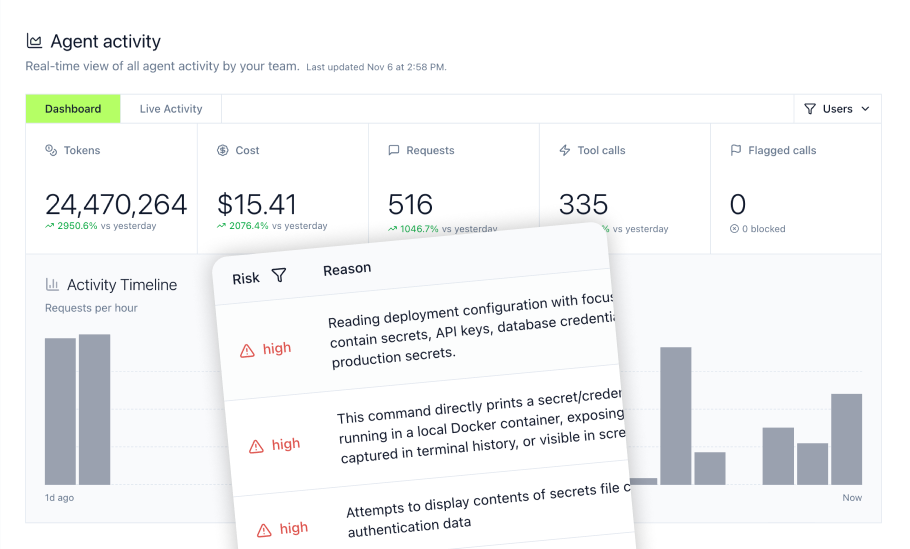
AI agents can write code and analyze data, but connecting them safely to MongoDB clusters remains the primary bottleneck for enterprise AI deployments in 2026. With Gartner predicting up to 40% of enterprise applications will include integrated task-specific agents by 2026, organizations need infrastructure that transforms local MongoDB connections into production-ready, governed services. An MCP Gateway sits between AI agents and MongoDB databases, brokering secure access to MCP tools while enforcing security policies, tracking access, and managing authentication across teams.
The Model Context Protocol has emerged as a widely adopted standard for connecting AI clients, supported by Anthropic, OpenAI, Google, and Microsoft, to enterprise data sources. However, many MongoDB MCP deployments still require additional work before they are ready for centralized authentication, audit logging, and role-based permissions. MCP gateways solve these challenges by providing governed infrastructure for AI-to-database connectivity.
This guide evaluates the leading MCP gateway solutions for MongoDB integration, examining deployment options, security features, compliance postures, and team governance capabilities to help organizations choose the right architecture.
Key Takeaways
- Engineering teams can reduce repetitive database-access work by using governed natural-language interfaces for common MongoDB tasks
- Permission failures are a recurring AI agent risk. Gateway-level, role-based tool governance helps prevent unauthorized database operations
- Virtual MCP Bundles enable use-case-specific MongoDB endpoints with SCIM-driven membership and approved operations, such as read-only access for analysts and write access for developers
- MongoDB's official MCP Server supports database operations, Atlas management tools, and Performance Advisor access for supported Atlas environments
- Organizations using managed gateways can centralize routine database access governance and reduce ad hoc connector maintenance
1. MintMCP Gateway: Enterprise-Grade MongoDB Governance
MintMCP provides governed MCP infrastructure for enterprise MongoDB connectivity without the overhead of building security, authentication, and observability from scratch. The platform's approach addresses the fundamental challenge of turning local or hosted MCP servers into production-ready services that IT and security teams can confidently approve.
What Makes MintMCP Different
MintMCP's Virtual MCP Bundles create use-case-specific endpoints that expose only the minimum required MongoDB tools, not entire server capabilities. An analytics team receives read-only find and aggregate tools, while DevOps teams access administrative operations with approval workflows. This granular tool governance implements the principle of least privilege at the MCP layer rather than relying solely on database-level permissions.
The platform's one-click deployment transforms local MCP servers into hosted, OAuth-protected services. Rather than requiring each developer to configure MongoDB connection strings in local config files, administrators configure connector authentication centrally using shared service accounts or per-user credentials. The gateway wraps enterprise authentication around MongoDB endpoints and supports OAuth brokering for stdio and hosted MCP servers.
Enterprise Security Features
- SOC 2 Type II audited controls, compliance with HIPAA standards, and complete audit trails for compliance reporting
- Enterprise SSO and SCIM-driven RBAC with identity-provider group mapping
- Centralized observability for MongoDB tool calls, policy activity, and audit review
- Centralized credential management eliminating plaintext connection strings on developer machines
- Role-based tool access with tool-level allowlisting and rule-based policy by team, use case, or agent identity
- External DLP and guardrails integrations through gateway middleware running in a JS sandbox
MongoDB Integration Capabilities
MintMCP supports the official MongoDB MCP Server with database operations including schema inspection, find, aggregate, count, and index management. When paired with Atlas service account credentials, teams can use MongoDB MCP Server capabilities for Performance Advisor workflows, including slow query analysis and index recommendations.
The platform also provides hosted MCP connectors run by MintMCP, plus pre-built connectors for Snowflake, Elasticsearch, and Gmail, enabling organizations to centralize governance across multiple data sources through a single gateway.
Deployment Options
- Cloud: Managed SaaS-first, with US and EU deployment options and VPC or self-hosted deployment available on request
- Setup Time: Initial MongoDB connector deployment in minutes
- AI Client Support: Claude, Cursor, ChatGPT, Gemini, Copilot, VS Code, Custom GPTs, Windsurf
Getting Started: Visit MintMCP to schedule a demo or access the quickstart documentation
2. TrueFoundry MCP Gateway
TrueFoundry's Primary Focus
TrueFoundry provides a unified control plane for organizations managing significant AI infrastructure who need both LLM routing and MCP server governance in a single platform. The gateway emphasizes performance optimization for teams where latency-sensitive applications require minimal overhead between AI agents and MongoDB clusters.
The platform targets organizations with dedicated platform engineering teams capable of building and maintaining MCP server integrations. TrueFoundry provides the gateway infrastructure while expecting teams to develop MongoDB connectors tailored to their specific query patterns and security requirements.
Performance Characteristics
TrueFoundry reports approximately 3-4ms latency at typical load with capacity exceeding 350 requests per second per vCPU. Organizations running high-frequency AI agent queries against MongoDB may benefit from this performance profile when low gateway overhead is a requirement.
Access Control Architecture
The gateway implements tool-level access control at the gateway layer rather than relying on downstream database permissions. This approach prevents AI agents from invoking unauthorized MongoDB operations regardless of the underlying connection credentials, addressing scenarios where service accounts have broader permissions than specific users should access.
Deployment Model
- Managed and self-hosted options available for hybrid cloud requirements
- Token optimization features are positioned around reducing context window consumption
- Setup complexity: Higher than managed-only platforms; requires platform team investment
Tradeoffs to consider
TrueFoundry can fit platform engineering teams that want a broader AI infrastructure control plane, but that approach can require more customer-side platform ownership. Teams prioritizing managed SaaS-first MCP governance, hosted MCP connectors, SCIM-driven Virtual MCP Bundles, and Agent Bundles with M2M auth may prefer MintMCP's data-permissions-first gateway model.
3. Composio Gateway
Composio's Primary Focus
Composio takes an integration-breadth approach to MCP gateway architecture, providing a broad managed integration library beyond MongoDB for organizations seeking unified connectivity across multiple enterprise tools.
Development teams prioritizing rapid production deployment over marginal latency optimization find value in Composio's pre-built integration library. Rather than building MongoDB MCP configurations from scratch, teams leverage existing connectors with unified OAuth handling across all connected tools.
Integration Approach
The platform's managed integration model abstracts the complexity of maintaining individual MCP server configurations. MongoDB connectivity comes through their integration library alongside CRM systems, project management tools, and communication platforms, all accessible through a single governance layer.
Developer Experience
- Pre-configured MongoDB connectors with minimal setup
- Unified authentication flow across all integrations
- Managed gateway operations with unified authentication across integrations
- SOC 2 Type II audited status available
Tradeoffs to consider
Composio is often a strong fit for developer and AI engineering teams building external customer-facing AI products. Organizations focused on internal employee and internal-agent governance should evaluate whether they need MintMCP capabilities such as SCIM-driven RBAC, Virtual MCP Bundles, Agent Bundles, tool-update policy, centralized audit, and gateway plus Agent Monitor two-layer governance.
4. MongoDB MCP Server (Official Open-Source)
Open-Source MongoDB Integration
The official MongoDB MCP Server provides free, direct connectivity between AI clients and MongoDB clusters for development, prototyping, and teams with capacity to implement security controls independently.
MongoDB's official implementation includes comprehensive database operations without licensing fees. Teams gain immediate access to natural language queries, schema inspection, and index management through direct connections to AI clients like Claude Desktop, VS Code, and Cursor.
Available Tools
Database Operations (Connection String Only):
- list-databases, list-collections, collection-schema
- find, aggregate, count, explain
- insert-one, insert-many, update-one, update-many, delete-one, delete-many
- create-index, collection-indexes, collection-storage-size
Atlas Management (Requires Service Account):
- atlas-list-orgs, atlas-list-projects, atlas-list-clusters
- atlas-get-performance-advisor for slow query identification
- atlas-create-db-user, atlas-create-access-list
Setup Requirements
Configuration requires Node.js 20.19.0 or later, Node.js 22.12.0 or later when using Node 22, or a supported Docker-based setup. MongoDB's documentation recommends read-only mode for preventing data changes in many client configurations, and write operations can be enabled by omitting --readOnly or setting the relevant read-only environment variable to false.
Considerations for Enterprise Use
Organizations must implement authentication, audit logging, and team governance independently. Connection strings containing credentials can reside in local config files on developer machines when deployed directly, creating access paths security teams may struggle to audit or revoke centrally.
- Cost: Free and open-source
- Setup Time: Varies by AI client, deployment model, and security requirements
- Support: Official MongoDB documentation plus open-source project resources
Tradeoffs to consider
The official MongoDB MCP Server is useful for direct development workflows, but it is not a full enterprise governance layer by itself. Teams that need SSO, SCIM-driven RBAC, centralized credential management, per-use-case tool bundles, policy enforcement, and audit logs typically add an MCP gateway such as MintMCP in front of the server.
5. Docker MCP Gateway
Container-Native Architecture
The Docker MCP Gateway approach leverages container isolation for organizations deeply invested in container-native workflows who require familiar security models and deployment patterns.
Running MongoDB MCP Server inside Docker containers provides process isolation, container image control, and integration with existing container orchestration infrastructure. Teams already managing Kubernetes or Docker Swarm deployments extend their operational practices to MCP server management.
Tradeoffs
Containerization can add operational overhead compared to native STDIO execution. Organizations accepting this performance tradeoff gain container-based security boundaries and deployment consistency across environments. Teams should also distinguish Docker-based MCP deployment patterns from unrelated vulnerabilities in third-party MCP packages.
Implementation Path
- Containerize MongoDB MCP Server with environment variable injection for credentials
- Deploy through existing CI/CD pipelines
- Leverage Docker security features (read-only filesystems, user namespaces, resource limits)
- Integrate with container logging and monitoring infrastructure
Resource Requirements
- Technical Expertise: Intermediate to advanced container operations knowledge
- Infrastructure: Container runtime environment (Docker, Kubernetes)
- Observability: Limited native visibility; requires custom logging integration
6. Lunar.dev MCPX
Governance-Focused Architecture
Lunar.dev focuses on enterprise governance requirements with granular role-based access control and centralized secret management for organizations prioritizing audit capabilities.
The platform emphasizes policy enforcement and compliance logging over raw performance. Teams subject to regulatory requirements find value in comprehensive audit trails tracking MongoDB tool invocation with user attribution.
Reported Characteristics
- Gateway routing for MCP traffic
- Granular RBAC with tool-level permissions
- Centralized secret management eliminating distributed credentials
- Audit log retention for compliance reporting
Enterprise Fit
Organizations in regulated industries, including healthcare and financial services, evaluating governance-first gateway architectures include Lunar.dev in their assessment alongside managed platforms offering similar compliance postures.
Tradeoffs to consider
Lunar.dev MCPX is relevant for teams prioritizing MCP security and governance controls. Buyers should compare its governance model against MintMCP's data-permissions-first architecture, including SSO and SCIM-driven RBAC, Virtual MCP Bundles, Agent Bundles, hosted MCP connectors, Admin MCP, and gateway plus Agent Monitor coverage.
7. Lasso Security Gateway
Security-Focused Capabilities
Lasso Security approaches MCP gateway architecture from a security-first perspective, adding threat detection and PII protection to the gateway layer.
The platform implements protective measures between AI agents and MongoDB including prompt injection detection, PII masking before data reaches AI models, and tool risk analysis. Organizations concerned about AI agent behavior accessing sensitive database content evaluate Lasso's security overlay approach.
Protection Layers
- Threat detection for suspicious query patterns
- PII redaction preventing sensitive field exposure to AI models
- Tool risk analysis based on observed behavior
- Query filtering for potentially dangerous operations
Performance Considerations
Security processing can add latency overhead to gateway operations. Organizations prioritizing protection over performance may accept this tradeoff for high-security environments handling regulated data.
Tradeoffs to consider
Lasso Security can help teams focused on threat detection and sensitive-data controls. Teams should also evaluate whether they need MintMCP's internal employee and agent governance layer, including SCIM-driven RBAC, Virtual MCP Bundles, Agent Bundles, credential management, audit logs, and external DLP or guardrails integrations through gateway middleware.
Deploy MongoDB MCP Infrastructure with MintMCP
MintMCP transforms the complexity of enterprise MongoDB-AI connectivity into a straightforward deployment process. Rather than spending weeks implementing authentication, audit logging, and team governance from scratch, organizations deploy production-ready MongoDB MCP infrastructure in minutes.
The platform's Virtual MCP Bundle architecture ensures analytics teams receive read-only access while developers gain write capabilities, all through a single governed gateway. Combined with centralized observability, centralized credential management, SOC 2 Type II audited controls, and compliance with HIPAA standards, MintMCP provides the enterprise infrastructure that turns shadow AI deployments into sanctioned, auditable database access.
Organizations are seeing rapid growth in shadow AI deployments. Without centralized gateway governance, developers may install MongoDB MCP Server directly with production credentials in plaintext config files, creating access paths that security teams cannot monitor or revoke. MCP Gateways consolidate these scattered connections into controlled infrastructure where security teams gain visibility into which AI tools access which databases, with the ability to revoke access instantly through the authentication layer.
Visit MintMCP to schedule a demo and see how one-click MongoDB deployment, OAuth protection, and complete audit trails accelerate AI agent initiatives while supporting enterprise compliance programs.
Frequently Asked Questions
What is an MCP Gateway and how does it specifically benefit MongoDB users?
An MCP Gateway sits between AI agents (Claude, ChatGPT, Cursor) and MongoDB databases, routing authenticated MCP tool calls to MongoDB while enforcing security policies. For MongoDB users, gateways provide centralized authentication, audit trails tracking every database operation, and role-based permissions that prevent AI agents from executing unauthorized queries. Rather than configuring connection strings on every developer machine, administrators deploy governed endpoints that IT and security teams can monitor and control.
How do MCP Gateways enhance the security and compliance of MongoDB data?
Gateways implement tool-level governance preventing AI agents from invoking database operations beyond their assigned permissions, regardless of underlying MongoDB credentials. This addresses the reality that permission failures are a recurring AI agent risk. Enterprise gateways like MintMCP provide SOC 2 Type II audited controls, complete audit logs for compliance reporting, compliance with HIPAA standards, and integration with enterprise identity providers through SSO and SCIM-driven RBAC for centralized access control.
Can MCP Gateways integrate MongoDB with various AI tools and platforms?
Yes. MCP Gateways support connections from Claude Desktop, VS Code, Cursor, ChatGPT Custom GPTs, Gemini, Copilot, Windsurf, and other MCP-compatible clients. The gateway handles protocol translation so teams use their preferred AI tools while MongoDB access flows through a single governed endpoint. MintMCP additionally supports Elasticsearch, Snowflake, and other data sources through the same gateway infrastructure.
What are the deployment options for an MCP Gateway for MongoDB?
Deployment options range from fully managed cloud services (MintMCP, Composio) to self-hosted architectures (Docker, TrueFoundry hybrid). MintMCP is managed SaaS-first with US and EU deployment options, plus VPC or self-hosted deployment available on request. Managed gateways provide setup in minutes with automatic security configuration, while self-hosted approaches require platform team investment in infrastructure, authentication, and observability. Most enterprises find managed solutions deliver faster time-to-value given the engineering effort required for production-grade self-hosted deployments.
How does a MongoDB MCP Gateway help in managing Shadow AI within an organization?
Without centralized gateway governance, developers may install MongoDB MCP Server directly with production credentials in plaintext config files, creating access paths that organizations cannot audit. Organizations are seeing rapid growth in shadow AI deployments. MCP Gateways consolidate these scattered connections into controlled infrastructure where security teams gain visibility into which AI tools access which databases, with the ability to revoke access instantly through the authentication layer.