Connecting AI agents to Elasticsearch data requires more than a simple API call. It demands centralized authentication, audit logging, credential management, and policy enforcement across every query. An MCP gateway serves as the control plane that manages how AI assistants like Claude, ChatGPT, Gemini, Copilot, and Cursor interact with your Elasticsearch clusters, transforming natural language requests into properly secured Query DSL operations.
For enterprises running AI agents at scale, the right gateway determines whether your Elasticsearch integration meets compliance requirements, delivers acceptable performance, or creates security blind spots. This guide examines seven MCP gateway options for Elasticsearch integration in 2026, covering setup complexity, compliance posture, performance characteristics, and cost structures to help you make an informed decision.
Key Takeaways
- MCP gateways can reduce the manual work involved in constructing Elasticsearch queries by translating natural language requests into governed tool calls
- Gateway latency varies significantly by architecture, deployment model, and workload, directly impacting AI conversation responsiveness
- Managed gateways can reduce operational overhead versus open-source alternatives, but total cost depends on usage, infrastructure, and internal DevOps capacity
- Setup time varies widely, from relatively quick deployment with pre-built connectors to substantially longer setup for self-hosted open-source solutions
1. MintMCP: Deploy Enterprise Elasticsearch Integration in Minutes
MintMCP provides production-ready Elasticsearch connectivity through its pre-built connector, eliminating the infrastructure overhead that typically delays AI-to-data integrations. The platform transforms local MCP servers into governed services with built-in monitoring, authentication, credential management, and audit capabilities.
What Makes MintMCP Different
The Elasticsearch MCP Server includes five dedicated tools: search for Query DSL operations, esql for ES|QL analytics queries, list_indices for discovering available data, get_mappings for understanding index structure, and get_shards for cluster health monitoring. Each tool operates under centralized governance with audit trails.
Unlike approaches requiring custom integration work, MintMCP's deployment model handles OAuth protection and enterprise authentication. The gateway wraps STDIO-based and hosted MCP servers with SSO enforcement and OAuth brokering, letting teams deploy Elasticsearch access without modifying existing cluster configurations.
Enterprise Governance Features
- SOC 2 Type II audited status for regulated industry requirements
- Compliant with HIPAA standards, with HIPAA documentation and BAAs available for customers handling protected health information
- Audit logs tracking Elasticsearch queries with user attribution
- SSO and SCIM-driven RBAC for team and identity-provider group governance
- Tool-level allowlisting and rule-based policy controlling which teams can access which Elasticsearch capabilities
- Credential management for Elasticsearch and other connected systems
- Virtual MCP Bundles for per-use-case endpoints with SCIM-driven membership
- Agent Bundles with M2M auth and "act as agent" flow for internal-agent governance
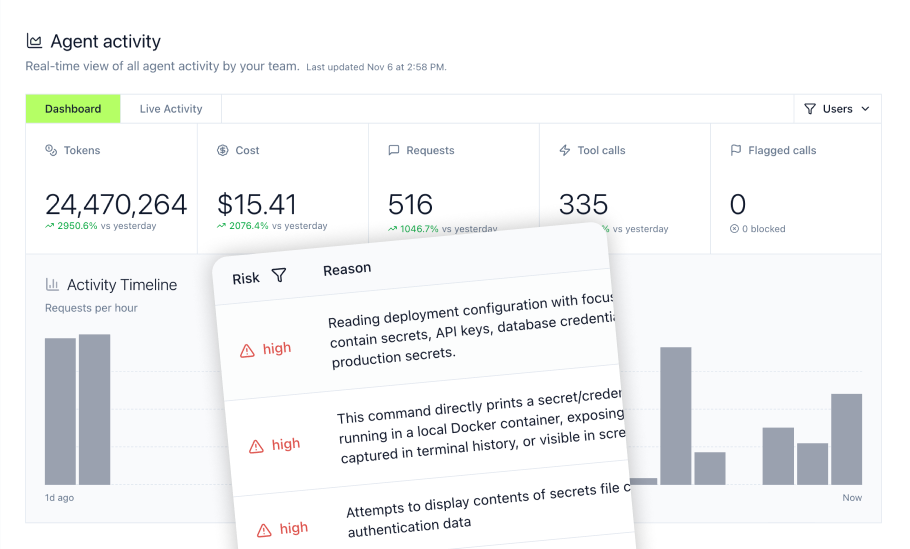
- Centralized observability dashboards for usage patterns and security alerts
- Gateway + Agent Monitor coverage for Claude, Cursor, ChatGPT, Gemini, and Copilot governance
Pricing Structure
- Custom quote-based pricing
- Per-user licensing based on active AI agent users
- Platform fees that scale with usage and team size
- Managed SaaS-first deployment in the US and EU, with VPC/self-hosted options on request
- Enterprise SLAs and dedicated support available
Team Fit
MintMCP addresses organizations needing compliance-ready Elasticsearch access without dedicated DevOps resources. The platform's pre-built connectors reduce evaluation complexity while Agent Monitor adds visibility into how coding agents interact with local files, shell commands, prompts, and MCP tools.
2. Bifrost (Maxim AI)
Bifrost operates as part of the Maxim AI observability platform, providing an MCP gateway focused on performance and explicit tool execution. Its workflow centers on runtime tool discovery and a single gateway endpoint for tool discovery, execution, and management.
Primary Focus
Bifrost emphasizes developer-first tooling with explicit approval over AI agent behavior. The architecture prioritizes low-overhead request handling and fast deployment, with support for autonomous agent mode when teams choose configurable auto-approval.
Technical Characteristics
- Single gateway URL for tool discovery, execution, and management
- Zero-config startup for rapid deployment
- Runtime tool discovery for connected MCP servers
- Explicit approval workflows with configurable auto-approval
- Integration with Maxim AI's broader observability platform
Where Bifrost Fits
Teams already evaluating or using Maxim AI's observability tools gain unified monitoring across LLM interactions and MCP tool calls. The architecture appeals to engineering teams building production agents requiring precise control over execution patterns.
Tradeoffs to consider
Bifrost is developer- and platform-engineering oriented, with an OSS-first and self-hosted-first posture. Teams should evaluate whether they need MintMCP-style managed SaaS-first deployment, SSO and SCIM-driven RBAC, Virtual MCP Bundles, Agent Bundles, hosted MCP connectors, and gateway-level policy controls for internal employee and internal-agent governance.
3. TrueFoundry
TrueFoundry positions its MCP gateway as part of a unified AI infrastructure platform, offering consolidated management for organizations already running LLM workloads on TrueFoundry's systems.
Primary Focus
The platform provides standalone MCP servers with per-server permissions, enabling teams to experiment with Elasticsearch access under separate configurations. This approach simplifies governance for organizations with diverse team requirements accessing shared data infrastructure.
Technical Characteristics
- Standalone MCP servers with per-server permissions
- Unified token management across MCP servers
- OAuth-based on-behalf-of authentication patterns
- Hybrid deployment options for varied infrastructure requirements
- Consolidated observability for AI operations
Where TrueFoundry Fits
Organizations with existing TrueFoundry AI infrastructure investments can extend their platform to Elasticsearch connectivity without adopting additional vendors. The unified approach reduces operational complexity for teams managing both LLM serving and tool integrations.
Tradeoffs to consider
TrueFoundry is broader AI infrastructure for platform and ML teams, while MintMCP is focused on MCP gateway governance for IT, Security, and AI Operations. Teams should compare whether they need MintMCP's data-permissions-first model, SCIM-driven Virtual MCP Bundles, Agent Bundles with M2M auth, hosted MCP connectors, and tool-update policy for internal employee and agent governance.
4. IBM ContextForge
IBM ContextForge provides an open-source MCP gateway option under the Apache 2.0 license, enabling self-hosted deployments with full code access. The project supports federation across multiple Elasticsearch clusters for complex enterprise architectures.
Primary Focus
ContextForge targets organizations requiring customization beyond managed platform capabilities. The federation support enables multi-cluster deployments where AI agents need unified access across geographically distributed Elasticsearch instances.
Technical Characteristics
- Apache 2.0 open-source licensing
- Federation support for multi-cluster architectures
- Flexible database backend (PostgreSQL, MySQL, SQLite)
- Auto-discovery and health monitoring capabilities
- Self-hosted deployment with full configuration control
Where ContextForge Fits
Enterprises with dedicated DevOps teams comfortable operating open-source infrastructure can leverage ContextForge for maximum customization. Organizations with multi-cluster Elasticsearch deployments benefit from the federation capabilities not available in simpler gateway solutions. Organizations requiring commercial backing should verify current support options directly.
Tradeoffs to consider
A self-hosted open-source gateway can provide flexibility, but it also places connector operations, scaling, runtime management, and ongoing maintenance on the customer. MintMCP addresses this with managed SaaS-first deployment, hosted MCP connectors run by MintMCP, SSO and SCIM-driven RBAC, Virtual MCP Bundles, and centralized audit logs.
5. Docker MCP Gateway
Docker MCP Gateway provides container-native MCP server management with security isolation through Docker's established container runtime. The gateway integrates naturally with Docker Desktop environments and existing container orchestration workflows.
Primary Focus
The gateway emphasizes supply chain security through cryptographically signed container images and isolation boundaries between MCP servers. Each MCP server instance runs in its own sandboxed container context, helping prevent lateral movement between tool instances.
Technical Characteristics
- Container isolation for MCP server instances
- Cryptographically signed images for supply chain security
- Catalog-based server distribution and profile management
- Docker Desktop integration for developer convenience
- Community-driven open-source development
Where Docker Fits
Teams with Docker-centric infrastructure gain native integration without additional runtime dependencies. The container isolation model appeals to security-conscious organizations requiring strong boundaries between different MCP server instances accessing various data sources.
Tradeoffs to consider
Docker MCP Gateway fits container-native teams that want runtime isolation and local or containerized MCP server management. Teams also needing data-permissions-first governance should evaluate whether they require MintMCP capabilities such as SSO and SCIM-driven RBAC, Virtual MCP Bundles, Agent Bundles, OAuth brokering for STDIO and hosted servers, and centralized observability across AI clients.
6. Requesty
Requesty offers a managed MCP gateway with free credits for initial testing, lowering the barrier for teams evaluating Elasticsearch integration approaches. The platform emphasizes compatibility across multiple AI clients.
Primary Focus
The gateway provides templates for common integrations alongside Elasticsearch, including GitHub, Notion, and Linear connections. This breadth appeals to teams needing multiple tool integrations beyond database access.
Technical Characteristics
- Compatibility across Claude Code, Cursor, Roo Code, and VS Code
- Integration templates
- Real-time analytics dashboards
- Per-user key management
Where Requesty Fits
Startups and small teams testing MCP concepts can evaluate Elasticsearch integration without significant upfront commitment. Usage-based pricing after free credits may suit organizations with unpredictable or growing query volumes.
7. Microsoft MCP Gateway
Microsoft's open-source MCP gateway provides Azure-native integration patterns for organizations committed to Microsoft's cloud ecosystem. The project offers Kubernetes deployment patterns for containerized environments.
Primary Focus
The gateway targets Azure-committed organizations seeking MCP capabilities within their existing Microsoft infrastructure investments. Azure AD integration simplifies identity management for enterprises already using Microsoft's identity platform.
Technical Characteristics
- Open-source under permissive licensing
- Azure-native integration patterns
- Kubernetes deployment support
- Azure AD authentication integration
- Community-driven development
Where Microsoft Fits
Organizations with substantial Azure infrastructure investments gain native integration without cross-cloud complexity. The Kubernetes patterns support container orchestration approaches common in Azure Kubernetes Service deployments.
Understanding Elasticsearch MCP Integration
Before selecting a gateway, understanding how AI agents interact with Elasticsearch through MCP clarifies the technical requirements. The Model Context Protocol standardizes how AI assistants connect to external tools, with Elasticsearch MCP servers exposing query capabilities through defined tool interfaces.
How MCP Gateways Connect AI to Elasticsearch
An MCP gateway sits between AI clients (Claude, ChatGPT, Gemini, Copilot, Cursor) and Elasticsearch MCP servers, providing centralized authentication, routing, and observability. Instead of each AI client connecting directly to Elasticsearch with separate credentials and no visibility, the gateway consolidates management while exposing standardized tools.
The typical Elasticsearch MCP implementation includes:
- Search tool: Executes Query DSL for flexible document retrieval
- ES|QL tool: Runs Elasticsearch's query language for advanced analytics
- List indices tool: Discovers available data sources in the cluster
- Get mappings tool: Retrieves field structures for specific indices
- Get shards tool: Returns cluster health and allocation information
Security Considerations for AI-Elasticsearch Access
Without gateway mediation, AI agents operate as black boxes with significant security risks. As enterprises expand AI tool access, governance frameworks become increasingly important. Gateways address this by providing:
- Authentication enforcement: OAuth, SAML, and SSO integration following NIST authentication standards for enterprise identity
- Audit trails: Logs of every query with user attribution
- Policy enforcement: Granular controls over which tools and indices each user can access, aligned with ISO/IEC 27001 information security practices
- Rate limiting: Protection against runaway queries consuming cluster resources, addressing concerns outlined in OWASP Top 10 for LLM Applications
Implementation Considerations
Setup Time Expectations
Setup complexity varies significantly across gateway options. Managed platforms with pre-built Elasticsearch connectors can often be configured much faster than self-hosted open-source solutions, which may also require infrastructure provisioning and additional operational setup.
For MintMCP's Elasticsearch connector, the setup process involves:
- Preparing Elasticsearch credentials with appropriate permissions
- Configuring the gateway connection for Elastic Cloud or self-hosted Elasticsearch
- Applying SSO, SCIM-driven RBAC, and tool-level policy through the gateway
- Connecting AI clients via configuration file or OAuth flow
- Testing queries through the natural language interface
Cost Structure Patterns
Gateway pricing follows three primary models:
- Managed SaaS: Monthly subscription based on interactions, users, or servers (MintMCP, Requesty)
- Platform bundle: MCP gateway included with broader AI infrastructure platform (TrueFoundry, Maxim AI)
- Open-source + infrastructure: Free licensing with cloud infrastructure costs (IBM ContextForge, Docker, Microsoft)
For small teams, managed platforms introduce subscription costs while open-source approaches shift more of the burden to infrastructure and ongoing DevOps maintenance.
Performance Impact
Gateway latency directly affects user experience when AI agents make multiple Elasticsearch queries per conversation. Even small per-call overhead can add up when an AI workflow makes many tool calls in sequence.
Performance-critical deployments should benchmark actual query patterns before committing to a gateway, as synthetic benchmarks rarely capture real-world query complexity and result sizes.
Deploy Enterprise Elasticsearch Access with MintMCP
MintMCP transforms Elasticsearch integration from a months-long infrastructure project into a same-day deployment. The MCP Gateway provides the governance layer enterprises need: SOC 2 Type II audited status, audit trails, SSO and SCIM-driven RBAC, credential management, and tool-level policy without requiring custom development or dedicated DevOps resources.
The platform's pre-built Elasticsearch connector enables natural language queries against existing clusters while maintaining enterprise security standards. Organizations gain centralized authentication, audit logging, and policy enforcement across every AI-to-data interaction. The deployment model reduces infrastructure provisioning and custom integration work.
For teams managing multiple data sources beyond Elasticsearch, MintMCP's connector ecosystem extends the same governance framework to Snowflake, Gmail, and other enterprise systems. Gateway + Agent Monitor coverage adds visibility into how coding agents interact with data, files, shell commands, prompts, and MCP tools, creating a unified observability layer across AI infrastructure.
Managed SaaS-first deployment is available in the US and EU, with VPC/self-hosted options on request. Enterprise SLAs and dedicated support support production readiness for organizations with strict uptime and response-time requirements.
Book a demo to see MintMCP's Elasticsearch integration in action, or visit the documentation to begin evaluation.
Frequently Asked Questions
What is an MCP Gateway and how does it help with Elasticsearch integration?
An MCP gateway serves as a centralized control plane between AI assistants and Elasticsearch clusters. Instead of each AI client (Claude, ChatGPT, Gemini, Copilot, Cursor) connecting directly to Elasticsearch with separate credentials and no visibility, the gateway consolidates authentication, audit logging, credential management, and policy enforcement. This enables natural language queries against Elasticsearch while maintaining enterprise security and compliance requirements.
How do MCP Gateways ensure data security when AI agents query Elasticsearch?
Gateways enforce authentication through OAuth, SAML, and SSO integration before allowing any Elasticsearch access. Queries generate audit logs with user attribution, timestamps, and query parameters. Role-based access controls and tool-level policies restrict which users can query specific indices, and rate limiting helps prevent runaway queries from consuming cluster resources. For sensitive deployments, gateways like MintMCP provide SOC 2 Type II audited status, HIPAA standards support, SSO and SCIM-driven RBAC, and centralized auditability.
What AI clients work with MCP gateways for Elasticsearch access?
MCP-compatible clients include Claude, ChatGPT, Microsoft Copilot, Cursor IDE, Gemini, VS Code with MCP extensions, Goose, LibreChat, Open WebUI, and Windsurf. The gateway handles protocol translation, enabling compatible clients to query Elasticsearch through the same secured interface regardless of the client's native capabilities.
How long does it take to set up an MCP gateway with Elasticsearch?
Setup time varies by gateway type. Managed platforms with pre-built connectors like MintMCP can often be configured relatively quickly by preparing Elasticsearch API credentials, configuring the gateway connection, applying SSO and tool-level policy, and connecting AI clients. Self-hosted open-source solutions may require substantially more time including infrastructure provisioning, SSL certificate configuration, and authentication setup.
What ongoing costs should I expect for MCP gateway operation?
Managed gateways typically charge subscription fees based on usage patterns and team size. Open-source gateways eliminate licensing costs but incur infrastructure expenses for cloud resources plus DevOps labor for maintenance. Total cost of ownership depends on deployment model, usage volume, team size, and available internal engineering resources.